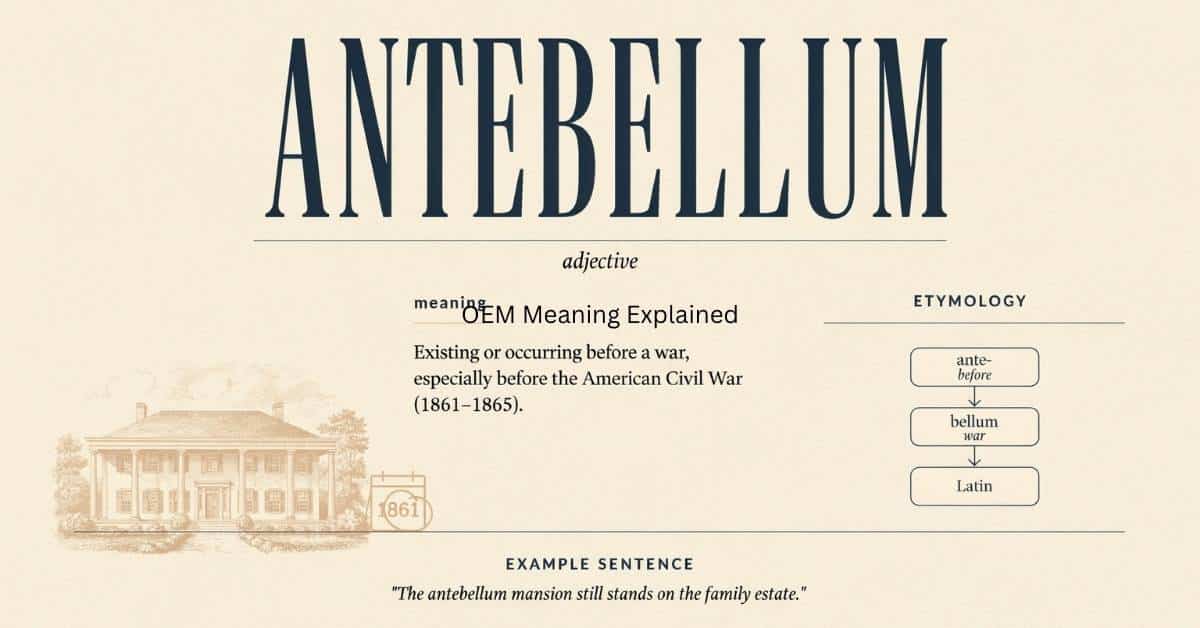
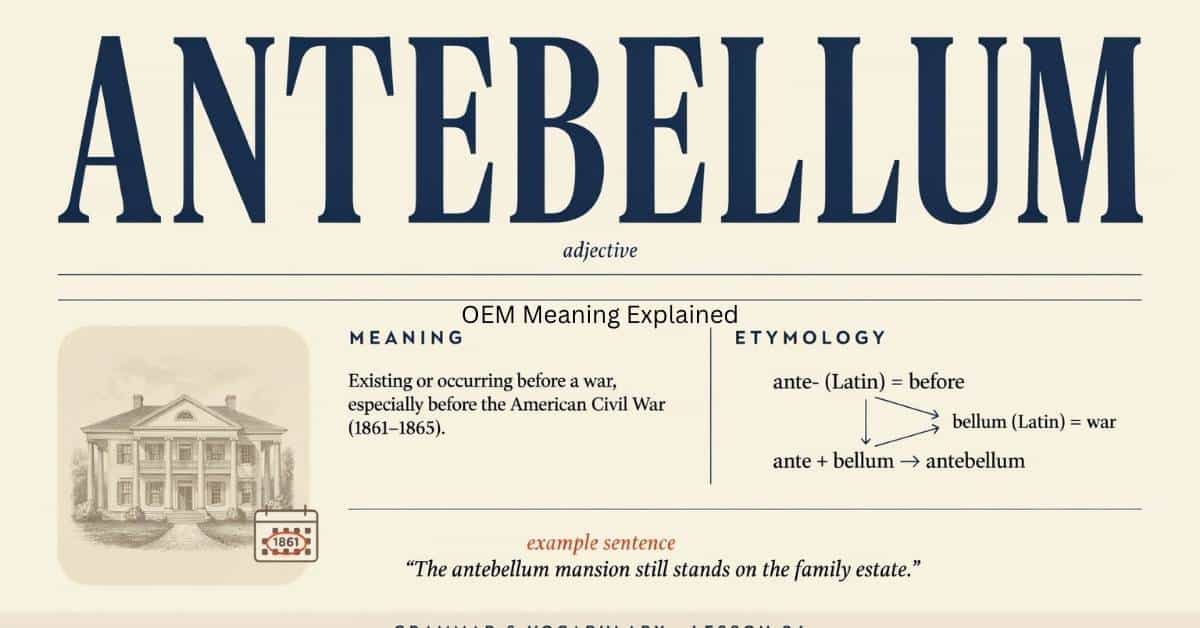
Antebellum meaning refers to “before the war,” a phrase derived from the Latin words ante (before) and bellum (war). In modern English, however, the term is most commonly used to describe the period in the Southern United States before the American Civil War (1861–1865). Historians, educators, and researchers frequently use antebellum to discuss the region’s society, economy, politics, architecture, literature, and culture during the decades leading up to the Civil War.
While the definition seems straightforward, the historical significance of the word is far more complex. The Antebellum Era witnessed rapid economic growth driven by the cotton economy, territorial expansion, intense political debates over slavery, and social changes that ultimately contributed to one of the most transformative conflicts in American history. Today, the term also carries cultural and historical sensitivity because it is closely tied to the institution of enslaved labor and the legacy of the Antebellum South.
In this guide, you’ll learn what antebellum means, where the word originated, how historians use it, what years define the antebellum period, why it remains relevant today, and how to use it correctly in both academic and everyday contexts.
Quick Facts About Antebellum
| Topic | Explanation |
|---|---|
| Meaning | Before the war |
| Language Origin | Latin (ante + bellum) |
| Pronunciation | an-tee-BEL-um |
| Part of Speech | Adjective |
| Most Common Usage | Refers to the American South before the Civil War |
| Historical Period | Generally from the early 1800s until 1861 |
| Opposite Term | Postbellum (after the war) |
| Related Topics | American Civil War, Reconstruction, slavery, plantation economy, Antebellum architecture |
What Does “Antebellum” Mean?
At its simplest, antebellum means “before the war.” Although the word could technically describe any period preceding a war, in American history it almost always refers to the decades before the Civil War.
The term is widely used in:
- History textbooks
- Academic research
- Museum exhibits
- Historical documentaries
- Architecture guides
- Genealogy records
For example:
- Antebellum South
- Antebellum architecture
- Antebellum homes
- Antebellum literature
- Antebellum society
These phrases all describe aspects of life in the Southern United States before the outbreak of the Civil War.
Literal Meaning vs. Historical Meaning
Many readers assume antebellum always means “before any war,” but context matters.
Literal meaning
- Ante = before
- Bellum = war
Combined, the word simply means before war.
Historical meaning
In the United States, historians almost always use the word to describe the pre-Civil War era, particularly the Antebellum South.
This distinction is important because the historical meaning has become much more common than the literal translation.
Where Does the Word Antebellum Come From?
The word has its roots in Latin, a language that has influenced English vocabulary for centuries.
It combines two simple Latin words:
- Ante — before
- Bellum — war
Many English words use ante- as a prefix, including:
- Antecedent
- Antenatal
- Antedate
- Antechamber
Similarly, bellum appears in historical and legal terminology connected with war.
Understanding these roots makes the meaning easier to remember.
Memory Tip:
Ante = Before
Bellum = War
Antebellum = Before the War
How to Pronounce Antebellum
Correct pronunciation helps when discussing history in classrooms, presentations, or conversations.
Phonetic Pronunciation
an-tee-BEL-um
or
an-tuh-BEL-um
Both pronunciations are commonly accepted in English.
Syllable Breakdown
An • te • bel • lum
The emphasis falls on:
BEL
Common Pronunciation Mistakes
Some people incorrectly pronounce it:
- an-tee-bell-LOOM
- an-te-BELL-um
Listening to reputable dictionary pronunciations can help you become more confident using the word.
The Antebellum Era: What Time Period Does It Refer To?
When people ask “What is the antebellum period?”, they usually mean the decades leading up to the American Civil War.
Although historians may define the period slightly differently depending on context, it generally covers the early nineteenth century through 1861, when the Civil War began.
A Simple Timeline
| Period | Major Events |
|---|---|
| Early 1800s | Expansion of the United States |
| 1803 | Louisiana Purchase |
| 1820s–1850s | Cotton economy expands rapidly |
| Mid-1800s | Growth of plantation agriculture |
| 1830s–1860 | Rising national debate over slavery |
| 1861 | American Civil War begins |
| After 1865 | Reconstruction Era (Postbellum period) |
This timeline helps explain why historians frequently distinguish between the antebellum and postbellum periods.
Why Is the Antebellum South So Important in American History?
The Antebellum South shaped many of the political, economic, and social developments that led to the Civil War.
Understanding this period helps explain why the conflict occurred and how it transformed the United States.
1. The Cotton Economy
The invention and widespread adoption of the cotton gin made cotton one of America’s most profitable exports.
Large plantations across states such as:
- Georgia
- Alabama
- Mississippi
- Louisiana
- South Carolina
became central to the global cotton trade.
The region’s prosperity depended heavily on enslaved labor, making slavery deeply intertwined with its economy.
2. Plantation Society
Large plantations were not simply farms.
They functioned as economic enterprises supported by:
- Agricultural production
- Trade
- Transportation networks
- Skilled labor
- Enslaved workers
This plantation system influenced nearly every aspect of Southern society.
3. Political Tensions
During the antebellum period, disagreements intensified over issues including:
- States’ rights
- Expansion into western territories
- Federal authority
- Slavery
- Economic policy
These growing conflicts gradually divided Northern and Southern states.
4. Social Structure
Society during the antebellum era was highly stratified.
It included:
- Wealthy plantation owners
- Small farmers
- Merchants
- Skilled workers
- Free Black communities
- Millions of enslaved African Americans
Each group experienced the period differently, making the era far more complex than popular images often suggest.
5. Cultural Development
The antebellum years also witnessed significant developments in:
- Literature
- Music
- Religious movements
- Education
- Political philosophy
- Journalism
Many influential writers and thinkers emerged during this period, helping shape American identity before the Civil War.
Understanding the Historical Context Without Oversimplifying It
One reason antebellum meaning is widely searched today is that the word cannot be fully understood without acknowledging the historical realities of the era.
While some people associate the term mainly with elegant mansions or grand architecture, historians emphasize that the Antebellum South was also defined by the institution of slavery and the unequal social and economic systems built around it.
Millions of enslaved African Americans were forced to work on plantations that produced crops such as cotton, tobacco, rice, and sugar. Their labor generated immense wealth for many landowners while denying basic human rights to those who were enslaved. This history is central to understanding the period and should not be separated from discussions of antebellum society.
At the same time, the era was marked by rapid industrial growth in other parts of the country, the rise of the abolition movement, expanding transportation networks, increased immigration, and heated national debates about the future of the United States.
These developments eventually led to deep political divisions, the secession of Southern states, and the outbreak of the American Civil War in 1861.
Rather than viewing the antebellum era through a single lens, historians study it as a period of economic expansion, cultural development, political conflict, and profound social inequality. This balanced perspective provides a more accurate understanding of why the term remains important in history today.
Why the Word “Antebellum” Can Be Controversial Today
In recent years, antebellum has become more than just a historical term. It has also become part of broader conversations about historical memory, public monuments, museum interpretation, and how societies remember difficult chapters of the past.
For some people, the word simply describes a historical period or a style of architecture. For others, it evokes the realities of slavery, racial injustice, and the plantation economy that existed in much of the Southern United States before the Civil War.
This difference in perspective explains why the term sometimes generates debate.
A well-known example occurred in 2020, when the country music group Lady Antebellum changed its name to Lady A. The band explained that the change reflected a desire to move away from imagery associated with the antebellum South and its connections to slavery. The decision sparked public discussion about language, history, and cultural symbolism.
Despite these debates, historians continue to use antebellum in academic writing because it remains a precise and widely recognized term for describing the pre-Civil War period. The key is understanding the historical context in which the word is used rather than assuming it always carries the same meaning or intent.
Using the term thoughtfully—with awareness of both its literal definition and its historical associations—helps readers engage with American history in a more informed and balanced way.
Antebellum vs. Postbellum: What’s the Difference?
One of the easiest ways to understand antebellum meaning is to compare it with its opposite term, postbellum. While antebellum refers to the period before the American Civil War, postbellum describes the years after the war, particularly during the Reconstruction Era and the decades that followed.
Although the two words differ by only a prefix, they represent two dramatically different chapters in American history.
Antebellum vs. Postbellum Comparison
| Feature | Antebellum | Postbellum |
|---|---|---|
| Meaning | Before the war | After the war |
| Historical Period | Before 1861 | After 1865 |
| Associated Event | Lead-up to the Civil War | Reconstruction and rebuilding |
| Economy | Plantation-based, cotton economy | Industrial growth and economic transition |
| Labor System | Enslaved labor on plantations | Wage labor after emancipation |
| Political Climate | Increasing sectional conflict | National reunification and Reconstruction |
| Common Usage | Antebellum South, antebellum homes | Postbellum America, postbellum reforms |
Why This Comparison Matters
Many students confuse these terms because they both describe historical periods. A simple way to remember them is:
- Ante = Before
- Post = After
- Bellum = War
So:
- Antebellum = Before the war
- Postbellum = After the war
Understanding this distinction also makes it easier to follow discussions about the Civil War, Reconstruction, and the transformation of American society.
Learn More: TLDR Meaning
What Is Antebellum Architecture?
When people hear the word antebellum, they often think of grand Southern homes with towering white columns and sweeping verandas. These iconic buildings are examples of antebellum architecture, one of the most recognizable architectural styles in the United States.
However, these homes are more than beautiful landmarks—they are historical artifacts that reflect the economic, social, and political realities of the Antebellum South.
Key Characteristics of Antebellum Architecture
Most antebellum homes share several distinctive features:
- Large symmetrical designs
- Greek Revival or Neoclassical style
- Tall white columns
- Wide front porches
- Grand staircases
- High ceilings
- Large windows for ventilation
- Brick or wood construction
- Expansive gardens and surrounding land
These homes were designed to project wealth, status, and permanence.
Where Can You Find Antebellum Homes?
Many well-preserved antebellum buildings remain in states such as:
- Georgia
- Mississippi
- Louisiana
- South Carolina
- Virginia
- Alabama
- Tennessee
Some are now:
- Historic museums
- Hotels
- Educational centers
- Tourist attractions
- Preservation sites
Historical Context Matters
While these homes are admired for their architectural beauty, historians also emphasize that many were built and maintained through the labor of enslaved African Americans. Modern museums increasingly present this fuller history, helping visitors understand both the craftsmanship of the buildings and the human experiences connected to them.
Beyond Architecture: Other Common Uses of “Antebellum”
The word antebellum appears in many historical discussions beyond architecture. Understanding these contexts helps you recognize the term in books, documentaries, museums, and classrooms.
Antebellum Literature
Antebellum literature refers to works written before the Civil War or literature that explores life during that period.
Common themes include:
- Slavery
- Freedom
- Religion
- Family life
- Politics
- Social class
- National identity
These writings provide valuable insight into the ideas and conflicts shaping the nation before the war.
Antebellum Society
The phrase antebellum society describes the social structure of the Southern United States before 1861.
It included:
- Plantation owners
- Small farmers
- Merchants
- Skilled tradespeople
- Free Black communities
- Enslaved African Americans
The relationships among these groups influenced politics, economics, and everyday life throughout the region.
Antebellum Economy
The antebellum economy relied heavily on agriculture, especially the production of:
- Cotton
- Tobacco
- Rice
- Sugar
Cotton became one of America’s most valuable exports, linking Southern plantations to international trade and manufacturing industries around the world.
Antebellum Politics
Political debates during the antebellum era centered on issues such as:
- Expansion into western territories
- States’ rights
- Federal authority
- Slavery
- Tariffs
- Representation in Congress
These unresolved disputes contributed to the growing divide between Northern and Southern states.
Antebellum Culture
The term also appears in discussions of:
- Music
- Education
- Religion
- Art
- Fashion
- Newspapers
- Community traditions
Studying antebellum culture helps historians understand how Americans lived, worked, worshipped, and communicated before the Civil War reshaped the nation.
Is It Still Appropriate to Use the Word “Antebellum”?
A common question is whether the word antebellum is still acceptable in modern writing and conversation.
The answer is yes—when it is used accurately and with appropriate historical context.
Appropriate Uses
The term is widely accepted in:
- Academic research
- History books
- University courses
- Museum exhibits
- Historical documentaries
- Educational websites
- Genealogical research
In these settings, antebellum serves as a precise historical descriptor rather than a value judgment.
When Context Is Important
Outside academic contexts, the word may evoke different emotional responses because of its association with slavery and the plantation system.
For that reason, writers and speakers should:
- Use the term accurately.
- Avoid romanticizing the period.
- Acknowledge its historical realities when relevant.
- Consider the audience and purpose.
This balanced approach reflects both historical accuracy and cultural awareness.
Common Misconceptions About Antebellum
Because the term appears in many different contexts, misunderstandings are common. Clearing them up helps readers use the word correctly.
Misconception 1: Antebellum Means Before Any War
Reality: Although the Latin phrase literally means “before the war,” in American history it almost always refers to the period before the Civil War.
Misconception 2: Antebellum Only Refers to Mansions
Reality: Architecture is only one part of the story. Historians also discuss:
- Antebellum politics
- Antebellum economy
- Antebellum literature
- Antebellum society
- Antebellum culture
Misconception 3: The Word Is Always Offensive
Reality: The word itself is a neutral historical term. However, reactions to it may vary depending on context because of its connection to slavery and the history of the Antebellum South.
Misconception 4: Antebellum Is a Noun
Reality: Antebellum is most commonly used as an adjective.
Examples:
- Antebellum architecture
- Antebellum homes
- Antebellum society
Misconception 5: The Era Was Only About Slavery
Reality: Slavery was a central part of the period, but the antebellum era also included major developments in transportation, industry, education, literature, religion, politics, and westward expansion. Understanding the era requires examining all of these interconnected factors.
How Historians Use the Term Today
Professional historians continue to use antebellum because it clearly identifies a specific historical period.
You’ll commonly find the term in:
- University textbooks
- Scholarly journals
- Museum exhibits
- Historical archives
- Genealogy records
- Government preservation programs
- National Park Service materials
Rather than replacing the word, historians generally provide additional context to ensure readers understand its historical significance and the complexities of the era.
Why Precision Matters
Historical terms help scholars communicate accurately. Saying “antebellum South” immediately signals a specific time, place, and historical setting, making it easier to discuss political developments, economic systems, social structures, and cultural life before the Civil War.
Real-Life Examples of “Antebellum” in Context
Seeing the word used naturally makes its meaning easier to understand.
Example 1: History Textbook
The antebellum period witnessed increasing tensions between Northern and Southern states over slavery and states’ rights.
Example 2: Museum Description
Visitors can tour an antebellum home while learning about both its architecture and the lives of the people who lived and worked there.
The Example 3: Academic Research
The study examines economic changes in the antebellum South during the cotton boom.
And Example 4: Documentary
Historians explain how antebellum society influenced the causes of the American Civil War.
Incorrect Usage
❌ The soldiers returned during the antebellum period.
This is incorrect because soldiers returning home happened after the war.
✔ Correct:
The soldiers returned during the postbellum period.
See More: Chud Meaning
Related Historical Terms You Should Know
Understanding antebellum meaning becomes easier when you know several closely related historical terms.
| Term | Meaning | Relationship to Antebellum |
|---|---|---|
| Postbellum | After the war | Opposite of antebellum |
| Reconstruction | Period of rebuilding after the Civil War | Follows the antebellum era |
| Abolition | Movement to end slavery | Major force during the antebellum period |
| Confederacy | Southern states that seceded during the Civil War | Emerged after the antebellum era ended |
| Union | Northern states that remained in the United States | Opposed the Confederacy |
| Emancipation | The process of freeing enslaved people | Transformed American society during the Civil War |
| Plantation Economy | Agricultural system dependent on large-scale farming | Defined much of the antebellum South |
| Greek Revival | Architectural style inspired by ancient Greece | Common in antebellum homes |
| Old South | Cultural and historical term for the pre-Civil War South | Often overlaps with discussions of the antebellum era |
Knowing these terms provides a stronger understanding of American history and helps place the Antebellum Era within the broader timeline of the nation’s development.
Frequently Asked Questions About Antebellum Meaning
What does antebellum literally mean?
The word antebellum comes from the Latin words ante (before) and bellum (war), so its literal translation is “before the war.” In modern American English, it almost always refers to the period before the American Civil War (1861–1865) rather than any war in general.
What years are considered the antebellum period?
The antebellum period generally refers to the years from the early 1800s until the outbreak of the American Civil War in 1861. Some historians focus specifically on the decades between the War of 1812 and the Civil War, while others use the term more broadly to describe the entire pre-Civil War era.
Why is antebellum associated with the American South?
The term is closely connected to the Antebellum South because the Southern United States experienced major economic, political, and social developments during this period. The region’s cotton economy, plantation system, and reliance on enslaved labor became defining characteristics that shaped the nation’s history and contributed to the Civil War.
Is antebellum only about the Civil War?
Not exactly.
Although the literal meaning is “before the war,” the word is most commonly used in American history to describe the years leading up to the Civil War. In theory, the term could refer to the period before any war, but in practice, its historical association with the American Civil War is overwhelmingly dominant.
Is the word antebellum offensive?
The word itself is not inherently offensive. It is a recognized historical term used by historians, educators, museums, and academic institutions.
However, because it is closely linked to the Antebellum South, slavery, and plantation culture, some people view it as emotionally sensitive. The key is to use the word accurately, respectfully, and within its proper historical context.
Can antebellum describe other wars?
Technically, yes.
Since antebellum literally means “before the war,” it could describe the period before any conflict. However, in American historical writing, readers almost always interpret antebellum as referring to the years before the American Civil War. If you’re discussing another conflict, it’s best to specify the war to avoid confusion.
How do historians define antebellum?
Historians define the antebellum era as the pre-Civil War period in the United States, particularly in the Southern states. They use the term to examine topics such as:
- Politics
- Slavery
- The abolition movement
- Plantation economy
- Cotton production
- Architecture
- Literature
- Social structure
- Regional identity
The term helps place historical events within a clearly defined timeframe.
What is an antebellum house?
An antebellum house is a home built before the American Civil War, usually in the Southern United States.
Many antebellum homes feature:
- Greek Revival architecture
- Neoclassical design
- Large white columns
- Wide porches
- Symmetrical layouts
- Grand staircases
Today, many of these homes function as museums, historic landmarks, hotels, or educational sites.
What is antebellum architecture?
Antebellum architecture refers to the architectural styles that flourished in the American South before the Civil War.
Common characteristics include:
- Greek Revival
- Neoclassical influences
- Tall columns
- Elegant symmetry
- Large windows
- Spacious verandas
- Decorative interiors
These buildings are admired for their craftsmanship while also serving as reminders of the complex historical realities of the era in which they were built.
What is the difference between antebellum and postbellum?
The difference lies in timing:
- Antebellum = Before the American Civil War
- Postbellum = After the American Civil War
Historians use these terms to distinguish between two very different periods in American history, each marked by distinct political, economic, and social conditions.
Why did Lady Antebellum change its name?
In 2020, the country music group Lady Antebellum changed its name to Lady A. The band stated that the decision reflected a desire to move away from imagery associated with the Antebellum South and its connection to slavery. The name change sparked broader discussions about historical language, cultural memory, and public symbolism.
How do you use antebellum in a sentence?
Here are a few examples:
- The museum preserves several antebellum homes for educational purposes.
- She wrote a research paper about politics in the antebellum South.
- Historians continue to study antebellum society to better understand the causes of the Civil War.
- The novel explores family life during the antebellum period.
Final Thoughts
Antebellum meaning is much more than a simple dictionary definition. While its literal translation is “before the war,” the term has become deeply connected to one of the most significant periods in American history—the decades leading up to the American Civil War. It encompasses the Antebellum South, the plantation economy, slavery, abolition, political conflict, architecture, literature, and the social forces that shaped the nation.
Understanding the antebellum period requires looking beyond elegant homes and historical landmarks to examine the broader realities of the era. By considering both its achievements and its injustices, we gain a more complete picture of the past and a deeper appreciation of how history continues to influence the present.
Whether you encountered the term in a history class, while reading about antebellum architecture, researching the Civil War, or simply wondering what does antebellum mean, you now have the historical context and practical understanding needed to recognize and use the word with confidence.
Quick Reference
| Question | Answer |
|---|---|
| What does antebellum mean? | Before the war, usually referring to the American South before the Civil War. |
| Origin | Latin (ante = before, bellum = war). |
| Historical Period | Early 1800s to 1861. |
| Opposite Term | Postbellum. |
| Common Uses | Antebellum South, antebellum homes, antebellum architecture, antebellum literature, antebellum society. |
| Why is it important? | It describes a pivotal period that shaped the political, economic, cultural, and social history of the United States. |