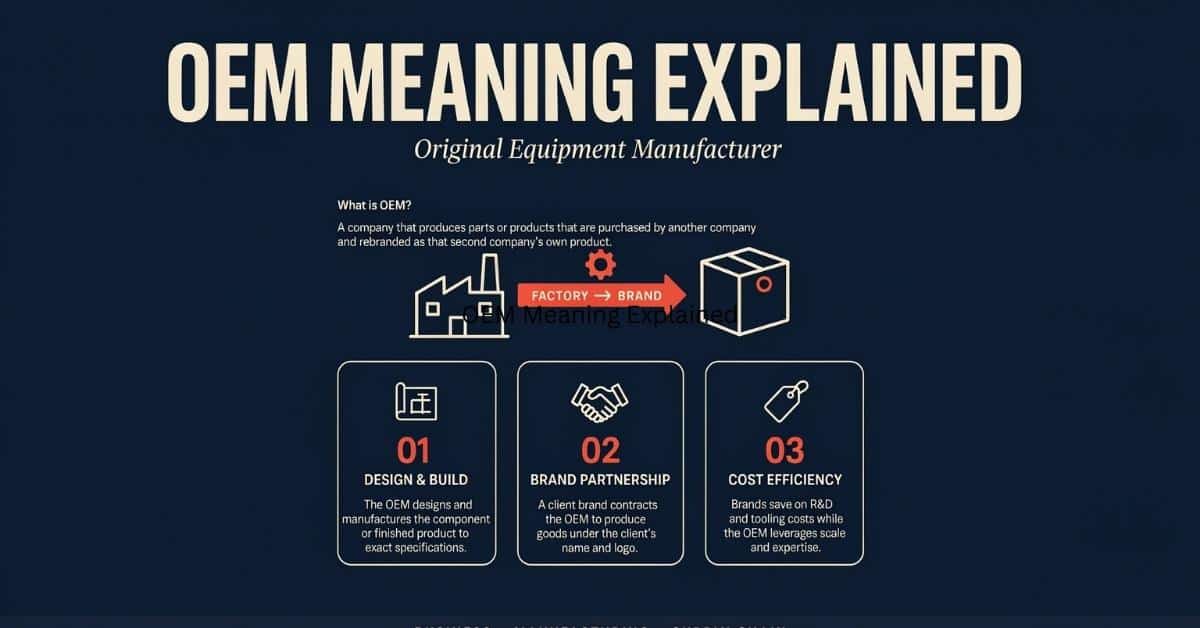
OEM meaning stands for Original Equipment Manufacturer. An OEM is a company that manufactures parts, components, or complete products that are used in another company’s branded products. Depending on the industry, the term OEM can refer to genuine replacement parts, software licenses, computer hardware, or manufacturing partnerships. Whether you’re buying a car part, installing Windows on a new PC, or learning about manufacturing, understanding OEM meaning helps you make smarter purchasing and business decisions.
If you’ve ever wondered why some OEM parts cost more than aftermarket parts, whether OEM products are always better, or why terms like OEM software, OEM supplier, and OEM manufacturer are used differently across industries, you’re in the right place. This guide explains everything in plain English with real-world examples, practical insights, and expert comparisons so you can confidently understand what OEM really means.
What Does OEM Mean?
The OEM full form is Original Equipment Manufacturer. While the definition sounds straightforward, its meaning changes slightly depending on the industry.
In simple terms, an Original Equipment Manufacturer is a business that produces products or components that become part of another company’s finished product. Sometimes the OEM manufactures complete products, while in other cases it produces only specific components.
For consumers, OEM meaning often refers to original replacement parts that match the specifications of the product that originally came from the factory.
OEM Meaning in Simple English
Imagine you buy a brand-new car. The brake pads, headlights, engine sensors, and filters installed during production are manufactured to meet the vehicle manufacturer’s exact standards. If you later replace those parts with the same factory-approved versions, you’re purchasing OEM parts.
Similarly, when you buy a laptop with Microsoft Windows already installed, the operating system is often supplied under an OEM license specifically designed for computer manufacturers like Dell, HP, or Lenovo.
Simply put:
OEM products are designed to meet the original specifications required by the brand selling the final product.
Why Does the Term “OEM” Confuse So Many People?
One of the biggest reasons people search for “What does OEM mean?” is because the term is used differently across industries.
For example:
- In the automotive industry, OEM usually refers to factory-original replacement parts.
- In software, OEM often refers to a special licensing agreement.
- In electronics, OEM companies manufacture components for globally recognized brands.
- In manufacturing, OEMs build products or parts that another company sells under its own brand.
Although these uses vary, the central idea remains the same: an OEM manufactures products that become part of another company’s branded offering.
What Is an Original Equipment Manufacturer?
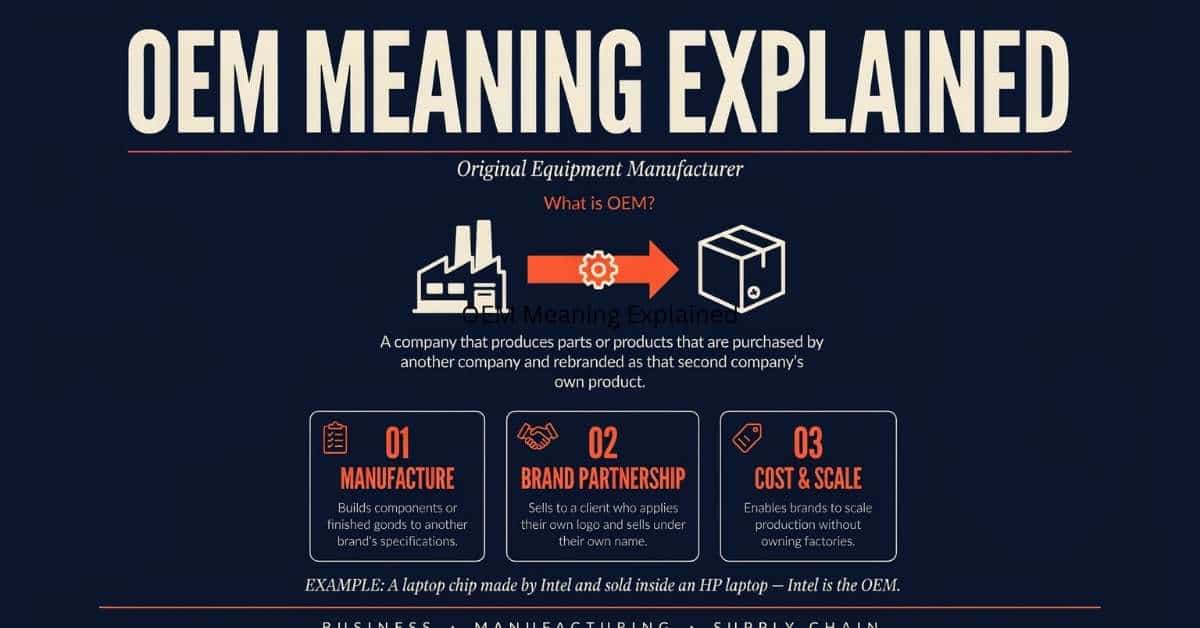
An Original Equipment Manufacturer (OEM) is a company responsible for producing products or components according to another company’s specifications.
Rather than selling every product directly to consumers, OEMs often work behind the scenes. Their expertise lies in manufacturing high-quality components, maintaining strict quality control, and ensuring compatibility with the finished product.
For example:
- Intel manufactures processors that power computers sold by Dell, HP, and Lenovo.
- Bosch and Denso manufacture many automotive components supplied to vehicle manufacturers.
- Foxconn manufactures products for companies like Apple under manufacturing agreements.
Consumers usually recognize the final brand, but many don’t realize how important the OEM is in the production process.
How OEM Companies Fit into the Manufacturing Process
Modern manufacturing depends on specialization. Instead of building every component themselves, companies partner with trusted OEM suppliers that have expertise in producing specific parts.
A simplified production process looks like this:
- A brand designs a product.
- An OEM manufacturer produces selected components or complete assemblies.
- The brand assembles, tests, and markets the final product.
- Customers purchase the finished branded product.
This collaborative model allows companies to focus on innovation while relying on experienced manufacturing partners.
Why Businesses Work with OEM Manufacturers
Many global companies choose OEM partnerships because they provide several advantages.
High Manufacturing Expertise
OEM companies specialize in producing certain components repeatedly while maintaining exceptional consistency.
Better Quality Control
Established OEM manufacturers follow rigorous manufacturing standards that help ensure reliability and performance.
Cost Efficiency
Instead of investing billions in new factories, businesses can partner with experienced OEM suppliers already equipped with advanced production facilities.
Faster Product Development
OEM partnerships allow brands to launch products more quickly because manufacturing expertise already exists.
Global Supply Chain Support
Modern supply chains rely heavily on OEM partnerships to manufacture millions of components used in vehicles, electronics, industrial equipment, and consumer products worldwide.
How OEM Works in Different Industries
The meaning of OEM becomes much easier to understand when viewed through real-world industries.
OEM Meaning in the Automotive Industry
When most consumers hear the phrase OEM parts, they’re thinking about cars.
In the automotive world, OEM parts are replacement components manufactured to match the exact specifications of the parts originally installed during vehicle production.
These parts are designed for:
- Perfect compatibility
- Reliable performance
- Factory specifications
- Warranty support
For example:
If your Toyota needs a replacement brake pad, purchasing an OEM brake pad means you’re buying a part manufactured to Toyota’s original specifications, often produced by suppliers like Denso or Bosch.
Common OEM automotive products include:
- Brake pads
- Oil filters
- Air filters
- Spark plugs
- Sensors
- Fuel injectors
- Headlights
- Alternators
- Water pumps
Because these parts are engineered for a specific vehicle, many drivers prefer them for their consistent fit and reliability.
Why Vehicle Owners Choose OEM Parts
Car owners often choose OEM replacement parts because they offer:
- Exact factory fit
- Reliable durability
- Manufacturer-approved quality
- Consistent performance
- Warranty compatibility
- Lower risk of installation problems
However, OEM parts may also cost more than some aftermarket alternatives, making it important to evaluate your budget and repair goals before making a decision.
OEM Meaning in Computers and Hardware
The computer industry uses the term OEM in another important way.
Companies such as Dell, HP, Lenovo, and ASUS purchase processors, memory, storage devices, and other hardware components from specialized manufacturers.
For example:
- Intel manufactures CPUs.
- AMD manufactures processors and graphics technologies.
- Samsung manufactures memory chips.
- Western Digital produces storage devices.
These components are integrated into branded computers sold to consumers.
This manufacturing ecosystem allows technology companies to build powerful systems without producing every internal component themselves.
What Is OEM Hardware?
OEM hardware refers to computer components supplied directly for installation in new systems.
Examples include:
- Motherboards
- SSDs
- Hard drives
- RAM
- Processors
- Graphics cards
- Power supplies
Businesses purchasing these components often prioritize compatibility, quality assurance, and long-term support.
OEM Meaning in Software
Software introduces another commonly misunderstood use of the term.
An OEM license is a software license provided to computer manufacturers for installation on new devices before they reach consumers.
The most familiar example is Microsoft Windows.
When you purchase a new laptop from Dell, HP, or Lenovo, Windows is typically pre-installed using an OEM Windows license.
This licensing model allows manufacturers to offer computers ready for immediate use while often reducing overall software costs.
Why Is OEM Software Usually Cheaper?
Many users wonder why OEM software often costs less than retail versions.
Several factors contribute to this pricing:
- It’s sold in large quantities to manufacturers.
- The license is generally tied to the original hardware.
- Technical support may be handled by the computer manufacturer instead of the software company.
- Distribution costs are lower.
Although OEM software is genuine, its licensing terms usually differ from retail software, making it important to understand any restrictions before purchasing.
OEM Meaning in Electronics
The electronics industry depends heavily on OEM partnerships.
Major brands rarely manufacture every individual component themselves. Instead, they collaborate with highly specialized suppliers.
Examples include:
- Apple
- Samsung
- Sony
- LG
These companies source displays, batteries, processors, sensors, cameras, and numerous internal components from trusted OEM manufacturers.
This collaborative manufacturing approach helps maintain high quality while supporting innovation and large-scale production.
Why OEM Relationships Matter in Electronics
OEM partnerships help electronics companies:
- Improve manufacturing efficiency
- Increase production capacity
- Maintain product consistency
- Introduce new technologies faster
- Strengthen global supply chains
Without OEM manufacturing, producing millions of smartphones, laptops, and smart devices each year would be significantly more challenging.
OEM Meaning in Manufacturing
The manufacturing sector represents the broadest use of the term.
Here, an OEM manufacturer produces products or components that another company incorporates into its own branded offerings.
OEM manufacturing is common across industries such as:
- Industrial machinery
- Aerospace
- Construction equipment
- Medical devices
- Consumer appliances
- Renewable energy
- Agricultural equipment
For example, a medical equipment company may purchase specialized sensors from an OEM supplier rather than developing them internally.
Likewise, an industrial machinery manufacturer may source precision bearings, hydraulic systems, or electronic controls from experienced OEM companies that specialize in those technologies.
This allows every participant in the manufacturing supply chain to focus on its core expertise while delivering reliable, high-quality products.
How the Meaning of OEM Has Changed Over Time
The definition of Original Equipment Manufacturer has evolved significantly over the years.
Historically, the term referred primarily to companies that produced components used in another manufacturer’s finished products. Over time, globalization, technological innovation, and increasingly complex supply chains expanded its meaning.
Today, OEM is used across multiple industries to describe manufacturing relationships, licensed software, factory-specification replacement parts, and specialized production partnerships.
This evolution explains why someone searching for OEM meaning may encounter different definitions depending on whether they’re reading about cars, computers, electronics, or industrial manufacturing.
Despite these variations, the core concept remains consistent: an OEM creates products or components that meet the original specifications required by another company’s branded product.
OEM vs Aftermarket: What’s the Difference?
One of the most common questions people ask after learning the OEM meaning is whether OEM parts are better than aftermarket parts. The answer depends on your priorities, such as quality, price, warranty, and performance.
An OEM part is manufactured to meet the original specifications of the vehicle, computer, or equipment. An aftermarket part, on the other hand, is produced by a third-party manufacturer that is not officially associated with the original brand.
Neither option is automatically better in every situation. The right choice depends on your budget, the product you’re repairing, and your long-term goals.
OEM vs Aftermarket Comparison
| Feature | OEM Parts | Aftermarket Parts |
|---|---|---|
| Manufacturer | Original Equipment Manufacturer or approved supplier | Independent third-party manufacturer |
| Compatibility | Exact factory fit | May vary depending on the manufacturer |
| Quality | Consistent factory specifications | Can range from basic to premium quality |
| Warranty | Often supports manufacturer warranty requirements | Warranty varies by manufacturer |
| Price | Usually higher | Often more affordable |
| Availability | Sometimes limited | Widely available |
| Customization | Limited | More design and performance options |
| Best For | Reliability and factory restoration | Budget-conscious buyers or performance upgrades |
When OEM Parts Are Worth the Extra Cost
Although OEM replacement parts generally cost more, there are situations where the additional investment makes sense.
Choose OEM parts if you:
- Want an exact factory fit.
- Own a newer vehicle still covered by a warranty.
- Plan to maintain the vehicle’s resale value.
- Prefer manufacturer-tested quality.
- Need maximum compatibility without modification.
- Drive a luxury or high-performance vehicle.
For example, replacing a damaged Toyota sensor with an OEM version designed by Denso helps ensure it performs exactly as intended.
When Aftermarket Parts May Be the Better Choice
There are also many situations where aftermarket parts provide excellent value.
Consider aftermarket parts if you:
- Want to reduce repair costs.
- Own an older vehicle.
- Need performance upgrades.
- Prefer more product choices.
- Buy from reputable manufacturers with strong warranties.
Many premium aftermarket brands produce components that meet—or sometimes exceed—OEM performance standards.
The key is choosing a trusted manufacturer instead of the cheapest available option.
Learn More: Antebellum Meaning
OEM vs Genuine Parts
Another area of confusion is the difference between OEM parts and genuine parts.
Although people often use these terms interchangeably, they are not always identical.
What Are Genuine Parts?
Genuine parts are replacement components sold directly under the vehicle or product manufacturer’s brand.
For example:
A brake pad sold inside Toyota packaging is considered a genuine Toyota part.
What Are OEM Parts?
An OEM part is manufactured by the company that originally produced the component according to factory specifications.
Sometimes the OEM is the same company that manufactures the genuine part. In other cases, the component is sold under the OEM manufacturer’s own branding rather than the vehicle manufacturer’s packaging.
OEM vs Genuine Parts Comparison
| OEM Parts | Genuine Parts |
|---|---|
| Produced by the original component manufacturer | Sold under the vehicle or product manufacturer’s brand |
| Often identical to factory-installed parts | Usually identical to OEM components |
| May be packaged differently | Packaged with the manufacturer’s branding |
| Can sometimes cost slightly less | Often carries a premium price |
Understanding this distinction helps buyers make informed purchasing decisions while avoiding unnecessary expenses.
OEM vs ODM vs White Label Manufacturing
Manufacturing terminology often causes confusion because several similar business models exist.
Understanding these differences is especially useful for entrepreneurs, importers, and business professionals.
| Model | Design Responsibility | Manufacturing Responsibility | Branding |
|---|---|---|---|
| OEM | Customer or brand owner | OEM manufacturer | Customer’s brand |
| ODM (Original Design Manufacturer) | Manufacturer | Manufacturer | Customer’s brand |
| White Label | Manufacturer | Manufacturer | Multiple brands |
| Private Label | Retailer may request changes | Manufacturer | Retailer’s exclusive brand |
OEM (Original Equipment Manufacturer)
An OEM manufactures products or components based on another company’s specifications.
Example:
A company designs a smart home device and hires an OEM factory to manufacture it according to its exact requirements.
ODM (Original Design Manufacturer)
An ODM not only manufactures the product but also develops the design.
Businesses simply choose an existing design and sell it under their own brand.
White Label Manufacturing
A white-label manufacturer creates the same product for multiple businesses.
Each company applies its own logo and packaging while the product itself remains nearly identical.
Private Label Manufacturing
Private-label products are manufactured exclusively for one retailer or brand, often with customized specifications or packaging.
Understanding these business models makes it easier to navigate today’s global manufacturing ecosystem.
OEM vs Original Equipment Supplier (OES)
Another commonly misunderstood term is OES, which stands for Original Equipment Supplier.
Although OEM and OES are closely related, they describe slightly different roles.
OEM
Produces products or components that become part of another company’s finished product.
OES
The supplier that manufactures the component originally installed in the vehicle or equipment.
For example, Bosch may supply braking components to multiple automobile manufacturers.
In many situations, the same company functions as both the OEM and the OES depending on the business relationship.
Are OEM Products Better?
Many consumers automatically assume that OEM products are always superior.
The reality is more balanced.
Whether an OEM product is “better” depends on what matters most to you.
Advantages of OEM Products
Consistent Quality
OEM manufacturers follow strict production standards to ensure consistent performance.
Exact Compatibility
Products are designed to match original specifications, reducing installation issues.
Reliable Performance
OEM components are engineered to perform alongside other factory-installed parts.
Warranty Confidence
Many manufacturers recommend OEM components during warranty periods.
Predictable Results
Professional repair shops often prefer OEM parts because they reduce unexpected fitment problems.
Potential Disadvantages of OEM Products
OEM products also have limitations.
Higher Cost
OEM components usually cost more than many aftermarket alternatives.
Limited Availability
Some OEM products must be ordered directly from authorized dealers.
Fewer Customization Options
Unlike aftermarket manufacturers, OEM companies typically focus on restoring original performance rather than offering upgrades.
Are OEM Parts Worth the Money?
The answer depends on your situation.
OEM Parts Are Usually Worth It If:
- Your vehicle is relatively new.
- You’re making insurance repairs.
- You want factory-original quality.
- Long-term reliability is important.
- You plan to sell the vehicle later.
- Maintaining warranty coverage matters.
Aftermarket May Be a Better Choice If:
- You’re repairing an older vehicle.
- Budget is your biggest concern.
- You’re upgrading performance.
- The aftermarket brand has an excellent reputation.
Instead of asking whether OEM is always better, ask which option best matches your needs.
How to Identify Genuine OEM Products
Counterfeit products have become increasingly common across the automotive, electronics, and industrial sectors.
Knowing how to verify an authentic OEM product can save you money and prevent costly repairs.
Check the Part Number
Every genuine OEM component has a manufacturer-approved part number.
Always compare it with the official manufacturer’s catalog.
Buy from Authorized Dealers
Purchase from:
- Authorized dealerships
- Official distributors
- Certified retailers
- Reputable online stores
Avoid unknown sellers offering prices that seem unrealistically low.
Examine the Packaging
Authentic OEM packaging usually includes:
- Manufacturer branding
- Product labels
- Security seals
- Barcode information
- Serial numbers
Poor printing quality or damaged packaging may indicate counterfeit products.
Verify the Warranty
Legitimate OEM products generally include warranty information and clear documentation.
If warranty details are missing, investigate before purchasing.
Research the Seller
Read customer reviews and verify whether the seller has experience supplying genuine OEM products.
Established businesses are typically more reliable than newly created online stores.
Real-World OEM Examples You Already Use Every Day
Many people interact with OEM products every day without realizing it.
Here are some familiar examples.
Computers
When you buy a Dell, HP, or Lenovo laptop, it often includes:
- Microsoft Windows installed under an OEM license.
- Intel or AMD processors.
- Samsung memory chips.
- SSDs manufactured by specialized storage companies.
These components come together to create the finished product consumers recognize.
Smartphones
Modern smartphones rely on complex OEM partnerships.
For example:
- Apple works with manufacturers such as Foxconn to assemble devices.
- Display panels, camera sensors, batteries, and processors are often produced by specialized suppliers.
Although consumers see one brand, dozens of OEM manufacturers contribute to the finished product.
Automobiles
Vehicle manufacturers depend heavily on OEM suppliers.
Examples include:
- Bosch fuel systems.
- Denso engine sensors.
- OEM brake pads.
- Factory-installed filters.
- Original lighting systems.
These components are engineered to meet the vehicle manufacturer’s exact requirements.
Medical Equipment
Hospitals use advanced diagnostic equipment built with specialized OEM components, including:
- Precision sensors.
- Imaging systems.
- Electronic controllers.
- Safety mechanisms.
OEM partnerships help maintain the accuracy and reliability required in healthcare environments.
Industrial Machinery
Factories around the world rely on OEM-manufactured components such as:
- Hydraulic systems.
- Bearings.
- Electric motors.
- Industrial sensors.
- Automation controllers.
Without OEM manufacturing, modern industrial production would be significantly less efficient.
Common Myths About OEM Products
Despite how widely the term Original Equipment Manufacturer (OEM) is used, there are still many misconceptions surrounding OEM products, OEM parts, and OEM software. Believing these myths can lead to poor purchasing decisions, unnecessary expenses, or confusion about product quality.
Let’s separate fact from fiction.
Myth 1: OEM Always Means Better Quality
Reality: OEM products are designed to meet the original factory specifications, but that doesn’t automatically make them superior to every alternative.
Many reputable aftermarket manufacturers invest heavily in research and development, producing components that perform just as well—or even better—for specific applications. The real difference lies in compatibility, consistency, and intended use, not simply the OEM label.
Myth 2: OEM Parts Are Always More Expensive
Reality: While OEM parts often carry a higher price, this isn’t always the case.
Pricing depends on several factors, including:
- Product availability
- Distribution channels
- Brand pricing strategy
- Supply chain costs
- Market demand
In some situations, OEM components can be competitively priced, especially for commonly replaced items.
Myth 3: OEM Parts Are Made by the Brand You See
Reality: Many consumers assume a vehicle manufacturer or electronics brand physically manufactures every component.
In reality, companies often work with trusted OEM suppliers.
For example:
- Toyota works with suppliers like Denso.
- Apple partners with companies such as Foxconn for manufacturing and assembly.
- Dell sources processors from Intel and AMD.
The finished product carries the brand’s name, while specialized OEM manufacturers produce many of the internal components.
Myth 4: OEM Software Is Illegal
Reality: OEM software is completely legitimate.
An OEM Windows license, for example, is an officially authorized version of Microsoft Windows installed by manufacturers like Dell, HP, or Lenovo before the computer reaches the customer.
The main difference is that OEM licenses usually have different transfer and support conditions than retail licenses.
Myth 5: OEM and Genuine Always Mean Exactly the Same Thing
Reality: Although they often overlap, OEM and genuine are not always identical.
A genuine part is sold under the manufacturer’s brand, while an OEM part may come directly from the original component manufacturer under its own branding.
Understanding this distinction can sometimes help buyers save money without sacrificing quality.
See More: TLDR Meaning
Advantages and Disadvantages of OEM Products
Every purchasing decision involves trade-offs. Understanding both the benefits and limitations of OEM products helps you choose wisely.
Advantages of OEM Products
Excellent Compatibility
OEM products are manufactured to match the original design specifications, making installation straightforward.
Reliable Quality
Manufacturers maintain strict quality control processes to ensure consistent performance.
Manufacturer Confidence
OEM components are widely recommended by vehicle manufacturers, computer brands, and industrial equipment producers because they are designed for the original product.
Warranty Support
Using OEM parts may simplify warranty-related repairs and reduce compatibility concerns.
Long-Term Reliability
OEM products are engineered to perform alongside the original system, reducing unexpected issues.
Disadvantages of OEM Products
Higher Initial Cost
OEM products often cost more than comparable aftermarket alternatives.
Limited Product Choices
Unlike aftermarket manufacturers, OEM companies generally focus on restoring original performance instead of offering customized upgrades.
Availability Can Vary
Older products sometimes require ordering OEM components through authorized dealers or specialized suppliers.
Less Flexibility
Consumers seeking higher performance or additional features may find more options in the aftermarket.
When Should You Choose OEM?
There isn’t a universal answer because every situation is different. Instead of asking, “Is OEM always better?” ask, “Which option best fits my needs?”
Choose OEM If:
- You own a new vehicle still covered by a manufacturer warranty.
- Factory-quality repairs are important.
- You want an exact fit without modification.
- Long-term reliability is your top priority.
- You plan to preserve resale value.
- You’re replacing critical safety components.
Consider Aftermarket If:
- You own an older vehicle.
- You’re looking for lower repair costs.
- You want performance upgrades.
- A reputable aftermarket manufacturer has an excellent track record.
- Warranty requirements are no longer a concern.
A Simple Decision Framework
Ask yourself these five questions before buying:
- Is the product safety-critical?
- Is warranty protection important?
- Do I need exact factory compatibility?
- Am I prioritizing value over originality?
- Is the aftermarket brand reputable?
Your answers will usually point you toward the right choice.
Mistakes Buyers Make When Choosing OEM Products
Even experienced buyers make avoidable mistakes.
Buying Solely Based on Price
The cheapest option isn’t always the best value.
Assuming Every “OEM-Compatible” Product Is Genuine
Marketing phrases such as OEM-compatible or OEM-style don’t necessarily mean the product is manufactured by the original equipment manufacturer.
Ignoring Part Numbers
Always verify manufacturer-approved part numbers before ordering replacement components.
Purchasing from Unknown Sellers
Counterfeit products remain a growing problem, particularly through unofficial online marketplaces.
Forgetting Warranty Requirements
Some warranties include recommendations regarding replacement parts. Review the warranty documentation before making major repairs.
Industry Trends Shaping OEM Manufacturing
The role of OEM manufacturers continues to evolve as technology and global markets change.
Electric Vehicles (EVs)
Electric vehicle production has increased demand for specialized battery systems, power electronics, sensors, and advanced software supplied by OEM partners.
Smart Manufacturing
Modern factories increasingly use automation, robotics, and AI-driven quality control to improve manufacturing precision.
Digital Supply Chains
Businesses now rely on connected supply chain systems that improve inventory management, production planning, and product traceability.
Sustainability
Manufacturers are investing in environmentally responsible production methods, recyclable materials, and energy-efficient manufacturing processes.
Advanced Electronics
The growing demand for smartphones, wearable devices, AI hardware, and connected products has strengthened partnerships between global brands and specialized OEM manufacturers.
These trends demonstrate that OEM manufacturing is becoming even more important as products become more sophisticated.
Frequently Asked Questions About OEM Meaning
What does OEM stand for?
OEM stands for Original Equipment Manufacturer, a company that manufactures products or components according to another company’s specifications.
What is OEM meaning in cars?
In the automotive industry, OEM parts are replacement components manufactured to meet the original factory specifications of the vehicle.
What is OEM meaning in manufacturing?
In manufacturing, an OEM manufacturer produces products or components that another company incorporates into its branded products.
What is OEM meaning in software?
An OEM license is software supplied directly to hardware manufacturers for installation on new devices before they are sold to customers.
Is OEM the same as original?
Not exactly. OEM products are manufactured to original specifications, but the branding and packaging may differ depending on how the product is sold.
Is OEM the same as genuine?
Not always. Genuine parts are sold under the manufacturer’s brand, while OEM parts may come directly from the original component manufacturer.
Are OEM parts made by the vehicle manufacturer?
Sometimes, but often they’re manufactured by specialized suppliers working under strict agreements with the vehicle manufacturer.
Why is OEM software cheaper?
OEM software is sold in large volumes to manufacturers, reducing distribution costs and using different licensing terms than retail versions.
Is OEM better than aftermarket?
Neither option is universally better. OEM offers factory compatibility and consistency, while high-quality aftermarket products may provide better pricing or specialized performance depending on the application.
What is the difference between OEM and ODM?
An OEM manufactures products according to another company’s design, while an Original Design Manufacturer (ODM) both designs and manufactures the product before another company brands it.
What is an OEM supplier?
An OEM supplier produces components, systems, or finished products used by another company in its branded offerings.
Can OEM products be resold?
Yes. OEM products can often be resold, but software licenses and certain contractual agreements may include specific restrictions. Always review the applicable licensing or distribution terms.
Final Thoughts
Whether you’re replacing a vehicle component, purchasing computer hardware, installing software, or exploring the world of manufacturing, understanding OEM meaning gives you a valuable advantage.
An Original Equipment Manufacturer plays a vital role in today’s global economy by producing reliable components and products that meet strict quality standards. From Intel processors inside laptops and Microsoft Windows OEM licenses to Bosch automotive systems and Foxconn manufacturing partnerships, OEM companies help create many of the products we use every day.
The next time you encounter terms like OEM parts, OEM software, OEM supplier, or OEM manufacturer, you’ll know they all share the same fundamental idea: products built to meet original specifications and support trusted brands with consistent quality, compatibility, and performance.
Instead of assuming OEM is always the best—or always the most expensive—evaluate your specific needs, compare your options carefully, and choose the solution that offers the best balance of quality, value, and long-term reliability.