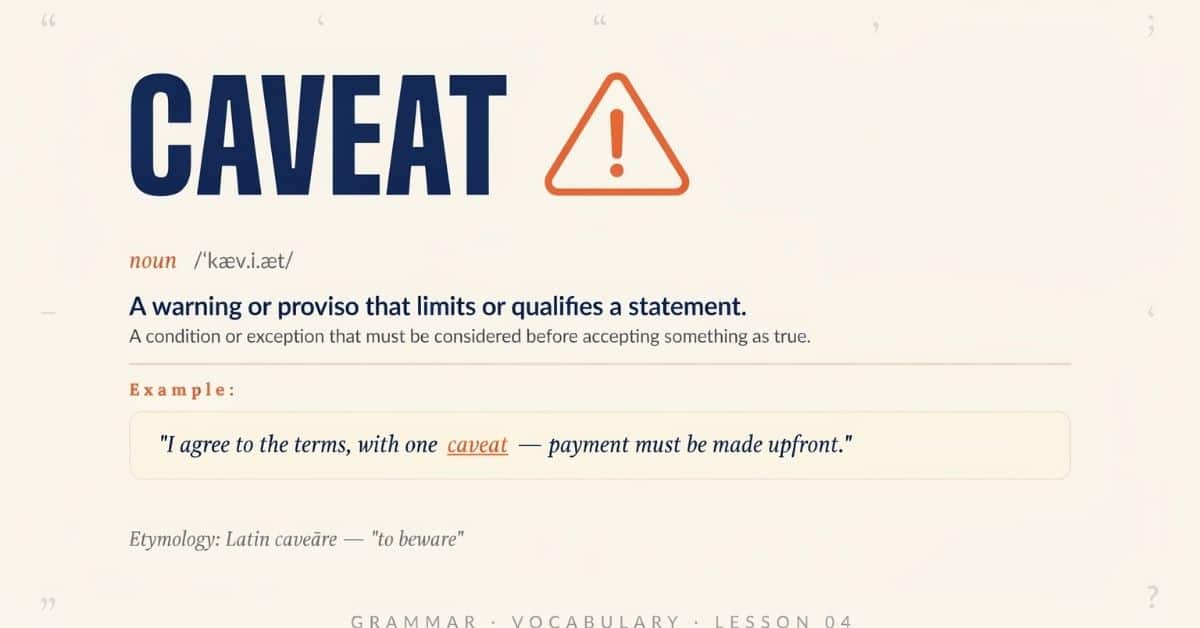
Caveat meaning is a warning, condition, limitation, or qualification that someone adds before making a statement, offering advice, or agreeing to something. In simple words, a caveat tells you that there is one important thing you should know before proceeding. It is commonly used in legal documents, business agreements, academic writing, and professional conversations to clarify exceptions or set expectations.
For example:
“The software is easy to use, but there’s one caveat—it only works on Windows.”
In this sentence, the caveat is the important limitation that users should know before making a decision.
Unlike a direct warning, a caveat is usually less alarming and more about adding a thoughtful qualification. Understanding how and when to use this word can make your communication sound more clear, precise, and professional.
At a Glance
| Topic | Quick Answer |
|---|---|
| Meaning | A warning, condition, or limitation attached to a statement. |
| Pronunciation | KAV-ee-aht (/ˈkæviæt/) |
| Part of Speech | Noun |
| Origin | Latin, meaning “let him/her beware.” |
| Formality | Mostly formal, but increasingly common in professional speech. |
| Common Uses | Business, law, education, research, workplace communication, journalism. |
| Legal Meaning | A formal notice or warning protecting someone’s legal interest. |
| Business Meaning | A condition or limitation that affects a proposal, agreement, or recommendation. |
| Example | “I support your idea with one caveat—it may exceed the budget.” |
| Similar Words | Warning, disclaimer, proviso, qualification, limitation, condition. |
What Does “Caveat” Mean?
Many people first encounter the word caveat while reading a contract, news article, research paper, or business email. Although it may sound sophisticated, its meaning is actually quite straightforward.
A caveat is an important note that changes, limits, or qualifies what has just been said. Think of it as saying:
- “There’s one important condition.“
- “Keep this limitation in mind.“
- “Before you continue, here’s something you should know.“
It doesn’t necessarily mean something is wrong—it simply means that additional context matters.
Simple Meaning (For Beginners)
Imagine your friend recommends a restaurant and says:
“The food is fantastic, but one caveat—they only accept cash.”
The restaurant is still worth visiting, but there’s an important condition you should know beforehand.
In this case, caveat simply means “one thing to watch out for.”
Dictionary Meaning
Most dictionaries define caveat as:
A warning, caution, qualification, or limitation that should be considered before taking action or accepting a statement.
While this definition is accurate, it often feels too formal for everyday learners. The key idea is that a caveat adds an important exception rather than rejecting the original statement.
Meaning in Plain English
If someone says:
“I agree—with one caveat.”
They really mean:
“I agree, but there’s one important condition you need to know first.“
That’s why caveat meaning in English is often easier to understand as an important note, exception, or limitation rather than simply a warning.
Why Do People Use the Word “Caveat”?
Many English speakers choose caveat because it sounds professional, precise, and balanced. Instead of completely disagreeing with someone, they acknowledge the main point while adding an important qualification.
This makes the word especially common in business communication, legal English, academic writing, and workplace discussions.
People often use caveat to:
- Set realistic expectations before making a promise.
- Clarify a limitation without sounding negative.
- Reduce misunderstandings by mentioning exceptions early.
- Protect themselves legally or professionally by explaining conditions.
- Present balanced opinions instead of making absolute statements.
For example:
“Your marketing strategy looks excellent. My only caveat is that it may require a larger budget than expected.”
Rather than criticizing the idea, the speaker is simply pointing out an important limitation.
How to Pronounce Caveat
Many learners know the meaning but hesitate to say the word aloud. Fortunately, the pronunciation is easier than it looks.
Pronunciation
IPA (International Phonetic Alphabet):
/ˈkæviæt/
A simple pronunciation guide is:
KAV-ee-at
The stress falls on the first syllable.
Syllable Breakdown
Cav • e • at
Breaking the word into smaller parts makes it easier to remember and pronounce naturally.
Common Pronunciation Mistakes
People sometimes pronounce it incorrectly as:
- Cave-eet
- Ka-vat
- Kay-vee-at
- Cave-it
The most natural pronunciation is:
KAV-ee-at
Listening to native speakers and repeating the word in full sentences can help improve confidence.
Memory Trick
Think of this sentence:
“CAVe explorers should know one important fact.”
The “CAV” sound matches the beginning of caveat, making it easier to remember.
Why “Caveat” Sounds More Professional Than “Warning”
One reason this word appears frequently in business meetings, legal documents, and academic papers is that it feels less confrontational than saying “warning.”
Compare these examples:
Warning
“Warning: This plan may fail.”
This sounds direct and potentially alarming.
Caveat
“I support the plan with one caveat—we should monitor costs closely.”
The second sentence sounds more collaborative because it introduces a thoughtful qualification instead of a blunt warning.
This subtle difference is why professionals often prefer caveat when discussing:
- Contracts
- Negotiations
- Business proposals
- Research findings
- Policy recommendations
- Project planning
- Client communications
Caveat Meaning in Different Contexts
The exact meaning of caveat changes slightly depending on where it’s used. Understanding these contexts helps you choose the right word in the right situation.
Everyday Conversation
In daily life, caveat usually refers to one important condition or exception.
Example:
“I’d recommend that gym with one caveat—it’s very crowded after work.”
Here, the recommendation is positive, but there’s a limitation to consider.
Workplace Communication
Managers, consultants, and team leaders often use caveat to communicate professionally without sounding overly critical.
Example:
“Your proposal is ready for approval. My only caveat is that we should confirm the timeline with the client.”
This keeps the discussion constructive while highlighting a necessary consideration.
Business Communication
In business, a caveat often qualifies an offer, recommendation, or agreement.
For instance:
“The investment looks promising, with one caveat—market conditions remain unpredictable.”
Using caveat here signals that the opportunity is worthwhile, but decision-makers should proceed with awareness of the associated limitation.
Caveat Meaning in Different Contexts
Understanding caveat meaning becomes much easier when you see how the word is used in different situations. While the core idea—a warning, limitation, or qualification—remains the same, the context determines its exact purpose.
Legal Meaning of Caveat
In law, a caveat has a more specific meaning than it does in everyday English.
A legal caveat is a formal notice filed with a court or public authority to protect a person’s legal interest or to prevent certain actions from being taken without notifying them first.
For example:
- Someone may file a caveat in a property dispute to prevent the transfer of ownership without their knowledge.
- In probate matters, a family member might file a caveat to temporarily stop the distribution of an estate until a dispute is resolved.
Example
“The lawyer filed a caveat before the property could be transferred.”
In this situation, caveat acts as a legal safeguard, not merely a warning.
Common Legal Terms
- Legal caveat
- Caveat filed
- File a caveat
- Court caveat
- Probate caveat
- Property caveat
Business Meaning of Caveat
In the business world, a caveat is usually an important condition attached to a proposal, agreement, recommendation, or investment.
Executives, consultants, managers, and investors frequently use this word because it sounds professional, balanced, and objective.
Example
“The acquisition appears profitable, but there’s one caveat—operating costs are expected to increase next year.”
Rather than rejecting the deal, the speaker is encouraging careful decision-making.
Common Business Situations
- Investment advice
- Contract negotiations
- Sales presentations
- Client proposals
- Risk assessments
- Business reports
- Financial planning
Academic Meaning of Caveat
Researchers and professors often use caveat to explain the limitations of a study or conclusion.
For example:
“The findings are encouraging, with one important caveat—the sample size was relatively small.”
This tells readers that the results are useful but should be interpreted carefully.
You’ll often see caveat in:
- Research papers
- Journals
- Thesis writing
- Scientific reports
- University lectures
Caveat in News and Media
Journalists use caveat when reporting information that requires context or qualification.
Example:
“Economic growth continues, although analysts offered one caveat regarding inflation.”
Here, the word signals that readers should not draw conclusions too quickly.
What Does “With One Caveat” Mean?
One of the most searched phrases is “with one caveat.”
It simply means:
“I agree, but there is one important condition or exception.”
This expression is extremely common in:
- Business meetings
- Presentations
- Interviews
- News reports
- Academic discussions
- Professional emails
Examples
“The proposal looks excellent, with one caveat—we’ll need additional funding.”
“I recommend the software, with one caveat—it requires a high-speed internet connection.”
“The hotel was wonderful, with one caveat—parking spaces were limited.”
Notice that the overall opinion remains positive. The speaker is simply introducing an important limitation.
Learn More: OEM Meaning Explained
Real-Life Examples of Caveat
Seeing the word in everyday situations makes it much easier to remember.
Family
“You can borrow the car, but there’s one caveat—please return it before dinner.”
Explanation: The permission includes an important condition.
Friends
“I’ll join the trip with one caveat—I can’t travel on Friday.”
Here, the speaker agrees while setting a limitation.
Office
“The manager approved the budget with one caveat—all expenses must be documented.”
This is a common workplace example.
School
“Your project received excellent marks, but my only caveat is that your references need updating.”
Teachers often use caveat when giving constructive feedback.
Law
“The attorney advised signing the agreement with one caveat regarding liability.”
The legal advice includes an important qualification.
Sales
“This laptop is an excellent value. The only caveat is that it doesn’t include a charger.”
Customers appreciate knowing important limitations before purchasing.
Healthcare
“The treatment is highly effective, with one caveat—some patients experience mild side effects.”
Medical professionals frequently qualify recommendations this way.
Technology
“The application is free, with one caveat—advanced features require a subscription.”
This example is common in software reviews.
Customer Support
“We can process your refund with one caveat—the original receipt is required.”
The condition is clear without sounding harsh.
Research
“The experiment was successful, with one caveat—additional testing is necessary.”
Researchers use caveats to maintain scientific accuracy.
Caveat vs. Similar Words
Many learners confuse caveat with words like warning, disclaimer, or condition. Although they are related, each has a distinct meaning.
| Word | Meaning | Best Used When |
|---|---|---|
| Caveat | An important limitation or qualification | Professional, legal, business, academic contexts |
| Warning | Alerts someone to possible danger or risk | Safety instructions and emergencies |
| Disclaimer | A statement limiting legal responsibility | Websites, advertisements, legal notices |
| Condition | A requirement that must be met | Contracts, agreements, permissions |
| Proviso | A formal condition written into a contract | Legal documents |
| Exception | Something excluded from a general rule | Rules, policies, procedures |
| Limitation | A restriction or boundary | Products, services, research, capabilities |
Caveat vs. Warning
Although both involve caution, they are not interchangeable.
Warning
A warning alerts people to danger or serious risk.
Example:
“Warning: Wet floor.”
The goal is immediate safety.
Caveat
A caveat highlights an important limitation or qualification.
Example:
“The restaurant is excellent, with one caveat—reservations are essential.”
The situation isn’t dangerous; it simply requires awareness.
Caveat vs. Disclaimer
A disclaimer mainly protects someone from legal responsibility.
Example:
“Results may vary.”
A caveat, however, explains an important limitation before making a statement.
Example:
“I recommend this investment, with one caveat—returns are not guaranteed.”
Caveat vs. Condition
A condition is a rule that must be satisfied.
Example:
“You may enter if you have a ticket.”
A caveat explains an important consideration.
Example:
“You may attend, with one caveat—the venue has limited seating.”
Caveat vs. Proviso
Both are common in legal English.
However:
- Proviso almost always appears in legal contracts.
- Caveat has much broader use in everyday professional communication.
Common Phrases That Use “Caveat”
Understanding these expressions helps you recognize the word instantly.
With One Caveat
Means:
There is one important condition.
Important Caveat
Refers to a significant limitation.
Example:
“One important caveat should be noted.”
Legal Caveat
A formal legal notice protecting someone’s rights.
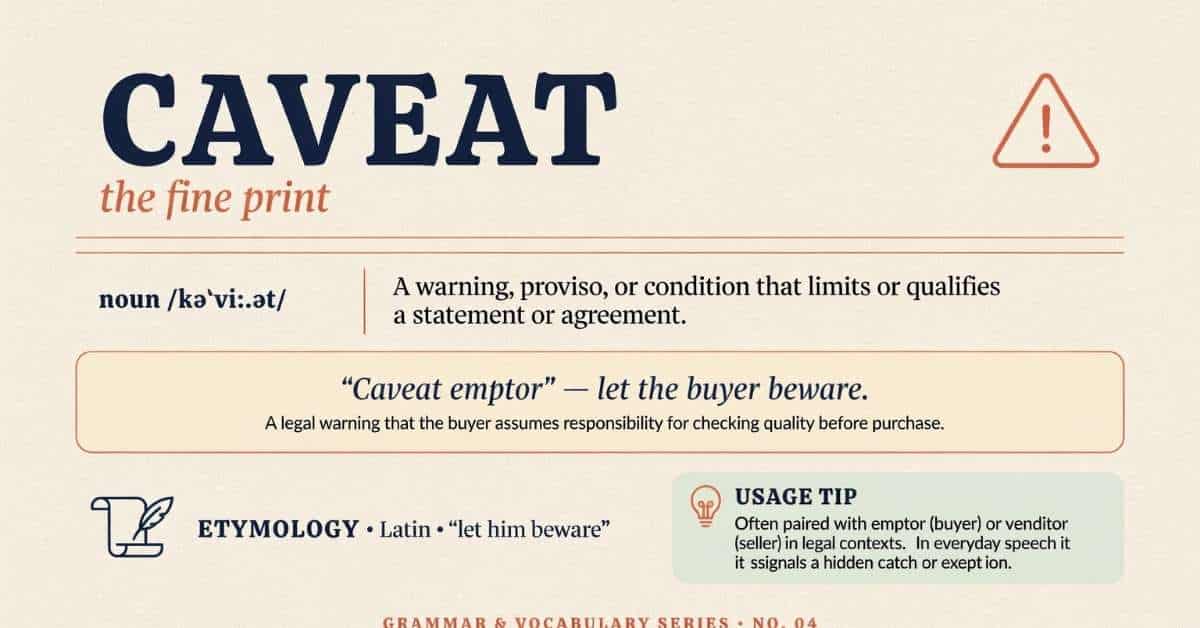
Caveat Emptor
One of the oldest legal phrases.
It is Latin for:
“Let the buyer beware.”
This principle reminds buyers that they should carefully inspect products before purchasing because the seller may not be responsible for every defect.
Subject to One Caveat
Frequently appears in contracts and negotiations.
Meaning:
The agreement is accepted, but one condition still applies.
Synonyms of Caveat
The best synonym depends on the context.
Formal Synonyms
- Qualification
- Limitation
- Reservation
- Provision
Legal Synonyms
- Proviso
- Notice
- Restriction
- Condition
Business Synonyms
- Qualification
- Limitation
- Consideration
- Restriction
Everyday Alternatives
- Catch
- One thing to remember
- One condition
- One exception
- Important note
These alternatives are often easier to understand in casual conversation.
When Not to Use These Synonyms
While warning, condition, and disclaimer may seem similar, replacing caveat with them can change the meaning. Choosing the right term depends on whether you’re emphasizing risk, a legal limitation, or simply an important qualification.
Antonyms of Caveat
Unlike many English words, caveat doesn’t have one perfect opposite. A caveat adds a warning, limitation, or qualification, so its opposite would be a statement that expresses complete certainty or no restrictions.
Here are the closest antonyms depending on the context:
| Word | Meaning | When to Use It |
|---|---|---|
| Assurance | A promise that everything is acceptable | Customer service, business |
| Guarantee | A commitment that something will happen | Contracts, products |
| Certainty | No doubt or limitation | Academic or professional writing |
| Approval | Full acceptance without conditions | Workplace communication |
| Confirmation | Verification without exceptions | Formal communication |
Example
With Caveat
“I approve the proposal, with one caveat—the timeline should be reviewed.”
Without Caveat
“I fully approve the proposal.”
The second statement contains no limitation, making it the closest conceptual opposite.
Common Mistakes People Make
Even advanced English learners sometimes misuse the word caveat. Understanding these common errors will help you use it confidently.
Mistake 1: Treating Caveat as a Safety Warning
Many people think caveat always means danger.
Incorrect
“Caveat! The road is slippery.”
Correct
“Warning! The road is slippery.”
A warning alerts people to immediate danger, while a caveat introduces an important qualification or limitation.
Mistake 2: Using Caveat Instead of Disclaimer
A disclaimer protects someone from legal responsibility.
A caveat explains a condition before making a statement.
Incorrect
“Our website includes a caveat.”
Better
“Our website includes a disclaimer.”
Mistake 3: Using Caveat in Very Casual Conversations
Although native speakers understand the word, it is still considered fairly formal.
Instead of saying:
“One caveat—we’re out of milk.”
Many people naturally say:
“One thing to remember…”
or
“Just one catch…”
Mistake 4: Overusing the Word
Repeating caveat several times in the same article or presentation can make your writing sound unnatural.
Instead, vary your language with words like:
- qualification
- limitation
- condition
- exception
- important note
This keeps your writing engaging while maintaining semantic richness.
When Should You Use “Caveat”?
A simple decision framework can help.
Use Caveat When You Want To:
- Add an important limitation to a statement.
- Qualify your opinion.
- Explain an exception.
- Set realistic expectations.
- Sound professional in business communication.
- Clarify legal or contractual conditions.
- Present balanced recommendations.
Example
“The software performs exceptionally well, with one caveat—it requires a stable internet connection.”
Avoid Using Caveat When:
- Giving emergency safety instructions.
- Speaking to audiences unfamiliar with formal English.
- Simpler words make your message clearer.
- Writing for young children.
- A direct warning is more appropriate.
For example:
Instead of:
“One caveat—the fire alarm is ringing.”
Say:
“Warning: Leave the building immediately.”
Is Caveat a Formal Word?
Yes. Caveat is generally considered a formal English word, although it has become increasingly common in professional communication.
Where It Fits Naturally
- Business meetings
- Legal documents
- Academic writing
- Research papers
- Professional emails
- News reports
- Corporate presentations
Where Simpler Alternatives May Be Better
- Casual conversations
- Text messages
- Informal social media posts
- Conversations with young learners
Choosing the right word for your audience improves clarity and communication.
See More: Antebellum Meaning
Origin and History of the Word
The word caveat comes from Latin, where it means “let him or her beware.”
It entered English through legal language and gradually expanded into business, academic, and professional writing.
One of the best-known Latin phrases containing the word is:
Caveat Emptor
Meaning:
“Let the buyer beware.”
Historically, this principle reminded buyers that they were responsible for checking a product before purchasing it.
Today, caveat emptor is still widely discussed in:
- Contract law
- Consumer protection
- Business ethics
- Commercial transactions
Although modern consumer laws provide stronger protections, the phrase remains an important legal and business concept.
Why “Caveat” Is So Common in Law and Business
Professionals prefer caveat because it allows them to express balance, precision, and transparency.
In Law
Lawyers use caveats to:
- Protect legal rights
- Delay certain legal actions
- Notify courts of existing claims
- Clarify contractual limitations
In Business
Business professionals use caveats to:
- Explain project risks
- Discuss investment opportunities
- Set client expectations
- Highlight contractual conditions
- Present balanced recommendations
Instead of rejecting an idea outright, a caveat acknowledges its value while identifying a limitation that decision-makers should consider.
Expert Writing Tips
If you want to sound like a confident English speaker or writer, use caveat thoughtfully rather than frequently.
Use It Naturally
✅ “I agree with your proposal, with one caveat.”
Avoid Overcomplicating Simple Sentences
Instead of:
“I have one caveat regarding dinner.”
You could simply say:
“There’s one thing you should know.”
Context matters. In professional writing, caveat often sounds polished. In everyday conversation, simpler alternatives may feel more natural.
Good Usage
- “The investment looks promising, with one caveat.”
- “There’s one important caveat before we proceed.”
- “My only caveat concerns the project timeline.”
Poor Usage
- “Caveat! Don’t touch the wire.”
- “The teacher gave us a caveat homework.”
- “I caveated him yesterday.”
Remember, caveat is a noun, not a verb in standard everyday English.
Frequently Asked Questions
What does caveat mean in simple words?
A caveat is an important warning, condition, or limitation that someone adds before making a statement or agreement.
Is caveat the same as a warning?
Not exactly. A warning usually alerts people to danger, while a caveat explains an important limitation or qualification.
What does “with one caveat” mean?
It means:
“I agree, but there’s one important condition or exception.”
What is caveat meaning in law?
In law, a caveat is a formal notice filed to protect someone’s legal interest or to prevent certain actions until the interested party is informed.
What is caveat meaning in business?
In business, a caveat is an important condition, qualification, or limitation attached to a proposal, agreement, recommendation, or investment.
How do you pronounce caveat?
It is commonly pronounced:
KAV-ee-at
IPA:
/ˈkæviæt/
Is caveat a formal word?
Yes. It is commonly used in legal English, business communication, academic writing, and other professional settings.
Can I use caveat in everyday conversation?
Yes, but it may sound formal. In casual conversations, phrases like “one thing to remember,” “one catch,” or “one condition” often feel more natural.
What is the difference between caveat and disclaimer?
A caveat adds an important qualification to a statement, while a disclaimer limits legal responsibility or liability.
What is caveat emptor?
Caveat emptor is a Latin phrase meaning “let the buyer beware.” It reminds buyers to evaluate products carefully before making a purchase.
Is caveat positive or negative?
A caveat is neutral. It doesn’t necessarily indicate a problem—it simply highlights an important condition or limitation that should be considered.
Can I use caveat in an email?
Yes. In professional emails, caveat is an excellent way to introduce a qualification politely.
Example:
“I support moving forward, with one caveat regarding the delivery schedule.”
Final Verdict:
Understanding caveat meaning goes beyond memorizing a dictionary definition. A caveat is an important warning, limitation, condition, or qualification that helps people communicate more accurately and transparently. Whether you’re reading a legal document, preparing a business proposal, writing an academic paper, or simply trying to improve your English vocabulary, recognizing when to use caveat can make your communication clearer and more professional.
Remember these essential points:
- Caveat meaning refers to a warning, condition, limitation, or qualification attached to a statement.
- It is commonly used in law, business, research, and professional communication.
- The phrase “with one caveat” means there is one important exception or condition.
- A caveat is different from a warning, disclaimer, condition, or proviso, even though these words are related.
- Caveat emptor, meaning “let the buyer beware,” is one of the most recognized legal phrases derived from the word.
- Choosing caveat appropriately helps you sound more precise and professional, while simpler alternatives may be better in informal conversations.
By focusing on meaning, context, comparisons, pronunciation, examples, and practical usage, you can confidently understand and use caveat in everyday English as well as in legal, academic, and business settings.