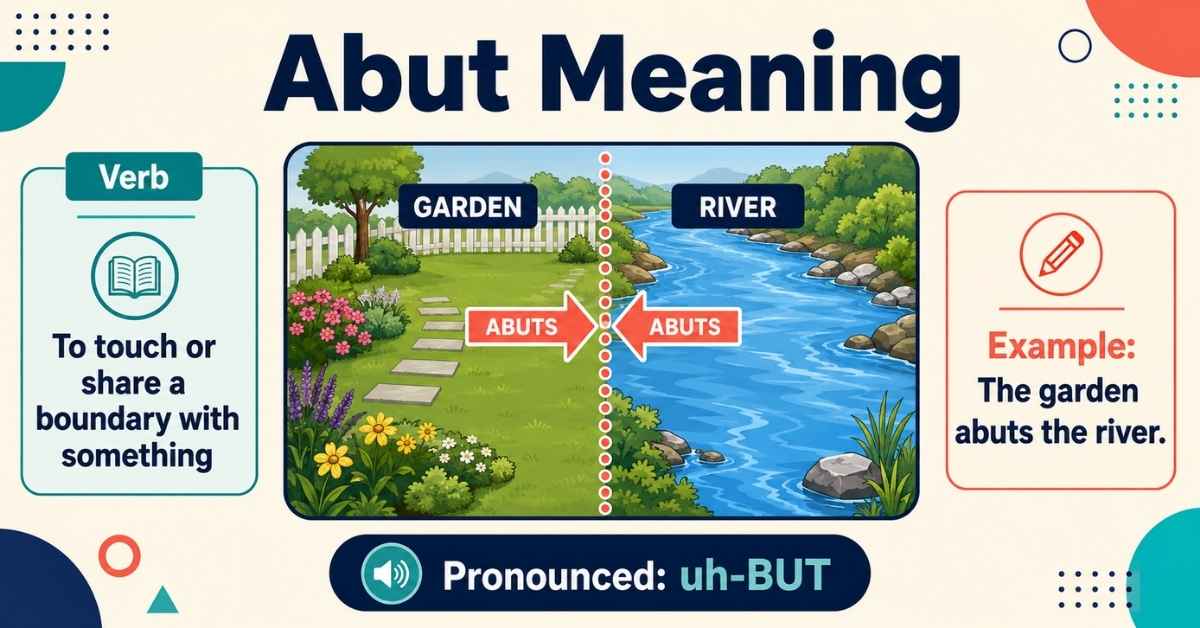
Abut meaning: “Abut” means to touch, meet, or share a boundary with something along an edge. If one property abuts another, the two properties have direct contact at their boundaries. The word commonly appears in real estate listings, property deeds, surveys, zoning notices, construction documents, and formal English.
For example:
“Our property abuts a public road.”
This means the property’s boundary directly touches the road. It is not merely close to it.
What Does Abut Meaning in Simple Words?
To abut something is to touch it along one side, end, or boundary. The word usually describes land, buildings, roads, walls, or natural features that meet without another object or space between them.
A simple way to remember the abut definition is:
Abut = touch at an edge or share a boundary.
| Quick fact | Answer |
|---|---|
| Part of speech | Verb |
| Pronunciation | uh-BUT |
| Phonetic spelling | /əˈbʌt/ |
| Basic meaning | To touch or meet along an edge |
| Past tense | Abutted |
| Present participle | Abutting |
| Common context | Property, land, construction, geography |
| Close synonyms | Adjoin, border, touch, meet |
How to Pronounce Abut Correctly
Abut is pronounced uh-BUT, with the stress on the second syllable.
- First syllable: a short “uh” sound
- Second syllable: sounds like “but”
It should not be pronounced like “a boot” or confused with the much more common word about.
Abut, Abuts, Abutted, and Abutting
The form of the verb changes according to tense and sentence structure.
| Word form | Use | Example |
|---|---|---|
| Abut | Base form | The two properties abut. |
| Abuts | Third-person singular | The garden abuts the school. |
| Abutted | Past tense | The old warehouse abutted the railway. |
| Abutting | Continuous form or adjective | The abutting property is privately owned. |
| Abutter | A person or owner whose land abuts another property | The council notified every abutter. |
| Abutment | A structure supporting the end of a bridge or arch | Engineers inspected the bridge abutment. |
Why Does Abutting Have Two T’s?
The final t is doubled when adding -ed or -ing because the final syllable is stressed and ends in a consonant-vowel-consonant pattern.
Therefore, the correct spellings are:
- Abutted, not “abuted”
- Abutting, not “abuting”
How to Use Abut Meaning in a Sentence
Abut may be used as either a transitive verb or an intransitive verb. In everyday terms, it can take a direct object or appear with a preposition such as on, upon, or against.
Abut Something
When used directly, abut means that one object or area touches another.
- The development abuts the highway.
- Our backyard abuts a protected woodland.
- The new extension abuts the original building.
Abut On or Upon Something
The phrases abut on and abut upon mean border on or have a common boundary with. “Abut upon” sounds more formal and is less common in modern conversation.
- The farm abuts on the river.
- Several residential lots abut upon the proposed development.
- The parking area abuts on a public sidewalk.
It Against Something
Abut against emphasizes physical contact between structures or surfaces.
- The retaining wall abuts against the neighboring garage.
- The kitchen counter abuts against the side wall.
Can Two Things Abut Each Other?
Yes. Two places or objects can abut each other when their edges meet.
“The two parcels abut each other along the eastern property line.”
However, the shorter sentence—“The two parcels abut”—usually communicates the same idea.
Natural Examples of Abut
The best way to understand what abut means is to see it used in realistic situations.
Property and Real Estate
- Our property abuts a public road.
- The vacant lot abuts the northern boundary of the school.
- All abutting landowners received a zoning notice.
- The survey shows that the two parcels share a common boundary.
Buildings and Construction
- The new office wing abuts the existing structure.
- A fire-resistant wall separates the abutting buildings.
- The garage abuts the boundary wall at the rear of the lot.
Nature and Geography
- The forest abuts the lake on its western side.
- Agricultural land abuts the protected wetland.
- The campsite lies where the valley abuts the foothills.
Here is a useful non-example:
“The house is near the park but does not abut it because a road lies between them.”
The house and park are nearby, but they do not touch. The intervening road prevents them from being abutting areas.
Abut vs. Adjacent, Adjoin, Border, and Contiguous
These words are related, but they are not always interchangeable.
| Word | Usual meaning | Must there be direct contact? |
|---|---|---|
| Abut | Touch or meet along an edge or boundary | Usually yes |
| Adjacent | Next to or very near | Not always |
| Adjoin | Be joined to or share a boundary | Usually yes |
| Border | Form or lie along an edge | Usually |
| Contiguous | Touching or connected without a break | Yes |
| Neighboring | Located nearby | No |
| Butt against | Press or end directly against something | Yes |
The most important distinction is between abut and adjacent.
Two properties that abut are generally adjacent, but two adjacent properties do not necessarily abut. A road, alley, pathway, stream, or separate parcel may lie between them.
The easiest rule to remember is:
Adjacent means nearby; abutting means touching.
What Does Abut Meaning in Real Estate?
In real estate, abutting describes land or property that shares a boundary with another parcel, road, sidewalk, building, or public space.
If a deed says that a property abuts a road, the property line normally reaches the road boundary. If a planning notice refers to abutting property owners, it generally means owners whose land directly touches the property involved in the application.
Related real-estate terms include:
- Property line
- Lot line
- Boundary survey
- Abutting parcel
- Adjoining land
- Common boundary
- Neighboring landowner
- Zoning notice
- Planning application
Does a Property Across an Alley Abut Your Property?
Not usually. If an alley is a separate legal parcel or public right-of-way, the properties on opposite sides may be adjacent or nearby, but they may not technically abut each other.
The exact answer depends on the survey, deed, parcel map, and local legal definitions.
What Abutting Does Not Automatically Mean
The fact that two properties abut does not, by itself, determine every legal right or responsibility between their owners.
Abutting properties do not automatically have:
- Joint ownership
- A shared fence agreement
- A right to enter the neighboring land
- An easement
- A right-of-way
- Shared maintenance duties
- Identical zoning restrictions
- Permission to build across the boundary
These issues may be controlled by the deed, title records, survey, local property law, building codes, easements, private agreements, or court decisions.
If the term appears in a document affecting ownership, access, construction, or a boundary dispute, consult a qualified surveyor, conveyancer, or property lawyer in the relevant jurisdiction.
Three Real-World Property Scenarios
Two Yards Share a Fence
Two residential yards meet at the same lot line, and a fence runs along that boundary. The properties abut because they have direct boundary contact.
The fence does not necessarily prove the precise legal boundary. A professional survey may still be required.
Two Houses Are Separated by an Alley
The houses are close, but their individual parcels are separated by a public alley. They may be described as neighboring or adjacent, but the parcels generally do not abut each other if the alley is intervening land.
A Commercial Lot Meets a Public Sidewalk
A store’s lot line reaches the boundary of a public sidewalk. The lot may be said to abut the sidewalk. That description alone does not establish ownership of the sidewalk or give the owner unrestricted rights over it.
Use the EDGE Test to Understand Abut
When you are unsure whether two places abut, use the EDGE test:
- E — Examine the edges: Identify the legal or physical boundaries.
- D — Determine contact: Check whether those boundaries directly touch.
- G — Look for a gap: Find out whether a road, alley, path, waterway, or third parcel lies between them.
- E — Evaluate the context: Decide whether the word is being used casually, geographically, or as a legal property term.
If the boundaries touch and there is no intervening land, the areas probably abut.
Common Mistakes With Abut Meaning
Confusing Abut With About
Abut and about are completely different words.
- Abut: to touch along a boundary
- About: concerning, approximately, or around
Incorrect: “The article is abut property law.” Correct: “The article is about property law.”
Assuming Adjacent Always Means Abutting
An adjacent property may be close without sharing a property line. Always check whether there is a physical gap or intervening parcel.
Misspelling Abutted or Abutting
Remember to double the final t:
- Correct: abutted
- Correct: abutting
- Incorrect: “abuted”
- Incorrect: “abuting”
Using Abut for Anything Nearby
Two objects do not abut simply because they are in the same area. Their edges must normally meet or make direct contact.
Assuming Abut Creates Legal Rights
A shared boundary does not automatically create access rights, easements, ownership rights, or shared maintenance obligations.
LEARN MORE: Zionist Meaning
Where Did the Word Abut Come From?
Abut entered English through older French forms associated with the idea of coming up to an end or striking against something. Its history helps explain its modern meaning: one object, piece of land, or structure comes up to the edge of another.
The word is related in sense to butt against, although “abut” is more common in formal descriptions of property, boundaries, and structures.
Is Abut a Formal Word?
Abut is a standard English word, but it sounds more formal and technical than “touch” or “next to.” It appears most often in:
- Property deeds and land surveys
- Real estate descriptions
- Zoning and planning applications
- Construction and architectural documents
- Building codes
- Geographic descriptions
- Legal notices
In casual conversation, most people would say, “Our yard touches the park.” In a survey or planning document, the same relationship may be written as, “The property abuts the park.”
Frequently Asked Questions About Abut Meaning
What is the simplest meaning of abut?
Abut means to touch or meet along an edge or shared boundary.
How do you pronounce abut?
It is pronounced uh-BUT: /əˈbʌt/.
Does abut always mean touching?
Usually, yes. In property and geographic contexts, it normally indicates direct contact along a boundary, not merely being nearby.
Is abut a noun or a verb?
Abut is a verb. Related nouns include abutter and abutment.
What is the past tense of abut?
The past tense is abutted.
What does abutting property mean?
An abutting property is a parcel of land that directly touches or shares a boundary with another parcel or feature.
What is an abutting landowner?
An abutting landowner owns property that shares a boundary with the land, road, development, or public space being discussed.
What is the difference between abutting and adjacent?
Abutting normally means touching. Adjacent means next to or nearby and may not involve direct contact.
Is “abuts on” grammatically correct?
Yes. Both “the property abuts the road” and “the property abuts on the road” are correct. The version without “on” is often more concise.
Can properties separated by a road abut each other?
Usually not, because the road creates a space between them. However, legal descriptions and ownership boundaries vary, so the relevant deed and survey should be checked.
Does abutting property create an easement?
No. Abutting land does not automatically create an easement. An easement normally comes from a deed, recorded agreement, law, implication, necessity, or another recognized legal basis.
Is abut a slang word?
No. Abut is a standard formal English verb, not slang.
The Rule to Remember
When you see the word abut, think of two edges meeting. A garden can abut a school, a building can abut a wall, and a parcel of land can abut a road.
If the two things only sit nearby, use adjacent or neighboring. If their boundaries directly touch, abut is usually the precise word.