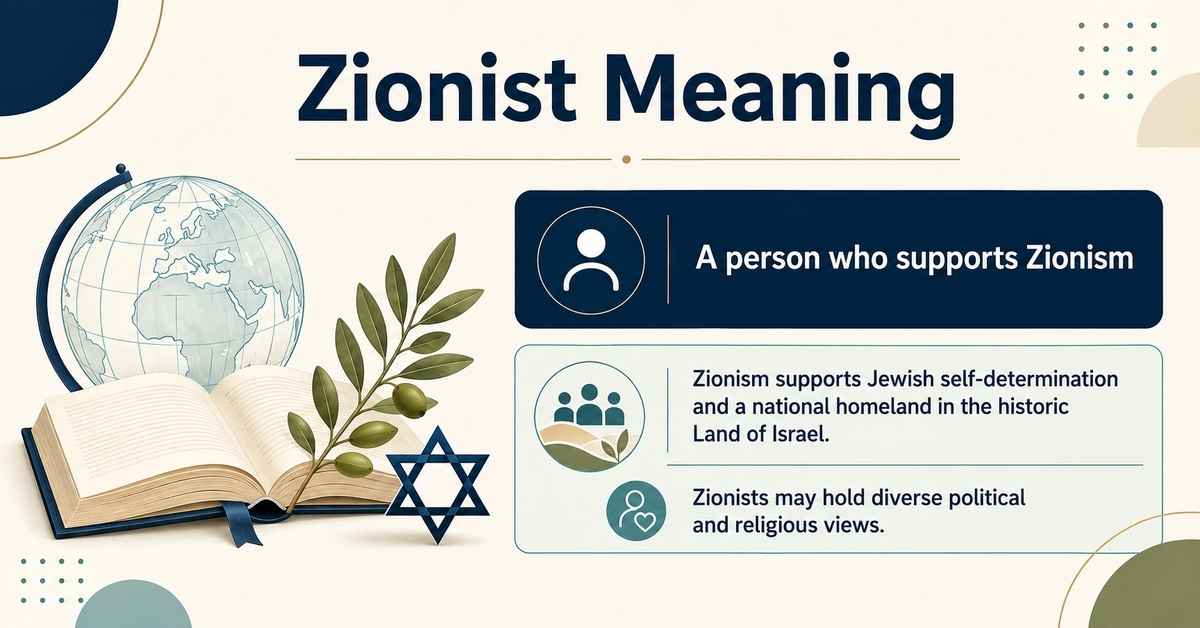
Zionist meaning refers to a person who supports Zionism—historically, the movement for a Jewish national home or state in historic Palestine/the Land of Israel and, today, generally the belief in Jewish national self-determination and Israel’s continued existence as a Jewish state. Being a Zionist does not automatically mean supporting Israel’s current government, the war in Gaza, West Bank settlements, annexation, or opposition to Palestinian statehood.
The word can be a personal identity, a neutral political description, a criticism, or an insult. Its intended meaning therefore depends on who is speaking, the historical period, and the surrounding context.
What Does Zionist Mean in Simple Words?
A Zionist is someone who believes that Jewish people should have collective self-determination in their historic homeland. In modern usage, it often describes a person who supports the continued existence of the State of Israel as a Jewish homeland.
“Zionist” can function as both a noun and an adjective:
- Noun: “She describes herself as a Zionist.”
- Adjective: “They belong to a Zionist organization.”
This basic definition does not tell you everything the person believes. Zionists disagree sharply about Israel’s borders, Palestinian rights, religion, settlements, security, democracy, and the possibility of a two-state solution.
What the label does not automatically mean
Calling someone a Zionist does not necessarily mean that the person:
- Supports Benjamin Netanyahu or another Israeli leader
- Approves of every Israeli military action
- Supports settlements in the West Bank
- Opposes an independent Palestinian state
- Wants Israel to annex Palestinian territories
- Believes Israel should be governed through religious law
- Rejects equal rights for Palestinians
Zionism is an umbrella term, not one detailed political platform.
Zionist, Jewish, Israeli, and Pro-Israel Are Not Synonyms
One of the most common mistakes is treating religious identity, nationality, and political ideology as the same thing.
| Term | Basic meaning | Important distinction |
|---|---|---|
| Jewish | A religious, cultural, ancestral, or ethnic identity | Not every Jewish person is a Zionist or Israeli |
| Israeli | A citizen or national of Israel | Not every Israeli is Jewish or Zionist |
| Zionist | Someone who supports a form of Zionism | Does not necessarily support every Israeli policy |
| Pro-Israel | Someone broadly supportive of Israel | May not personally use the Zionist label |
| Anti-Zionist | Someone opposed to Zionism | Not automatically antisemitic in every context |
Are all Jewish people Zionists?
No. Jewish people hold diverse political and religious views. Some identify strongly as Zionists, some feel connected to Israel but avoid the label, and others are non-Zionist or anti-Zionist.
Can a non-Jew be a Zionist?
Yes. Christian Zionists support Israel for religious, historical, or political reasons. Other non-Jews may support Jewish self-determination without belonging to Judaism.
Are all Israelis Zionists?
No. Israeli describes nationality or citizenship. Israel includes Jewish, Palestinian Arab, Druze, Christian, Muslim, and other communities with different political beliefs.
Where Did the Word Zionist Come From?
The term begins with Zion, a name originally associated with a hill in Jerusalem. Over time, Zion became a religious and poetic name for Jerusalem and the wider Land of Israel. Jewish prayers and traditions maintained the idea of a connection or eventual return to Zion throughout centuries of diaspora life.
The Austrian Jewish writer Nathan Birnbaum is generally credited with using the term “Zionism” in 1890. However, he did not create the broader Jewish connection to Zion or begin every activity later associated with the movement.
Theodor Herzl became the best-known organizer of modern political Zionism. He published Der Judenstaat—The Jewish State—in 1896 and helped convene the First Zionist Congress in Basel in 1897. The congress organized efforts to secure a recognized national home for Jewish people.
How Zionist Meaning Changed Over Time
The meaning of Zionist evolved alongside the movement itself.
| Period | Development |
|---|---|
| Before modern Zionism | Zion mainly carried religious, historical, and cultural meaning |
| Late 19th century | Zionist described supporters of organized Jewish nationalism |
| 1897 onward | The movement pursued a recognized Jewish national home |
| 1917–1948 | Zionism became connected to immigration, settlement, and state-building in British-controlled Palestine |
| 1948 | Israel was established, while Palestinians experienced mass displacement known as the Nakba |
| After 1948 | Zionism increasingly referred to supporting and developing Israel |
| Today | The term can describe an identity, political belief, criticism, or pejorative label |
The Balfour Declaration and British Mandate
In 1917, the British government issued the Balfour Declaration, supporting the establishment of a “national home for the Jewish people” in Palestine. The declaration became a major milestone for the Zionist movement.
However, Palestine already had an Arab Palestinian population with its own social, political, and national aspirations. During the British Mandate, Jewish immigration and settlement increased while tensions between the two national movements intensified.
Israel’s establishment and the Nakba
Israel declared independence in 1948. For Zionists, this represented the achievement of Jewish statehood after centuries of persecution and, most recently, the Holocaust.
For Palestinians, the same period is remembered as the Nakba, meaning “catastrophe.” Hundreds of thousands of Palestinians fled or were expelled from their homes during the conflict. This is why Jewish and Palestinian accounts of Zionism can describe the same history in profoundly different ways.
It is also important to remember that Zionism predates the Holocaust. The Holocaust strengthened international and Jewish support for a safe Jewish homeland, but the political movement had already existed for several decades.
What Do Zionists Believe?
The narrowest shared idea is that Jewish people are entitled to some form of collective self-determination in their ancestral homeland. Beyond that principle, Zionists disagree about almost everything from borders to religion.
Common themes include:
- Jewish peoplehood and national identity
- A historical or cultural connection to the land
- Collective safety from persecution and antisemitism
- Support for Israel’s continued existence
- Jewish cultural, educational, and linguistic development
The main types of Zionism
| Type | Principal emphasis |
|---|---|
| Political Zionism | Achieving statehood through diplomacy and political organization |
| Cultural Zionism | Reviving Jewish culture, education, and the Hebrew language |
| Labor Zionism | Combining Jewish state-building with socialist and labor ideals |
| Revisionist Zionism | Emphasizing territorial claims, nationalism, and military strength |
| Liberal Zionism | Combining support for Israel with democracy, civil equality, and often Palestinian statehood |
| Religious Zionism | Connecting Jewish statehood and the land with religious belief |
| Christian Zionism | Non-Jewish support for Israel influenced partly by Christian theology |
These traditions show why one person may identify as a Zionist while opposing settlements and supporting two states, while another may support wider territorial control.
Why Palestinians May Understand Zionism Differently
A complete definition must explain both what Zionists sought and what Palestinians experienced.
Supporters commonly describe Zionism as a movement for Jewish national liberation, security, cultural revival, and protection from antisemitism. They emphasize Jewish historical connections to the land and the vulnerability of Jews living as minorities.
Palestinians and many other critics focus on immigration, land settlement, British imperial support, displacement, the Nakba, occupation, and unequal political power. From this perspective, Zionism cannot be separated from the consequences of creating a Jewish-majority state in a land where another people already lived.
Acknowledging Jewish historical connection does not require erasing Palestinian presence. Likewise, recognizing Palestinian displacement does not require denying Jewish history. Understanding both perspectives is different from accepting every political argument made by either side.
Is Zionist an Insult or Slur?
Zionist is not inherently a slur. Many people use it proudly as a personal identity. Historians, journalists, and political researchers also use it as a neutral descriptive term.
Its function changes according to context:
“I am a Zionist because I support Jewish self-determination.”
Self-identification.
“The organization describes itself as liberal Zionist.”
Neutral political description.
“The historian criticizes Zionism’s role in Palestinian displacement.”
Political or historical criticism.
“Zionists secretly control the banks and media.”
This uses “Zionists” within a classic conspiracy theory about hidden Jewish power. In that context, the word may be functioning as an antisemitic dog whistle or substitute for “Jews.”
The surrounding claim—not the word alone—determines whether the usage is neutral, critical, insulting, or hateful.
Does Being a Zionist Mean Supporting Israel’s Government?
No. Supporting a state’s continued existence is not the same as supporting every government that leads it.
A Zionist may oppose:
- Netanyahu’s government
- Israeli settlement expansion
- A particular military operation
- Annexation of occupied territory
- Discriminatory laws
- Religious control over state institutions
Other Zionists may support some or all of those policies. The label alone does not provide enough information.
Can a Zionist Support Palestine?
Yes. Some Zionists support both Jewish and Palestinian self-determination. Liberal and two-state Zionists commonly advocate for an independent Palestinian state alongside Israel.
For example, someone may support Israel’s continued existence, oppose West Bank settlements, criticize Israeli military conduct, and support Palestinian independence while still identifying as a Zionist.
However, many Palestinians and anti-Zionists argue that Zionism cannot be separated from Palestinian dispossession. This disagreement concerns not only present-day policies but also the historical structure and consequences of a Jewish-majority nation-state.
LEARN MORE: SMH Meaning
Is Anti-Zionism the Same as Antisemitism?
Anti-Zionism and antisemitism are not exact synonyms. Anti-Zionism concerns opposition to Zionism, while antisemitism means prejudice or hatred directed at Jewish people.
The boundary can become blurred when political language:
- Blames all Jews for Israel’s actions
- Targets Jewish institutions because of Israeli policies
- Uses conspiracy theories about money, media, or government control
- Demands that Jewish individuals prove their political loyalty
- Threatens people because they are Jewish, Israeli, or Zionist
Criticizing settlements, military conduct, discrimination, nationalism, or an Israeli government is not automatically antisemitic. Context matters, and respected scholars and organizations disagree about where some boundaries should be drawn.
The safest approach is to examine the exact claim, target, evidence, and surrounding language instead of relying only on labels.
How to Interpret “Zionist” in a Conversation
Use the CONTEXT test when the intended meaning is unclear:
- Consider the speaker: Are they self-identifying, describing, criticizing, or accusing?
- Observe nearby words: Are they discussing identity, statehood, government, war, or a particular policy?
- Note the period: Does Zionist refer to the historical movement or modern Israel?
- Test for conflation: Are Jewish, Israeli, and Zionist being treated as identical?
- Examine the claim: What does the speaker believe Zionists support?
- Check for stereotypes: Are conspiracy claims or collective blame present?
- Triangulate the meaning: Compare historical, Jewish, Palestinian, and dictionary perspectives.
This framework helps you interpret what the word means in a specific sentence without making assumptions about an entire group.
Common Misunderstandings About Zionists
| Misunderstanding | More accurate explanation |
|---|---|
| All Jews are Zionists | Jewish political and religious views differ |
| All Zionists are Jewish | Christian and other non-Jewish Zionists exist |
| Every Israeli is a Zionist | Israeli is a nationality, not one ideology |
| Zionists support every Israeli action | Zionists disagree about governments and policies |
| All Zionists reject Palestinian statehood | Some actively support two states |
| Zionism has one fixed definition | It contains several historical and modern traditions |
| Anti-Zionism is always antisemitic | The content and target must be examined |
| Anti-Zionism can never become antisemitic | It can reproduce anti-Jewish stereotypes and collective blame |
Frequently Asked Questions
What is a Zionist in one sentence?
A Zionist is a person who supports Zionism, generally understood today as Jewish national self-determination and the continued existence of Israel as a Jewish state.
Is Zionism a religion?
No. Zionism is primarily a nationalist and political movement, although it has both secular and religious branches.
Is Zionist another word for Jewish?
No. Jewish describes an identity, people, culture, or religion. Zionist describes support for an ideology or national movement.
Can an atheist be a Zionist?
Yes. Modern political Zionism began largely as a secular nationalist movement, and many Zionists are nonreligious.
Do all Zionists support Israeli settlements?
No. Settlements are among the most disputed issues within Zionist politics.
Can Zionists criticize Israel?
Yes. Zionists may criticize Israeli leaders, laws, settlements, or military actions while supporting Israel’s continued existence.
Why is Zionist sometimes used as an insult?
Some critics associate Zionism with occupation, displacement, or Israeli military policy. The term may also be misused as a hostile substitute for “Jew,” so the surrounding language is essential.
What is the difference between Zionism and anti-Zionism?
Zionism supports Jewish national self-determination or Israel’s continued existence as a Jewish state. Anti-Zionism opposes that ideology, although anti-Zionists differ significantly about their preferred alternative.
The Meaning Depends on Context
Zionist meaning cannot be understood responsibly through a slogan alone. At its core, a Zionist supports some form of Jewish national self-determination. But the label does not automatically reveal the person’s views about Israel’s government, Palestinian rights, settlements, Gaza, borders, or peace.
Whenever you encounter the word, identify the speaker, historical period, specific policy, and surrounding language. That context reveals far more than the label by itself.