The Quick Answer
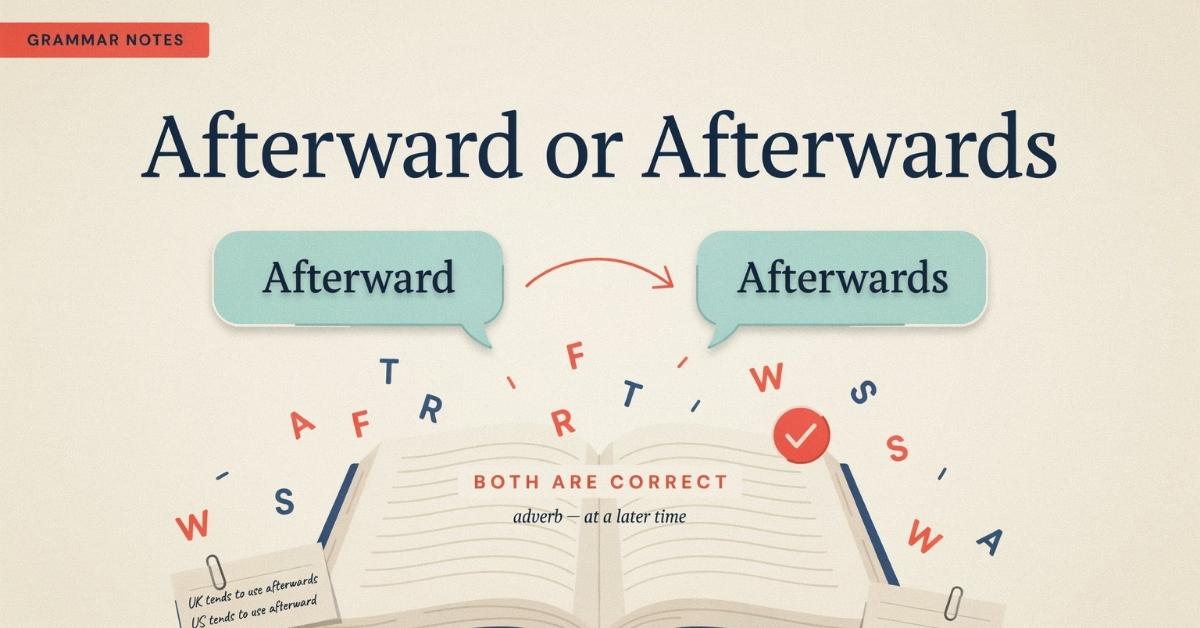
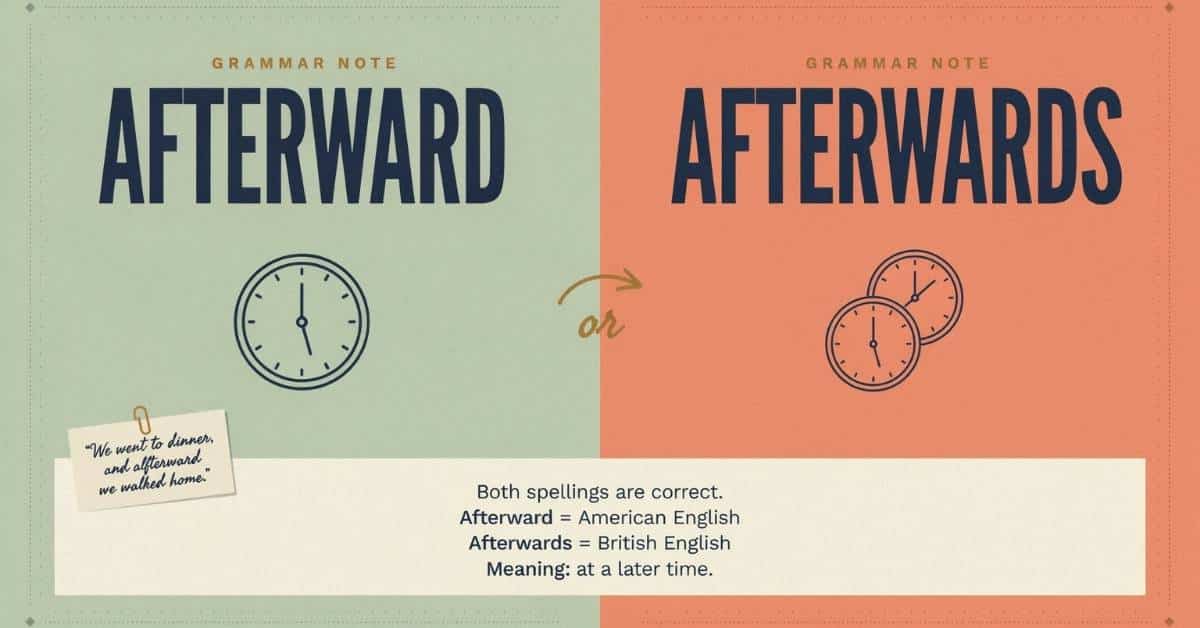
Afterward or afterwards—which one is correct? The simple answer is that both afterward and afterwards are grammatically correct and have the same meaning. They both mean “at a later time,” “later,” or “after that.” The main difference is regional preference. Afterward is more commonly used in American English, while afterwards is generally preferred in British English.
If you’re writing for a U.S. audience, use afterward. If you’re writing for a U.K. audience, use afterwards. In most situations, native speakers will understand either version without confusion.
However, there are important nuances involving English grammar, regional spelling preferences, editorial style guides, academic writing, and professional communication. Understanding these distinctions can help you write with greater confidence and consistency.
What Does Afterward Mean?
Afterward is an adverb that means:
- At a later time
- Following an event
- Subsequently
- Later on
- After that
Examples of Afterward
- We had dinner and went for a walk afterward.
- She completed the interview and relaxed afterward.
- The meeting ended, and everyone left afterward.
In each example, afterward refers to something that happened following a previous event.
What Does Afterwards Mean?
Afterwards carries exactly the same meaning as afterward. It is also an adverb used to indicate that something happened later or following another event.
Examples of Afterwards
- We had dinner and went for a walk afterwards.
- She completed the interview and relaxed afterwards.
- The meeting ended, and everyone left afterwards.
The meaning remains identical. The primary difference lies in regional language conventions rather than grammar.
Is There Any Difference?
One of the most common questions people ask is:
“What is the difference between afterward and afterwards?”
The answer is surprisingly simple.
| Feature | Afterward | Afterwards |
|---|---|---|
| Meaning | Same | Same |
| Grammar | Correct | Correct |
| Part of Speech | Adverb | Adverb |
| American English | Preferred | Less common |
| British English | Less common | Preferred |
| Formality | Equal | Equal |
| Usage in Writing | Common | Common |
From a grammatical standpoint, there is virtually no difference.
The distinction is largely based on regional English usage rather than meaning or correctness.
Why Does English Have Both Afterward and Afterwards?
The existence of both forms comes from a broader pattern found throughout the English language.
Consider these word pairs:
- Toward and towards
- Forward and forwards
- Backward and backwards
- Upward and upwards
- Downward and downwards
Historically, English developed both -ward and -wards endings. Over time, different regions adopted different preferences.
Generally:
- American English tends to favor -ward endings.
- British English often prefers -wards endings.
This explains why Americans commonly write afterward, while British writers often choose afterwards.
Is Afterward American English?
Yes.
Afterward is typically the preferred spelling in American English.
Many American newspapers, businesses, universities, publishers, and professional organizations favor the version without the final “s.”
American English Examples
- We discussed the proposal and met afterward.
- The conference ended, and attendees networked afterward.
- She completed the exam and celebrated afterward.
If your audience is located in the United States, afterward is usually the safest choice.
Is Afterwards British English?
Yes.
Afterwards is more common in British English, though British readers will still understand afterward perfectly well.
British English Examples
- We went to lunch afterwards.
- The football match ended, and supporters gathered afterwards.
- The presentation finished, and questions followed afterwards.
For content targeting readers in the United Kingdom, afterwards often sounds more natural.
Which Is More Common: Afterward or Afterwards?
The answer depends on location.
In the United States
You will generally encounter:
- afterward ✔
- afterwards ✔ but less common
In the United Kingdom
You will generally encounter:
- afterwards ✔
- afterward ✔ but less common
This pattern mirrors other regional spelling preferences throughout English grammar.
For international audiences, either form is acceptable as long as you maintain consistency throughout your writing.
Is One More Formal Than the Other?
No.
A common misconception is that afterwards sounds more formal because it is longer.
In reality:
- Afterward is not more formal.
- Afterwards is not more formal.
- Both are appropriate in formal and informal writing.
You can confidently use either form in:
- Academic writing
- Business communication
- Professional emails
- Blog articles
- Reports
- Presentations
- Journalism
The deciding factor should be audience location and style consistency rather than formality.
Should You Use Afterward or Afterwards in Academic Writing?
Students, researchers, and academics often wonder whether afterward or afterwards is the better choice for essays, dissertations, journal articles, and research papers.
The truth is that both forms are correct, but academic writing typically follows a specific style guide or institutional standard.
General Recommendation
- If you’re writing in American English, use afterward.
- If you’re writing in British English, use afterwards.
- Always follow your university’s preferred style guide.
Academic Examples
- The data were collected and analyzed afterward.
- Participants completed a questionnaire and were interviewed afterward.
- The samples were examined afterwards using additional testing procedures.
- Researchers reviewed the findings afterwards to identify trends.
The most important rule is consistency. Switching between both versions within the same paper can make your writing appear less polished.
Afterward vs Afterwards in Business Writing
In professional communication, consistency matters more than choosing one version over the other.
Whether you’re writing emails, reports, proposals, or presentations, either form is acceptable.
Business Email Examples
- Let’s discuss the details afterward.
- We can schedule a follow-up meeting afterward.
- The team reviewed the results afterwards.
- Management approved the proposal and met afterwards to discuss implementation.
Corporate Writing Tip
Companies operating globally often choose one spelling standard and apply it across all content.
This helps maintain brand consistency and editorial quality.
Which Version Should Content Writers Use?
For bloggers, copywriters, marketers, and professionals, the best choice depends on the target audience.
If Your Audience Is in the United States
Use:
Afterward
Example:
“The webinar ended, and participants received additional resources afterward.”
If Your Audience Is in the United Kingdom
Use:
Afterwards
Example:
“The webinar ended, and participants received additional resources afterwards.”
For International Websites
Either form works, but once you choose one version, use it consistently throughout the article.
Search engines understand both spellings and treat them as closely related language variations.
Learn More: Disenrollment Explained
Common Mistakes People Make
Although afterward and afterwards are easy words to use, writers still make several common mistakes.
Mistake #1: Thinking One Is Wrong
Incorrect assumption:
❌ Afterwards is incorrect.
❌ Afterward is incorrect.
Reality:
✅ Both are correct.
Mistake #2: Mixing Both Versions in One Article
Example:
“The event ended afterward. Participants met afterwards.”
While technically correct, mixing spellings may look inconsistent.
Better:
✔ Use afterward throughout.
or
✔ Use afterwards throughout.
Mistake #3: Assuming One Is More Formal
Many writers believe:
- afterward = informal
- afterwards = formal
This is not true.
Both forms are accepted in formal and professional writing.
Mistake #4: Ignoring Audience Location
A writer targeting American readers should generally prefer afterward.
A writer targeting British readers should generally prefer afterwards.
Audience expectations matter.
See More: OMS Meaning in Text
Real-World Examples of Afterward
The best way to understand usage is through practical examples.
Everyday Conversation
- We went shopping and had coffee afterward.
- I’ll call you afterward.
- They watched a movie afterward.
Professional Communication
- The manager spoke with the client afterward.
- We reviewed the contract afterward.
- The team met afterward to discuss next steps.
Academic Writing
- Researchers analyzed the responses afterward.
- The survey data were processed afterward.
- Students completed a reflection exercise afterward.
Journalism and Reporting
- Officials released a statement afterward.
- The committee met afterward to review findings.
- Witnesses spoke with reporters afterward.
Real-World Examples of Afterwards
Everyday Conversation
- We had dinner and talked afterwards.
- She called me afterwards.
- They went home afterwards.
Professional Communication
- The board met afterwards to discuss strategy.
- Staff attended a workshop and networked afterwards.
- Management reviewed the proposal afterwards.
Academic Writing
- Researchers examined the results afterwards.
- Additional testing was performed afterwards.
- Participants completed interviews afterwards.
Journalism and Reporting
- Police issued a statement afterwards.
- Officials met afterwards to discuss concerns.
- The organization released updates afterwards.
Afterward and Afterwards Synonyms
If you’re looking for alternatives, consider these related words and phrases:
- Later
- Later on
- Subsequently
- Thereafter
- Following that
- After that
- At a later time
- Eventually
- In due course
Example
Original:
“We spoke afterward.”
Alternative:
“We spoke later.”
or
“We spoke subsequently.”
Keep in mind that some alternatives sound more formal than others.
Afterward vs Afterwards: A Simple Decision Framework
Still unsure which version to choose?
Use this quick framework.
Question 1
Are you writing for an American audience?
Yes → Use afterward
Question 2
Are you writing for a British audience?
Yes → Use afterwards
Question 3
Are you writing for an international audience?
Choose one version and stay consistent
Question 4
Does your organization have a style guide?
Follow the style guide
Question 5
Do you personally prefer one version?
Use your preferred version consistently
This approach eliminates nearly all uncertainty.
Learn More: Roll call or Role call
The Golden Rule
If you remember only one thing from this article, remember this:
Afterward and afterwards mean exactly the same thing.
The difference is not grammar.
The difference is not formality.
The difference is not correctness.
The difference is primarily a matter of American English versus British English preference.
Use afterward for American audiences.
Use afterwards for British audiences.
Remain consistent throughout your writing.
Frequently Asked Questions
Is Afterward or Afterwards Correct?
Yes, both afterward and afterwards are correct. They have the same meaning and can usually be used interchangeably. The primary distinction is regional preference. Afterward is more common in American English, while afterwards is more common in British English.
What Is the Difference Between Afterward and Afterwards?
There is almost no difference in meaning.
Both words mean:
- Later
- After that
- Subsequently
- Following an event
The only notable difference is usage preference across different English-speaking regions.
Example
American English:
“We spoke afterward.”
British English:
“We spoke afterwards.”
Both sentences are equally correct.
Is Afterwards Grammatically Correct?
Absolutely.
Some people mistakenly believe that afterwards is outdated or incorrect, but this is not true. It remains widely used throughout the United Kingdom and other regions influenced by British English.
Is Afterward Grammatically Correct?
Yes.
Afterward is the standard form preferred by many American writers, editors, publishers, and organizations.
It appears regularly in:
- News articles
- Business reports
- Academic papers
- Marketing content
- Professional communication
Can Afterward and Afterwards Be Used Interchangeably?
In most situations, yes.
For example:
- We went home afterward.
- We went home afterwards.
Both sentences communicate the same idea.
However, for consistency and professionalism, it’s best to use one version throughout a document instead of switching back and forth.
Which Is More Common in American English?
Afterward is generally more common in American English.
Many U.S.-based publications, businesses, universities, and writers naturally prefer the version without the final “s.”
Example:
“The meeting ended, and the team met afterward.”
Which Is More Common in British English?
Afterwards is generally more common in British English.
British publications and speakers often favor the version ending in “-wards.”
Example:
“The meeting ended, and the team met afterwards.”
Which Is Better for Essays?
Neither is inherently better.
Use the version that matches:
- Your institution’s style guide
- The regional English standard you’re following
- The spelling conventions used throughout the rest of your paper
Consistency is more important than the specific choice.
Which Version Should Bloggers Use?
Bloggers should consider their audience.
If Your Readers Are Mostly American
Use afterward.
If Your Readers Are Mostly British
Use afterwards.
If Your Audience Is Global
Choose one version and apply it consistently across all content.
This creates a more professional reading experience.
Is One More Formal Than the Other?
No.
Both words work equally well in:
- Formal writing
- Informal writing
- Academic documents
- Business communication
- Journalism
- Online content
Do Style Guides Prefer Afterward or Afterwards?
Most style guides follow regional language conventions.
For example:
- American English style guides typically lean toward afterward
- British English style guides often favor afterwards
When working under a specific editorial style, always follow the guide’s recommendations.
Related Word Pairs That Follow the Same Pattern
Understanding afterward vs afterwards becomes easier when you recognize a broader English language pattern.
Several words exist in both -ward and -wards forms.
Common Examples
| American Preference | British Preference |
|---|---|
| Toward | Towards |
| Forward | Forwards |
| Backward | Backwards |
| Upward | Upwards |
| Downward | Downwards |
| Afterward | Afterwards |
This pattern helps explain why both versions continue to exist in modern English.
Rather than viewing them as competing spellings, think of them as regional variants.
Expert Writing Tips for Using Afterward or Afterwards
Professional writers, editors, and content creators often follow a few simple rules.
Rule 1: Match Your Audience
If you’re writing for Americans, choose afterward.
If you’re writing for British readers, choose afterwards.
Rule 2: Stay Consistent
Avoid switching between both versions in the same article, report, or document.
Consistency improves readability and professionalism.
Rule 3: Don’t Overthink It
Many writers spend unnecessary time worrying about which version is “correct.”
The reality is that both forms are accepted by native speakers and grammar experts.
Rule 4: Focus on Clarity
Your readers care far more about clear communication than whether you choose afterward or afterwards.
Choose the version appropriate for your audience and move on.
Rule 5: Follow Existing Style Standards
If your company, university, publisher, or client uses a style guide, follow that standard throughout the project.
Common Sentences Using Afterward and Afterwards
To build confidence, here are additional examples.
Using Afterward
- We reviewed the results afterward.
- The team celebrated afterward.
- Researchers analyzed the findings afterward.
- We met afterward to finalize the plan.
- The workshop concluded afterward.
Using Afterwards
- We reviewed the results afterwards.
- The team celebrated afterwards.
- Researchers analyzed the findings afterwards.
- We met afterwards to finalize the plan.
- The workshop concluded afterwards.
These examples demonstrate how interchangeable the two forms are.
Final Verdict: Afterward or Afterwards?
If you’re still wondering whether to use afterward or afterwards, here’s the simplest answer:
✅ Both are correct.
✅ Both mean “later” or “after that.”
✅ Neither is more formal.
✅ Neither is grammatically superior.
The primary difference is regional preference.
- Use afterward for American English.
- Use afterwards for British English.
- Stay consistent throughout your writing.
For students, professionals, bloggers, marketers, journalists, and business writers, this straightforward rule will help you choose confidently every time.