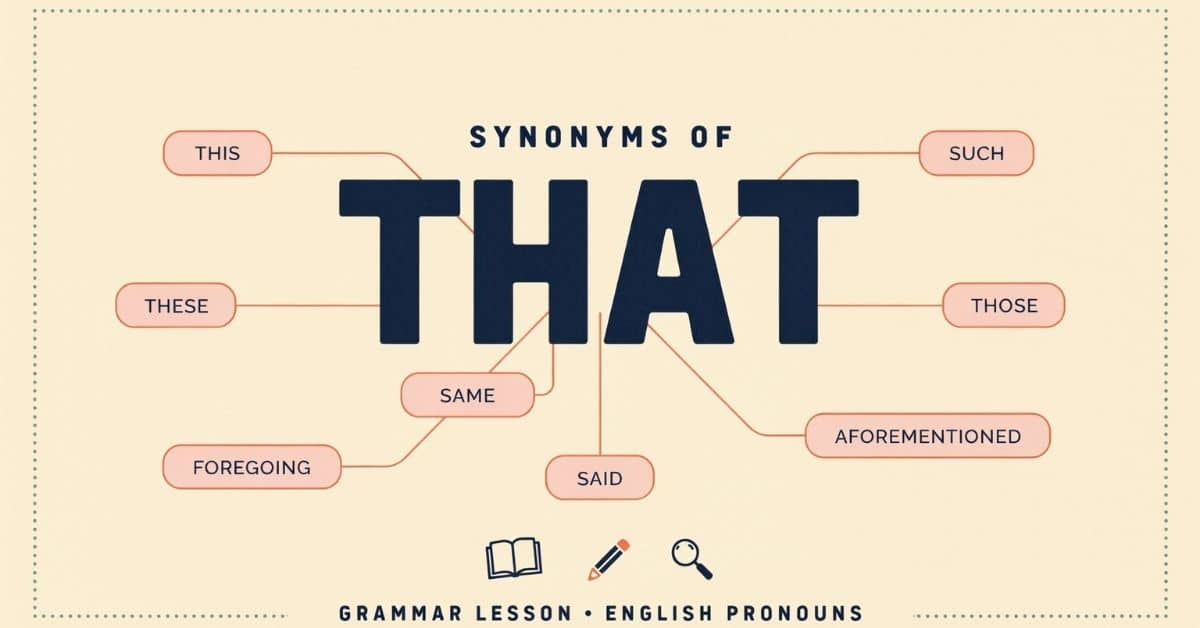
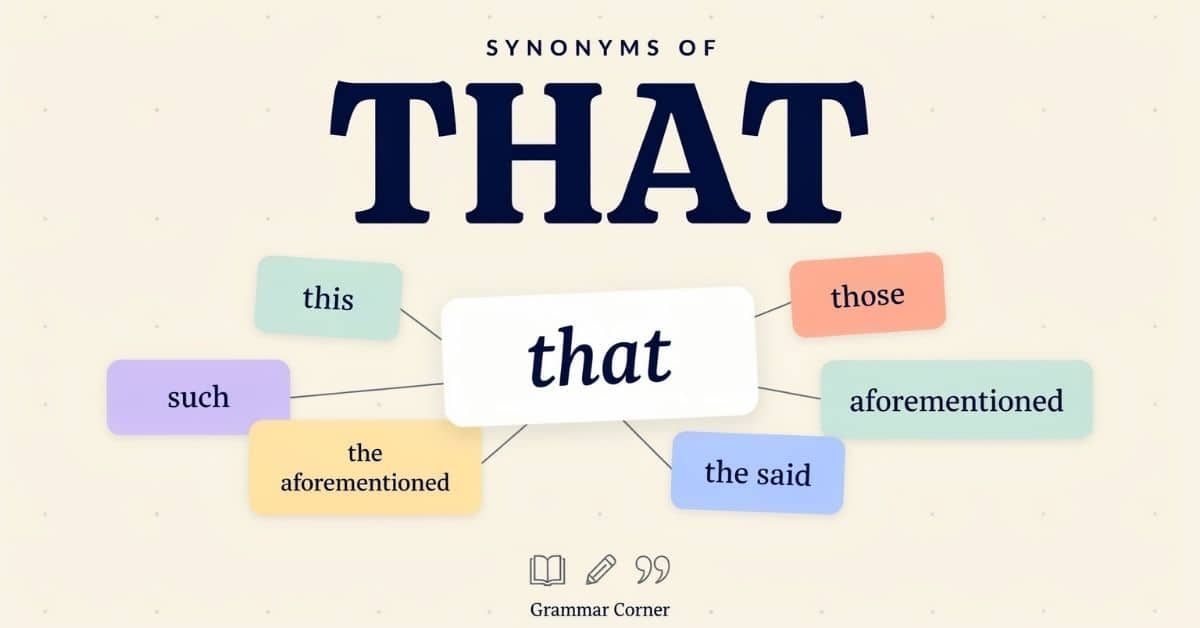
Synonyms of that include which, who, this, those, these, such, the aforementioned, the specified, said, and the one. However, the best alternative depends on how the word functions in a sentence. In many cases, professional writers and editors simply remove that altogether to improve readability and sentence flow.
If you’ve ever wondered what is another word for that, how to avoid repeating it in your writing, or whether you can remove it entirely, this guide will help you choose the right alternative while improving your grammar, style, and clarity.
Why People Search for Synonyms of “That”
At first glance, searching for another word for that seems straightforward. Most people assume they simply need a replacement word.
In reality, the search intent is much deeper.
Writers often search for synonyms of that because they:
- Want to avoid repetition
- Need stronger academic writing
- Are editing business documents
- Want their content to sound more professional
- Are trying to improve sentence structure
- Need alternatives for essays, reports, and emails
- Want to humanize AI-generated content
The challenge is that that serves several grammatical functions. It can act as a pronoun, conjunction, determiner, or relative pronoun. Because of this, there is no single perfect replacement.
Understanding the role of that in your sentence is the first step toward choosing a better alternative.
Signs You’re Overusing “That”
Many writers don’t realize how often they rely on this word.
Consider the following sentence:
The report that the manager said that the team submitted was approved.
Although grammatically correct, it sounds repetitive and awkward.
Overusing that can lead to:
- Wordy sentences
- Reduced readability
- Slower sentence flow
- Mechanical writing
- Lower engagement
Professional editors frequently remove unnecessary instances of that because concise writing is generally easier to read.
Before You Replace “That,” Understand Its Role in a Sentence
Not every use of that can be replaced with a synonym.
Let’s examine its most common functions.
“That” as a Relative Pronoun
In this role, that introduces information about a person, place, or thing.
Example:
The book that I borrowed was fascinating.
Possible alternative:
The book which I borrowed was fascinating.
However, depending on the style guide, which may not always be the preferred choice.
“That” as a Demonstrative Pronoun
Here, that points to something specific.
Example:
That was an incredible presentation.
Possible alternatives:
- This
- Such an event
- The experience
Example:
This was an incredible presentation.
“That” as a Conjunction
In many sentences, that simply connects clauses.
Example:
She said that she would attend.
A better version may be:
She said she would attend.
In this situation, removing that often improves readability more than replacing it.
25 Synonyms of “That” With Examples and Usage Tips
1. Which
Which is one of the most common alternatives to that when referring to things.
Example:
The software which I downloaded works perfectly.
Best for:
- Academic writing
- Formal writing
- Explanatory content
Common mistake:
Using which and that interchangeably without understanding clause rules.
2. Who
Use who when referring to people.
Incorrect:
The teacher that inspired me.
Better:
The teacher who inspired me.
Best for:
- Professional writing
- Academic papers
- Formal communication
3. This
This works well when referring to something close in context.
Example:
This solution offers several advantages.
Ideal for:
- Business writing
- Reports
- Presentations
4. Those
Use those when referring to plural nouns.
Example:
Those ideas deserve consideration.
Best for:
- Academic discussions
- Business communication
5. These
Example:
These recommendations improved performance.
Works particularly well in:
- Research papers
- Reports
- Content writing
6. Such
Such creates a more formal tone.
Example:
Such behavior is unacceptable.
Excellent for:
- Academic writing
- Legal writing
- Formal reports
7. The Aforementioned
Example:
The aforementioned proposal was approved.
Commonly used in:
- Legal documents
- Business reports
- Professional correspondence
8. The Specified
Example:
The specified requirements must be met.
Useful for:
- Technical writing
- Compliance documents
- Instruction manuals
9. Said
Example:
Said agreement remains valid.
Most common in:
- Legal writing
- Regulatory documentation
10. The One
Example:
The one I recommended is still available.
Works naturally in conversation and informal writing.
Additional Alternatives
Depending on context, you may also use:
- The indicated
- The noted
- The referenced
- The mentioned
- Such a
- This particular
- Those specific
- The stated
- The identified
- The designated
- The cited
- The highlighted
- The selected
- The relevant
- The applicable
Remember that context matters more than simply finding a synonym.
Learn more: Afterward or Afterwards
When You Should Remove “That” Instead of Replacing It
Many professional editors follow a simple principle:
If removing that doesn’t change meaning or clarity, remove it.
Example:
Before:
She explained that the project was successful.
After:
She explained the project was successful.
The second version feels cleaner and more natural.
Another example:
Before:
I believe that this strategy will work.
After:
I believe this strategy will work.
The meaning remains unchanged.
In many cases, the best answer to what can I use instead of that is:
Nothing at all.
Situations Where Removing “That” Improves Flow
Blog Writing
Readers prefer concise sentences.
Before:
The article that we published yesterday gained traction.
After:
The article we published yesterday gained traction.
Email Writing
Before:
I think that your suggestion is excellent.
After:
I think your suggestion is excellent.
Marketing Copy
Before:
We believe that our solution delivers value.
After:
We believe our solution delivers value.
The revised version sounds stronger and more confident.
When You Should Never Remove “That”
Removing that is not always safe.
Example:
The claim that the company made was controversial.
Removing that may create confusion.
Another example:
The fact that he resigned surprised everyone.
Here, that helps preserve clarity and meaning.
Good writing balances conciseness with comprehension.
Which vs. That: The Grammar Rule That Confuses Most Writers
One of the most searched grammar questions is:
What is the difference between which and that?
The answer involves restrictive clauses and nonrestrictive clauses.
Use “That” for Essential Information
Example:
The car that has a flat tire belongs to Sarah.
The phrase identifies a specific car.
Use “Which” for Additional Information
Example:
The car, which has a flat tire, belongs to Sarah.
The tire information is extra rather than essential.
Understanding this distinction helps improve both grammar and professional writing quality.
Who vs. That: Referring to People Correctly
Although many people use that when referring to individuals, who is often preferred.
Less Formal:
The employee that completed the project.
More Natural:
The employee who completed the project.
Using who typically sounds more polished and respectful.
Synonyms of “That” in Academic Writing
Academic writing values precision and formality.
Strong alternatives include:
- Which
- Such
- These
- Those
- The aforementioned
Example:
Before:
That result supports the hypothesis.
After:
This result supports the hypothesis.
Or:
Such findings support the hypothesis.
These alternatives often create a more scholarly tone.
Synonyms of “That” in Professional and Business Writing
Business communication benefits from clarity and efficiency.
Email Example
Before:
I believe that this proposal addresses your concerns.
After:
I believe this proposal addresses your concerns.
Report Example
Before:
That recommendation should be implemented immediately.
After:
This recommendation should be implemented immediately.
Small adjustments can make writing appear more authoritative and professional.
See More: Disenrollment Explained
Synonyms of “That” in Creative Writing and Storytelling
Creative writing requires a balance between clarity, rhythm, and natural language. While that is perfectly acceptable, excessive use can make prose feel repetitive and less engaging.
Creating Natural Dialogue
People rarely speak with perfect grammar. In dialogue, removing unnecessary instances of that often makes conversations sound more authentic.
Before:
I think that you’re right.
After:
I think you’re right.
Before:
She told me that she was leaving.
After:
She told me she was leaving.
The second versions reflect how people naturally communicate.
Improving Narrative Flow
Strong storytelling depends on smooth sentence structure.
Before:
The house that stood on the hill was abandoned.
After:
The house on the hill was abandoned.
The revised sentence is shorter and more vivid.
Avoiding Repetitive Sentence Structures
Writers often fall into a pattern:
- The man that…
- The car that…
- The project that…
- The report that…
Mixing sentence structures improves readability and keeps readers engaged.
Example:
Instead of:
The report that the team submitted was approved.
Try:
The team’s report was approved.
How Editors Reduce Repeated Use of “That”
Professional editors don’t automatically remove every occurrence of that. Instead, they evaluate whether the word improves clarity.
Step 1: Identify Every Instance of “That”
During editing, search for every use of that in your document.
Ask:
- Is it necessary?
- Does it improve understanding?
- Can the sentence stand without it?
Step 2: Test Removal
Example:
Original:
She believes that the strategy will succeed.
Edited:
She believes the strategy will succeed.
The meaning remains intact.
Step 3: Replace Only When It Improves Meaning
Many writers make the mistake of replacing that simply to avoid repetition.
Good editing focuses on clarity, not word replacement.
Before:
The solution that was proposed appears effective.
After:
The proposed solution appears effective.
Notice how restructuring the sentence often works better than finding another word.
Step 4: Use the Read-Aloud Test
Read the sentence aloud.
If it sounds awkward without that, keep it.
If it sounds smoother without it, remove it.
This simple editing technique is widely used by experienced writers and editors.
Why AI Overuses “That”
AI systems tend to favor predictable sentence constructions.
Common pattern:
The study found that the results indicated that the strategy was effective and that participants benefited from the program.
While grammatically correct, the sentence feels mechanical.
How to Humanize AI-Written Sentences
Before:
The company stated that the initiative would improve efficiency and that employees would receive additional support.
After:
The company stated the initiative would improve efficiency, and employees would receive additional support.
The revised version sounds more natural and conversational.
Common Mistakes When Replacing “That”
Many writers try to eliminate every instance of that, which often creates new problems.
Using “Which” Incorrectly
Incorrect:
The laptop which I bought yesterday is broken.
In some style guides, that is preferred because the information is essential.
Preferred:
The laptop that I bought yesterday is broken.
Understanding which vs. that helps prevent grammar mistakes.
Using “Who” Incorrectly
Incorrect:
The person that helped me was friendly.
While acceptable in some contexts, many editors prefer:
The person who helped me was friendly.
When referring to people, who usually sounds more natural.
Replacing “That” When Removal Is Better
Many writers search for a synonym when the sentence simply needs editing.
Before:
She mentioned that the meeting was postponed.
After:
She mentioned the meeting was postponed.
No replacement needed.
Creating Awkward Sentences
Some replacements may technically work but sound unnatural.
Example:
The aforementioned restaurant serves excellent food.
While appropriate in a legal report, it sounds strange in casual conversation.
Always match your word choice to the context.
Quick Decision Guide: Keep, Remove, or Replace?
One of the easiest ways to improve your writing is to follow a simple decision-making process.
| Situation | Keep | Remove | Replace |
|---|---|---|---|
| Meaning becomes unclear without it | ✔ | ✘ | Sometimes |
| Sentence sounds smoother without it | ✘ | ✔ | ✘ |
| Referring to a person | ✘ | ✘ | ✔ (Who) |
| Academic writing | Sometimes | Sometimes | ✔ |
| Business writing | Sometimes | ✔ | ✔ |
| Legal writing | ✔ | ✘ | ✔ |
| Casual conversation | Sometimes | ✔ | Sometimes |
Fast Editing Checklist
Before publishing any document, ask yourself:
- Is that necessary here?
- Would removing it improve readability?
- Would another word improve clarity?
- Does the sentence sound natural aloud?
- Am I replacing it simply to avoid repetition?
Following this checklist helps create cleaner, more professional writing.
Frequently Asked Questions
What is another word for “that”?
Some common alternatives include which, who, this, these, those, such, the one, the specified, and the aforementioned. The best choice depends on the sentence context.
Can I remove “that” from a sentence?
Yes. In many cases, removing that improves readability without changing meaning.
Example:
She said that she agreed.
can become:
She said she agreed.
Is “which” a synonym for “that”?
Sometimes. However, which and that serve different grammatical purposes and should not always be used interchangeably.
What is the difference between “which” and “that”?
Generally, that introduces essential information, while which introduces additional information.
Is using “that” too often bad writing?
Not necessarily. Problems arise when repeated use creates wordy or repetitive sentences.
How do professional writers avoid repeating “that”?
They:
- Remove unnecessary occurrences
- Rewrite sentence structures
- Use contextual alternatives
- Focus on readability rather than strict word replacement
What are formal alternatives to “that”?
Formal alternatives include:
- Such
- The aforementioned
- The specified
- The stated
- The referenced
What can I use instead of “that” in an essay?
For academic writing, consider:
- Which
- Such
- These
- Those
- This
These options often create a more scholarly tone.
What is the best synonym of “that” in business writing?
Common business-writing alternatives include:
- This
- The specified
- The proposed
- The aforementioned
However, removing that is often the most effective solution.
Can removing “that” improve readability?
Yes. Many editors remove unnecessary uses of that because shorter sentences often read more smoothly.
Final Takeaway: The Best Alternative to “That” Depends on Context
There is no universal replacement for that. While words such as which, who, this, those, these, and such can serve as effective alternatives, the best choice always depends on grammar, context, and purpose.
Professional writers follow three simple rules:
- Keep “that” when it improves clarity.
- Remove “that” when the sentence remains clear without it.
- Replace “that” only when another word genuinely improves meaning or style.
The strongest writing isn’t created by avoiding a particular word. It’s created by making deliberate choices that improve readability, precision, and communication.
When evaluating synonyms of that, focus less on finding endless replacements and more on understanding how the word functions within your sentence. In many situations, that knowledge will improve your writing far more than any synonym ever could.