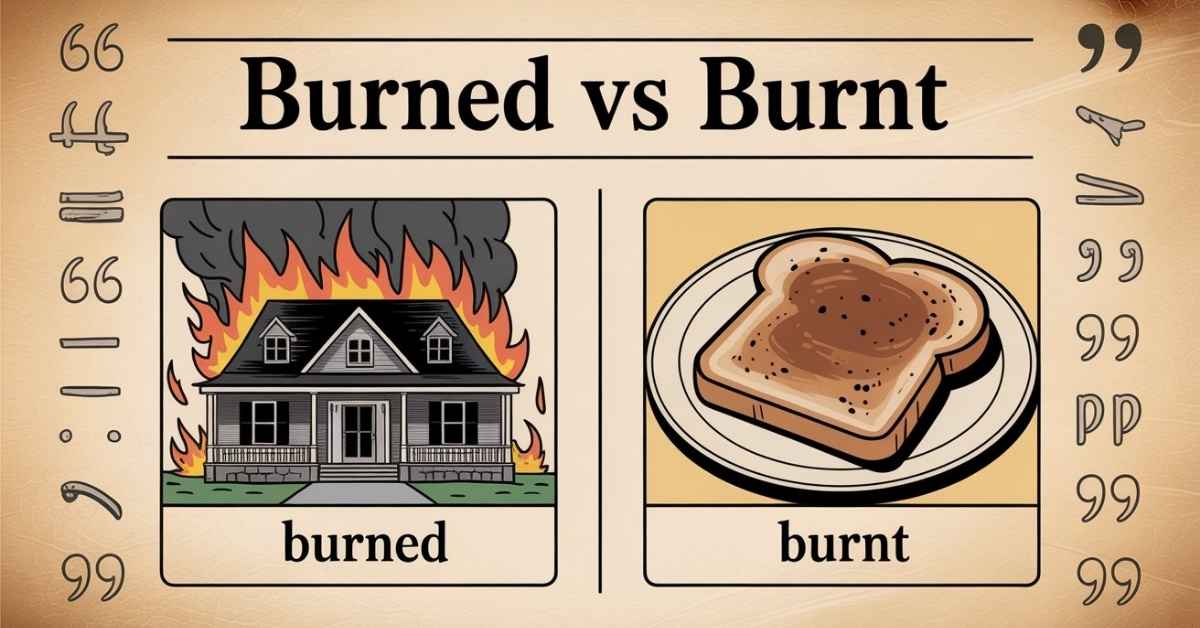
Burned vs burnt is one of those English grammar questions that confuses even native speakers. The short answer is simple: both “burned” and “burnt” are grammatically correct. However, “burned” is more common in American English, especially in formal writing, while “burnt” appears more often in British English and in descriptive phrases like “burnt toast” or “burnt orange.”
That sounds straightforward — until you start noticing both words everywhere.
You might see:
- burned out in a business article
- burnt caramel in a recipe
- burnt sienna in an art store
- burned buildings in a news report
At that point, the real question becomes:
When should you actually use burned or burnt?
This guide explains the difference between burned and burnt, how native speakers use them, which form editors prefer, and why some phrases simply sound more natural with one version over the other.
Burned vs Burnt at a Quick Glance
| Situation | Preferred Form |
|---|---|
| Formal American writing | Burned |
| British English | Burnt often preferred |
| Academic writing | Burned |
| Journalism | Burned |
| Descriptive phrases | Burnt often sounds more natural |
| Recipes and food writing | Burnt commonly appears |
| Casual conversation | Either works |
What Is the Difference Between Burned and Burnt?
The difference between burned and burnt mainly comes down to:
- regional English
- tone
- usage style
- context
Both words are forms of the verb “burn.”
Burned
In modern English, especially American English, burned is the standard:
- past tense
- past participle
Examples
- The paper burned quickly.
- She accidentally burned the cookies.
- Several homes were burned during the wildfire.
Burnt
Burnt is also correct, but it is more commonly used:
- in British English
- as an adjective
- in descriptive or sensory language
Examples
- burnt toast
- burnt sugar
- burnt edges
- burnt orange
This is why many people search:
“Is burnt grammatically correct?”
Yes — absolutely.
Why “Burnt Toast” Sounds More Natural Than “Burned Toast”
This is where most grammar articles become too simplistic.
Technically, both phrases are correct:
- burned toast
- burnt toast
But to native speakers, “burnt toast” often sounds more vivid and natural.
Why?
Because burnt carries a slightly more descriptive and sensory tone.
Compare these:
- “The toast was burned.” → factual
- “I smelled burnt toast.” → descriptive and visual
That subtle difference explains why:
- burnt caramel
- burnt ends
- burnt sienna
- burnt orange
still remain extremely common even in places where burned dominates formal writing.
Burned vs Burnt in American English
In American English, burned is overwhelmingly preferred in:
- newspapers
- academic writing
- business communication
- professional emails
- formal publications
Most American editors and style guides lean toward:
burned
Common American Examples
- The building burned overnight.
- He felt completely burned out after work.
- The wood was burned during testing.
Even though Americans still say burnt toast and burnt orange, the general preference is still burned.
Burned vs Burnt in British English
In British English, burnt appears far more naturally and frequently.
British English traditionally keeps more irregular “-t” verb endings, including:
- learnt
- dreamt
- spelt
- spoilt
- burnt
That means British readers are far more comfortable seeing:
- burnt
- burnt out
- burnt toast
in everyday writing.
British Usage Examples
- I burnt the dinner again.
- The edges looked slightly burnt.
- He seemed completely burnt out after the project.
Why English Uses Both Burned and Burnt
The answer lies in the history of English grammar.
Over time, many English verbs became more regular in American English.
That is why American English increasingly prefers:
- learned over learnt
- dreamed over dreamt
- spelled over spelt
- burned over burnt
Meanwhile, British English preserved more traditional forms.
This broader language pattern helps explain why both versions still exist today.
Which Is Correct: Burned or Burnt?
Here is the truth most people really want to know:
Neither word is wrong.
The better choice depends on:
- audience
- writing style
- regional English
- tone
- context
When You Should Use “Burned”
Use burned when:
- writing for American readers
- creating academic content
- writing formal documents
- writing business emails
- following American editorial style
- you want the safest modern choice
Examples
- The evidence was burned in the fire.
- She burned her hand while cooking.
- The files were permanently burned onto the disc.
When You Should Use “Burnt”
Use burnt when:
- writing for British audiences
- describing appearance, texture, or flavor
- using artistic or sensory language
- writing creatively
- using established phrases
Examples
- The room smelled like burnt sugar.
- She wore a burnt orange sweater.
- The crust had slightly burnt edges.
Burned Out vs Burnt Out
This is another common grammar confusion.
Burned Out
In American English:
- burned out is more common
Example
- I feel completely burned out after working all week.
Burnt Out
In British English:
- burnt out sounds more natural
Example
- He looked emotionally burnt out after the exams.
Both expressions are understood worldwide.
Why Editors Usually Prefer “Burned”
Many professional publications favor:
- consistency
- regular verb forms
- standardized American spelling
That is why newspapers, academic journals, and corporate publications often choose:
burned
This does not mean:
- burnt is outdated
- burnt is incorrect
- burnt sounds unnatural
It simply reflects modern editorial preference in American English.
Common Phrases That Usually Use “Burnt”
Some expressions became so common that they sound strange with burned instead.
Examples
- burnt toast
- burnt orange
- burnt sienna
- burnt ends
- burnt sugar
You rarely hear:
- burned orange
- burned sienna
because these phrases evolved naturally through long-term language usage.
Common Myths About Burned and Burnt
Myth 1: “Burnt” Is Incorrect
False.
Burnt is fully correct English.
Myth 2: Americans Never Use “Burnt”
False.
Americans still frequently use:
- burnt toast
- burnt edges
- burnt orange
especially in descriptive language.
Myth 3: Burned and Burnt Mean Exactly the Same Thing
Not always.
While the meaning is similar, the tone and feel can differ slightly depending on context.
Why Native Speakers Still Use Both
Language is emotional as much as grammatical.
Some words survive because:
- they sound better
- they feel more vivid
- they create stronger imagery
- they fit familiar expressions
That is exactly why burnt remains popular.
For many native speakers:
- burned sounds neutral and factual
- burnt sounds descriptive and sensory
Learn More: Nuances Synonyms
Real-World Examples Across Different Contexts
Journalism
- Several historic buildings burned overnight.
Casual Conversation
- I burnt the garlic again.
Academic Writing
- The samples were burned during analysis.
Recipes
- The sauce developed a slightly burnt flavor.
Literature
- A burnt smell drifted through the hallway.
Interior Design
- The walls were painted burnt orange.
The Safest Rule to Remember
If you are unsure:
- use burned for formal American writing
- use burnt for descriptive phrases where it sounds more natural
Quick Memory Trick
Burned
= modern, neutral, formal
Burnt
= descriptive, sensory, traditional
This shortcut makes the distinction much easier to remember.
Frequently Asked Questions
Is burnt grammatically correct?
Yes. Both burned and burnt are grammatically correct English forms.
Which is more common in American English?
Burned is more common in American English, especially in formal writing and journalism.
Is burnt British English?
It is more commonly used in British English, but Americans still use it too.
Why does burnt toast sound more natural?
Because burnt often functions more naturally as a descriptive adjective.
Can I use burnt in formal writing?
Yes, although burned is generally the safer choice in formal American writing.
Why is it called burnt orange instead of burned orange?
Certain phrases became fixed naturally over time, and burnt orange simply sounds more idiomatic to native speakers.
Which do editors prefer?
Most American editors prefer burned, especially in professional and edited publications.
Final Thoughts on Burned vs Burnt
The debate around burned vs burnt is not really about right or wrong.
It is about:
- regional English
- writing style
- tone
- rhythm
- natural usage
If you primarily write in American English, burned is usually the safest and most professional choice.
But burnt remains completely correct and often sounds more natural in:
- descriptive phrases
- British English
- food writing
- artistic language
- sensory descriptions
Understanding that subtle distinction is what separates simply knowing grammar from truly understanding how English is naturally used.