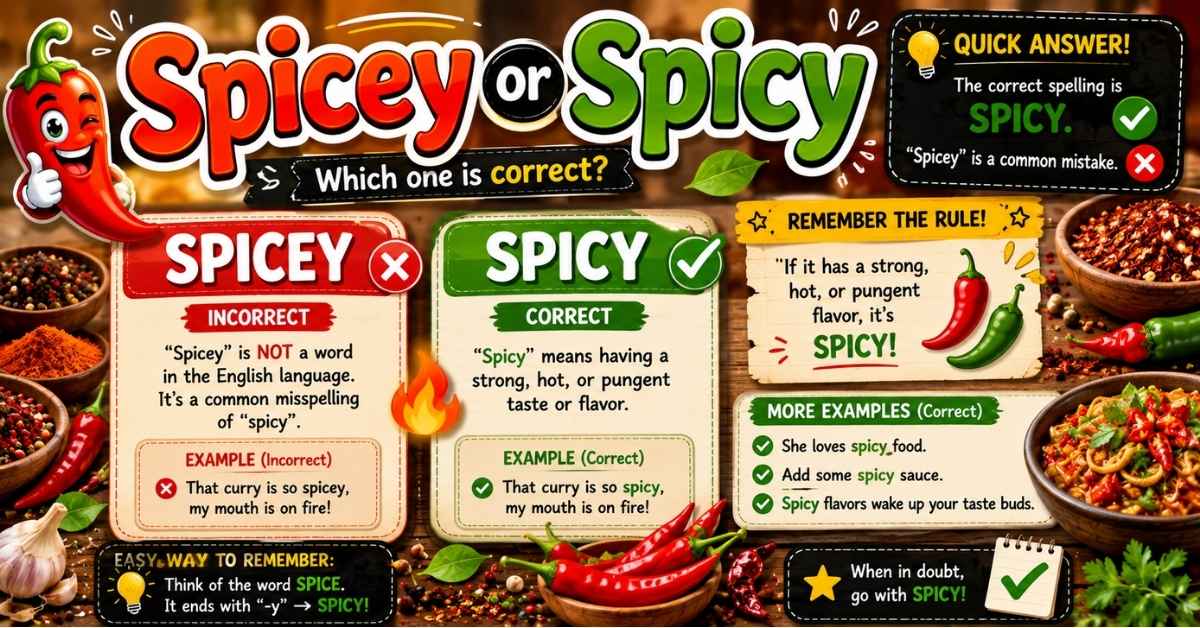
Spicey or spicy is a common spelling question, and the short answer is simple: spicy is the correct spelling in modern English, while spicey is usually considered a misspelling or an uncommon variant you should avoid in everyday writing.
If you paused before typing it—or searched because both versions looked right—you’re not alone. English spelling can be surprisingly tricky, especially when a word like spice ends with an “e,” making spicey feel natural at first glance.
But in both American and British English, spicy is the standard spelling used in recipes, restaurant menus, blog posts, product descriptions, and everyday conversation. Whether you’re writing about spicy food, updating SEO content, or simply checking your spelling before publishing, this guide explains why spicy is correct, why “spicey” causes confusion, and the easiest way to remember it next time.
Quick Answer: Is It Spicey or Spicy?
Here’s the fast answer:
| Word | Correct? | Recommended? |
|---|---|---|
| Spicy | ✅ | Yes |
| Spicey | ❌ / uncommon | No |
Use spicy when writing:
- Spicy curry
- Spicy noodles
- Spicy chicken wings
- Spicy salsa
- Best spicy ramen recipes
Avoid:
- Spicey curry
- Spicey snacks
- Spicey recipe ideas
If you’re wondering how to spell spicy food correctly, the answer is always spicy.
Why “Spicey” Looks Right Even When It Isn’t
This is where the confusion happens.
Your brain sees:
spice
…and naturally expects:
spicey
That feels logical.
But English doesn’t always follow the pattern we expect.
A few examples:
- ice → icy
- juice → juicy
- spice → spicy
In English orthography, the final “e” is often dropped before adding “y.”
That’s why:
✅ spice → spicy ❌ spice → spicey
And that explains why “spicey vs spicy” confuses so many people.
Why “Spicy” Is the Standard Spelling in Modern English
The word spicy is the accepted adjective form of spice.
It refers to:
- food with strong seasoning
- heat from peppers
- bold flavor
- something lively or sharp in tone
Major dictionaries consistently list spicy as the standard spelling:
- Merriam-Webster
- Cambridge Dictionary
- Collins Dictionary
- Oxford University Press
Across editorial writing and standard English grammar, spicy is the preferred spelling.
That includes:
- blog content
- academic writing
- recipe websites
- restaurant menus
- ecommerce descriptions
So if you’re asking “is spicey a word?” the safest answer is:
Use spicy. It’s the standard spelling readers and search engines expect.
Is “Spicey” Ever a Real Word?
You may still see spicey online.
That can happen because of:
Typing mistakes
Very common.
User-generated content
Forums, captions, comments.
Search autocomplete confusion
People search for “spicey or spicy” often.
Older or inconsistent writing
Rare, but possible.
Seeing “spicey” somewhere doesn’t make it standard.
For modern English writing:
Spicy = correct Spicey = avoid
That applies in both personal and professional content.
Real-Life Examples: How “Spicy” Is Used Correctly
Practical examples matter more than theory.
Here’s how spicy naturally appears.
In food writing
- This Curry has a rich, spicy flavor.
- The noodles are spicy and packed with garlic.
- I love spicy roasted chickpeas.
On menus
- Spicy chicken burger
- Extra spicy wings
- Spicy shrimp tacos
at product descriptions
- Premium spicy seasoning blend
- Sweet and spicy chili sauce
- Bold spicy snack mix
In titles
- Best spicy ramen recipes
- Easy spicy chicken dinner ideas
- Top spicy snacks to try
In everyday conversation
- “That dip is really spicy.”
- “I wanted something spicy tonight.”
These examples help reinforce the correct spelling of spicy in real contexts.
Does Using “Spicey” Hurt SEO or Content Credibility?
This matters more than many people realize.
Google understands spelling variations.
But readers notice.
If your page says spicey instead of spicy, it can affect:
Professionalism
Looks less polished.
Trust
Readers may question accuracy.
Keyword targeting
Most users search spicy.
Content consistency
Spelling matters.
Ecommerce conversions
Product titles feel more credible when correct.
For:
- food blogs
- recipe sites
- Pinterest titles
- product listings
- restaurant websites
US vs UK: Is “Spicy” Correct Everywhere?
Yes.
| Region | Preferred spelling |
|---|---|
| United States | spicy |
| United Kingdom | spicy |
| Canada | spicy |
| Australia | spicy |
There isn’t a US/UK split here.
No matter where you publish:
Use spicy.
Learn More: Laid Out or Layed Out?
Easy Trick to Remember the Correct Spelling
A simple memory trick:
Think:
ice → icy
Then:
spice → spicy
Or remember:
Drop the e before adding y
That makes spicy easier to recall next time.
Common Sentences People Double-Check Before Publishing
These are the exact kinds of phrases people stop and think about:
- Is this spicy enough?
- Extra spicy wings
- Spicy garlic sauce
- Best spicy dinner recipes
- Spicy chips for movie night
- Sweet and spicy glaze
- Homemade spicy noodles
If one of those made you pause, you’re definitely not the only one.
The correct spelling is still spicy.
Common Mistakes Related to “Spicy”
A few nearby spelling questions:
Spiciness or spicy-ness?
Correct: ✅ spiciness
Spicier or spicyer?
Correct: ✅ spicier
Spicy food vs hot food
Not always identical.
Spicy often refers to seasoning or pepper heat.
Examples:
- Chili pepper
- curry
- salsa
“Hot” can also refer to temperature.
Frequently Asked Questions
Is spicey wrong?
Usually yes.
Spicy is the accepted spelling.
Why do I see spicey online?
Mostly:
- typos
- search behavior
- user-generated content
How do you spell spicy food?
Spicy food is correct.
Is spicy correct in British English?
Yes.
UK and US both use spicy.
Can spicey hurt SEO?
Potentially yes.
Readers trust correct spelling more, and spicy aligns with common search behavior.
Why does spicey feel correct?
Because spice ends with “e,” and English can feel inconsistent.
Is spicy only used for food?
Mostly food—but it can also describe bold personality or lively conversation.
Example: “That interview got spicy.”
Final Answer: Spicey or Spicy?
Use spicy.
It’s:
✅ the correct spelling ✅ preferred in modern English ✅ used by dictionaries ✅ clearer for readers ✅ stronger for SEO ✅ best for menus, recipes, product descriptions, and everyday writing
If you typed spicey before searching this, you’re definitely not the first.
It’s one of those words that looks believable both ways.
But when you’re writing for readers—or search engines—spicy is the version to trust.