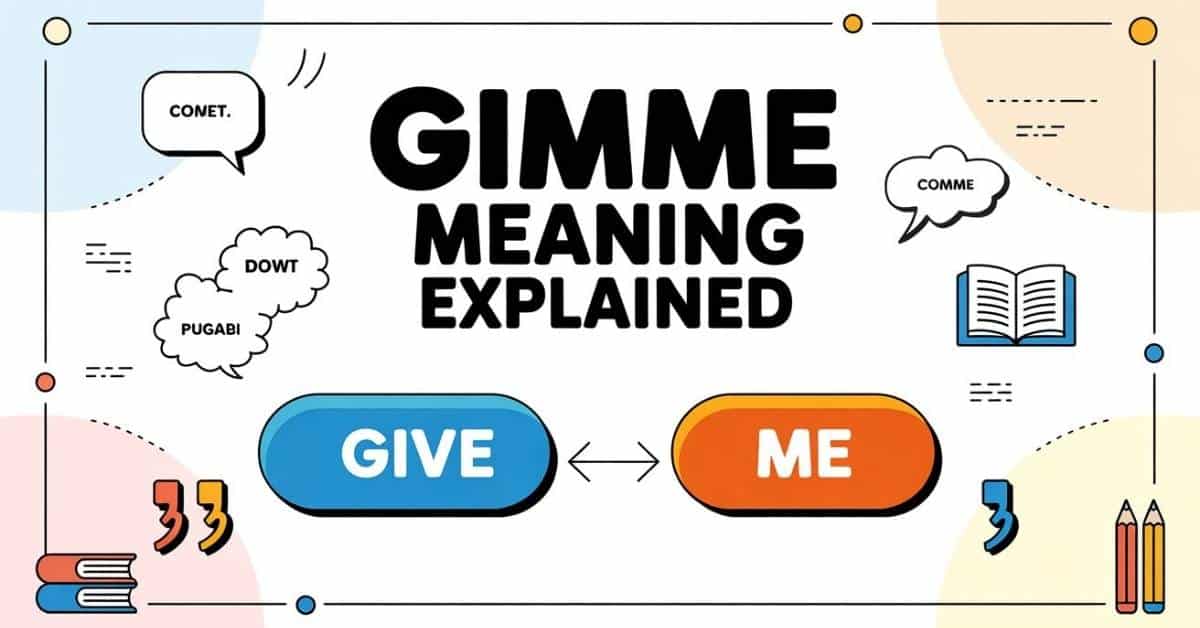
Gimme meaning is simply “give me.” The word “gimme” is an informal spoken contraction commonly used in casual English conversations, texting, social media, songs, and movies. Native English speakers often shorten “give me” into “gimme” during fast or relaxed speech because it sounds more natural and conversational.
For example:
- “Gimme a minute.”
- “Can you gimme that book?”
- “Gimme a break!”
Although “gimme” is extremely common in spoken English, it is generally considered informal English and should usually be avoided in professional writing, academic work, or formal communication.
If you’ve ever wondered:
- What does gimme mean in text?
- Is gimme slang?
- Is gimme rude?
- Can English learners use gimme naturally?
This guide explains everything in a practical, human-friendly way.
What Does “Gimme” Mean?
The word “gimme” is a shortened, casual way of saying “give me.”
It comes from the way native speakers naturally blend words together in spoken English. Instead of clearly pronouncing “give me,” people often say it quickly, which creates the sound:
“gimme”
That’s why you hear it constantly in:
- casual conversations
- text messages
- movies
- music lyrics
- TikTok videos
- gaming chats
- social media captions
Simple Definition
Gimme = Give me
It’s mainly used when someone wants something casually or informally.
Examples:
- “Gimme your phone for a second.”
- “Can you gimme some water?”
- “Gimme a chance.”
- “Gimme the remote.”
How Do You Pronounce “Gimme”?
The pronunciation of “gimme” sounds like:
GIM-ee
Phonetic pronunciation:
/ˈɡɪmi/
Native speakers usually say it quickly and smoothly during conversation.
This is part of something called connected speech, where English words naturally blend together in fast communication.
That’s why:
- “give me” becomes gimme
- “going to” becomes gonna
- “want to” becomes wanna
- “let me” becomes lemme
Understanding these contractions helps English learners sound more natural and improve conversational fluency.
Why Do People Say “Gimme” Instead of “Give Me”?
People use “gimme” because casual spoken English is designed for speed, rhythm, and comfort.
When native speakers talk quickly, words naturally compress together.
Instead of saying:
“Give me a second.”
Many people naturally say:
“Gimme a second.”
It feels:
- smoother
- friendlier
- more relaxed
- more conversational
This type of language shortening is extremely common in American English and internet communication.
Is “Gimme” a Real Word or Just Slang?
This is one of the most searched questions related to gimme meaning.
The answer is interesting.
“Gimme” Is a Real Informal Word
Major dictionaries include the word because it is widely used in everyday English.
However, it is still considered:
- informal
- conversational
- casual speech
It is not typically recommended for:
- formal essays
- business reports
- academic writing
- professional emails
Is “Gimme” Slang?
Not exactly.
The word sits between:
- an informal contraction
- and casual conversational slang
Native speakers do not usually see it as “bad English.” Instead, they see it as relaxed spoken language.
That’s why you hear it constantly in:
- songs
- movies
- sports
- texting
- gaming chats
- social media conversations
Is “Gimme” Grammatically Correct?
Technically, “give me” is the grammatically standard version.
But in real-life communication, “gimme” is widely accepted in casual speech.
So the answer depends on context.
Grammatically Appropriate Situations
- talking with friends
- texting
- casual conversation
- social media posts
- informal dialogue
Situations Where It’s Better to Avoid It
- school assignments
- professional emails
- workplace reports
- academic papers
- formal presentations
When Native Speakers Commonly Use “Gimme”
Understanding context is important because tone changes meaning.
Friendly Conversations
Friends use “gimme” naturally all the time.
Examples:
- “Gimme your charger.”
- “Gimme a hug.”
- “Gimme five minutes.”
It sounds casual and relaxed.
Text Messages and Social Media
The phrase is extremely common in texting culture.
Examples:
- “gimme a sec”
- “gimme that link”
- “gimme your opinion”
- “gimme more details”
On platforms like TikTok, Instagram, Snapchat, and gaming chats, shorter expressions feel faster and more natural.
Music, Movies, and Pop Culture
Many songs and movie lines use “gimme” because it sounds emotional, rhythmic, and conversational.
Examples include:
- “Gimme More”
- “Gimme Shelter”
- “Gimme Love”
Writers often prefer informal speech because it sounds more human and expressive.
Playful or Humorous Situations
Sometimes “gimme” sounds playful instead of demanding.
Example:
“C’mon, gimme a break!”
Tone and facial expression completely change how the phrase feels.
When You SHOULD NOT Use “Gimme”
Although “gimme” is common, there are situations where it may sound unprofessional or rude.
Professional Emails
This sounds too casual:
“Gimme the report by 5 PM.”
A better alternative:
“Could you please send me the report by 5 PM?”
Professional communication requires more polished language.
Academic Writing
Teachers and professors usually expect standard English grammar.
Avoid using:
- gimme
- gonna
- wanna
- gotta
in formal academic work.
Workplace Communication
Even in relaxed workplaces, “gimme” can sound abrupt if used incorrectly.
Especially with:
- clients
- managers
- customers
- formal business partners
Tone matters a lot.
Learn More: Nighttime or Night Time
Is “Gimme” Rude?
Not automatically.
Whether “gimme” sounds rude depends on:
- tone of voice
- relationship
- situation
- body language
- wording
Friendly Example
“Hey, gimme a second!”
Sounds natural and harmless.
Aggressive Example
“Gimme that now.”
This can sound demanding or impatient.
How to Make “Gimme” Sound More Polite
Adding softening words changes the emotional tone.
Better Versions
- “Can you gimme a minute?”
- “Please gimme some time.”
- “Could you gimme a hand?”
This makes the phrase sound friendlier and less abrupt.
“Gimme” vs “Give Me” — What’s the Difference?
Although both phrases mean the same thing, they create different impressions.
| Phrase | Tone | Formality |
|---|---|---|
| Give me | Neutral | More formal |
| Gimme | Casual | Informal |
“Give Me”
- clearer
- more professional
- safer in formal communication
“Gimme”
- conversational
- relaxed
- emotional
- natural in speech
Native speakers usually prefer “gimme” during fast casual conversation because it feels smoother.
Common Expressions Using “Gimme”
“Gimme a Break”
Meaning:
- stop being annoying
- that’s ridiculous
- give me some relief
Example:
“You expect me to finish this tonight? Gimme a break!”
“Gimme a Minute”
Meaning:
- wait briefly
- give someone time
Example:
“Gimme a minute and I’ll help you.”
“Gimme That”
This can sound:
- playful
- excited
- rude
depending on tone.
“Gimme Some Space”
Meaning:
- leave me alone temporarily
- emotional distance request
Often used during stress or frustration.
Real-Life Examples of “Gimme” in Conversation
Casual Friend Conversation
“Hey, gimme your headphones for a sec.”
Texting Example
“Can u gimme the address?”
Parent and Child Example
“Mom, gimme one more chance!”
Movie-Style Dialogue
“Gimme the keys and nobody gets hurt.”
This kind of dramatic speech appears frequently in movies because it sounds emotionally intense.
Why English Speakers Shorten Words Like “Give Me”
English naturally becomes more relaxed during fast speech.
This process is called:
- connected speech
- speech reduction
- conversational contraction
It helps communication feel:
- faster
- smoother
- more emotional
- more natural
Other Common Informal English Contractions
If you understand gimme meaning, you’ll probably recognize these too:
| Informal Form | Full Form |
|---|---|
| gonna | going to |
| wanna | want to |
| gotta | got to |
| lemme | let me |
| kinda | kind of |
| outta | out of |
These are extremely common in spoken English and social media language.
Can English Learners Use “Gimme”?
Absolutely — but carefully.
Native Speakers Will Understand You
“Gimme” is very common in conversational English.
Using it casually with friends sounds natural.
But Context Matters
Avoid overusing informal expressions in:
- interviews
- workplace communication
- formal writing
- customer support emails
Understanding when NOT to use slang is just as important as learning vocabulary.
How to Sound Natural Without Sounding Rude
The safest approach is:
- use “gimme” casually
- avoid it professionally
- pay attention to tone
English fluency is not only about grammar — it’s also about social awareness and conversational context.
Is “Gimme” Mostly American English?
“Gimme” is strongly associated with American English, but people around the world understand it because of:
- movies
- music
- gaming culture
- social media
- internet communication
British English speakers understand it too, although they may use it less frequently.
Why “Gimme” Feels More Emotional Than “Give Me”
Informal speech creates emotional closeness.
That’s why:
- songs use contractions
- movies use casual dialogue
- texting uses shortened language
“Gimme” sounds:
- warmer
- faster
- more expressive
- more emotional
compared to the more neutral phrase:
“give me.”
Quick Guide: Should You Use “Gimme”?
| Situation | Use “Gimme”? | Better Alternative |
|---|---|---|
| Texting friends | Yes | — |
| Social media captions | Yes | — |
| Casual conversation | Yes | — |
| Workplace email | No | “Could you give me…” |
| Academic essay | No | “Give me” |
| Customer communication | Usually no | More professional wording |
Frequently Asked Questions
What does “gimme” mean in text?
In texting, “gimme” means “give me.” It’s used casually in chats, DMs, and social media conversations.
Is “gimme” proper English?
It is considered informal English, not formal standard writing.
Is “gimme” rude?
Not necessarily. Tone and context determine whether it sounds friendly or demanding.
How do you pronounce “gimme”?
It is pronounced:
GIM-ee /ˈɡɪmi/
Is “gimme” slang?
It’s more accurately described as an informal spoken contraction, although many people casually call it slang.
Can I use “gimme” in writing?
Yes, in informal writing like:
- texts
- social media posts
- dialogue
- casual messages
Avoid it in professional or academic writing.
Why do Americans say “gimme”?
Because spoken English naturally shortens words during fast conversation.
Final Thoughts on “Gimme Meaning”
Understanding gimme meaning is about more than vocabulary. It also helps you understand how real English conversations work.
Native speakers constantly shorten words to sound:
- faster
- friendlier
- more relaxed
- more natural
That’s why expressions like:
- gonna
- wanna
- gotta
- lemme
- gimme
appear everywhere in movies, songs, texting, and casual speech.