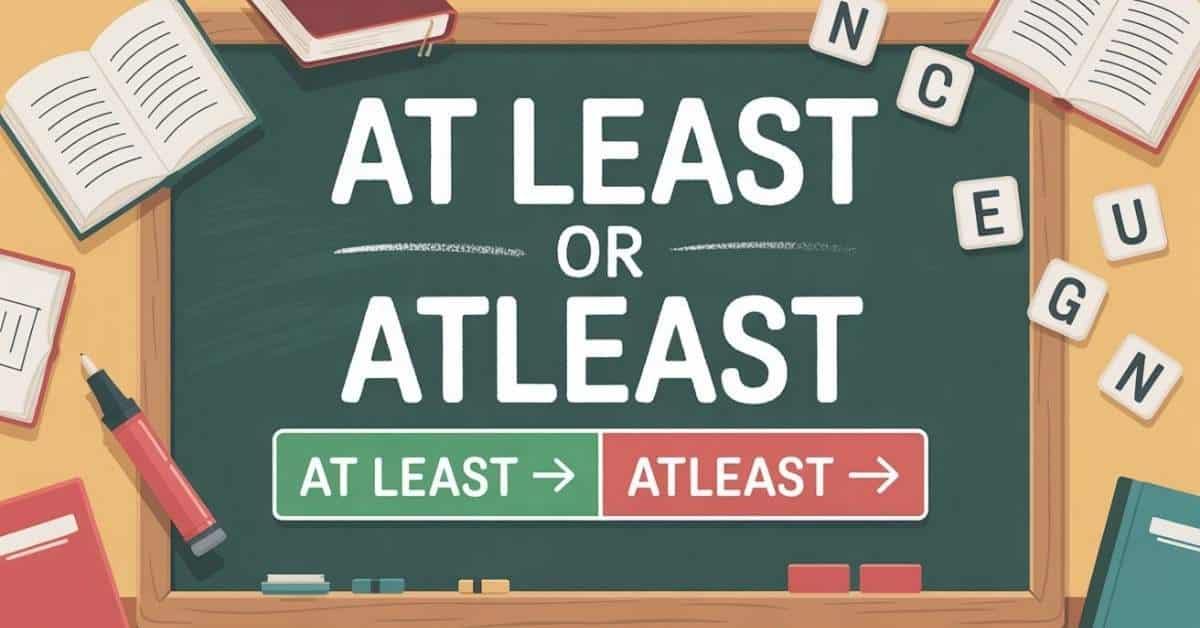
Atleast or at least — the correct form is “at least.” The single-word version “atleast” is incorrect and is considered a spelling mistake in all forms of English writing, including academic, professional, and informal communication. Although many people naturally type it as one word, the proper grammatically accepted version is always at least, meaning no less than a certain amount or minimum level.
This confusion is extremely common, but understanding the difference is important because using the correct form improves your writing clarity, credibility, and professionalism instantly.
Quick Answer: Atleast or at Least?
The answer is simple:
| Correct | Incorrect |
|---|---|
| At least | Atleast |
✔ At least = correct spelling ✘ Atleast = spelling mistake
According to major language references like Merriam-Webster and Cambridge Dictionary, the phrase is always written as two separate words.
What “At Least” Means
It refers to:
- A minimum amount
- A lower limit
- Or a positive minimum expectation
Example:
- You need at least 5 hours of sleep.
Why People Write “Atleast” (The Hidden Psychology Behind the Mistake)
The mistake is not random — it comes from how the human brain processes language.
1. Your brain merges frequently used phrases
When two words are often used together, the brain starts treating them as a single unit. This leads to writing errors like:
- alot instead of a lot
- everytime instead of every time
- infact instead of in fact
- atleast instead of at least
This is a cognitive shortcut, not a grammar misunderstanding.
2. Fast typing increases fusion errors
On keyboards and smartphones, people prioritize speed over accuracy, which causes word merging.
3. Exposure to incorrect usage online
Social media and informal writing often include mistakes, reinforcing incorrect patterns.
What Does “At Least” Really Mean? (Simple Breakdown)
Understanding meaning helps prevent mistakes.
Meaning 1: Minimum requirement
- You must wait at least 10 minutes.
Meaning 2: Lower limit
- The price is at least $50.
Meaning 3: Positive framing
- We arrived late, but at least we made it safely.
In all cases, it represents a minimum threshold or consolation point.
Can “Atleast” Ever Be Correct?
No.
Even in informal writing, messaging apps, or casual speech, “atleast” is still incorrect spelling.
What authorities say:
- Oxford English Dictionary recognizes only “at least”
- No standard English dictionary accepts “atleast” as a valid word
British vs American English?
There is no difference. Both use: ✔ at least ✘ atleast
Why This Small Error Actually Matters
Even though it looks minor, spelling impacts perception.
1. Academic writing
Teachers and examiners notice spelling precision. Small mistakes reduce perceived accuracy.
2. Professional communication
Emails and reports reflect attention to detail.
3. Job applications
Recruiters associate writing quality with competence.
4. Content creation
Poor spelling reduces trust and authority.
Even a small error like “atleast” can reduce credibility subconsciously.
Real-Life Examples of Correct Usage
Everyday English
- I need at least one hour to finish this.
Academic Writing
- The study included at least three experiments per group.
Business Communication
- Please submit the report at least two days in advance.
Formal Writing
- The policy requires at least five years of experience.
Common Mistakes People Make
1. Writing it as one word
❌ atleast ✔ at least
2. Confusing meaning with similar phrases
- at most
- at least
- no less than
3. Overuse in writing
Repetition reduces clarity in professional writing.
Learn More: Gimme Meaning
At Least vs Similar Expressions
At least vs At most
- At least = minimum
- At most = maximum
At least vs Minimum
- “At least” is a phrase
- “Minimum” is a noun/adjective
At least vs No less than
Both are similar in meaning, but “at least” is more natural in modern English.
How Professional Editors Catch This Mistake Instantly
Experienced editors recognize patterns quickly.
Why they notice it
- Broken word spacing patterns stand out visually
- It signals rushed or unedited writing
What it suggests to readers
- Lack of proofreading
- Low attention to detail
Even though it’s small, it affects perceived writing quality.
Simple Tricks to Never Misspell “At Least” Again
Trick 1: The separation rule
Remember: it always has two words.
Trick 2: The “a lot” comparison
If you write “a lot” separately, think the same for “at least.”
Trick 3: Replacement test
Try replacing it with:
- “no less than”
If it works, use at least.
Similar Grammar Mistakes
Many users who search this also struggle with:
- alot or a lot
- everytime or every time
- infront or in front
- upto or up to
- incase or in case
- altogether vs all together
These follow the same linguistic pattern: incorrect word fusion.
Why “At Least” Is More Important Than It Looks
This phrase plays a key role in communication.
1. Writing confidence
Correct usage builds confidence in writing.
2. Reader trust
Clean writing improves readability and trust.
3. Professional perception
Attention to detail influences how others judge your competence.
4. Communication clarity
Correct grammar reduces ambiguity.
Frequently Asked Questions
Is “atleast” a real word?
No. It is a spelling mistake.
Is “at least” one word or two?
It is always two words.
Why do people write “atleast”?
Because the brain naturally merges commonly used word pairs.
Is “atleast” ever accepted?
No, not in any standard English form.
Why does spell check flag it?
Because it is not recognized in formal English dictionaries.
Can I use “atleast” in text messages?
It is still incorrect, though commonly seen informally.
What is the difference between “at least” and “at most”?
- At least = minimum
- At most = maximum
Is it used in both British and American English?
Yes — but always as at least.
How can I remember the correct spelling?
Think of it as:
“a minimum of two words = at least”
Final Verdict: Atleast or At Least?
The conclusion is clear and consistent:
- ✔ At least = correct spelling
- ✘ Atleast = incorrect spelling
While the mistake is extremely common, especially in fast digital writing, it should always be avoided in academic, professional, and formal contexts.
Understanding this difference not only improves your grammar but also strengthens your writing confidence, clarity, and credibility.