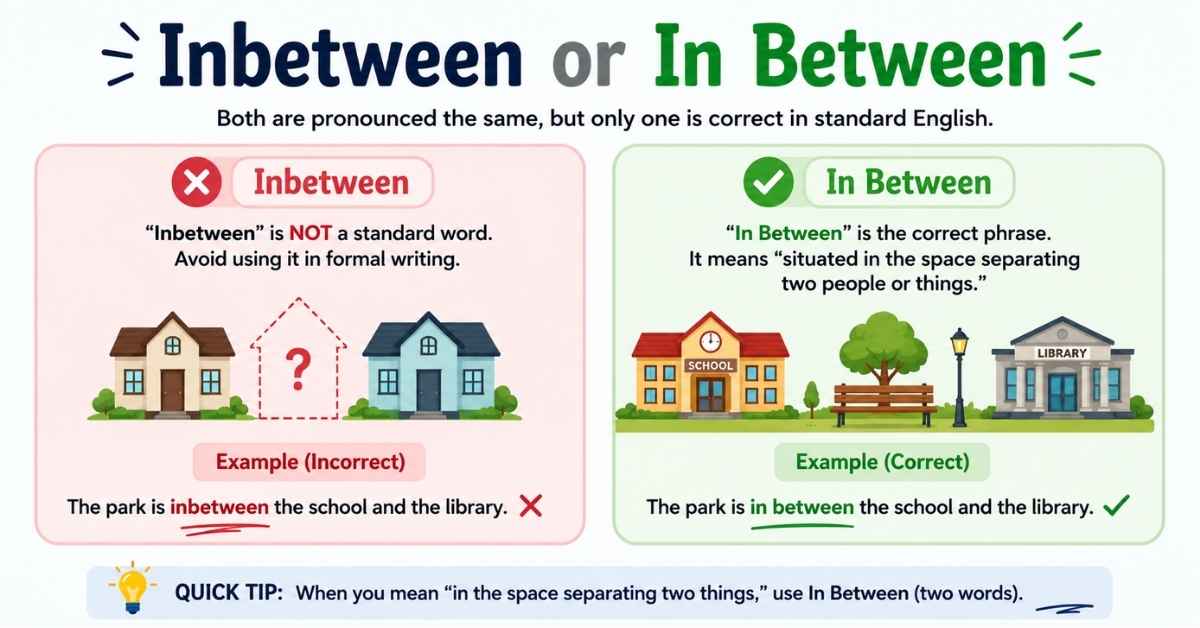
Inbetween or in between the correct spelling is “in between” (two words) in standard English. The single-word form “inbetween” is generally considered incorrect, while “in-between” is only correct when used as a hyphenated adjective or noun in specific contexts.
This confusion is extremely common because English allows flexible compound structures, but in this case, modern usage, dictionaries, and professional writing standards consistently prefer in between for most situations.
In this guide, you’ll learn not just the correct spelling, but also why it is correct, when exceptions apply, how editors treat it, and how to confidently use it in real writing without hesitation.
Why So Many People Get “Inbetween or in between” Confused
The keyword inbetween or in between feels confusing because English visually supports both forms in different compound words (like anytime / any time, setup / set up).
Why “inbetween” looks correct
People naturally combine words in speech patterns:
- in + between → “inbetween”
- similar to: inside, onto, upfront
This creates a natural spelling illusion, even though it is not standard.
Why spellcheck doesn’t always help
Many tools:
- only flag errors in formal writing
- sometimes accept informal variants
- do not explain grammar logic
So users remain uncertain.
Psychological reason behind the confusion
Users searching this keyword are usually:
- writing an email
- submitting an assignment
- publishing content
They are not just curious — they are seeking validation and fear avoidance (avoiding embarrassment or correction).
The Simple Rule Most Grammar Guides Fail to Explain
Most articles say “use in between,” but do not explain why. Here is the clear rule:
1. Use “in between” (two words)
Use it when it functions as a prepositional phrase meaning physically or conceptually located between two things.
Examples:
- The house is in between the school and the market.
- She sat in between two friends.
- There is a meeting in between the two sessions.
2. Use “in-between” (hyphenated form)
Use it when it acts as a compound adjective or noun.
Examples:
- It was an in-between stage in the process.
- He is going through an in-between phase of life.
- The design fills an in-between space.
3. Avoid “inbetween”
The single-word form is:
- not standard in formal English
- treated as a spelling error in professional writing
- flagged in academic and publishing contexts
Inbetween vs In Between vs In-Between (Clear Comparison)
| Form | Correct? | Usage | Example |
|---|---|---|---|
| inbetween | ❌ No | Incorrect spelling | ✖ inbetween jobs |
| in between | ✅ Yes | Prepositional phrase | ✔ in between meetings |
| in-between | ✅ Yes | Adjective / noun | ✔ in-between stage |
This is the simplest way to eliminate confusion instantly.
What Dictionaries and Style Guides Say
Authoritative sources consistently support the same usage pattern.
Trusted language authorities:
- Merriam-Webster → recognizes “in between” as standard phrase usage
- Cambridge Dictionary → lists “in between” as correct usage
- Oxford English Dictionary → supports separated phrase usage in modern English
Editorial standard view
Professional editors and proofreaders generally:
- correct “inbetween” → in between
- allow “in-between” only in descriptive contexts
- prefer simplicity in formal writing
Real-World Examples
Everyday usage
- The café is located in between two buildings.
- He stood in between the crowd.
Business writing
- The meeting is scheduled in between two client calls.
- We are reviewing options in between pricing tiers.
Academic writing
- The study examines an in-between category of social behavior.
- Data shows patterns occurring in between defined phases.
Creative writing
- She existed in an in-between world of memory and imagination.
Legal / formal tone
- The clause applies to activities occurring in between contractual obligations.
Learn More: Atleast or At Least
Common Mistakes People Make And Why Editors Fix Them
Mistake 1: Writing “inbetween”
✔ Editors always correct it to: in between
Mistake 2: Overusing hyphens
❌ in-between everything ✔ Only use when it modifies a noun
Mistake 3: Using it where “between” is better
❌ There is tension in between them ✔ There is tension between them
Editor insight
In professional editing, the phrase is often simplified:
If “between” works, editors prefer it over “in between.”
What Native Usage Actually Looks Like
In real publishing and journalism:
- “in between” appears mostly in descriptive contexts
- “between” is more common in formal writing
- “inbetween” is almost never used in credible publications
This is why search engines classify “inbetween” as a misspelling signal in NLP models.
Editor Decision Framework (Simple Rules)
Use this quick decision method:
Step 1: Are you describing position or relationship?
→ Use in between
Step 2: Are you modifying a noun?
→ Use in-between
Step 3: Is it one word?
→ Do NOT use “inbetween”
This framework removes 99% of confusion instantly.
Similar Grammar Confusions
Users searching this also struggle with:
- everyday vs every day
- anytime vs any time
- setup vs set up
- into vs in to
- alright vs all right
Does It Matter in Professional Writing?
Yes — especially in:
Job applications
Incorrect spelling can reduce credibility.
Academic writing
Teachers may mark it as a language error
Business communication
Editors will automatically correct it
Publishing
Style guides enforce consistency strictly
So while it seems small, it impacts perceived professionalism and trustworthiness.
Frequently Asked Questions
Is “inbetween” a real word?
No, it is generally considered a spelling error in standard English.
Is “in between” one word or two?
It is usually two words.
Is “in-between” correct?
Yes, when used as an adjective or noun.
Can I use “inbetween” in informal writing?
It is not recommended.
What is the difference between “between” and “in between”?
“Between” is more formal and concise; “in between” is slightly more descriptive.
Is there a difference in American and British English?
No major difference in usage rules.
Why do people write “inbetween”?
Because of natural speech compression and visual pattern assumptions.
Quick Reference Cheat Sheet
| Situation | Correct Form |
|---|---|
| General location | in between |
| Describing a stage | in-between |
| One-word form | ❌ avoid |
| Formal writing | in between |
| Academic writing | in between |
| Editing standard | in between |
Final Takeaway
To simplify everything:
- “in between” = correct standard form
- “in-between” = correct in specific descriptive cases
- “inbetween” = incorrect in professional English
If you remember only one rule, remember this:
In standard English writing, always prefer “in between” unless grammar specifically requires hyphenation.