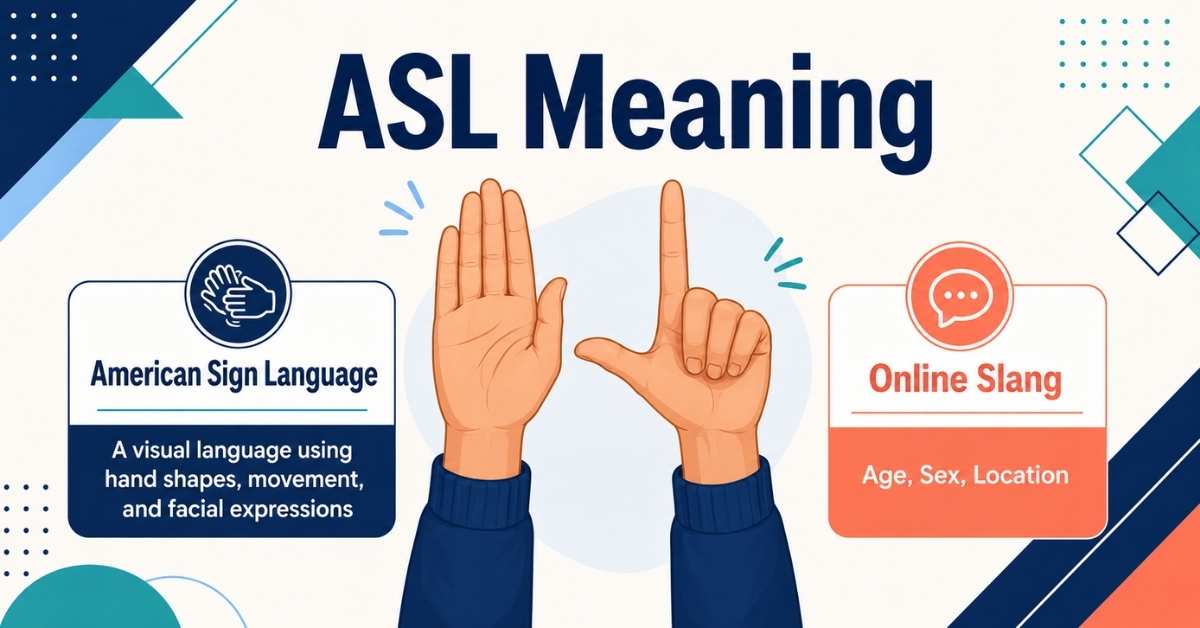
ASL meaning depends on where and how the abbreviation appears. In most situations, ASL means American Sign Language, “age, sex, location,” or “as hell.” If it follows an adjective, as in “I’m tired asl,” it usually means “as hell.” If someone sends “ASL?” as a standalone message, they are probably asking for your age, sex and location.
That overlap can create an awkward moment. Older internet users may remember ASL from AOL and IRC chatrooms, while Gen Z and Gen Alpha often use lowercase asl to emphasize an opinion. In a school, workplace or accessibility conversation, however, ASL almost certainly refers to American Sign Language.
ASL Meaning at a Glance
The fastest way to understand ASL is to examine its position, punctuation and surrounding words.
| Example | ASL meaning | Context clue |
|---|---|---|
| “That exam was hard asl.” | As hell | Appears after an adjective |
| “Hey, ASL?” | Age, sex, location? | Standalone question |
| “She teaches ASL.” | American Sign Language | Educational context |
| “An ASL interpreter will attend.” | American Sign Language | Accessibility context |
| “The village is 800 m ASL.” | Above sea level | Follows an elevation |
Uppercase ASL often refers to American Sign Language, while lowercase asl frequently means “as hell.” However, capitalization is only a clue. People do not always follow writing rules on TikTok, Snapchat, Instagram, Discord or WhatsApp.
Use the PLACE Method to Decode ASL
When the intended meaning is unclear, use this five-part framework.
P — Check the Punctuation
A question mark changes the likely meaning. “ASL?” usually asks for age, sex and location. By comparison, “That was funny asl” uses the term for emphasis.
L — Notice Its Location
When asl follows an adjective such as funny, cold, pretty, or boring, it normally means as hell. When it appears alone at the start of an online conversation, it probably requests personal details.
A — Read the Adjacent Words
Words such as learn, class, interpreter, signer, Deaf, and fingerspelling point toward American Sign Language. Words such as tired, fast, good, and crazy indicate slang.
C — Consider the Conversation
Think about who sent the message. A teacher discussing an ASL course means something different from an unknown person sending “ASL?” in a dating app or gaming chat.
E — Identify the Environment
A public TikTok comment, private Snapchat message, college course and geography report each create a different context. The platform alone does not determine the answer.
What Does ASL Mean in Slang?
In modern slang, lowercase asl means “as hell.” It acts as a degree intensifier, making an adjective stronger.
For example, “That movie was boring asl” means “That movie was extremely boring.” The writer is not discussing American Sign Language or requesting someone’s location.
Common ASL Slang Examples
| Slang example | Plain-English meaning | Tone |
|---|---|---|
| “I’m tired asl.” | I’m extremely tired. | Frustrated |
| “You’re funny asl.” | You’re very funny. | Complimentary |
| “It’s cold asl outside.” | It is extremely cold outside. | Emphatic |
| “That outfit is pretty asl.” | That outfit is very attractive. | Complimentary |
| “This class is boring asl.” | This class is extremely boring. | Negative |
| “The game was hard asl.” | The game was extremely difficult. | Frustrated |
| “That song is good asl.” | That song is very good. | Positive |
Although people often call every ASL meaning an acronym, this version behaves differently. “As hell” is better understood as informal slang compression, not a traditional acronym in which each letter represents a separate word.
Is ASL a Bad Word?
Using asl to mean “as hell” contains an implied mild profanity. It is generally harmless among friends, but it may be inappropriate in:
- Professional emails
- School assignments
- Customer communication
- Formal articles
- Conversations where profanity is unwelcome
More formal alternatives include very, extremely, seriously, remarkably and particularly.
Why Gen Z and Millennials Read ASL Differently
The meaning of internet slang changes as communication platforms evolve.
During the early days of AOL, IRC and anonymous chatrooms, A/S/L commonly meant “age, sex, location.” It allowed strangers to exchange basic information quickly.
Millennials and older internet users may still interpret ASL that way. Many younger users, however, encounter asl in TikTok captions, Instagram comments and text messages where it means “as hell.”
Neither interpretation is automatically wrong. This is an example of semantic change, where one written form develops different meanings across generations and communities.
What Does “ASL?” Mean in a Message?
When someone sends “ASL?” by itself, they are usually asking:
- How old are you?
- What is your sex or gender?
- Where are you located?
A traditional response might look like “21/F/Chicago.” The abbreviation was once a common online icebreaker, especially when chatroom profiles revealed very little information.
Today, this meaning may still appear in:
- Anonymous chatrooms
- Dating apps
- Discord servers
- Online gaming communities
- Role-playing groups
- Random direct messages
- Nostalgic discussions about early internet culture
It is more likely to mean age, sex and location when it appears at the beginning of a conversation, includes a question mark or is followed by a request for a photograph.
Is It Safe to Answer an ASL Request?
You are never required to share personal information with an online stranger. This is especially important for children and teenagers.
A general country or broad age range may seem harmless. However, combining your age, location, school, photograph and daily routine can make identification easier.
Avoid sharing:
- Your exact address
- Live location
- School or workplace
- Phone number
- Daily schedule
- Private photographs
- Other identifying details
Safe responses include:
- “What do you mean by ASL?”
- “I don’t share personal information online.”
- “I’m not comfortable answering that.”
- “Do you mean American Sign Language?”
- “I only share my country, not my exact location.”
If the sender becomes intrusive, sexual or aggressive, end the conversation, block the account and use the platform’s reporting tools.
Parents should also check the complete conversation before panicking. “My class was boring asl” is ordinary slang; it is not evidence that a teenager shared personal details.
ASL as American Sign Language
American Sign Language is a complete natural language used primarily by Deaf and hard-of-hearing communities in the United States and much of English-speaking Canada. Some hearing people also learn and use it.
ASL is not spoken English translated into hand gestures. It has its own:
- Grammar
- Syntax
- Word formation
- Sentence structure
- Regional variation
- Cultural conventions
Facial expressions and body movements are not optional decoration. They can communicate questions, emotions, emphasis and grammatical information.
The Five Components of an ASL Sign
Meaning can depend on five major parameters:
- Handshape
- Palm orientation
- Location
- Movement
- Non-manual signals, including facial expressions and body position
Changing one component can change the intended sign. This is why learning from qualified teachers and Deaf-led resources is more effective than memorizing written descriptions.
ASL, Fingerspelling and Signed English
Fingerspelling is part of ASL, but it is not the entire language. Signers may fingerspell names, borrowed terms or words without an established sign.
Signed English follows English vocabulary and word order more closely. ASL follows its own linguistic structure and communicates information through space, movement and non-manual markers.
A Brief History of ASL
Modern ASL developed through contact among early American signing communities and French Sign Language. In 1817, Thomas Hopkins Gallaudet and Laurent Clerc helped establish the American School for the Deaf in Hartford, Connecticut.
Over time, the language continued to develop within Deaf communities. Linguist William Stokoe later helped demonstrate academically that ASL was a complete language rather than a simplified collection of gestures.
Who Uses ASL?
ASL may be used by:
- Deaf and hard-of-hearing people
- Hearing children of Deaf adults
- Family members and friends
- Teachers and certified interpreters
- Healthcare professionals
- Social workers
- Hearing second-language learners
Capital-D Deaf can refer to a cultural and linguistic identity. Lowercase deaf is often used when discussing hearing status. Individual preferences should always be respected.
Is American Sign Language Universal?
ASL is not a universal sign language. Different Deaf communities have developed distinct languages with their own grammar, vocabulary and cultural history.
| Signed language | Main regional association |
|---|---|
| ASL | United States and much of English-speaking Canada |
| BSL | United Kingdom |
| Auslan | Australia |
| PSL | Pakistan |
| LSF | France |
British Sign Language and American Sign Language are different even though English is widely spoken in both countries. Their alphabets, vocabulary and grammar are not the same.
For readers in Pakistan, PSL means Pakistan Sign Language. ASL may still appear in American courses, films and accessibility content, but PSL is more relevant when communicating within Pakistan’s Deaf community.
What Does ASL Mean on TikTok, Snapchat and Instagram?
Platform names provide helpful context, but public and private conversations can use ASL differently.
| Platform or setting | Most likely meaning | Qualification |
|---|---|---|
| TikTok comment | As hell | Usually follows an opinion or adjective |
| Instagram caption | As hell | Often adds humor or emphasis |
| Snapchat DM | Either slang meaning | Check whether it is a question |
| Discord or gaming chat | Either slang meaning | Conversation purpose matters |
| Dating app | Age, sex, location | Common when requesting personal details |
| Educational video | American Sign Language | Look for language-learning terms |
| Workplace notice | American Sign Language | Usually relates to accessibility |
If you are wondering what ASL means in a text from a guy or girl, the sender’s gender does not determine the answer. Grammar and context do.
Uppercase ASL vs Lowercase asl
Standard edited writing usually follows these patterns:
- ASL — American Sign Language
- A/S/L? — Age, sex, location?
- asl — As hell
- ASL after a measurement — Above sea level
Online users frequently ignore capitalization, so do not rely on letter case alone.
American Sign Language and age/sex/location are normally pronounced letter by letter: A-S-L. The theory that lowercase asl comes from saying “as hell” quickly is popular, but its precise slang origin is not firmly established.
LEARN MORE: Limerence Meaning
Common ASL Misunderstandings
Several assumptions cause unnecessary confusion:
- ASL does not always mean American Sign Language.
- Lowercase asl does not always request someone’s location.
- Capitalization is a useful clue, not an absolute rule.
- Every “ASL?” message is not automatically predatory.
- ASL is not universal sign language.
- American Sign Language is not signed English.
- Fingerspelling is only one part of ASL.
- Facial expressions and body movements carry linguistic meaning.
- Not every Deaf person uses ASL.
- TikTok, Snapchat and Instagram do not assign fixed definitions to slang.
Frequently Asked Questions
What does ASL mean in texting?
ASL can mean “as hell” or “age, sex, location.” If it follows an adjective, it usually means “as hell.” When sent alone as “ASL?” it generally requests personal details.
What does ASL mean for Gen Z?
Gen Z commonly uses lowercase asl as an intensifier meaning “as hell.” For example, “pretty asl” means extremely pretty.
Is ASL offensive?
American Sign Language is not offensive. Slang asl implies “hell,” so it may be unsuitable in formal or profanity-free settings.
How should I respond when someone asks “ASL?”
Ask what they mean or politely decline: “I don’t share personal details online.” You do not need to provide your age or location.
Does uppercase ASL always mean American Sign Language?
No. Uppercase letters are a helpful signal, but informal messages often ignore capitalization.
Is ASL the same as Signed English?
No. ASL has its own grammar, while Signed English represents English more directly through signs.
Can hearing people learn ASL?
Yes. Hearing family members, teachers, interpreters, healthcare professionals and other learners can study ASL.
What does ASL mean in geography?
In an elevation or mapping context, ASL can mean above sea level, although other abbreviations such as AMSL are also used.
The Simplest Rule to Remember
The correct ASL meaning becomes much easier to identify when you look at its grammatical position:
- After an adjective: “as hell”
- Standalone question: “age, sex, location”
- Language or accessibility context: American Sign Language
- After an elevation: above sea level
When the context remains unclear, simply ask what the person means. And if someone requests personal information, never feel pressured to answer.