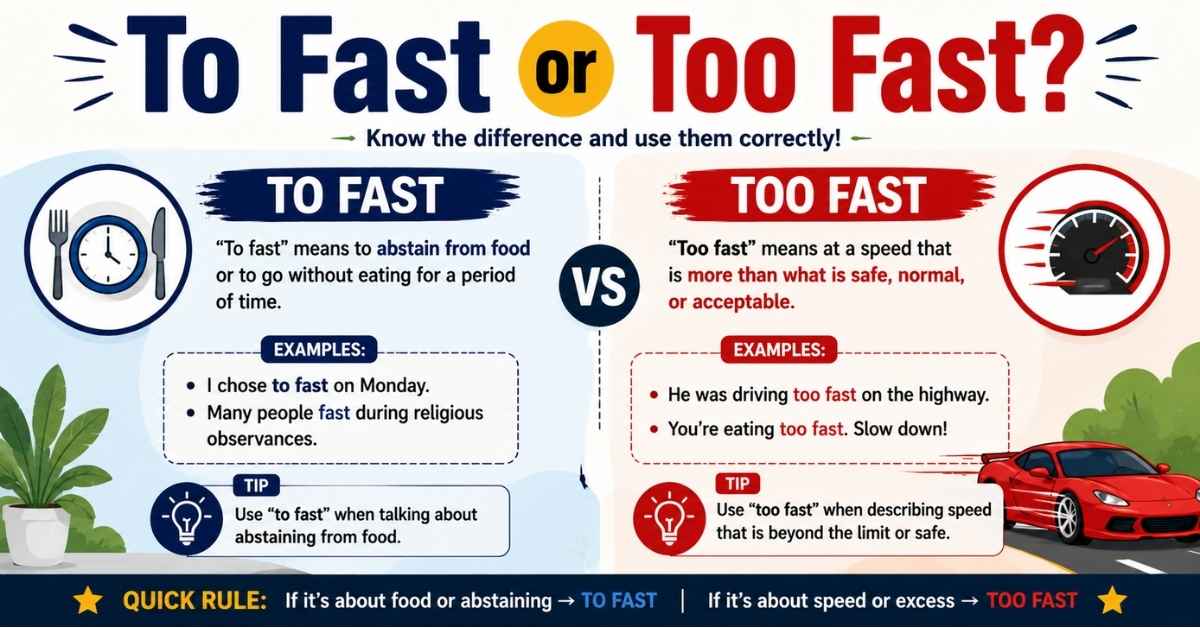
To fast or too fast — the correct phrase is usually “too fast” when you are talking about something happening excessively quickly. However, “to fast” can also be correct in certain situations when “fast” is used as a verb meaning to avoid food for religious, health, or medical reasons.
This confusion is incredibly common because “to” and “too” sound exactly the same in spoken English. Even native speakers mix them up in text messages, workplace emails, social media captions, and academic writing. The good news is that once you understand the difference in context, it becomes much easier to avoid this grammar mistake confidently.
Quick Answer: Which One Is Correct?
Here’s the simplest explanation:
| Phrase | Correct? | Meaning |
|---|---|---|
| Too fast | Yes | Moving excessively quickly |
| To fast | Sometimes | Using “fast” as a verb meaning to avoid food |
Examples:
- “You are driving too fast.” ✅
- “She wants to fast before the medical procedure.” ✅
Most of the time, people searching for “to fast or too fast” actually mean “too fast.”
“Too Fast” Meaning and Correct Usage
The phrase “too fast” is used when something happens at an excessive speed or quicker than desired. In English grammar, the word “too” means:
- excessively
- more than necessary
- beyond an acceptable limit
That extra “o” in “too” often signals “extra” or “more than enough.”
Common Real-Life Examples
- “You’re speaking too fast for me to understand.”
- “The car was moving too fast on the highway.”
- “I typed too fast and made several grammar mistakes.”
- “The meeting ended too fast.”
- “The kids grew up too fast.”
This is the version commonly used in:
- casual conversation
- texting
- business communication
- proofreading
- social media writing
- academic English
When users search:
- is it too fast or to fast
- difference between to fast and too fast
- grammar rules for too
- correct phrase too fast
When “To Fast” Is Actually Correct
This is where many grammar articles oversimplify the explanation.
While “too fast” is far more common, “to fast” is not automatically wrong.
It becomes correct when “fast” functions as a verb rather than an adjective or adverb.
What Does “Fast” Mean as a Verb?
As a verb, “fast” means:
- to avoid eating food
- to abstain from food temporarily
This usage appears in:
- religious fasting
- intermittent fasting
- medical preparation
- spiritual practices
Correct Examples of “To Fast”
- “I decided to fast for 16 hours.”
- “Some people choose to fast for health reasons.”
- “Patients may need to fast before surgery.”
- “He plans to fast during Ramadan.”
In these examples:
- “to” is part of an infinitive verb phrase
- “fast” is the action verb
This contextual nuance is what many competitors fail to explain properly.
Why So Many People Confuse “To” and “Too”
The confusion between “to” and “too” happens because they are homophones — words that sound identical but have different meanings and spellings.
Why the Mistake Happens So Often
1. Spoken English Sounds Identical
When speaking naturally, there is almost no audible difference between:
- “to fast”
- “too fast”
2. Voice Typing and Autocorrect
Modern communication increases grammar confusion because:
- smartphones autocorrect unpredictably
- speech-to-text tools misinterpret words
- people type quickly without proofreading
For example:
“Sorry, I typed to fast.”
This is one of the most common online writing mistakes.
3. Fast Digital Communication
People often:
- text quickly
- skip proofreading
- rely on predictive text
That leads to:
- spelling confusion
- grammar errors
- communication mistakes
4. Even Native Speakers Make This Mistake
Many people assume only English learners confuse these words, but that’s not true.
Even fluent speakers sometimes write:
- to much
- to many
- to late
- to fast
because the brain processes sound faster than spelling during rapid communication.
The Simplest Trick to Remember the Difference
If you struggle with:
- to vs too
- grammar correction
- proofreading mistakes
this memory trick helps instantly.
Easy Memory Rule
“Too” Has an Extra “O”
Think of the extra “o” as meaning:
extra amount
So:
- too fast = excessively fast
- too loud = excessively loud
- too expensive = more expensive than desired
Fast Decision Rule
Ask yourself:
“Do I mean excessively?”
If YES → use too
Example:
- “You’re talking too fast.”
If NO and “fast” is an action verb → use to fast
Example:
- “I want to fast tomorrow.”
Real Examples in Everyday English
Many grammar websites use robotic textbook examples that don’t reflect how people actually communicate.
Here’s how these phrases appear naturally in real life.
Examples in Text Messages
Correct:
- “You replied too fast.”
- “I was typing too fast and hit send accidentally.”
Incorrect:
- “You replied to fast.” ❌
Examples in School or Academic Writing
Correct:
- “The experiment happened too fast to record accurately.”
- “Students sometimes write too fast during exams.”
Correct Use of “To Fast”:
- “The researchers chose to fast before blood testing.”
Examples in Workplace Communication
Correct:
- “The presentation moved too fast for new employees.”
- “You’re scrolling too fast through the report.”
Medical Context:
- “Employees scheduled for surgery may need to fast overnight.”
Examples in Social Media Captions
Common Usage:
- “Summer went by too fast.”
- “Life moves too fast sometimes.”
Health & Wellness Usage:
- “I’m learning to fast safely.”
These examples improve contextual understanding far more than generic grammar definitions.
Common Mistakes People Make With “Too”
The confusion between “to” and “too” doesn’t stop with “too fast.”
People commonly make similar grammar mistakes such as:
| Incorrect | Correct |
|---|---|
| to much | too much |
| to many | too many |
| to late | too late |
| to hard | too hard |
| to expensive | too expensive |
This happens because:
- the words sound identical
- typing speed increases errors
- proofreading is skipped
Is “To Fast” Ever Wrong?
Yes — and this depends entirely on sentence structure.
Incorrect Usage
- “You are driving to fast.” ❌
- “She talks to fast.” ❌
Why?
Because in these sentences:
- “fast” describes speed
- you need “too” meaning excessively
Correct Usage
- “He wants to fast during the religious holiday.” ✅
- “Doctors asked patients to fast before surgery.” ✅
Here:
- “fast” is a verb
- “to” belongs to the infinitive phrase
This distinction is the key to mastering the phrase confidently.
Why Many Grammar Articles Confuse Readers
A lot of grammar content online creates unnecessary confusion because it:
- overcomplicates simple rules
- uses technical grammar jargon
- ignores real-world usage
- oversimplifies nuanced cases
Some articles incorrectly claim:
“To fast is always wrong.”
That is factually incomplete.
Helpful grammar explanations should include:
- context
- realistic examples
- conversational English
- practical application
Users don’t just want grammar theory. They want confidence in actual communication.
How Native Speakers Actually Use These Phrases
In real conversation, native speakers overwhelmingly use:
- too fast when discussing speed
- to fast only in health or religious contexts
Common Spoken Examples
- “You’re walking too fast.”
- “Everything happened too fast.”
- “I’m trying to fast twice a week.”
Learn More: Envolved or Involved?
Quick Self-Test: Can You Spot the Correct Phrase?
Choose the correct phrase.
1.
“You’re driving ___ fast.”
✅ too fast
2.
“My doctor told me ___ before the blood test.”
✅ to fast
3.
“She speaks ___ fast during presentations.”
✅ too fast
4.
“They decided ___ for spiritual reasons.”
✅ to fast
If you answered correctly, you now fully understand the difference.
Fast Rule Summary You Can Remember in Seconds
Here’s the easiest way to remember it forever.
Use “Too Fast” When:
- talking about excessive speed
- describing something happening quicker than desired
- discussing communication speed
Example:
- “You’re talking too fast.”
Use “To Fast” When:
- “fast” is a verb
- discussing avoiding food
- referring to fasting practices
Example:
- “I want to fast tomorrow.”
Frequently Asked Questions About To Fast or Too Fast?
Is “too fast” grammatically correct?
Yes. “Too fast” is grammatically correct when something happens excessively quickly.
Can “to fast” ever be correct?
Yes. It is correct when “fast” functions as a verb meaning to avoid food.
Why do people confuse “to” and “too”?
Because they are homophones and sound identical in spoken English.
Is this mistake common among native speakers?
Very common. Fast typing, autocorrect, and casual communication cause many people to confuse these words.
How can I stop making this mistake?
Use this simple rule:
- too = extra/excessive
- to = direction or part of a verb phrase
Does autocorrect cause this confusion?
Yes. Smartphones and predictive text often fail to detect contextual grammar mistakes.
Is “too fast” formal or informal English?
It works in both formal and informal English depending on context.
Can grammar checkers detect this mistake?
Most modern proofreading and grammar checker tools can identify the error, but they are not always perfect.
Final Verdict:
If you are describing excessive speed, the correct phrase is almost always “too fast.”
However, “to fast” becomes grammatically correct when “fast” is used as a verb meaning to avoid food.
Understanding this distinction helps improve:
- grammar accuracy
- proofreading skills
- writing confidence
- communication clarity
And most importantly, you no longer need to second-guess yourself every time you type the phrase.