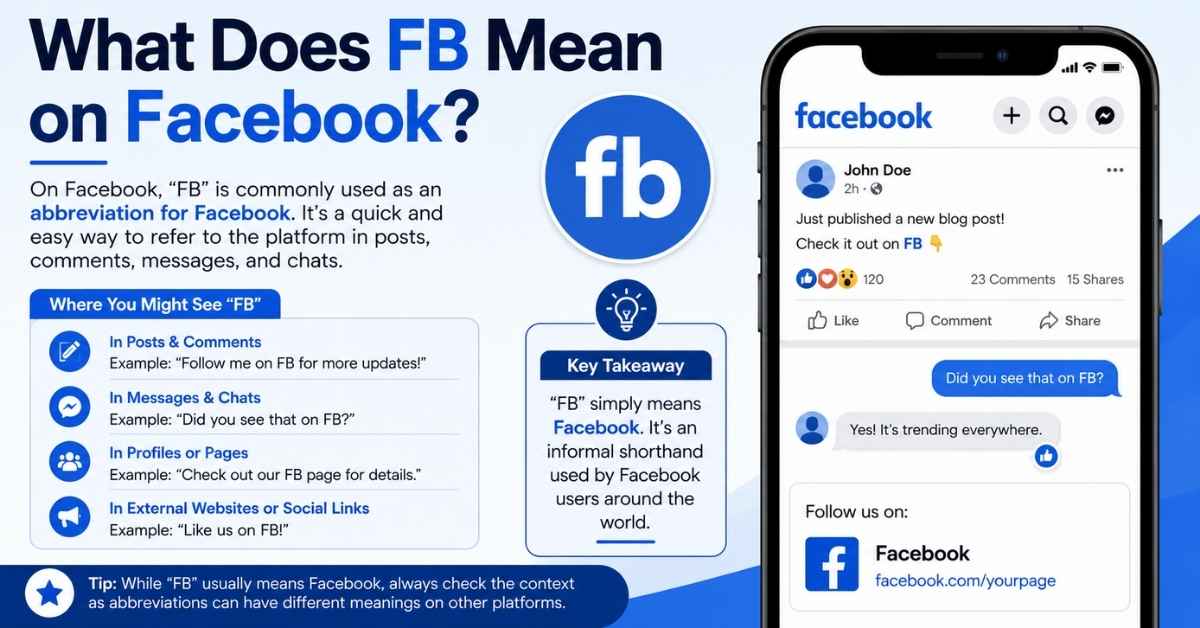
What does FB mean on Facebook? FB simply stands for Facebook in most situations. It’s the most widely used abbreviation for the social media platform and appears in conversations, comments, Facebook Messenger, Facebook Marketplace, Facebook Groups, and even text messages. However, depending on the context, FB can also mean “Follow Back” or a few other less common terms. Understanding the surrounding conversation is the key to identifying the correct meaning.
If you’ve ever seen someone write “Check FB,” “Add me on FB,” or “Message me on FB,” you may have wondered whether they were referring to Facebook itself or something else. In this guide, you’ll learn what FB means on Facebook, why people use this abbreviation, when it has different meanings, and how to interpret it correctly in everyday online conversations.
What Does FB Mean on Facebook?
The simplest answer is that FB is the standard abbreviation for Facebook. People shorten the platform’s name because it’s faster to type, easier to recognize, and commonly used across social media, messaging apps, and online discussions.
You’ll frequently come across FB in phrases like:
- “I found it on FB.”
- “Follow our FB page.”
- “I’ll send you the details on FB Messenger.”
- “Join our FB group.”
- “Check the latest update on FB.”
In each of these examples, FB clearly refers to Facebook.
Although Meta Platforms renamed its parent company from Facebook to Meta in 2021, millions of users still casually refer to the platform as FB. The abbreviation remains widely recognized worldwide and continues to appear in conversations, blogs, advertisements, and social media posts.
The Simple Definition
FB = Facebook
That’s the meaning you’ll encounter most often.
Whether someone is talking about:
- their Facebook account
- a Facebook profile
- Facebook Messenger
- a Facebook Page
- Facebook Marketplace
- or Facebook Groups
the abbreviation FB almost always represents Facebook.
For example:
“I uploaded the photos to FB yesterday.”
Here, FB simply means the Facebook platform.
Another example:
“Can you message me on FB?”
This refers to sending a message through Facebook Messenger.
Because the abbreviation is so common, many people use FB without even realizing they’re shortening the platform’s name.
Why Do People Say “FB” Instead of Facebook?
Typing Facebook every time can feel unnecessary, especially during quick conversations. That’s one of the biggest reasons why the abbreviation FB has become part of everyday internet language.
People commonly use FB because it is:
- Shorter and faster to type.
- Easier to use in casual conversations.
- Familiar to almost every internet user.
- Widely understood across different countries.
- Common in text messages, social media captions, and comments.
For instance, instead of writing:
“I saw your post on Facebook.”
many users naturally type:
“I saw your post on FB.”
The meaning remains exactly the same, but the sentence feels quicker and more conversational.
Is FB an Official Abbreviation?
While FB isn’t the platform’s official public name anymore, it has long been recognized as the informal abbreviation for Facebook.
In fact, before Facebook rebranded its parent company as Meta, the company even traded on the stock market under the ticker symbol FB. This historical association strengthened the abbreviation’s popularity, and people continue using it today out of habit.
You’ll still see FB used in:
- Social media discussions
- Technology blogs
- Online forums
- Text messages
- Business conversations
- Customer support chats
- Digital marketing communities
Because the abbreviation is so widely accepted, most people instantly understand that FB refers to Facebook.
Does FB Always Mean Facebook?
Although FB usually means Facebook, it doesn’t always have the same meaning.
Like many internet abbreviations, FB changes depending on where and how it’s used.
Imagine someone writes:
“FB if you follow me.”
On Instagram or X (formerly Twitter), this usually means “Follow Back.”
Now consider another sentence:
“I listed my bike on FB.”
Here, FB clearly refers to Facebook Marketplace.
Likewise:
“Let’s continue the conversation on FB Messenger.”
Again, FB means Facebook.
The abbreviation itself doesn’t change—the surrounding context determines its meaning.
Quick Comparison: What Does FB Mean in Different Contexts?
| Context | Meaning of FB | Likelihood |
|---|---|---|
| Facebook posts | ⭐⭐⭐⭐⭐ | |
| Facebook comments | ⭐⭐⭐⭐⭐ | |
| Facebook Messenger | ⭐⭐⭐⭐⭐ | |
| Facebook Marketplace | ⭐⭐⭐⭐⭐ | |
| Facebook Groups | ⭐⭐⭐⭐⭐ | |
| Instagram comments | Follow Back | ⭐⭐⭐⭐ |
| X (formerly Twitter) | Follow Back | ⭐⭐⭐⭐ |
| Workplace discussions | Feedback | ⭐⭐ |
| American football | Fullback | ⭐ |
As you can see, when you’re already on Facebook, the abbreviation almost always refers to the platform itself.
Common Places You’ll See FB on Facebook
Many people search for “what does FB mean on Facebook” after seeing the abbreviation somewhere on the platform. Understanding the context makes it much easier to interpret.
Let’s look at the most common places where you’ll encounter FB.
FB in Facebook Posts
Posts are one of the most common places where people shorten Facebook to FB.
Examples include:
“I shared the full story on FB.”
“New photos are now on FB.”
“Our event is live on FB.”
In these examples, FB simply replaces the full word Facebook without changing the meaning.
Businesses, creators, influencers, and everyday users all use this abbreviation because it’s concise and instantly recognizable.
FB in Facebook Comments
Comments tend to be informal, so abbreviations appear even more frequently.
You might read comments like:
“Saw this on FB yesterday.”
“Found your profile through FB.”
“FB keeps recommending this page.”
Every one of these examples refers to the Facebook platform, not another meaning.
FB in Facebook Messenger
People often shorten platform names while chatting.
Common examples include:
“I’ll send it through FB.”
“Check your FB Messenger.”
“Let’s continue on FB.”
In conversations like these, FB usually points to Facebook Messenger or the Facebook app itself.
Since Messenger is closely connected to Facebook, users often switch between the two names naturally.
FB in Facebook Marketplace
One of the fastest-growing areas where you’ll see this abbreviation is Facebook Marketplace.
Buyers and sellers commonly write:
“Available on FB Marketplace.”
“Message me on FB if you’re interested.”
“Listed only on FB.”
These phrases help save space while keeping communication clear.
If you’re shopping online or selling locally, you’ll likely encounter this abbreviation regularly.
FB in Facebook Groups
Communities and discussion groups also rely heavily on abbreviations.
You’ll often find posts like:
“This is one of the best FB groups for beginners.”
“Share this in your local FB group.”
“Ask the admins in the FB community.”
Whether the discussion is about hobbies, education, business, or local events, FB almost always refers to Facebook Groups.
FB in Facebook Profiles and Pages
Another common use appears in personal profiles and business pages.
For example:
- Visit our FB page for updates.
- Connect with me on FB.
- Our FB profile has more photos.
- Follow our official FB page.
Here, FB acts as a convenient shorthand for Facebook without creating confusion.
Because millions of people recognize the abbreviation immediately, businesses and individuals continue using it across bios, websites, newsletters, and promotional materials.
Why Context Is More Important Than the Abbreviation
One mistake many people make is assuming every abbreviation has only one meaning.
In reality, internet language is highly contextual.
When you see FB, ask yourself:
- Which platform am I using?
- What is the conversation about?
- Does Facebook make sense here?
- Could the person be referring to something else, such as “Follow Back”?
Most of the time, especially on Facebook, Messenger, Marketplace, Groups, and Pages, the answer is simple—FB means Facebook.
Understanding this small detail can help you avoid confusion and interpret online conversations with confidence.
Real-Life Examples of FB in Everyday Conversations
Sometimes, the easiest way to understand an abbreviation is to see it used in real conversations. While FB almost always refers to Facebook on the platform itself, the surrounding sentence provides the final clue.
Here are some examples you’ll likely encounter online.
| Conversation | What FB Means |
|---|---|
| “I saw your vacation photos on FB.” | |
| “Can you add me on FB?” | Facebook account |
| “I’ll send you the link through FB Messenger.” | Facebook Messenger |
| “The item is listed on FB Marketplace.” | Facebook Marketplace |
| “Join our local FB Group for updates.” | Facebook Group |
| “Check our official FB Page for today’s announcement.” | Facebook Page |
| “Nice profile! FB?” | Follow Back (usually on Instagram or X) |
| “Thanks for the FB on my account!” | Follow Back |
Notice how the first six examples are directly related to the Facebook ecosystem, while the last two come from other social media platforms. This is why context always matters more than the abbreviation itself.
FB vs. Follow Back: Understanding the Difference
One of the biggest reasons people search “what does FB mean on Facebook” is because they’ve also seen FB used to mean “Follow Back.” Although both meanings are correct, they’re used in completely different situations.
Knowing the difference prevents misunderstandings.
When FB Means Facebook
In most online conversations, FB simply means Facebook.
You’ll commonly see it when people are talking about:
- Their Facebook profile
- A Facebook account
- Facebook Messenger
- Facebook Marketplace
- Facebook Pages
- Facebook Groups
- Photos and videos shared on Facebook
- Events created on Facebook
- Facebook Reels and Stories
Examples:
“I posted the announcement on FB.”
“Search my name on FB.”
“Let’s connect on FB after work.”
In each case, replacing FB with Facebook makes perfect sense.
When FB Means Follow Back
Outside Facebook, especially on Instagram, X (formerly Twitter), TikTok, and occasionally Threads, FB often stands for Follow Back.
This is common among creators trying to grow their audience.
Examples include:
“Follow me and I’ll FB.”
“FB everyone who follows.”
“Instant FB.”
Here, FB is a promise that the person will follow your account in return.
If you’re browsing Instagram comments or replying to social media posts, this is probably the intended meaning.
A Simple Trick to Identify the Correct Meaning
Whenever you see FB, ask yourself three quick questions:
1. Which platform am I using?
If you’re already on Facebook, FB almost certainly means Facebook.
If you’re on Instagram or X, there’s a good chance it means Follow Back.
2. What is the conversation about?
If people are discussing:
- Marketplace
- Messenger
- Groups
- Pages
- Posts
- Events
then FB = Facebook.
If they’re talking about:
- followers
- likes
- social media growth
- mutual follows
then FB = Follow Back.
3. Does the sentence make sense?
Compare these examples:
“Message me on FB.”
Clearly means Facebook.
Now compare it with:
“Follow me and I’ll FB.”
Clearly means Follow Back.
Reading the entire sentence almost always removes any confusion.
Why Do People Still Say FB Instead of Meta?
In 2021, Facebook’s parent company officially changed its corporate name to Meta. Many people wondered whether the abbreviation FB would disappear.
It didn’t.
The reason is simple: people were already accustomed to saying FB, and habits don’t change overnight.
Today:
- The company is called Meta Platforms.
- The social media platform is still Facebook.
- Millions of users continue calling it FB in everyday conversations.
For example:
- “Find us on FB.”
- “Message us on FB Messenger.”
- “Check our FB Page.”
These expressions remain perfectly normal, even years after the Meta rebrand.
The abbreviation has become part of internet culture rather than official branding.
Does Meta Affect the Meaning of FB?
Not really.
When someone says FB, they almost always mean the Facebook platform, not the parent company.
This distinction is important because many users mistakenly believe Facebook was renamed to Meta.
In reality:
- Meta owns Facebook.
- Facebook remains the name of the social networking platform.
- FB continues to be the widely understood shorthand for Facebook.
Understanding this relationship helps avoid confusion when reading technology news or social media discussions.
Other Meanings of FB You Might Encounter
Although Facebook is the dominant meaning, FB can represent other words in different industries and online communities.
Here are the most common alternatives.
| Meaning | Common Context |
|---|---|
| Social media, Messenger, Marketplace | |
| Follow Back | Instagram, X, TikTok |
| Feedback | Workplace conversations |
| Fullback | American football |
| Federal Bureau | Government-related discussions |
The important thing is not to memorize every possible definition.
Instead, focus on the context in which the abbreviation appears.
FB as Feedback
In professional settings, FB often means feedback.
For example:
“Can you give me your FB on this presentation?”
Here, the speaker isn’t referring to Facebook at all—they’re asking for comments or suggestions.
FB as Fullback
Sports fans may use FB when discussing American football.
Example:
“The team’s FB scored the winning touchdown.”
In this context, FB refers to the Fullback position.
This meaning is uncommon outside sports conversations.
FB in Government or Organizational Names
Occasionally, FB appears as part of official names or abbreviations in government, education, or business.
These uses are much less common than Facebook, especially for people searching online.
If your conversation involves social media, messaging, or online communities, it’s almost always safe to assume FB means Facebook.
Common Misunderstandings About FB
Because abbreviations often have multiple meanings, many people make incorrect assumptions.
Let’s clear up the most common misconceptions.
Is FB a Separate App?
No.
FB is simply a shortened way of saying Facebook.
There isn’t a separate social media platform called FB.
When someone asks you to “add them on FB,” they’re asking you to connect on Facebook.
Is FB Different from Facebook?
Again, no.
The abbreviation and the platform refer to the same thing.
Think of it the same way people shorten words like:
- Info → Information
- Pic → Picture
- App → Application
Likewise:
FB → Facebook
Does FB Always Mean Follow Back?
No.
This is one of the biggest misconceptions online.
Although Follow Back is a legitimate meaning, it mainly appears on platforms where users are trying to increase followers.
On Facebook itself, FB almost always refers to Facebook.
Is FB Outdated After the Meta Rebrand?
Not at all.
Millions of people still use FB every day.
Businesses, creators, bloggers, marketers, and casual users continue writing phrases like:
- Visit our FB Page
- Join our FB Group
- Follow us on FB
- Watch our latest FB Reel
The abbreviation remains one of the most recognized internet shortcuts.
Can FB Have More Than One Meaning?
Absolutely.
Like many internet abbreviations, FB has multiple meanings.
The key is to identify:
- the platform,
- the topic,
- and the surrounding conversation.
Doing this makes it easy to understand what the writer intended without guessing.
Learn More: STSU Meaning in Text
How to Know What FB Means in Any Conversation
By now, you’ve learned that FB usually means Facebook, but it can occasionally represent Follow Back, Feedback, or other terms. The easiest way to avoid confusion is to use a simple interpretation framework.
Instead of guessing, follow these four steps.
Step 1: Identify the Platform
The platform often reveals the meaning instantly.
If You’re on Facebook
When you see FB on:
- Facebook posts
- Facebook comments
- Facebook Messenger
- Facebook Marketplace
- Facebook Groups
- Facebook Pages
- Facebook Reels
- Facebook Stories
it almost always means Facebook.
Example:
“I listed it on FB Marketplace.”
Meaning: Facebook Marketplace
If You’re on Instagram, X, or TikTok
On other social media platforms, FB may mean Follow Back.
Example:
“Follow me and I’ll FB.”
Meaning: Follow Back
The platform itself provides an important clue.
Step 2: Read the Entire Sentence
Many people focus on the abbreviation and ignore the surrounding words.
That’s often where confusion begins.
Consider these examples:
“Check my FB profile.”
Clearly refers to Facebook.
Now compare it with:
“FB if I follow you.”
Clearly refers to Follow Back.
Reading the full sentence usually reveals the intended meaning.
Step 3: Look for Related Keywords
Certain words frequently appear alongside specific meanings.
Keywords That Usually Mean Facebook
- Profile
- Account
- Messenger
- Marketplace
- Page
- Group
- Post
- Comment
- Story
- Reel
- Friend Request
- News Feed
Examples:
“Visit our FB Page.”
“Join our FB Group.”
“Send it through FB Messenger.”
Keywords That Usually Mean Follow Back
- Follow
- Followers
- Following
- Likes
- Growth
- Engagement
Examples:
“Instant FB.”
“FB everyone who follows me.”
These clues make interpretation much easier.
Step 4: Choose the Most Logical Meaning
Always ask:
“Which meaning fits naturally in this conversation?”
For example:
“I saw it on FB yesterday.”
The logical meaning is Facebook.
Whereas:
“Follow me and I’ll FB immediately.”
The logical meaning is Follow Back.
The best interpretation is usually the simplest one.
A Quick Decision Framework
Use this simple reference whenever you’re unsure.
| Situation | Meaning of FB |
|---|---|
| Facebook post | |
| Facebook comment | |
| Facebook Messenger chat | |
| Facebook Marketplace listing | |
| Facebook Group discussion | |
| Instagram comment section | Follow Back |
| X (Twitter) conversation | Follow Back |
| Workplace email | Feedback |
| Football discussion | Fullback |
This framework works in nearly every situation.
Why Understanding Social Media Abbreviations Matters
Internet language evolves quickly.
Every year, new abbreviations appear across:
- Social media
- Messaging apps
- Online forums
- Gaming communities
- Professional networks
Understanding terms like FB, DM, PM, TBH, IMO, and ICYMI helps you communicate more effectively online.
It also prevents misunderstandings.
For example, someone unfamiliar with social media abbreviations might completely misinterpret a conversation simply because they don’t recognize a common shortcut.
Digital communication is faster than ever, and abbreviations are part of that evolution.
Expert Tips for Understanding Internet Abbreviations
Many people try to memorize every internet acronym they encounter.
That’s not necessary.
Instead, focus on understanding context.
Context Is More Important Than the Acronym
A single abbreviation can have multiple meanings.
For example:
- FB = Facebook
- FB = Follow Back
- FB = Feedback
- FB = Fullback
The surrounding conversation determines which meaning is correct.
Consider the Platform First
This is often the fastest solution.
If you’re on Facebook:
FB almost certainly means Facebook.
If you’re discussing followers on Instagram:
FB probably means Follow Back.
Platform awareness eliminates most confusion instantly.
Don’t Assume Every Meaning Applies
Many acronym websites list dozens or even hundreds of definitions.
In reality, only a few are relevant to everyday users.
When people search:
“what does fb mean on facebook”
they’re usually interested in the social media meaning, not obscure industry abbreviations.
Focus on the most likely interpretation before exploring alternatives.
Language Changes Over Time
Social media terminology evolves constantly.
Terms that were popular years ago may become less common, while new expressions emerge.
Despite changes in online culture, FB remains one of the most widely recognized abbreviations for Facebook, even after the company’s transition to Meta Platforms.
Frequently Asked Questions
What Does FB Stand for on Facebook?
FB stands for Facebook. It is the most common abbreviation used for the platform in posts, comments, Messenger conversations, Marketplace listings, and Groups.
Is FB the Same as Facebook?
Yes.
FB is simply a shortened version of Facebook. Both terms refer to the same social networking platform.
What Does FB Mean in Facebook Comments?
In most Facebook comments, FB means Facebook.
Example:
“I saw this on FB yesterday.”
The commenter is referring to Facebook itself.
What Does FB Mean in Messenger?
In Facebook Messenger, FB generally refers to Facebook or the Messenger platform connected to it.
Example:
“Send it to me on FB.”
Meaning: Send it through Facebook.
What Does FB Mean in Facebook Marketplace?
In Facebook Marketplace, FB is a shortened way of referring to Facebook or Marketplace activity.
Example:
“Listed only on FB.”
Meaning: Listed only on Facebook Marketplace.
Why Do People Say FB Instead of Facebook?
People use FB because it is:
- Faster to type
- Easier in casual conversations
- Universally recognized
- Common across social media
The abbreviation saves time while remaining easy to understand.
Does FB Ever Mean Follow Back?
Yes.
On platforms such as:
- X (formerly Twitter)
- TikTok
- Threads
FB can mean Follow Back.
The meaning depends on the context.
What Does FB Mean on Instagram?
On Instagram, FB often means Follow Back, especially in comments, bios, and growth-focused conversations.
Example:
“Follow me and I’ll FB.”
Meaning: Follow me and I’ll follow you back.
Is FB Still Used After Facebook Became Meta?
Absolutely.
Although the parent company changed its name to Meta, millions of people still use FB as the common abbreviation for Facebook.
Is FB an Official Abbreviation?
While Facebook’s official branding emphasizes the full platform name, FB remains the most widely recognized informal abbreviation used by individuals, businesses, marketers, and online communities.
Can FB Have More Than One Meaning?
Yes.
Common meanings include:
- Follow Back
- Feedback
- Fullback
The correct interpretation depends on the conversation and platform.
Final Thoughts
So, what does FB mean on Facebook? In almost every Facebook-related situation, FB simply means Facebook. It’s a convenient abbreviation used in Facebook Messenger, Facebook Marketplace, Facebook Groups, Facebook Pages, profiles, comments, posts, Reels, and everyday online conversations.
While FB can occasionally mean Follow Back, Feedback, or other terms, those meanings are highly dependent on context. If you’re browsing Facebook and someone says “Check FB,” “Add me on FB,” or “Message me on FB,” they’re almost certainly referring to the Facebook platform itself.
The easiest way to determine the correct meaning is to look at the platform, read the surrounding sentence, and consider the overall topic of the conversation. In most cases, the answer becomes obvious within seconds.
As social media language continues to evolve, understanding abbreviations like FB helps you communicate more confidently, avoid misunderstandings, and stay connected in today’s digital world.