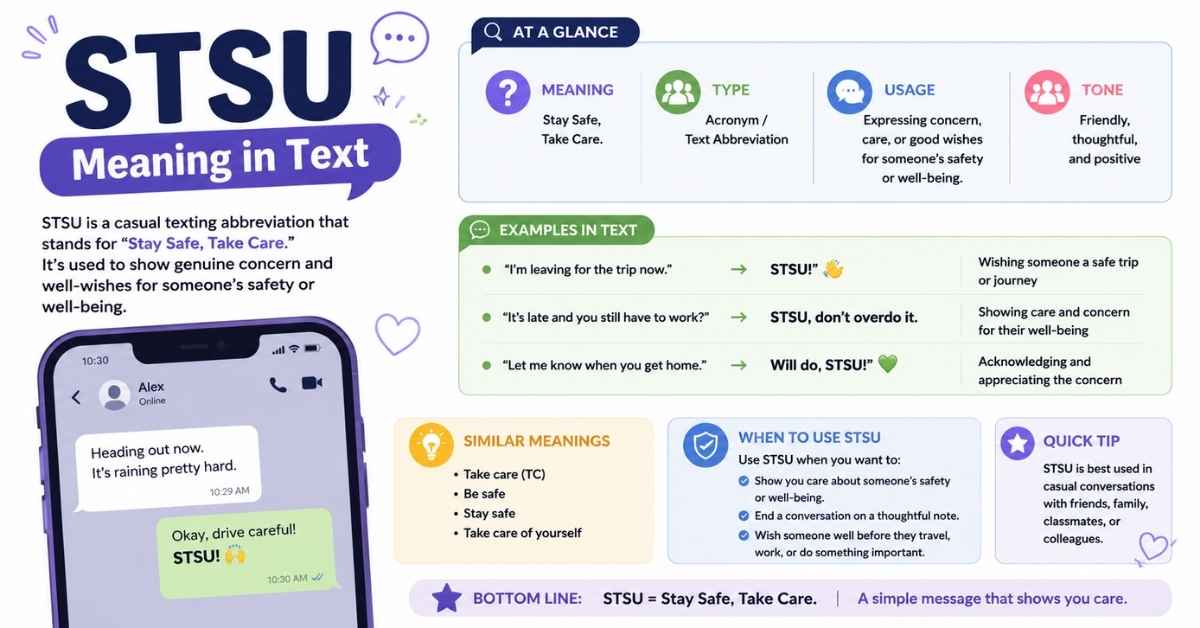
STSU meaning in text most commonly refers to “Shut the sh*t up” or a less explicit version of “Shut up!” It is an internet slang abbreviation people use in text messages, social media conversations, gaming chats, and messaging apps like Snapchat, TikTok, Instagram, WhatsApp, Discord, and Messenger. However, unlike many common texting abbreviations, STSU doesn’t have one universally accepted meaning. The correct interpretation depends on the conversation, tone, emojis, and the relationship between the people chatting.
If you searched “what does STSU mean in text”, chances are you just received this abbreviation in a message and want to know whether it was meant as a joke, friendly teasing, or an insult. The good news is that context tells the real story. In many casual conversations between friends, STSU is simply a humorous reaction similar to saying, “Oh, stop!” or “You’re kidding me!” In other situations, especially during heated arguments, it can carry a much harsher meaning.
This guide explains what STSU means, where it’s used, when it’s considered rude, how to reply, and why different websites give different definitions. By the end, you’ll know exactly how to interpret STSU in almost any conversation.
| Quick Answer | Explanation |
|---|---|
| Most common meaning | STSU is commonly used as a slang abbreviation that usually means “Shut the sh*t up” or a softened variation of “Shut up!”, depending on the conversation. |
| Used on | TikTok, Snapchat, Instagram, WhatsApp, Discord, Messenger, gaming chats, and text messages. |
| Tone | Can be playful, sarcastic, surprised, teasing, or genuinely rude, depending on the relationship and context. |
| Is it offensive? | Sometimes. Among close friends it is often joking, but with strangers or during arguments it can be offensive. |
| Safe for work? | No. It’s best avoided in professional or formal conversations. |
| Should you reply? | Yes, but your response should match the tone of the conversation. |
What Does STSU Mean in Text?
At its core, STSU is an online acronym used to express a strong emotional reaction. Depending on the situation, it can communicate surprise, disbelief, playful teasing, sarcasm, excitement, frustration, or annoyance.
Unlike official dictionary words, internet slang evolves naturally through online communities. That means abbreviations like STSU often develop slightly different meanings across different groups, platforms, and generations.
The most common interpretation remains:
STSU = “Shut the sh*t up” (or simply “Shut up!”)
Despite sounding aggressive, many people use it affectionately with close friends.
For example:
Friend A: “I just won free concert tickets!”
Friend B: “STSU! No way 😂”
Here, STSU isn’t an insult. Instead, it expresses shock, excitement, and disbelief.
Now compare that with another conversation:
Person A: “You’re always wrong.”
Person B: “STSU.”
In this case, the abbreviation clearly carries a negative and dismissive tone.
The words themselves haven’t changed—the context has.
Why Context Matters More Than the Acronym
One of the biggest mistakes people make is assuming every internet abbreviation has only one meaning.
With STSU, the surrounding conversation completely changes how readers interpret it.
Several factors influence its meaning.
Your Relationship with the Sender
This is often the biggest clue.
If your best friend sends:
“STSU 😂😂”
They’re probably laughing with you.
If a stranger sends:
“STSU.”
The message feels much more hostile.
People naturally speak differently with:
- Close friends
- Family members
- Romantic partners
- Gaming teammates
- Coworkers
- Online acquaintances
The closer the relationship, the more likely STSU is intended as playful banter rather than an insult.
The Tone of the Conversation
Tone completely changes the emotional meaning.
Consider these examples.
Playful
“You finally admitted I was right?”
“STSU 😂”
Meaning:
“You’re impossible.”
Shocked
“Taylor Swift followed me!”
“STSU!! 😭”
Meaning:
“I can’t believe it!”
Sarcastic
“Sure… because you’re always perfect.”
“STSU 🙄”
Meaning:
Mild irritation mixed with sarcasm.
Angry
“Leave me alone.”
“STSU.”
Meaning:
A genuine expression of frustration.
The same abbreviation communicates very different emotions depending on the overall conversation.
Emojis Tell Half the Story
Modern digital communication isn’t just about words.
Emojis provide emotional context that abbreviations alone cannot.
| Emoji | Likely Meaning |
|---|---|
| 😂 | Playful teasing |
| 😭 | Dramatic disbelief |
| 🤣 | Friendly joking |
| ❤️ | Affectionate teasing |
| 🙄 | Sarcasm |
| 😡 | Anger |
| 😅 | Awkward humor |
Ignoring emojis often leads to misunderstanding the message.
Is STSU Always Rude?
No.
This surprises many people because the literal wording sounds offensive.
In reality, many internet users treat STSU the same way they treat expressions like:
- “Stop it!”
- “Get out of here!”
- “No way!”
- “You’re joking!”
None of these are automatically rude.
Everything depends on tone, familiarity, and context.
Think of it as similar to friends saying:
“I hate you.”
Among close friends, that sentence often means:
“You’re hilarious.”
Between strangers, it would likely be offensive.
The same social rule applies to STSU.
When STSU Is Playful
Among friends, STSU often appears after exciting news, unbelievable stories, or funny jokes.
Example:
Emma: “I accidentally met my favorite actor today.”
Lily: “STSU!! That’s insane 😭❤️”
Meaning:
- disbelief
- excitement
- happiness
- shared enthusiasm
Nobody feels insulted.
Instead, the abbreviation becomes part of friendly conversation.
When STSU Can Be Offensive
The abbreviation becomes offensive when it’s intended to dismiss or silence someone.
For example:
Person A:
“Can you stop interrupting me?”
Person B:
“STSU.”
Here, the message communicates annoyance rather than humor.
Without a friendly relationship, STSU may easily come across as disrespectful.
This is why online etiquette matters just as much as understanding the slang itself.
Why Different Websites Give Different Meanings
If you’ve searched “STSU meaning” on Google, you’ve probably noticed something confusing.
One website says it means one thing.
Another gives a completely different definition.
A third lists several unrelated expansions.
So who’s right?
The answer is that internet slang isn’t regulated by an official dictionary.
Unlike traditional English words, online acronyms evolve through real conversations on platforms like TikTok, Snapchat, Reddit, Discord, Instagram, and gaming communities. As different groups adopt an abbreviation, they sometimes create new interpretations that spread within smaller communities.
That’s why you may find multiple definitions online.
However, not every definition is equally common.
Some meanings are:
- Widely used across texting and social media
- Popular only in specific online communities
- Rare or outdated
- Completely unrelated organizational acronyms that happen to share the same letters
The safest approach is not to memorize every possible expansion, but to look at the conversation surrounding the message.
Ask yourself:
- Who sent it?
- What were you discussing?
- Were they joking?
- Did they use laughing emojis?
- Was the conversation friendly or argumentative?
Answering these questions almost always reveals the intended meaning more accurately than relying on a single dictionary-style definition.
The Psychology Behind Using STSU
One reason abbreviations like STSU remain popular is that they allow people to express strong emotions quickly without typing a full sentence.
Instead of writing:
“I seriously can’t believe what you just told me.”
Someone simply types:
“STSU 😭”
It’s faster, more expressive, and fits naturally into today’s text messaging culture.
Younger users, especially those active on TikTok, Snapchat, Instagram, Discord, and gaming communities, often prefer short, emotionally expressive slang because it keeps conversations fast-paced and informal.
In many cases, the abbreviation isn’t really about telling someone to be quiet. Instead, it’s a reaction that communicates:
- Surprise
- Disbelief
- Excitement
- Playful teasing
- Friendly banter
- Exaggerated emotion
Understanding this emotional layer helps you interpret STSU far more accurately than focusing only on its literal words.
Learn More: What Does WBU Mean
Real Chat Examples: How STSU Is Used in Everyday Conversations
Reading a definition is helpful, but seeing STSU in realistic conversations makes it much easier to understand. Below are examples that show how the same texting acronym can express different emotions depending on the context.
Example 1: Friends Celebrating Good News
Alex: “I just got front-row concert tickets!”
Mia: “STSU!! 😭 That’s incredible!”
What it means
Here, STSU expresses shock, excitement, and happiness. Mia isn’t telling Alex to be quiet—she’s reacting to unbelievable news.
Tone: Friendly and excited
Example 2: Playful Teasing
Ryan: “I finally beat you at the game.”
Chris: “STSU 😂 It was pure luck.”
What it means
This is classic friendly banter. The abbreviation replaces a playful “Oh, shut up!” without real hostility.
Tone: Humorous
Example 3: Romantic Conversation
Emma: “I still smile every time I think about our first date.”
Jake: “STSU ❤️ You’re going to make me blush.”
What it means
Among couples, STSU can be affectionate and teasing rather than offensive.
Tone: Flirty and playful
Example 4: Gaming Chat
Player 1: “I carried the whole team.”
Player 2: “STSU 🤣 We all saw the scoreboard.”
What it means
Gaming communities often use internet slang casually. Here, the response is lighthearted.
Tone: Competitive but friendly
Example 5: During an Argument
Person A: “You never listen.”
Person B: “STSU.”
What it means
Without emojis or a friendly relationship, the phrase becomes dismissive and potentially offensive.
Tone: Angry
Example 6: Group Chat Reaction
Sarah: “Guess who just met their favorite singer?”
Friends: “STSU!! 😭😭”
What it means
Everyone is expressing excitement and disbelief.
Tone: Shared enthusiasm
How to Reply When Someone Says STSU
If you’re wondering “How do I reply to STSU?”, the best response depends on why the other person used it.
If They’re Joking
Keep the playful mood going.
Examples:
- “I knew you’d say that 😂”
- “You know it’s true!”
- “Believe it or not, it actually happened.”
If They’re Shocked
Reassure them or add more details.
Examples:
- “I couldn’t believe it either.”
- “I have pictures if you don’t believe me.”
- “It honestly surprised me too.”
If They’re Flirting
Respond warmly if you’re comfortable.
Examples:
- “Now you’re making me smile.”
- “Too late—you already blushed.”
- “I’ll take that as a compliment.”
If They’re Annoyed
Stay calm rather than escalating the conversation.
Examples:
- “Let’s slow down.”
- “I didn’t mean to upset you.”
- “Maybe we misunderstood each other.”
If You’re Unsure What They Meant
The easiest solution is simply to ask.
Examples:
- “Wait… are you joking? 😂”
- “I’m not sure how you meant that.”
- “Were you kidding?”
Clarifying the tone prevents unnecessary misunderstandings.
Where You’ll Most Commonly See STSU
Like many online acronyms, STSU appears more often on informal platforms than in professional communication.
Snapchat
On Snapchat, people often use STSU as a quick reaction to surprising photos, stories, or messages.
Example:
“I got free VIP passes.”
“STSU 😭”
The tone is usually playful.
TikTok
Comment sections on TikTok move quickly, so short texting abbreviations are common.
You’ll often see STSU in response to:
- funny videos
- unbelievable stories
- viral moments
- celebrity news
On Instagram, the abbreviation appears in:
- direct messages
- comment sections
- story replies
- meme pages
Again, context determines whether it’s playful or sarcastic.
Because people usually chat with family and friends on WhatsApp, STSU often carries a lighter tone.
However, avoid using it with people who may misunderstand the slang.
Discord
Discord communities, especially gaming servers, frequently use internet slang, chat abbreviations, and reaction phrases.
Here, STSU is often used jokingly between teammates who know each other well.
Messenger
On Messenger, usage depends entirely on the relationship between participants.
Friends may find it funny.
Professional contacts probably won’t.
STSU vs Similar Texting Slang
Many people confuse STSU with other text message abbreviations. Although they look similar, they don’t always carry the same emotional tone.
| Slang | Meaning | Typical Tone | Common Use |
|---|---|---|---|
| STSU | Usually “Shut the sh*t up” or “Shut up!” | Playful, sarcastic, or rude depending on context | Friends, social media, gaming |
| STFU | “Shut the f* up” | Much stronger and more aggressive | Heated arguments or blunt jokes |
| STU | “Shut up” | Milder than STFU | Casual chats |
| IKYFL | “I Know You’re Lying” | Disbelief | Social media and texting |
| ICL | “I Can’t Lie” | Honest admission | Casual conversations |
| ATP | “At This Point” | Frustration or emphasis | Texting and online discussions |
Understanding these differences helps you interpret conversations more accurately.
Can STSU Mean Something Else?
Yes.
One reason this keyword is confusing is that STSU doesn’t always refer to the same thing.
Depending on the situation, you may encounter:
- a texting slang meaning
- a community-specific abbreviation
- an organization or institution that shares the same initials
- a completely unrelated acronym outside social media
This explains why different websites sometimes provide conflicting definitions.
The easiest way to identify the correct meaning is to ask yourself:
- Is this a text message?
- Is it on TikTok, Snapchat, Discord, or another social platform?
- Does the conversation involve friends?
- Is the sender reacting emotionally?
If the answer is yes, the slang interpretation is usually the correct one.
When You Should Avoid Using STSU
Even if your friends use STSU regularly, there are situations where it’s best to avoid it.
Professional Communication
Never use internet slang like STSU in:
- work emails
- business messaging apps
- client conversations
- job interviews
- networking messages
Professional communication requires clear and respectful language.
School or Academic Settings
Teachers, professors, or classmates may not interpret the abbreviation the same way your friends do.
When in doubt, use complete sentences instead.
Talking to Someone You Don’t Know Well
Without an established relationship, the abbreviation can easily sound rude.
If you’re unsure how someone might interpret it, it’s safer to avoid using it.
During Serious Conversations
If someone is discussing:
- family problems
- health concerns
- personal loss
- mental well-being
- important decisions
Using STSU could appear insensitive, even if you intended it as a joke.
Common Misunderstandings About STSU
Several myths continue to spread online.
Myth 1: STSU Always Means the Same Thing
Reality: Context changes everything.
Myth 2: It’s Always Offensive
Reality: Many friends use it affectionately.
Myth 3: Everyone Understands STSU
Reality: Many people have never encountered this chat abbreviation.
Myth 4: It’s Safe in Every Conversation
Reality: Tone, audience, and platform all matter.
Myth 5: Every Website Lists the Same Definition
Reality: Different sources often describe different meanings because internet slang evolves quickly and isn’t governed by an official dictionary.
See More: What Does IMO Mean
How Internet Slang Like STSU Becomes Popular
If you’ve ever wondered why abbreviations like STSU suddenly appear everywhere, you’re not alone. Internet slang evolves much faster than traditional language because millions of people communicate online every day.
Unlike words found in a dictionary, slang develops naturally through conversations. A phrase might start in a small online community, become popular on TikTok or Discord, and then spread to Snapchat, Instagram, WhatsApp, and other messaging apps. As more people adopt it, the meaning may shift slightly depending on the platform or community.
For example, gamers may use an abbreviation differently from content creators or close friends chatting in a private group. That’s why the same texting abbreviation can sound humorous in one conversation but harsh in another.
The best way to understand any online slang is to look beyond the letters and pay attention to:
- Who sent the message
- What was being discussed
- The overall tone of the conversation
- Any emojis or punctuation used
- Your relationship with the sender
This approach works not only for STSU but also for many other chat abbreviations and internet acronyms that continue to evolve.
A Simple Context Decoder for STSU
Instead of guessing what STSU means every time you see it, use this quick framework.
| If STSU appears with… | It Usually Means… |
|---|---|
| 😂 🤣 | Friendly teasing or joking |
| 😭 | Shock, excitement, or disbelief |
| ❤️ | Playful affection |
| 😅 | Awkward humor |
| 🙄 | Mild sarcasm or annoyance |
| 😡 | Anger or frustration |
| No emojis + short replies | Potentially serious or rude |
Remember, emojis don’t change the definition, but they often reveal the sender’s emotional intent.
Should You Use STSU Yourself?
Before adding STSU to your own vocabulary, think about your audience.
It’s generally appropriate when:
- You’re chatting with close friends.
- Everyone understands internet slang.
- The conversation is lighthearted.
- The joke is clearly mutual.
It’s usually better to avoid it when:
- Talking to coworkers or clients.
- Sending professional emails or messages.
- Speaking with teachers or professors.
- Chatting with someone you’ve just met.
- Discussing sensitive or emotional topics.
Choosing language that matches the situation is part of good online etiquette and helps prevent misunderstandings.
Frequently Asked Questions
What does STSU mean in text?
STSU meaning in text most commonly refers to “Shut the sh*t up” or a softened version of “Shut up!” Depending on the conversation, it can express surprise, disbelief, playful teasing, sarcasm, or annoyance rather than literal hostility.
What does STSU stand for?
In casual text messaging and social media, STSU is generally understood as a shortened form of “Shut the sh*t up.” However, because it’s not a standardized acronym, you may occasionally encounter different meanings in unrelated contexts.
Is STSU rude?
It can be, but not always.
Among close friends, it’s often used jokingly. During arguments or conversations with strangers, it may sound dismissive or offensive.
What does STSU mean on Snapchat?
On Snapchat, STSU is usually a playful reaction to something surprising, funny, or unbelievable. Most users interpret it as exaggerated disbelief rather than an actual command to be quiet.
What does STSU mean on TikTok?
On TikTok, the abbreviation often appears in comments reacting to:
- Viral videos
- Funny moments
- Unexpected stories
- Celebrity news
- Memes
In many cases, it simply means “I can’t believe that!” or “You’re kidding!”
Is STSU the same as STFU?
No.
Although both expressions tell someone to “shut up,” STFU is generally much stronger and more aggressive.
STSU, especially among friends, is more likely to be used jokingly or as a reaction to surprising news.
Can STSU be used jokingly?
Yes.
This is actually one of its most common uses. Friends often type STSU 😂 after hearing exciting, unbelievable, or funny news.
How should I reply to STSU?
Your reply should match the tone of the conversation.
If it’s playful:
- “I know, right? 😂”
- “You’ll never believe the rest!”
- “I’m serious!”
If it seems hostile:
- Stay calm.
- Ask for clarification if needed.
- Avoid escalating the conversation.
Does STSU have different meanings?
Yes.
Outside internet slang, the same letters may represent unrelated organizations, projects, or internal abbreviations. That’s why context is essential when interpreting the acronym.
Is STSU popular among Gen Z?
Yes. Like many text message abbreviations, STSU is most commonly seen among younger users who communicate frequently through TikTok, Snapchat, Instagram, Discord, WhatsApp, and other social media platforms.
Final Thoughts
Internet language changes constantly, and abbreviations like STSU are a perfect example of how digital communication continues to evolve. While the letters themselves are simple, the meaning behind them depends on tone, context, and relationships.
Rather than assuming every acronym has one fixed definition, focus on the conversation as a whole. Look at who sent the message, how they normally communicate, the emojis they used, and what was being discussed. Doing so will help you understand not only STSU but countless other internet slang, texting acronyms, and social media abbreviations you encounter online.
As new expressions emerge across TikTok, Snapchat, Instagram, Discord, WhatsApp, and other messaging platforms, understanding the context behind the words will always be more valuable than memorizing every abbreviation.