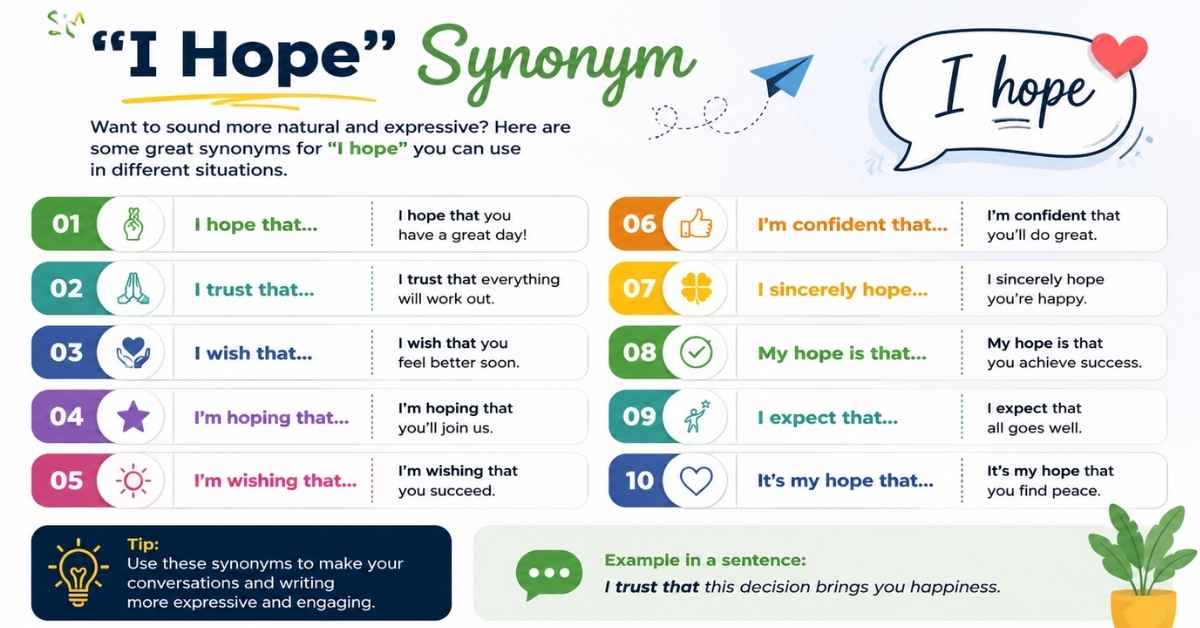
I hope synonym options include phrases like “I trust,” “I’m confident,” “I sincerely hope,” “I wish,” “Here’s hoping,” and “With any luck.” The best alternative depends on who you’re talking to, the tone you want to convey, and the context of your message. While “I hope” is a polite and versatile expression, using the same phrase repeatedly can make emails, letters, and conversations feel repetitive. Choosing the right synonym helps your writing sound more professional, natural, confident, and engaging without changing your intended meaning.
Whether you’re writing a business email, an academic paper, a cover letter, a client proposal, or a friendly message, knowing another way to say “I hope” can instantly improve your communication. In this guide, you’ll discover the best alternatives to “I hope,” understand when to use each one, avoid common mistakes, and learn how native English speakers naturally express hope in different situations.
The Best Synonyms for “I Hope” at a Glance
If you’re looking for a quick answer, here’s a handy comparison table with some of the most natural alternatives to “I hope.”
| Alternative | Tone | Best For | Formality |
|---|---|---|---|
| I trust | Professional | Business emails, clients | ⭐⭐⭐⭐⭐ |
| I’m confident | Positive & Professional | Reports, presentations | ⭐⭐⭐⭐⭐ |
| I sincerely hope | Formal & Respectful | Official letters | ⭐⭐⭐⭐⭐ |
| I wish | Neutral | General writing | ⭐⭐⭐ |
| Here’s hoping | Casual | Friends, social media | ⭐⭐ |
| With any luck | Conversational | Everyday conversations | ⭐ |
| Wishing you the best | Warm | Personal messages | ⭐⭐⭐ |
| Fingers crossed | Friendly | Text messages | ⭐ |
| I look forward to | Professional | Emails, follow-ups | ⭐⭐⭐⭐⭐ |
| I’m optimistic that | Formal | Business & academic writing | ⭐⭐⭐⭐ |
Expert Tip: There isn’t one perfect synonym for “I hope.” The right expression depends on your audience, relationship, and purpose. Choosing the correct phrase can make your writing sound significantly more polished.
Why People Search for an “I Hope” Synonym
At first glance, replacing “I hope” may seem like a simple vocabulary exercise. In reality, most people search for another way to say “I hope” because they want to improve the quality of their writing.
Here are the most common reasons:
- Avoid repeating “I hope” in every email.
- Sound more professional when communicating with clients or managers.
- Make academic writing clearer and more formal.
- Write messages that feel warmer and more genuine.
- Expand vocabulary and improve English writing skills.
- Use phrases that sound natural to native English speakers.
For example, imagine you’re sending several emails each day. Beginning every message with “I hope you’re doing well” quickly becomes repetitive. Replacing it with a more suitable expression helps your communication feel fresh while maintaining professionalism.
How to Choose the Right Alternative Based on Your Situation
One of the biggest mistakes people make is assuming every synonym works in every situation. It doesn’t.
The best alternative to “I hope” depends on three important factors:
- Who you’re writing to
- Why you’re writing
- How formal the communication should be
Let’s explore each scenario.
When Writing a Professional Email
Professional emails require language that is respectful, concise, and confident.
Instead of repeatedly writing:
I hope you’re doing well.
You could say:
- I trust you’re doing well.
- I trust you’ve had a productive week.
- I hope your week is going well.
- I hope everything has been going smoothly for you.
- I appreciate your time today.
Among these, “I trust you’re doing well” is often considered a stronger professional alternative because it conveys confidence while remaining polite.
Example
Instead of:
I hope you’re doing well.
Try:
I trust you’ve had a productive week and had a chance to review my proposal.
This version sounds more polished and avoids a cliché opening.
When Writing to a Client
Client communication should balance professionalism with warmth.
Good alternatives include:
- I trust everything is going well on your end.
- I hope your project is progressing smoothly.
- I’m confident we’ll achieve great results together.
- Wishing you continued success with your project.
These expressions demonstrate both courtesy and confidence, which helps strengthen professional relationships.
Example
I trust your team had a successful product launch. I’m excited to discuss the next steps for our collaboration.
Notice how the sentence feels personalized instead of relying on a generic greeting.
When Writing to Your Manager or Employer
Communication with a supervisor should remain respectful, direct, and positive.
Suitable alternatives include:
- I trust everything is going well.
- I’m confident this approach will meet our objectives.
- I appreciate your guidance.
- I look forward to your feedback.
Example
Instead of writing:
I hope you like my report.
Try:
I’m confident this report addresses the project’s key objectives, and I look forward to your feedback.
This wording projects confidence while remaining professional.
When Writing to a Professor or Instructor
Academic communication benefits from a respectful and formal tone.
Useful alternatives include:
- I trust you’re doing well.
- I appreciate your time and consideration.
- I sincerely hope this meets the assignment requirements.
- I look forward to your feedback.
Example
I appreciate your time in reviewing my paper and look forward to your suggestions for improvement.
Compared to a simple “I hope you like my paper,” this version sounds far more polished.
When Writing to Friends or Family
Personal messages allow for more warmth and personality.
Natural alternatives include:
- Here’s hoping everything goes well!
- Wishing you all the best.
- Fingers crossed!
- I really hope everything works out for you.
- Best of luck!
Example
Here’s hoping your interview goes amazingly well—you’ve worked so hard for it!
This feels genuine and conversational.
When Posting on Social Media
Social media communication tends to be relaxed and engaging.
Popular alternatives include:
- Fingers crossed!
- Here’s hoping!
- Can’t wait to hear how it goes!
- Wishing everyone the best today!
- Sending positive vibes!
Example
Here’s hoping the weather stays sunny for the weekend! ☀️
This sounds friendly and natural without feeling overly formal.
Professional Alternatives to “I Hope”
If you’re writing business emails, reports, proposals, or workplace messages, choosing the right words can leave a stronger impression.
Below are some of the best professional synonyms for “I hope.”
1. I Trust
Meaning: Expresses confidence while remaining polite.
Best For:
- Business emails
- Client communication
- Professional networking
- Workplace correspondence
Example
I trust you had a pleasant weekend and are ready for the upcoming meeting.
When to Avoid
Avoid using “I trust” with close friends or casual conversations, as it can sound overly formal.
2. I’m Confident
This phrase communicates certainty rather than simple hope.
Best For
- Project proposals
- Team updates
- Presentations
- Professional reports
Example
I’m confident our strategy will deliver strong results over the coming months.
This wording demonstrates assurance while remaining positive.
3. I Sincerely Hope
Adding “sincerely” increases the emotional sincerity of your message.
Best For
- Official letters
- Formal emails
- Expressions of concern
- Congratulations
Example
I sincerely hope your recovery continues smoothly.
The phrase sounds thoughtful without becoming overly emotional.
4. I’m Optimistic That
This is an excellent choice when discussing future outcomes.
Example
I’m optimistic that our partnership will continue to grow successfully.
Compared with simply saying “I hope,” this alternative conveys a stronger sense of confidence.
5. I Look Forward To
Although it isn’t a direct synonym, it’s one of the most effective replacements in professional communication because it focuses on future action rather than uncertainty.
Example
I look forward to discussing this opportunity with you next week.
This is often a better choice than:
I hope to hear from you soon.
because it sounds more confident while remaining courteous.
Why These Alternatives Work Better
Professional communication isn’t just about replacing words—it’s about choosing language that reflects the right tone.
A thoughtful alternative to “I hope” can help you:
- Build stronger relationships with clients.
- Make emails sound more polished.
- Communicate confidence without sounding arrogant.
- Improve clarity and professionalism.
- Create a more positive impression on readers.
Most importantly, using a variety of expressions prevents your writing from becoming repetitive while making your communication feel more authentic and engaging.
Formal Alternatives to “I Hope” for Business and Academic Writing
When writing to clients, recruiters, professors, executives, or business partners, your wording should reflect professionalism, confidence, and respect. While “I hope” is perfectly acceptable, choosing a more suitable phrase can make your message sound more polished and purposeful.
The key is selecting an expression that matches the tone of your communication without sounding forced or overly formal.
1. I Trust
Best for: Business emails, client communication, networking
Tone: Professional, confident, courteous
Example
I trust you’ve had a productive week and are ready for tomorrow’s meeting.
Why it works: Unlike “I hope,” “I trust” expresses confidence while remaining polite. It’s one of the most common alternatives used in professional correspondence.
2. I Look Forward To
Best for: Follow-up emails, interviews, proposals
Tone: Positive and forward-looking
Example
I look forward to discussing the proposal with you next week.
Although it isn’t a direct synonym for “I hope,” it often communicates the intended message more effectively by focusing on future collaboration.
3. I’m Confident
Best for: Reports, presentations, project updates
Example
I’m confident this strategy will improve customer engagement.
This phrase communicates belief based on evidence rather than simple optimism.
4. I Remain Optimistic
Best for: Long-term projects, partnerships, negotiations
Example
I remain optimistic that we’ll reach a mutually beneficial agreement.
This expression sounds thoughtful and measured, making it ideal for formal communication.
5. I Anticipate
Best for: Academic papers, research, official reports
Example
I anticipate positive outcomes following the implementation of these recommendations.
Unlike casual alternatives, “I anticipate” suggests expectation based on logical reasoning.
Formal Alternatives Comparison Table
| Phrase | Best Used For | Tone | Confidence Level |
|---|---|---|---|
| I trust | Business emails | Professional | High |
| I’m confident | Reports | Strong | Very High |
| I sincerely hope | Formal letters | Respectful | Medium |
| I remain optimistic | Long-term communication | Professional | High |
| I anticipate | Academic writing | Formal | High |
| I look forward to | Email closings | Positive | High |
Casual and Friendly Ways to Say “I Hope”
When you’re messaging friends, family members, classmates, or colleagues you know well, your language can be much more relaxed.
Instead of sounding overly formal, choose expressions that feel warm and genuine.
Here’s Hoping
One of the most natural alternatives.
Example
Here’s hoping everything works out exactly the way you planned!
This phrase feels encouraging and optimistic.
Fingers Crossed
Perfect for everyday conversations.
Example
Fingers crossed your exam goes well tomorrow!
This is commonly used in texts, chats, and social media posts.
Wishing You the Best
Suitable for both personal and semi-professional situations.
Example
Wishing you the best with your new job!
It expresses kindness without sounding repetitive.
Best of Luck
Ideal when someone is preparing for:
- Interviews
- Exams
- Presentations
- Competitions
- New opportunities
Example
Best of luck with your presentation today!
Can’t Wait to Hear How It Goes
Instead of saying:
I hope everything goes well.
You could write:
Can’t wait to hear how everything turns out!
This feels far more conversational.
Sending Positive Thoughts
Useful during difficult situations.
Example
Sending positive thoughts your way during this challenging time.
This expression communicates empathy while avoiding repetitive wording.
Better Alternatives to “I Hope You’re Doing Well”
Few email openings are as overused as:
I hope you’re doing well.
There’s nothing grammatically wrong with it, but recipients who receive dozens of emails each day have likely seen this opening countless times.
Using a more thoughtful greeting can immediately make your email stand out.
Professional Alternatives
Instead of:
I hope you’re doing well.
Try:
- I trust you’re doing well.
- I trust you’ve had a productive week.
- I hope your week has been going smoothly.
- I hope things have been going well on your end.
- I hope all is well with you.
These maintain a professional tone while adding variety.
Client-Friendly Alternatives
For customer or client communication, personalization is even more effective.
Examples:
- I trust your recent project has been progressing smoothly.
- I hope your team has had a successful quarter.
- I hope everything has been going well since our last conversation.
Notice how these greetings reference the recipient’s situation instead of relying on a generic phrase.
Networking Email Alternatives
When reaching out to a new contact:
Instead of:
I hope you’re doing well.
Try:
- It’s great to connect with you.
- Thank you for taking the time to read my email.
- I appreciate the opportunity to reach out.
- I enjoyed learning about your work.
These introductions quickly establish relevance.
Cold Outreach Alternatives
Cold emails benefit from getting to the point.
Example:
I’ve been following your company’s recent work and wanted to introduce myself.
This opening is more engaging than a routine greeting because it immediately explains why you’re writing.
Before-and-After Email Examples
Practical examples help demonstrate how replacing “I hope” can improve clarity and professionalism.
Example 1: Business Email
Before
I hope you’re doing well. I wanted to follow up regarding our proposal.
After
I trust you’ve had a productive week. I’m following up regarding the proposal we discussed last Tuesday.
Why it’s better
- More confident
- More personalized
- Gets to the point quickly
Example 2: Job Application
Before
I hope you had time to review my application.
After
I appreciate your time in reviewing my application and look forward to hearing your feedback.
This sounds more respectful and professional.
Example 3: Customer Support
Before
I hope your issue has been resolved.
After
I trust your issue has now been resolved successfully. Please let us know if there’s anything else we can assist you with.
The revised version feels more reassuring.
Example 4: Academic Email
Before
I hope you enjoyed reading my paper.
After
I appreciate your time in reviewing my paper and welcome any feedback you may have.
This wording is more appropriate for academic communication.
Example 5: Personal Message
Before
I hope your vacation was fun.
After
I can’t wait to hear all about your vacation—I hope you had an amazing time!
This version feels warmer and more conversational.
“I Hope” vs. Similar Expressions
Although many phrases appear interchangeable, they each communicate slightly different meanings.
| Expression | Meaning | Best Context |
|---|---|---|
| I hope | General optimism | Everyday communication |
| I trust | Confident expectation | Business emails |
| I wish | Personal desire | Informal conversations |
| I’m confident | Strong belief | Professional writing |
| I anticipate | Expected future outcome | Academic writing |
| Here’s hoping | Friendly optimism | Casual conversations |
| Fingers crossed | Playful hope | Text messages |
| Wishing you the best | Encouragement | Personal and professional messages |
Understanding these subtle differences helps you choose language that matches both your purpose and your audience.
Common Mistakes When Replacing “I Hope”
Replacing “I hope” isn’t always the right choice. Some alternatives change the meaning or create an unintended tone.
Here are a few common mistakes to avoid.
Using “I Trust” Too Casually
While “I trust” works well in business communication, it may sound stiff in a friendly text message.
Instead of
I trust your vacation was enjoyable.
A friend would probably appreciate:
Hope you had an amazing vacation!
Using “I Wish” in Professional Emails
“I wish” often expresses a personal desire rather than confidence.
Professional writing usually benefits from stronger alternatives such as:
- I look forward to
- I’m confident
- I trust
- I appreciate
Repeating the Same Greeting
Beginning every email with:
I hope you’re doing well.
can quickly become repetitive.
Rotate between several natural openings to keep your communication fresh.
Choosing Words That Sound Unnatural
Some dictionary synonyms rarely appear in real conversations.
For example:
- Aspire
- Yearn
- Long for
These may technically relate to hope, but they don’t work as replacements in most emails or everyday conversations.
Always prioritize natural English over literal synonym lists.
Ignoring Your Audience
The same expression won’t work equally well for:
- Your manager
- A client
- A professor
- A close friend
- A family member
Choosing the right alternative means considering your relationship with the reader, not just the dictionary definition.
Learn More: What Does CYC Mean in Text
Which Alternatives Sound Most Natural to Native English Speakers?
One of the biggest problems with many thesaurus websites is that they list words that are technically related to “hope” but rarely used in real conversations or professional writing.
If your goal is to sound like a native English speaker, focus on expressions people genuinely use every day rather than uncommon dictionary entries.
Commonly Used in Professional Communication
These alternatives appear frequently in business emails, workplace communication, networking, and client correspondence.
- I trust…
- I look forward to…
- I’m confident…
- I appreciate…
- I’m optimistic that…
- I sincerely hope…
Example
Instead of:
I hope you received my previous email.
Write:
I trust you received my previous email.
Or:
I wanted to follow up regarding my previous email.
In many cases, you can remove “I hope” entirely and create a stronger sentence.
Commonly Used in Everyday Conversations
When talking to friends or family, native speakers usually choose simpler, warmer expressions.
Examples include:
- Hope everything goes well!
- Best of luck!
- Fingers crossed!
- Here’s hoping!
- Wishing you all the best!
- Take care!
- Good luck!
These sound friendly without being overly formal.
Natural Alternatives for Social Media
On platforms like LinkedIn, Facebook, Instagram, or X, people tend to use conversational language.
Examples:
- Wishing everyone a wonderful weekend!
- Here’s hoping for better weather tomorrow.
- Sending positive vibes!
- Good luck to everyone taking exams today!
- Can’t wait to hear your updates!
These expressions feel authentic and engaging.
Expressions That Can Sound Outdated or Unnatural
Some dictionary synonyms rarely work as replacements for “I hope.”
Examples include:
- Yearn
- Long for
- Aspire
- Covet
- Crave
Although these words have related meanings, they express desire, not the polite expectation conveyed by “I hope.”
For example:
❌ I yearn you are doing well.
This sounds unnatural.
Instead, write:
✅ I hope you’re doing well.
or
✅ I trust you’re doing well.
How to Make Your Writing Sound More Natural Without Overusing “I Hope”
Strong writers don’t simply replace words—they vary sentence structure and adapt their tone to the situation.
Here are practical techniques you can start using immediately.
Focus on the Reader
Instead of talking about your hope, acknowledge the reader’s situation.
Before
I hope your presentation went well.
Better
Congratulations on completing your presentation. I hope it was a great success.
Or:
I trust your presentation went smoothly.
The message feels more personal and thoughtful.
Remove “I Hope” When It Isn’t Necessary
Sometimes the strongest sentence doesn’t include “I hope” at all.
Before
I hope you can review the attached document.
Better
Please review the attached document at your convenience.
Removing unnecessary words often makes your writing clearer and more confident.
Personalize Your Message
Generic greetings rarely leave a lasting impression.
Instead of:
I hope you’re doing well.
Try:
I enjoyed our conversation last week and wanted to follow up.
Or:
Congratulations on your recent promotion!
Personalization immediately makes your message feel genuine.
Match Your Tone to the Situation
Ask yourself:
- Am I writing to a client?
- A manager?
- A professor?
- A friend?
- A customer?
The answer determines which alternative to “I hope” will sound most appropriate.
See More: What Does FB Mean on Facebook
Quick Decision Guide: Which Phrase Should You Use?
If you’re unsure which expression fits your situation, use this table as a quick reference.
| If You’re Writing To… | Best Alternative | Why It Works |
|---|---|---|
| Client | I trust… | Professional and confident |
| Manager | I’m confident… | Positive and respectful |
| Professor | I appreciate… | Formal and courteous |
| Recruiter | I look forward to… | Forward-looking and professional |
| Customer | Wishing you the best… | Friendly and supportive |
| Friend | Here’s hoping… | Casual and warm |
| Family | Hope everything goes well! | Natural and sincere |
| Social Media Audience | Fingers crossed! | Conversational and engaging |
Common Situations and the Best Alternatives
Business Email
Instead of:
I hope you’re doing well.
Use:
- I trust you’re doing well.
- I trust you’ve had a productive week.
- Thank you for your time today.
Job Application
Instead of:
I hope to hear from you soon.
Use:
- I look forward to hearing from you.
- Thank you for considering my application.
Cover Letter
Instead of:
I hope you will consider my application.
Use:
- I’m confident my experience aligns with your requirements.
- I appreciate your consideration.
Customer Support
Instead of:
I hope your issue has been resolved.
Use:
- I trust your issue has now been resolved successfully.
- Please let us know if we can assist you further.
Academic Writing
Instead of:
I hope this paper demonstrates…
Use:
- This paper demonstrates…
- The findings suggest…
- The research indicates…
Academic writing generally benefits from objective language rather than personal expressions.
Expert Tips for Choosing the Right Synonym
Here are a few practical guidelines that professional writers and editors follow.
Use “I Trust” Carefully
It’s excellent for business communication, but it may sound too formal in casual conversations.
Avoid Replacing “I Hope” Just for Variety
If “I hope” is already the clearest and most natural option, keep it.
Replacing it unnecessarily can make your writing sound forced.
Think About the Reader
The same sentence can sound very different depending on who receives it.
For example:
Client
I trust everything is progressing smoothly.
Friend
Hope everything’s going well!
Both are correct—but each fits a different audience.
Keep Your Language Simple
Simple, natural English almost always sounds better than complicated vocabulary.
Instead of trying to impress readers with unusual words, focus on clarity, warmth, and authenticity.
Frequently Asked Questions
What is another way to say “I hope”?
Some of the best alternatives include “I trust,” “I’m confident,” “I sincerely hope,” “I look forward to,” “Here’s hoping,” and “Wishing you the best.” The right choice depends on whether you’re writing a professional email, an academic paper, or a casual message.
Is “I hope” professional?
Yes. “I hope” is grammatically correct and perfectly acceptable in professional communication. However, varying your wording occasionally can make your emails sound more polished and less repetitive.
What is a formal alternative to “I hope”?
Professional alternatives include:
- I trust
- I’m confident
- I remain optimistic
- I anticipate
- I sincerely hope
These phrases are especially suitable for business communication, professional writing, and academic correspondence.
Can I replace “I hope” in an email?
Absolutely. Many email openings sound more natural when you use alternatives such as:
- I trust you’re doing well.
- Thank you for your time.
- I appreciate your consideration.
- I look forward to your response.
The best choice depends on your relationship with the recipient and the purpose of the email.
Is “I trust” better than “I hope”?
Neither phrase is universally better.
- “I hope” expresses optimism and warmth.
- “I trust” conveys confidence and professionalism.
Use “I trust” mainly in formal or business communication, while “I hope” remains appropriate in many everyday situations.
How do I stop repeating “I hope” in emails?
Rotate between natural alternatives, personalize your opening, or begin your email with the reason you’re writing instead of a greeting. This makes your communication more engaging and avoids repetitive phrasing.
What is another way to say “I hope you’re doing well”?
You can use:
- I trust you’re doing well.
- I trust you’ve had a productive week.
- I hope all is well with you.
- I hope your week has been going smoothly.
- I appreciate your time today.
- It’s great to connect with you again.
These alternatives feel fresh while maintaining a professional tone.
Which alternative sounds most natural?
For business emails, “I trust” and “I look forward to” are among the most natural choices.
For friends and family, expressions like “Hope everything goes well,” “Fingers crossed,” and “Wishing you the best” feel warm and conversational.
Final Thoughts
Finding the right i hope synonym isn’t about replacing one phrase with another simply for variety. It’s about choosing language that matches your audience, purpose, and tone.
For professional emails, phrases like “I trust,” “I’m confident,” and “I look forward to” help you communicate with confidence and clarity. In academic writing, objective language often works better than personal expressions. And for friends, family, or social media, casual alternatives such as “Here’s hoping,” “Fingers crossed,” or “Wishing you the best” sound genuine and natural.
Ultimately, “I hope” remains a perfectly correct and widely accepted expression. The most effective writers don’t avoid it—they simply know when to use it and when another phrase communicates their message more effectively. By understanding the subtle differences between these alternatives and tailoring your wording to each situation, you can make every email, message, or conversation feel more polished, authentic, and engaging.