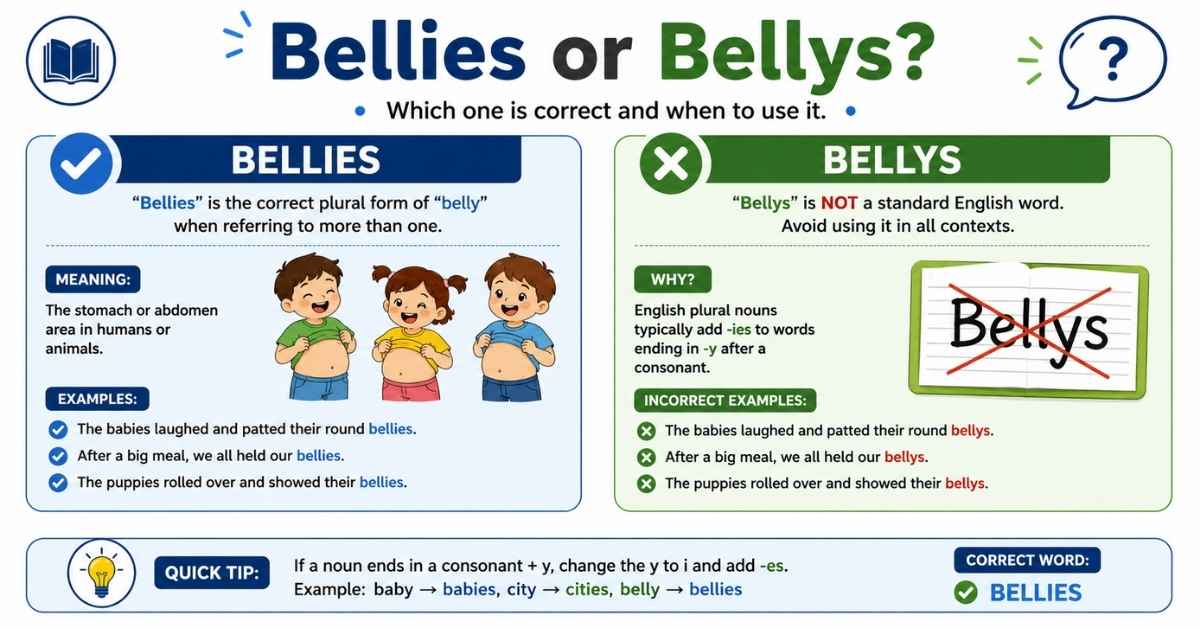
Bellies or bellys — if you’ve ever paused while writing because you weren’t sure which spelling is correct, you’re not alone. “Bellies” is the correct plural of “belly,” while “bellys” is incorrect in standard English. The reason is simple: when a noun ends with a consonant followed by the letter “y,” you usually replace the “y” with “ies” to form the plural. That’s why belly → bellies, just as baby → babies and city → cities.
This is one of the most common English grammar and spelling rules that confuses students, ESL learners, writers, and even native speakers. The mistake often happens because English contains several pluralization patterns, making it easy to second-guess yourself.
In this guide, you’ll learn why “bellies” is the correct plural of belly, why “bellys” isn’t considered a proper English word, the grammar rule behind the spelling, common exceptions, practical examples, and easy memory tricks that will help you avoid similar mistakes in the future. By the end, you’ll understand the broader plural noun pattern instead of simply memorizing one word.
The Quick Answer: Is It Bellies or Bellys?
If you’re looking for a quick answer, here it is:
✅ Bellies is the correct plural form of belly.
❌ Bellys is incorrect in standard English.
The word belly ends with a consonant (“l”) followed by the letter “y.” According to standard English spelling rules, nouns with this ending change the “y” to “ies” when they become plural.
Quick Reference Table
| Singular | Correct Plural | Incorrect |
|---|---|---|
| Belly | ✅ Bellies | ❌ Bellys |
Correct Examples
- The children laughed until their bellies hurt.
- The bears rubbed their bellies against the tree.
- After the big meal, everyone held their bellies and smiled.
Incorrect Examples
- ❌ The children laughed until their bellys hurt.
- ❌ The bears rubbed their bellys.
- ❌ Their bellys were full after dinner.
Whenever you’re wondering “is it bellies or bellys?”, remember that bellies is always the correct spelling in formal, academic, and everyday English.
Why Is Bellies Correct? Understanding the Grammar Rule
Many people know that bellies looks right but aren’t sure why. Understanding the rule makes it much easier to remember—not just for this word but for dozens of similar nouns.
The Rule
When a singular noun ends with:
Consonant + Y
change the Y to IES before adding the plural ending.
Formula
Singular → Remove Y → Add IES
For example:
- Belly → Bellies
- Baby → Babies
- Lady → Ladies
- Story → Stories
- Berry → Berries
Since belly ends with the consonant L followed by Y, it follows this rule perfectly.
Why Doesn’t English Simply Add “S”?
This is one of the most common questions people ask.
Imagine if English simply added S:
Belly → Bellys
Although it may seem logical, this spelling doesn’t follow standard English orthography (spelling conventions). Changing Y to IES preserves the established pattern used for thousands of English nouns ending in a consonant + Y.
Over time, this convention has become one of the fundamental grammar rules taught in schools and used consistently in dictionaries and style guides.
Expert Insight
English spelling may seem inconsistent at times, but plural forms often follow predictable patterns. Learning these patterns is much more effective than memorizing individual words. Once you understand why belly becomes bellies, you’ll automatically recognize the correct plural forms of many other nouns.
Breaking Down the Word
Let’s examine the word more closely.
Singular
Belly
Ends with:
L + Y
Since L is a consonant:
Replace:
Y
with
IES
Result:
✅ Bellies
Not
❌ Bellys
This small spelling change follows a long-established pluralization rule in English.
Why This Rule Matters
Learning this rule helps you write more accurately in many situations, including:
- School assignments
- Essays
- Professional emails
- Business documents
- Creative writing
- Blog articles
- Social media posts
Instead of guessing every time, you’ll understand the underlying pattern and write with confidence.
When Do Words Ending in Y Change to IES?
Now that you know why bellies is correct, it’s helpful to understand the broader rule that applies to many English nouns.
Whenever a noun ends with a consonant followed by the letter “y,” you generally:
- Remove the y
- Add ies
This rule appears throughout everyday English.
Common Examples
| Singular | Plural |
|---|---|
| Belly | Bellies |
| Baby | Babies |
| City | Cities |
| Lady | Ladies |
| Family | Families |
| Story | Stories |
| Country | Countries |
| Berry | Berries |
| Army | Armies |
| Party | Parties |
Notice how every singular noun ends with:
Consonant + Y
Each one changes to IES in the plural.
Recognizing the Pattern
Instead of remembering every word separately, train yourself to spot the ending.
Ask yourself:
Does the word end with a consonant before the letter Y?
If the answer is yes, you almost always replace Y with IES.
This simple habit dramatically reduces spelling mistakes.
Real-Life Examples
Everyday Conversation
The children laughed so hard that their bellies hurt.
At School
The teacher asked students to identify the plural of belly, and everyone correctly answered bellies.
Healthcare
The doctor examined the patients’ bellies during the checkup.
Animals
The penguins slid across the ice on their bellies.
Cooking
After Thanksgiving dinner, everyone’s bellies were completely full.
Using the word in different situations helps reinforce the correct spelling naturally.
A Helpful Observation
Many learners mistakenly think every word ending in Y changes to IES.
Fortunately, that’s not true.
There’s one important exception that every English learner should know.
When Do You Simply Add S Instead of IES?
Understanding the exception is just as important as learning the main rule.
If a noun ends with:
Vowel + Y
you do not change the Y.
Instead, you simply add S.
Examples
| Singular | Plural |
|---|---|
| Toy | Toys |
| Key | Keys |
| Boy | Boys |
| Donkey | Donkeys |
| Monkey | Monkeys |
| Day | Days |
| Valley | Valleys |
Notice something different?
The letter immediately before Y is a vowel:
- Toy
- Key
- Boy
- Day
Because of that vowel, the spelling remains unchanged.
Compare the Two Rules
| Ending | Rule | Example |
|---|---|---|
| Consonant + Y | Change Y → IES | Belly → Bellies |
| Vowel + Y | Add S | Toy → Toys |
This comparison makes it much easier to understand why “bellies” is correct but “toies” is not, and why “bellys” is incorrect while “toys” is perfectly acceptable.
An Easy Memory Trick
If the letter before Y is a consonant, let the Y say goodbye and welcome IES.
If the letter before Y is a vowel, simply add S.
Think of it like this:
- Babies
- Families
- Cities
- Stories
- Bellies
But:
- Toys
- Keys
- Boys
- Monkeys
- Valleys
Is “Bellys” Ever Correct?
One of the most common questions people ask after learning the plural rule is whether “bellys” is ever acceptable in English. The short answer is no.
In standard English grammar, “bellys” is considered an incorrect spelling of the plural noun belly. Whether you’re writing an essay, sending an email, publishing a blog post, or posting on social media, the correct plural is always bellies.
Why Do People Write “Bellys”?
There are several reasons this mistake appears so often:
- People assume every noun forms its plural by simply adding -s.
- They forget the consonant + y → ies rule.
- They type quickly without proofreading.
- Autocorrect doesn’t always catch every spelling pattern.
- ESL learners may apply plural rules from their native language.
Because bellys looks plausible at first glance, many writers don’t realize it’s incorrect until they check a dictionary or grammar guide.
Can You Use “Bellys” in Informal Writing?
Even in casual writing, “bellys” isn’t considered a correct alternative. While you might occasionally see it in:
- Online forums
- Social media comments
- User-generated content
- Typographical errors
it remains a spelling mistake, not an accepted variant.
If your goal is clear and professional communication, always write:
- ✅ Bellies
- ❌ Bellys
Bellies vs. Belly’s: Don’t Confuse the Plural with the Possessive
Another common source of confusion isn’t bellies or bellys—it’s bellies vs. belly’s.
Although these words look similar, they serve completely different grammatical purposes.
Understanding the Difference
| Word | Meaning |
|---|---|
| Belly | One stomach |
| Bellies | More than one stomach (plural) |
| Belly’s | Something belonging to one belly (singular possessive) |
| Bellies’ | Something belonging to multiple bellies (plural possessive) |
Examples
Bellies (Plural)
- The children rubbed their bellies after lunch.
- The puppies lay on their bellies in the sunshine.
Belly’s (Singular Possessive)
- The baby’s belly’s movement worried the doctor.
- The dog’s belly’s fur was soft.
Bellies’ (Plural Possessive)
- The patients’ bellies’ measurements were recorded.
- The dancers’ bellies’ movements were perfectly synchronized.
Many people mistakenly add an apostrophe whenever they form a plural. In reality, apostrophes show possession, not plurality.
Learn More: I Hope Synonym
Real-Life Examples You Can Copy with Confidence
Learning grammar rules is helpful, but seeing them used naturally makes them much easier to remember.
Everyday Conversation
- After the picnic, everyone’s bellies were completely full.
- The children laughed until their bellies hurt.
- Our cats rolled onto their bellies for attention.
School Writing
- The science book explains how mammals protect their bellies.
- Students compared the bellies of different insects during class.
Business Writing
- The charity campaign focused on feeding hungry bellies around the world.
- The report discussed livestock health, including injuries to animals’ bellies.
Medical Context
- The doctor gently examined the patients’ bellies.
- Nurses checked newborn babies’ bellies for signs of infection.
Wildlife and Nature
- Crocodiles often rest on their bellies near riverbanks.
- Penguins slide across the ice on their bellies to conserve energy.
Children’s Stories
- The teddy bears lay on their bellies after pretending to enjoy a picnic.
- The little rabbits scratched their fluffy bellies while resting.
These examples demonstrate how naturally bellies fits into everyday English, while bellys never appears in correct writing.
Common Mistakes People Make with “Bellies”
Understanding what goes wrong helps you avoid repeating the same mistake.
Mistake 1: Simply Adding S
Many learners write:
❌ Belly → Bellys
because they assume every plural follows the same pattern.
Correct:
✅ Belly → Bellies
Mistake 2: Confusing Plural and Possessive
Incorrect:
❌ Belly’s (when you mean several bellies)
Correct:
✅ Bellies
Remember:
- Bellies = plural
- Belly’s = possessive
Mistake 3: Applying the Wrong Rule
Some learners memorize only one plural pattern.
Instead, remember there are two common endings:
- Consonant + y → ies
- Vowel + y → s
Knowing both rules prevents future mistakes.
Mistake 4: Trusting Autocorrect Too Much
Grammar-checking software is helpful, but it isn’t perfect.
Always proofread important writing, especially:
- Essays
- Job applications
- Professional emails
- Reports
- Website content
Developing your understanding of English grammar is more reliable than depending entirely on technology.
A Simple Trick to Remember the Rule Forever
One of the easiest ways to remember why belly becomes bellies is through a simple mnemonic.
The Memory Trick
If a consonant stands before the final “Y,” let the “Y” say goodbye and welcome “IES.”
Think of the Y changing into IES whenever it has a consonant as its neighbor.
Examples:
- Belly → Bellies
- Baby → Babies
- Lady → Ladies
- Story → Stories
- Berry → Berries
But when a vowel comes before Y, simply add S.
Examples:
- Toy → Toys
- Key → Keys
- Boy → Boys
- Monkey → Monkeys
- Valley → Valleys
This single rule will help you spell hundreds of English words correctly—not just bellies.
A Visual Shortcut
Ask yourself one question:
What letter comes before the Y?
If it’s a consonant
Replace Y with IES
✅ Belly → Bellies
If it’s a vowel
Keep the Y
Add S
✅ Toy → Toys
This quick mental check takes only a second and dramatically reduces spelling mistakes.
Why This Rule Exists in English
Many people wonder why English doesn’t simply add -s to every noun.
The answer lies in the history of English spelling conventions.
Over centuries, English developed consistent pluralization patterns that make words easier to pronounce and recognize.
Changing -y to -ies after a consonant creates smoother pronunciation and helps readers instantly identify the word as plural.
For example:
- Baby → Babies
- Family → Families
- Country → Countries
- Belly → Bellies
Without this convention, spellings like babys, familys, and bellys would feel unfamiliar because they don’t match the established patterns used throughout modern English.
Although English has many exceptions, this particular grammar rule remains one of its most reliable.
Does British English and American English Use Different Spellings?
Fortunately, this question has a simple answer.
No.
Both British English and American English use:
✅ Bellies
Neither variety accepts:
❌ Bellys
Unlike words such as:
- Colour / Color
- Centre / Center
- Organise / Organize
the plural of belly does not change between regions.
Whether you’re writing for readers in:
- the United States,
- the United Kingdom,
- Canada,
- Australia,
- New Zealand,
or any other English-speaking country, bellies remains the correct spelling.
This consistency makes the rule easy to apply worldwide.
See More: What Does CYC Mean in Text
Similar Words That Follow the Same Grammar Pattern
Once you understand belly → bellies, you’ll recognize dozens of similar words that follow the same consonant + y → ies pattern.
| Singular | Correct Plural |
|---|---|
| Belly | Bellies |
| Baby | Babies |
| Family | Families |
| Lady | Ladies |
| Story | Stories |
| Berry | Berries |
| Country | Countries |
| Army | Armies |
| City | Cities |
| Party | Parties |
Rather than memorizing each word individually, focus on the shared spelling rule. This approach builds stronger grammar skills and makes future writing much more confident.
Words That Look Similar but Follow a Different Rule
Not every word ending in Y changes to IES.
Some follow an entirely different pattern because they end with a vowel + y.
| Singular | Correct Plural |
|---|---|
| Toy | Toys |
| Key | Keys |
| Boy | Boys |
| Donkey | Donkeys |
| Monkey | Monkeys |
| Valley | Valleys |
| Journey | Journeys |
Notice that each of these words has a vowel immediately before the final Y, so the Y stays in place and you simply add S.
Comparing these two groups side by side makes it much easier to understand why bellies is correct while bellys is not.
Why This Mistake Is So Common
If you’ve ever typed bellys before stopping to wonder whether it looked right, you’re in good company.
This mistake is common because English combines multiple pluralization rules, and our brains naturally look for shortcuts. Since many nouns simply add -s, it’s easy to assume belly follows the same pattern.
Other factors also contribute:
- ESL learners often apply rules from their first language.
- Autocorrect doesn’t always prevent every spelling error.
- People write quickly on phones and social media without proofreading.
- Similar-looking words can create confusion.
- Many learners memorize individual spellings instead of understanding the underlying grammar rule.
The good news is that once you remember the consonant + y → ies pattern, you’ll avoid not only bellys, but many other common spelling mistakes as well.
Expert Tips to Avoid Similar Grammar Mistakes
Learning the correct plural of belly is useful, but the real goal is becoming a more confident writer. These practical habits will help you avoid many common English grammar and spelling mistakes.
1. Learn the Rule, Not Just the Word
Instead of memorizing that bellies is correct, remember the pattern:
- Consonant + y → ies
- Vowel + y → s
Once you know the rule, you’ll automatically recognize the correct plural forms of many words.
2. Look at the Letter Before the “Y”
Whenever you’re unsure, ask yourself:
Is there a consonant before the final “y”?
If yes, change y to ies.
If no (it’s a vowel), simply add s.
This quick check works for hundreds of English nouns.
3. Read Professionally Edited Content
Reading books, newspapers, magazines, and reputable websites exposes you to correct grammar naturally. Over time, the correct spelling becomes familiar, making mistakes less likely.
4. Use Trusted Dictionaries
If you’re uncertain, verify the spelling with reliable dictionaries rather than relying solely on search suggestions or social media posts.
Trusted references include:
- Merriam-Webster
- Cambridge Dictionary
- Oxford English Dictionary
- Collins Dictionary
These sources follow standard English spelling conventions and provide accurate grammar guidance.
5. Don’t Depend Entirely on Autocorrect
Spell-checking tools are helpful, but they aren’t perfect. Always proofread important writing, especially:
- School assignments
- Business emails
- Job applications
- Reports
- Blog articles
- Website content
Developing your understanding of plural nouns and grammar rules is far more reliable than depending on software alone.
Frequently Asked Questions
Is it bellies or bellys?
Bellies is the correct spelling. Bellys is incorrect in standard English because nouns ending in a consonant + y change the y to ies when forming the plural.
What is the plural of belly?
The correct plural of belly is bellies.
Example:
- The children held their bellies after eating.
Is bellys a real word?
No. Bellys is not accepted as the standard plural form in English. It is considered a spelling mistake.
Why does belly become bellies?
Because belly ends with a consonant (l) followed by y. According to the standard English grammar rule, you replace y with ies to make the noun plural.
Is the rule the same in British English and American English?
Yes. Both British English and American English use bellies.
What is the difference between bellies and belly’s?
- Bellies = more than one belly (plural)
- Belly’s = something belonging to one belly (singular possessive)
They are not interchangeable.
What other words follow the same grammar rule?
Many nouns follow the same pattern, including:
- Baby → Babies
- Family → Families
- Story → Stories
- Lady → Ladies
- Berry → Berries
- Country → Countries
- City → Cities
- Party → Parties
Learning these examples makes it easier to remember the rule.
Are there exceptions to nouns ending in “y”?
Yes.
If a noun ends with a vowel + y, simply add s.
Examples:
- Toy → Toys
- Boy → Boys
- Key → Keys
- Monkey → Monkeys
- Valley → Valleys
Can I use bellys in informal writing or on social media?
Even in casual writing, bellies remains the correct spelling. While you may occasionally see bellys online, it is still considered incorrect and should be avoided.
How can I remember when to use -ies?
A simple memory trick is:
If a consonant stands before the final “y,” let the “y” say goodbye and welcome “ies.”
This rule applies to belly, baby, family, city, story, and many other words.
Key Takeaways
If you only remember a few points from this guide, make them these:
- ✅ Bellies is the correct plural of belly.
- ❌ Bellys is not correct in standard English.
- When a noun ends in a consonant + y, replace the y with ies.
- When a noun ends in a vowel + y, simply add s.
- Don’t confuse bellies (plural) with belly’s (singular possessive).
- The rule is the same in British English and American English.
- Learning the pattern is more valuable than memorizing individual words because it applies to hundreds of English nouns.
Conclusion
If you’ve ever searched “bellies or bellys”, the answer is clear: bellies is the only correct plural form of belly in standard English. The spelling follows one of the most reliable English grammar rules—when a noun ends in a consonant followed by “y,” replace the “y” with “ies” to make it plural.
Rather than memorizing isolated words, focus on understanding the rule. Once you recognize the consonant + y → ies pattern, you’ll confidently spell not only bellies, but also babies, families, stories, cities, berries, and many other plural nouns correctly.
The next time you hesitate between bellies or bellys, you won’t need to guess. Simply look at the letter before the “y,” apply the grammar rule, and write with confidence. Whether you’re completing homework, writing an email, creating content, or proofreading an important document, mastering this simple spelling pattern will improve your accuracy and strengthen your overall writing skills.