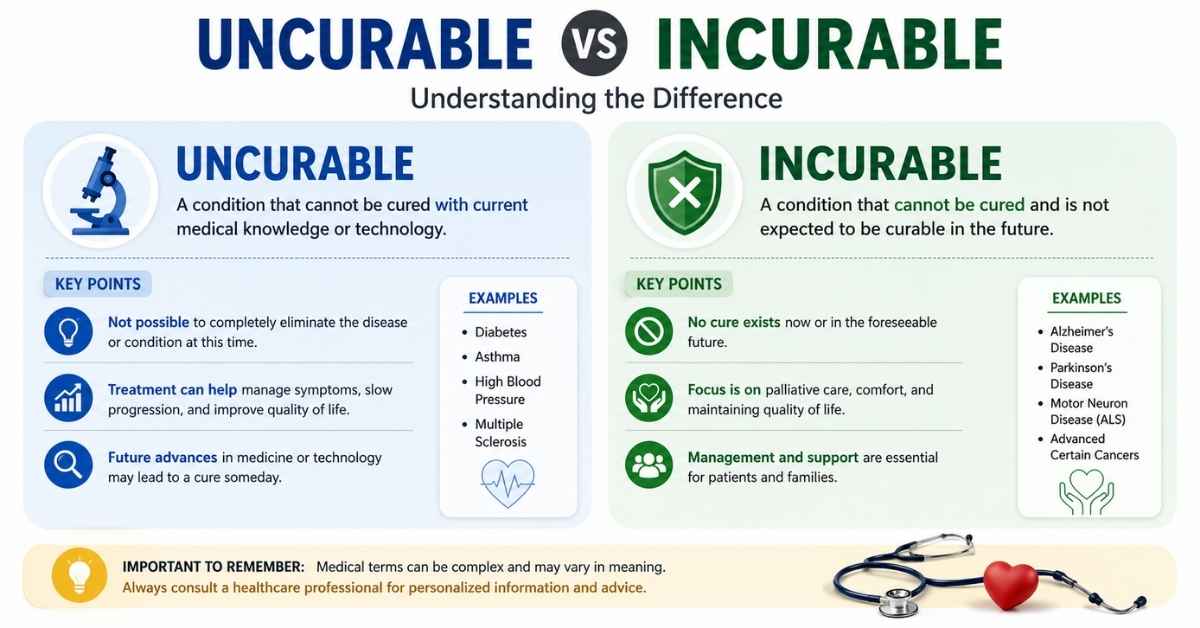
Uncurable vs incurable is a comparison many people search when they want to know which word is grammatically correct, more commonly used, and appropriate in medical or professional writing. The short answer is simple: “incurable” is the standard and widely accepted term in modern English, while “uncurable” is a valid but rarely used variant. In most situations—including medical terminology, academic writing, journalism, and everyday communication—incurable is the preferred choice because it is more familiar, widely recognized, and aligns with modern English usage.
Although both words describe something that cannot be cured, they are not equally common. You’ll frequently encounter incurable disease, incurable condition, or incurable illness in healthcare, scientific literature, dictionaries, and news articles, whereas uncurable appears far less often. Understanding the difference helps you choose the right word for essays, healthcare content, professional documents, and everyday conversations. In this guide, you’ll learn the meanings of both words, how they differ, when to use each one, and why incurable is almost always the better choice.
Uncurable vs Incurable at a Glance
Before diving into the details, here’s a quick comparison that answers the most common questions.
| Feature | Incurable | Uncurable |
|---|---|---|
| Meaning | Cannot be cured | Cannot be cured |
| Is it a real word? | Yes | Yes, but uncommon |
| Common in modern English | Very common | Rare |
| Used by doctors and researchers | Yes | Rarely |
| Appropriate for academic writing | Yes | Generally not recommended |
| Found in healthcare communication | Frequently | Seldom |
| Preferred by editors | Yes | Usually avoided |
| Best choice for most writing | ✔ Incurable | Only in unusual contexts |
Quick takeaway About uncurable vs incurable : If you’re unsure which word to use, choose incurable. It’s the accepted standard in medical writing, formal English, and professional communication.
What Does “Incurable” Mean?
The word incurable means something that cannot currently be cured. It most often describes a disease, illness, medical condition, or disorder for which there is no known cure. However, an incurable condition can often be treated, managed, or controlled, allowing people to live longer and maintain a better quality of life.
Outside medicine, incurable can also describe a personality trait or habit that is deeply ingrained and unlikely to change.
For example:
- She was diagnosed with an incurable disease, but modern treatments helped manage her symptoms.
- Scientists continue researching therapies for conditions once considered incurable.
- He’s an incurable optimist who always believes things will improve.
- Her love of travel is incurable.
Notice how the last two examples use the word figuratively rather than medically. This flexibility makes incurable useful in both formal and everyday English.
Why Is “Incurable” So Common?
Several reasons explain why incurable dominates modern English.
It Is the Standard Medical Term
Healthcare professionals consistently use incurable when discussing diseases that cannot yet be cured. You’ll find it in:
- medical journals
- healthcare websites
- patient education materials
- scientific publications
- research papers
Because medical communication values clarity and consistency, using a standard term helps avoid confusion.
It Appears in Formal Writing
Editors, publishers, universities, and style-conscious writers overwhelmingly prefer incurable because readers immediately recognize it.
You’ll commonly see phrases such as:
- incurable illness
- incurable condition
- incurable cancer
- incurable disease
- incurable genetic disorder
These combinations have become established expressions in modern English.
It Extends Beyond Medicine
Unlike some technical medical terms, incurable is also common in literature, journalism, and conversation.
Examples include:
- an incurable romantic
- an incurable collector
- an incurable dreamer
- an incurable habit
In these contexts, the word suggests that a characteristic is so deeply rooted that it is unlikely to change.
Understanding the Origin of “Incurable”
Knowing where the word comes from makes its meaning easier to remember.
The adjective combines:
- in- = not
- curable = capable of being cured
Together, incurable literally means “not capable of being cured.”
Over time, this form became the preferred choice in English because it followed established language patterns and gained widespread acceptance across medical, academic, and general writing.
What Does “Uncurable” Mean?
Uncurable also means not able to be cured. From a purely literal perspective, it expresses the same basic idea as incurable.
So why do many people hesitate to use it?
The answer lies in usage, not meaning.
Although uncurable appears occasionally in historical texts and some informal writing, it has never achieved the same level of acceptance as incurable. Today, most dictionaries, editors, healthcare professionals, and educators recommend incurable because it is the form readers expect to see.
This is why you rarely encounter phrases like:
- uncurable disease
- uncurable illness
- uncurable condition
Instead, you’ll almost always find:
- incurable disease
- incurable illness
- incurable condition
Language naturally favors certain word forms over others, and incurable became the dominant choice through long-term usage.
Is “Uncurable” a Real Word?
Yes, uncurable is a real English word, but it is uncommon.
Being a real word doesn’t necessarily mean it’s the best word to use. English contains many words that are technically correct but are considered unusual, outdated, or far less natural than their more widely accepted alternatives.
Think of it this way:
A word can exist in dictionaries yet still sound unfamiliar to most readers. That’s exactly the situation with uncurable.
If your goal is to write clearly and professionally, incurable remains the safer and more effective choice.
Why Is “Uncurable” Rare Today?
Several factors contributed to its decline.
Reader Familiarity
People encounter incurable far more often in books, newspapers, healthcare information, and online content. Familiarity influences which words become standard.
Professional Consistency
Medical professionals, researchers, editors, and publishers generally use the same terminology. Because incurable became established early, it continues to dominate modern usage.
Natural Language Evolution
Languages constantly simplify themselves over time. When two words express the same meaning, one usually becomes the preferred form while the other gradually fades from everyday use.
That is exactly what happened with uncurable and incurable.
Is “Uncurable” Correct or Is “Incurable” Better?
This is the question most people really want answered.
The honest answer is that both words can express the same idea, but they are not equally appropriate in modern English.
If you’re writing:
- a university essay,
- a healthcare article,
- a research paper,
- a blog post,
- a business document,
- or professional content,
incurable is the word you should choose.
It is:
- more natural
- more recognizable
- more widely accepted
- preferred by editors
- used in medical terminology
- common in scientific literature
- easier for readers to understand
By contrast, uncurable may distract readers because many have never encountered it before. Even if it’s technically understandable, it can appear awkward or outdated.
Which Word Fits Different Contexts ?
| Context | Best Choice |
|---|---|
| Medical writing | Incurable |
| Academic essays | Incurable |
| Scientific research | Incurable |
| Journalism | Incurable |
| Professional communication | Incurable |
| Everyday writing | Incurable |
| Historical quotations | Original wording |
Expert Tip: When two words share the same meaning but one is significantly more common and widely accepted, professional writers almost always choose the familiar form. Doing so improves readability, builds trust, and ensures your message feels natural to the audience.
Why Doctors, Researchers, and Editors Prefer “Incurable” In both uncurable vs incurable
If you’ve ever read patient education materials, medical journals, or healthcare websites, you’ve probably noticed that incurable appears almost everywhere. That’s not accidental—it reflects the importance of using consistent, precise, and universally understood terminology.
Clear Communication Matters
Medical language must minimize confusion. Patients, caregivers, researchers, and healthcare providers often rely on the same documents to understand complex conditions. Using the established term incurable helps everyone interpret information consistently.
For example, when discussing an incurable condition, readers immediately understand that the disease currently has no cure, even though treatments may still improve symptoms, slow progression, or enhance quality of life.
Scientific Writing Values Consistency
Research papers, clinical studies, and educational resources follow established terminology because consistency improves clarity and allows professionals worldwide to communicate effectively.
Replacing incurable with uncurable offers no additional precision and may even distract readers who are unfamiliar with the less common form.
Editors Prioritize Readability
Professional editors look for words that feel natural and instantly recognizable. Since incurable is the dominant form in modern English, it usually requires no explanation, making the text easier to read and understand.
Compassionate Language Is Equally Important
When writing about serious illnesses, choosing words carefully matters just as much as choosing the correct word.
Good medical communication aims to be:
- accurate
- clear
- respectful
- empathetic
- evidence-based
It’s also important to remember that incurable does not automatically mean untreatable, hopeless, or terminal. Many people live long, meaningful lives with incurable diseases thanks to advances in disease management, symptom control, and ongoing medical research. Understanding this distinction helps writers communicate with both precision and compassion.
Does “Incurable” Mean Untreatable?
One of the biggest misconceptions people have is believing that incurable and untreatable mean the same thing. They don’t.
A condition can be incurable because there is currently no cure that completely eliminates the disease. However, that same condition may still be treatable, meaning doctors can control symptoms, slow its progression, improve quality of life, or help patients live longer.
Understanding this distinction is essential because it prevents unnecessary fear and promotes more accurate communication.
Understanding the Difference
Think of these terms as answering different questions:
- Curable asks: Can this condition be completely eliminated?
- Treatable asks: Can medicine or therapy help manage it?
- Incurable asks: Is there currently no complete cure?
- Untreatable asks: Are there no effective treatments available?
- Terminal asks: Is the disease expected to lead to death despite treatment?
Although these concepts are related, they are not interchangeable.
Learn More: IY Meaning in Text
Curable vs Treatable vs Incurable vs Untreatable vs Terminal
| Term | Meaning | Can Treatment Help? | Can It Be Cured? |
|---|---|---|---|
| Curable | The disease can be completely eliminated. | Yes | Yes |
| Treatable | Symptoms or progression can be managed. | Yes | Not always |
| Incurable | There is currently no known cure. | Often yes | No |
| Untreatable | No effective treatment currently exists. | No | Usually no |
| Terminal | Expected to eventually cause death despite treatment. | Sometimes | Usually no |
Why This Difference Matters
Imagine two patients receive different diagnoses.
The first patient has a condition that is incurable, but medication allows them to continue working, traveling, and enjoying life for many years.
The second patient has a disease that is untreatable, meaning current medicine cannot effectively slow or manage it.
Although neither condition has a cure, their experiences are very different. That’s why using the correct medical terminology is so important.
Common Conditions Often Described as Incurable
Medical science continues to advance every year. Many conditions once considered impossible to manage now have highly effective treatments. Even so, some diseases are still described as incurable because no therapy can completely remove them from the body.
Examples include:
- Parkinson’s disease
- Alzheimer’s disease
- Multiple sclerosis (MS)
- Type 1 diabetes
- Certain genetic disorders
- Some forms of metastatic cancer
- HIV (currently manageable with modern treatment but not completely cured)
It’s important to understand that these examples do not mean there is no hope. Researchers continue developing new therapies, and treatment options improve regularly.
Many people with incurable illnesses live active, fulfilling lives thanks to advances in:
- disease management
- symptom control
- physical therapy
- targeted medications
- personalized treatment plans
- ongoing medical research
This is why healthcare professionals often emphasize management rather than cure.
Can an Incurable Disease Improve?
Yes—an incurable disease can absolutely improve in many ways, even if it cannot currently be cured.
This surprises many people because the word incurable sounds final. In reality, medicine is far more nuanced.
Improvement may include:
- reduced symptoms
- slower disease progression
- fewer complications
- better quality of life
- longer life expectancy
- periods of remission for certain conditions
For example, someone living with an incurable chronic illness may respond extremely well to treatment, allowing them to work, exercise, travel, and enjoy family life.
That is why healthcare providers often focus on:
- symptom management
- rehabilitation
- prevention of complications
- lifestyle improvements
- regular monitoring
- long-term care
Using incurable should never be interpreted as saying that treatment is pointless.
Grammar Perspective: Why “Incurable” Sounds More Natural
Many people wonder why incurable feels more familiar than uncurable when both appear to follow English word-building rules.
The answer lies in how English evolved over time.
The Role of Prefixes
English commonly creates opposite meanings by adding prefixes.
Examples include:
- accurate → inaccurate
- active → inactive
- complete → incomplete
- visible → invisible
- curable → incurable
Although the prefix un- is also common, English doesn’t apply every prefix to every adjective equally.
Language develops through usage rather than strict mathematical rules.
Over centuries, speakers naturally adopted incurable, while uncurable gradually became uncommon.
Today, readers instinctively recognize incurable, making it the more natural choice In uncurable vs incurable.
Is “Uncurable” Grammatically Wrong?
Not exactly.
Many people ask:
Is uncurable a word?
Yes.
Another common question is:
Is uncurable or incurable correct?
The answer is that incurable is the preferred and standard form.
Think of uncurable as a rare alternative that most professional writers simply don’t use.
If your goal is clear communication, choosing incurable is almost always the better decision.
Real-Life Examples of Correct Usage Between uncurable vs incurable
Seeing words used naturally makes the difference much easier to understand.
Medical Writing
✔ The patient was diagnosed with an incurable neurological disorder, but treatment significantly reduced symptoms.
✔ Researchers continue searching for new therapies for incurable diseases.
Academic Writing
✔ The study examined how patients cope with incurable chronic illnesses.
✔ Scientists are investigating innovative treatments for conditions previously considered incurable.
News Reporting
✔ Medical researchers announced encouraging progress toward treating several incurable diseases.
✔ Advances in biotechnology continue to improve outcomes for people living with incurable conditions.
Everyday Conversation
✔ My grandfather lived with an incurable illness for many years and still enjoyed life.
✔ Although the condition is incurable, doctors have excellent treatment options.
Figurative Usage
The word isn’t limited to healthcare.
Examples include:
- She’s an incurable optimist.
- He’s an incurable football fan.
- My sister is an incurable traveler.
- Their curiosity seems incurable.
These examples show how the word can describe personality traits that are unlikely to change.
Common Mistakes People Make
Because the topic combines grammar and medical terminology, several misunderstandings are common.
Mistake 1: Thinking Uncurable Is the Preferred Word
Although uncurable exists, it is rarely used in modern English.
Professional writers almost always choose incurable.
Mistake 2: Assuming Incurable Means Terminal
These words describe different concepts.
A person may live for decades with an incurable disease.
Terminal illnesses involve a very different medical prognosis.
Mistake 3: Confusing Incurable With Untreatable
This is perhaps the most common misunderstanding.
Many incurable conditions respond extremely well to treatment.
Treatment and cure are not the same thing.
Mistake 4: Using Harsh or Insensitive Language
When discussing serious illnesses, word choice matters.
Instead of writing:
“Nothing can be done.”
A more accurate and compassionate statement is:
“Although the condition is incurable, many effective treatments can help manage symptoms and improve quality of life.”
This approach is both medically accurate and emotionally considerate.
See More: What Does NBS Mean in Text
Which Word Should You Use?
If you’re still deciding between uncurable vs incurable, the recommendation is straightforward.
Choose incurable in almost every situation.
It is the form readers expect, editors recommend, and healthcare professionals use consistently.
Quick Decision Guide about uncurable vs incurable
| Situation | Recommended Word |
|---|---|
| Medical article | Incurable |
| Scientific paper | Incurable |
| University assignment | Incurable |
| Healthcare website | Incurable |
| Blog post | Incurable |
| News article | Incurable |
| Business writing | Incurable |
| Everyday communication | Incurable |
| Historical quotation | Preserve the original wording |
A Simple Rule to Remember
Ask yourself these questions:
- Are you writing for a broad audience?
- Is the topic medical or scientific?
- Do you want your writing to sound professional?
- Do you want readers to instantly recognize the word?
If the answer is yes to any of these, incurable is almost certainly the right choice.
Writer’s Tip
When multiple words share the same meaning, professional writers usually choose the version that is:
- more familiar
- more widely accepted
- easier to understand
- commonly used by experts
- preferred in formal writing
For this comparison, that word is incurable.
By consistently choosing the standard form, you’ll communicate more clearly, improve readability, and ensure your writing aligns with modern English conventions.
Frequently Confused Terms In uncurable vs incurable
Although uncurable vs incurable is the primary comparison, several related medical and language terms are often misunderstood. Knowing how they differ will help you communicate more accurately and confidently.
Curable vs Incurable
These two words are direct opposites.
A curable disease can be completely eliminated with appropriate treatment. Once cured, the disease no longer exists in the body.
An incurable disease, on the other hand, cannot currently be cured, but it may still be managed successfully with medication, therapy, lifestyle changes, or other treatments.
Quick Comparison
| Curable | Incurable |
|---|---|
| Can be cured | Cannot currently be cured |
| Treatment may eliminate the disease | Treatment often controls symptoms |
| Recovery is possible | Long-term management is common |
Example:
- Some bacterial infections are curable with antibiotics.
- Parkinson’s disease is currently considered incurable, but treatments can help manage symptoms.
Incurable vs Untreatable
These terms are not synonyms.
An incurable condition has no complete cure, but treatment may still improve symptoms, slow progression, or enhance quality of life.
An untreatable condition has no effective treatment currently available.
This distinction is important because using the wrong word can unintentionally give readers a misleading impression.
Incurable vs Terminal
Another common misconception is assuming that every incurable illness is terminal.
That isn’t true.
A terminal illness is expected to eventually result in death despite treatment.
An incurable illness simply means there is no known cure at present.
Many people live for years—or even decades—with incurable chronic diseases thanks to modern healthcare and ongoing medical advances.
Chronic vs Incurable
These words describe different aspects of a medical condition.
A chronic disease is one that lasts a long time or may be lifelong.
An incurable disease is one that cannot currently be cured.
Some chronic diseases are incurable, while others can improve significantly or even be resolved depending on the condition and treatment.
Cure vs Remission
People often confuse these concepts.
A cure means the disease has been completely eliminated.
Remission means the disease has become less active or symptoms have disappeared for a period of time, but the condition may still be present.
Understanding this difference helps explain why doctors may avoid saying a disease is “cured” even when a patient is doing very well.
How to Choose the Right Word Every Time
If you’re unsure whether to use uncurable or incurable, this simple framework can help.
Choose Incurable if you are writing:
- Medical content
- Healthcare information
- Academic papers
- Research articles
- Business or professional documents
- Blog posts
- News articles
- Educational resources
Consider Uncurable only when:
- You’re quoting historical material.
- You’re preserving the original wording of an older source.
- There’s a specific stylistic reason to keep the uncommon form.
For virtually all modern writing, incurable is the clearer, more natural, and more widely accepted choice.
Expert Tips for Writing About Serious Medical Conditions
When discussing illnesses, your goal should be more than grammatical accuracy. The language you choose can influence how readers understand and emotionally respond to sensitive topics.
Here are a few best practices:
- Be precise. Avoid using medical terms interchangeably when they have different meanings.
- Use compassionate language. Remember that real people and families may be reading your content.
- Avoid unnecessary alarm. Explain that incurable does not automatically mean terminal or untreatable.
- Focus on current knowledge. Medical research continues to evolve, and treatment options may improve over time.
- Write in plain English. Clear explanations help readers understand complex topics without confusion.
Whether you’re creating healthcare content, editing an academic paper, or writing a blog post, combining accuracy, clarity, and empathy makes your content more trustworthy and genuinely helpful.
Frequently Asked Questions About uncurable vs incurable
Is uncurable a real word?
Yes. Uncurable is a real English word, but it is rarely used in modern English. Most dictionaries recognize it, although incurable is the standard and much more common form.
Which is more common: uncurable or incurable?
Incurable is overwhelmingly more common in medical literature, academic writing, journalism, and everyday English.
Is uncurable grammatically wrong?
No. It isn’t grammatically wrong, but it is considered uncommon. In nearly every modern writing situation, incurable is the preferred choice.
Why do doctors use incurable instead of uncurable?
Healthcare professionals use incurable because it is the accepted medical term and promotes clear, consistent communication across research, patient education, and clinical practice.
Does incurable mean terminal?
No.
A disease can be incurable without being terminal. Many incurable conditions can be successfully managed for many years.
Can an incurable disease still be treated?
Absolutely.
Many incurable diseases respond well to medication, rehabilitation, lifestyle changes, surgery, or other therapies that improve quality of life and reduce symptoms.
Should I use uncurable in an essay?
Generally, no.
For academic, professional, or formal writing, incurable is the recommended choice because it is more widely recognized and accepted.
Is incurable only used in medicine?
No.
Although it’s most commonly associated with healthcare, incurable can also describe habits, emotions, or personality traits.
For example:
- an incurable optimist
- an incurable romantic
- an incurable collector
Are uncurable and incurable interchangeable?
They have essentially the same literal meaning, but they are not equally common. In modern English, incurable is almost always the better choice.
Final Verdict
When comparing uncurable vs incurable, the difference isn’t about meaning as much as modern usage.
Both words describe something that cannot be cured, but incurable has become the clear standard across medicine, education, journalism, and everyday communication. It is the word readers expect, professionals use, and style guides recommend.
If your goal is to write naturally, accurately, and confidently, incurable is the word you should use in almost every situation.