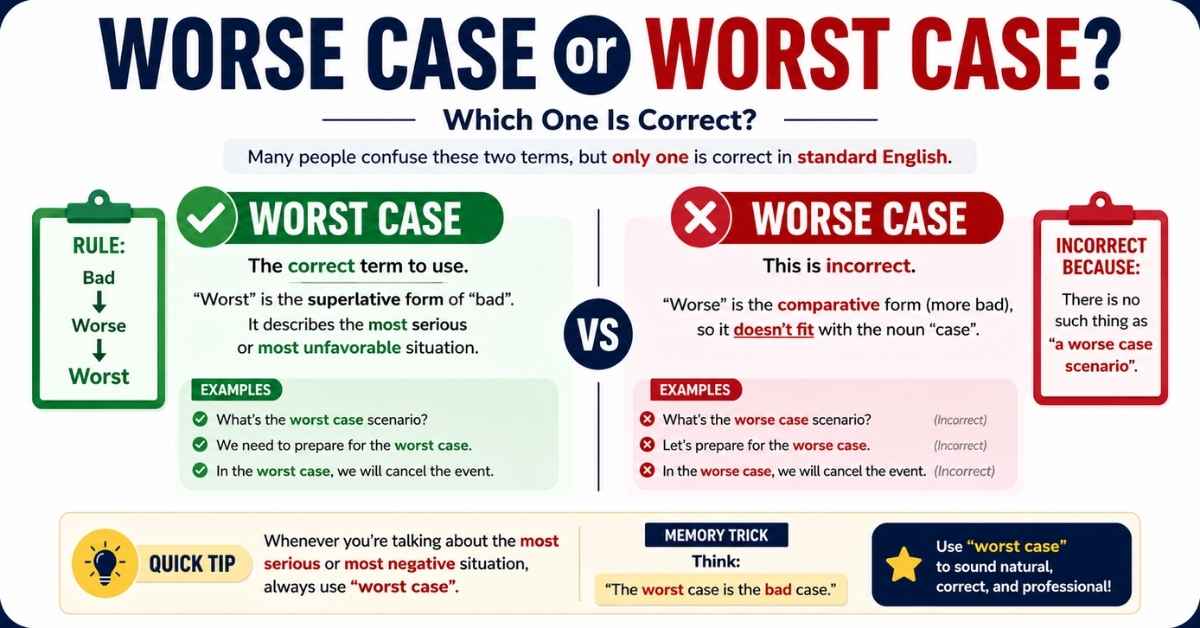
“Worst case” is the correct phrase in standard English, while “worse case” is grammatically incorrect in almost every situation. The word worst is the superlative form of bad, meaning it describes the most extreme or least favorable possibility. In contrast, worse is the comparative form, used only when comparing two things.
Correct: Let’s prepare for the worst-case scenario.
Incorrect: Let’s prepare for the worse case scenario.
If you’ve ever wondered whether to write worse case or worst case, this guide will explain the grammar rule, show real-life examples, and help you remember the correct phrase with confidence.
Introduction
Worse case or worst case is a common grammar question, and the answer is straightforward: “worst case” is correct, while “worse case” is not considered standard English. Although the two words sound similar, they serve different grammatical purposes. Using the wrong one can make an email, report, essay, or professional document look less polished.
Many people second-guess themselves before sending an important message because they’re unsure which version is correct. That’s understandable. English is full of commonly confused words, and worse and worst are among the easiest to mix up. Fortunately, once you understand the simple grammar rule behind them, you’ll never hesitate again.
In this guide, you’ll learn the difference between worse and worst, discover why worst case is the correct expression, understand when to use worst-case with a hyphen, and see plenty of practical examples from business writing, academic work, and everyday conversations.
Why “Worst Case” Is Correct and “Worse Case” Is Not
The phrase worst case has become a fixed expression in English. It refers to the most unfavorable, most extreme, or least desirable outcome that could happen in a particular situation.
Think of it this way:
- If you’re planning a project, the worst case is the biggest problem that could occur.
- If you’re discussing finances, the worst case is the maximum possible loss.
- If you’re talking about travel, the worst case might be that your flight is canceled.
Because the phrase refers to the most extreme possibility, English requires the superlative adjective worst, not the comparative adjective worse.
The Simple Grammar Rule
The easiest way to understand the difference is to remember the three forms of the adjective bad.
| Form | Function | Example |
|---|---|---|
| Bad | Basic adjective | This is a bad idea. |
| Worse | Comparative adjective (compares two things) | Today is worse than yesterday. |
| Worst | Superlative adjective (the most extreme) | This is the worst day of the week. |
Since worst case describes the most serious possible outcome, worst is always the correct choice.
Compare these examples:
- Worst case, we arrive an hour late.
- Let’s prepare for the worst-case scenario.
- Engineers always evaluate the worst-case outcome before approving the design.
❌ Worse case, we arrive an hour late.
❌ The worse case scenario is expensive.
The incorrect versions misuse the comparative adjective worse, making the sentence grammatically incorrect.
Why Do So Many People Say “Worse Case”?
If worst case is correct, why is worse case so common online and in everyday conversations?
There are several reasons.
1. The Words Sound Similar
In casual speech, worse and worst are pronounced similarly, especially when spoken quickly. As a result, people often type what they think they heard rather than what grammar requires.
2. Comparative and Superlative Adjectives Cause Confusion
Many English learners—and even native speakers—occasionally confuse comparative and superlative adjectives.
Examples include:
- less vs. least
- farther vs. farthest
- better vs. best
- worse vs. worst
Understanding one pair makes the others easier to master.
3. Typing Habits and Autocorrect
Fast typing, predictive text, and autocorrect can introduce mistakes, especially when people don’t proofread before publishing a blog post, social media update, or email.
4. Repetition Creates Familiarity
People often repeat phrases they’ve seen online without verifying whether they’re correct. Once an incorrect phrase appears frequently on forums, social media, or informal websites, others begin assuming it’s acceptable.
However, dictionaries, grammar references, and professional style guides consistently recognize worst case as the correct expression in standard English.
Understanding the Difference Between “Worse” and “Worst”
Although the two words are closely related, they perform very different jobs in a sentence.
Understanding this distinction will improve not only your grammar but also your confidence in professional writing.
When to Use “Worse”
Worse is a comparative adjective.
Use it only when comparing two people, objects, situations, or outcomes.
Examples:
- Today’s weather is worse than yesterday’s.
- My headache became worse after lunch.
- This route is worse than the highway.
- The second proposal looks worse than the first one.
- Customer satisfaction became worse after the policy change.
Notice that each sentence compares one thing with another.
When to Use “Worst”
Worst is a superlative adjective.
It refers to the most extreme person, object, condition, or possibility within a group or situation.
Examples:
- That was the worst movie I’ve ever seen.
- Winter is usually the worst season for allergies.
- The company prepared for the worst-case scenario.
- This is the worst traffic we’ve experienced all year.
- The rescue team planned for the worst possible outcome.
Whenever you’re describing the highest level of difficulty, danger, or negativity, worst is the correct word.
Side-by-Side Comparison
| Word | Meaning | Correct Example | Common Mistake |
|---|---|---|---|
| Worse | Compares two things | This option is worse than the first one. | ❌ Worse case scenario |
| Worst | Describes the most extreme situation | Prepare for the worst-case scenario. | ✅ Correct usage |
A simple question can help you choose the right word:
Are you comparing two things?
If yes, use worse.
Are you describing the most extreme possibility?
If yes, use worst.
What Does “Worst Case” Actually Mean?
The expression worst case refers to the most unfavorable outcome that could reasonably happen in a given situation. It’s commonly used in planning, decision-making, problem-solving, and risk assessment to prepare for unlikely but possible negative events.
Instead of assuming everything will go perfectly, people often ask:
“What’s the worst case?”
This question helps them think ahead and develop contingency plans.
For example:
- A business owner considers the worst case before launching a new product.
- Doctors explain the worst-case outcome so patients understand potential risks.
- Engineers test equipment under worst-case conditions to ensure safety.
- Investors evaluate the worst-case scenario before making financial decisions.
- Travelers think about the worst case in case of delayed flights or lost luggage.
Planning for the worst case doesn’t mean expecting failure. Instead, it demonstrates responsible thinking, effective risk management, and sound decision-making.
Because of this, the phrase appears frequently in professional writing, technical documentation, business communication, healthcare discussions, project management, legal documents, education, and everyday conversations.
By understanding the meaning of worst case, you’ll recognize why worse case doesn’t fit the intended meaning. The expression isn’t comparing two possibilities—it’s identifying the single most extreme possibility, which is exactly what the superlative adjective “worst” is designed to express.
Worst Case vs. Worst-Case: Do You Need a Hyphen?
One of the most common follow-up questions after learning that “worst case” is correct is whether it should be written with a hyphen. The answer depends on how the phrase is used in a sentence.
This is a common rule in English grammar that applies to many compound adjectives.
Use “Worst Case” (No Hyphen)
Write worst case without a hyphen when the phrase functions as a noun.
Examples
- The worst case is that we miss our flight.
- Let’s discuss the worst case before making a decision.
- Our team planned for the worst case.
- The worst case would be a complete system failure.
- Always prepare for the worst case during project planning.
In each sentence, worst case names the possible outcome rather than describing another noun.
Use “Worst-Case” (With a Hyphen)
Use a hyphen when worst-case comes before another noun and acts as a compound adjective.
Examples
- worst-case scenario
- worst-case outcome
- worst-case estimate
- worst-case assumptions
- worst-case planning
- worst-case analysis
- worst-case cost
- worst-case prediction
Example sentences:
- The company created a worst-case scenario before launching the product.
- Engineers performed a worst-case analysis to ensure the bridge would remain safe.
- The finance department calculated the worst-case cost before approving the budget.
- Doctors explained the worst-case outcome to the patient’s family.
The hyphen joins the words together so they work as one adjective describing the noun.
Quick Hyphen Rule
| Correct Usage | Why It Is Correct |
|---|---|
| Worst case | Functions as a noun |
| Worst-case scenario | Compound adjective before a noun |
| Worst-case outcome | Describes the noun “outcome” |
| Worst case is… | Predicate noun phrase |
| Prepare for the worst case. | No hyphen needed |
Easy Way to Remember
If scenario, outcome, analysis, plan, estimate, or another noun comes immediately after the phrase, use a hyphen.
If the phrase stands alone, leave the hyphen out.
Learn More: Uncurable vs Incurable
Common Sentences People Get Wrong
Many grammar mistakes happen because people type quickly or rely on how the phrase sounds rather than how it’s written.
Here are some of the most common errors and their correct versions.
| ❌ Incorrect | ✅ Correct |
|---|---|
| Worse case | Worst case |
| Worse case scenario | Worst-case scenario |
| Worse-case outcome | Worst-case outcome |
| Worse case analysis | Worst-case analysis |
| Worse case estimate | Worst-case estimate |
| Worse case planning | Worst-case planning |
| Worse case cost | Worst-case cost |
| Worse case prediction | Worst-case prediction |
| In the worse case | In the worst case |
| Prepare for the worse case | Prepare for the worst case |
| Worse possible outcome | Worst possible outcome |
| Worse possible scenario | Worst possible scenario |
| Worse case example | Worst-case example |
| Worse case assumptions | Worst-case assumptions |
| Worse case event | Worst-case event |
Notice that every incorrect example incorrectly substitutes the comparative adjective “worse” for the superlative adjective “worst.”
Real-Life Examples Across Different Situations
Understanding grammar is easier when you see how the phrase appears naturally in everyday communication.
Business Writing
Business professionals frequently discuss risks before making important decisions.
Examples:
- Our project manager prepared a worst-case scenario for the client presentation.
- The finance team estimated the worst-case cost before approving the investment.
- Every business plan should include a worst-case outcome and a recovery strategy.
Using the correct phrase demonstrates professionalism and attention to detail.
Academic Writing
Students and researchers often analyze possible outcomes.
Examples:
- The report discusses the worst-case scenario if climate targets are not achieved.
- Researchers examined the worst-case effects of prolonged drought.
- The paper evaluates both the best-case and worst-case outcomes.
Correct grammar is especially important in essays, dissertations, and research papers.
Workplace Emails
Professional communication benefits from clear, grammatically correct language.
Examples:
- Worst case, we’ll need another week to complete the project.
- Let’s prepare for the worst-case scenario before meeting the client.
- Even in the worst case, we can still meet our quarterly goals.
These phrases sound natural while maintaining a professional tone.
Healthcare
Medical professionals often discuss possible complications.
Examples:
- The doctor explained the worst-case outcome before surgery.
- Hospitals prepare for worst-case scenarios during emergency planning.
- The treatment plan considered the worst possible outcome.
Finance
Risk management is central to financial planning.
Examples:
- Investors should evaluate the worst-case scenario before buying stocks.
- Financial advisors calculate worst-case losses to help clients understand potential risks.
- Every investment strategy should include a worst-case analysis.
Legal Documents
Precision matters in legal writing.
Examples:
- The contract addresses the worst-case consequences of a breach.
- Lawyers often prepare for worst-case outcomes during negotiations.
- The agreement includes provisions for worst-case events.
Project Management
Successful projects anticipate challenges.
Examples:
- The project team developed a worst-case timeline.
- Managers reviewed the worst-case estimate before allocating resources.
- Risk assessments should include both likely and worst-case outcomes.
Everyday Conversation
The phrase also appears naturally in daily life.
Examples:
- Worst case, we’ll order pizza instead.
- The worst case is that we arrive a little late.
- Don’t panic—the worst-case scenario probably won’t happen.
Whether you’re speaking casually or writing formally, worst case remains the correct expression.
Why This Grammar Mistake Happens So Often
Even experienced writers occasionally hesitate between worse and worst.
Here’s why.
They Sound Similar
During fast conversations, the final “t” in worst is often softened or barely pronounced.
As a result, listeners may think they heard worse.
Comparative vs. Superlative Confusion
Many people remember that worse relates to bad, but they forget when to use the comparative and when to use the superlative.
Remember:
- Bad
- Worse
- Worst
Only worst represents the highest degree.
Fast Typing
People frequently type without proofreading.
Common mistakes appear in:
- emails
- text messages
- blogs
- social media
- discussion forums
Typing quickly increases the likelihood of writing worse case instead of worst case.
Autocorrect and Predictive Text
Although writing tools have improved, they don’t always recognize context.
If you aren’t paying attention, predictive text may reinforce an existing typo rather than correct it.
Quick Hyphen Rule
| Correct Usage | Why It Is Correct |
|---|---|
| Worst case | Functions as a noun |
| Worst-case scenario | Compound adjective before a noun |
| Worst-case outcome | Describes the noun “outcome” |
| Worst case is… | Predicate noun phrase |
| Prepare for the worst case. | No hyphen needed |
Easy Way to Remember
If scenario, outcome, analysis, plan, estimate, or another noun comes immediately after the phrase, use a hyphen.
If the phrase stands alone, leave the hyphen out.
Common Sentences People Get Wrong
Many grammar mistakes happen because people type quickly or rely on how the phrase sounds rather than how it’s written.
Here are some of the most common errors and their correct versions.
| ❌ Incorrect | ✅ Correct |
|---|---|
| Worse case | Worst case |
| Worse case scenario | Worst-case scenario |
| Worse-case outcome | Worst-case outcome |
| Worse case analysis | Worst-case analysis |
| Worse case estimate | Worst-case estimate |
| Worse case planning | Worst-case planning |
| Worse case cost | Worst-case cost |
| Worse case prediction | Worst-case prediction |
| In the worse case | In the worst case |
| Prepare for the worse case | Prepare for the worst case |
| Worse possible outcome | Worst possible outcome |
| Worse possible scenario | Worst possible scenario |
| Worse case example | Worst-case example |
| Worse case assumptions | Worst-case assumptions |
| Worse case event | Worst-case event |
Notice that every incorrect example incorrectly substitutes the comparative adjective “worse” for the superlative adjective “worst.”
Real-Life Examples Across Different Situations
Understanding grammar is easier when you see how the phrase appears naturally in everyday communication.
Business Writing
Business professionals frequently discuss risks before making important decisions.
Examples:
- Our project manager prepared a worst-case scenario for the client presentation.
- The finance team estimated the worst-case cost before approving the investment.
- Every business plan should include a worst-case outcome and a recovery strategy.
Using the correct phrase demonstrates professionalism and attention to detail.
Academic Writing
Students and researchers often analyze possible outcomes.
Examples:
- The report discusses the worst-case scenario if climate targets are not achieved.
- Researchers examined the worst-case effects of prolonged drought.
- The paper evaluates both the best-case and worst-case outcomes.
Correct grammar is especially important in essays, dissertations, and research papers.
Workplace Emails
Professional communication benefits from clear, grammatically correct language.
Examples:
- Worst case, we’ll need another week to complete the project.
- Let’s prepare for the worst-case scenario before meeting the client.
- Even in the worst case, we can still meet our quarterly goals.
These phrases sound natural while maintaining a professional tone.
Healthcare
Medical professionals often discuss possible complications.
Examples:
- The doctor explained the worst-case outcome before surgery.
- Hospitals prepare for worst-case scenarios during emergency planning.
- The treatment plan considered the worst possible outcome.
Finance
Risk management is central to financial planning.
Examples:
- Investors should evaluate the worst-case scenario before buying stocks.
- Financial advisors calculate worst-case losses to help clients understand potential risks.
- Every investment strategy should include a worst-case analysis.
Legal Documents
Precision matters in legal writing.
Examples:
- The contract addresses the worst-case consequences of a breach.
- Lawyers often prepare for worst-case outcomes during negotiations.
- The agreement includes provisions for worst-case events.
Project Management
Successful projects anticipate challenges.
Examples:
- The project team developed a worst-case timeline.
- Managers reviewed the worst-case estimate before allocating resources.
- Risk assessments should include both likely and worst-case outcomes.
Everyday Conversation
The phrase also appears naturally in daily life.
Examples:
- Worst case, we’ll order pizza instead.
- The worst case is that we arrive a little late.
- Don’t panic—the worst-case scenario probably won’t happen.
Whether you’re speaking casually or writing formally, worst case remains the correct expression.
Why This Grammar Mistake Happens So Often
Even experienced writers occasionally hesitate between worse and worst.
Here’s why.
They Sound Similar
During fast conversations, the final “t” in worst is often softened or barely pronounced.
As a result, listeners may think they heard worse.
Exposure to Incorrect Usage
The internet contains millions of user-generated posts.
When readers repeatedly encounter worse case, they may begin believing it’s acceptable.
However, frequency does not make it grammatically correct.
Professional editors, publishers, dictionaries, and writing style guides consistently recommend worst case.
A Simple Trick to Remember the Correct Phrase Forever
If you only remember one rule from this guide, make it this one:
If you’re talking about the MOST extreme possibility, use the MOST extreme word—”worst.”
Think of the adjective ladder:
Bad → Worse → Worst
Now ask yourself:
Am I comparing two things?
If yes:
Use worse.
Am I describing the most extreme possibility?
If yes:
Use worst.
Here’s another easy memory trick:
- Worse = comparing
- Worst = final extreme
Every time you hear the phrase worst-case scenario, imagine preparing for the absolute worst thing that could happen. That mental image makes it much easier to choose the correct word.
Similar Grammar Mistakes You Should Avoid
People who confuse worse and worst often struggle with other commonly confused words as well.
Understanding one grammar rule makes many others easier.
| Common Mistake | Correct Usage |
|---|---|
| Worse vs. Worst | Comparative vs. Superlative |
| Less vs. Least | Comparative vs. Superlative |
| Better vs. Best | Comparative vs. Superlative |
| Farther vs. Farthest | Distance comparison |
| Then vs. Than | Time vs. Comparison |
| Affect vs. Effect | Verb vs. Noun |
| Fewer vs. Less | Countable vs. Uncountable nouns |
| Who vs. Whom | Subject vs. Object |
Learning these patterns improves your English grammar, writing accuracy, proofreading skills, and confidence in professional writing, academic writing, and business communication.
The more you recognize these relationships, the easier it becomes to avoid common grammar mistakes before they reach your readers.
Is “Worst Case” Formal or Informal?
One of the most common questions after learning the correct phrase is whether “worst case” is appropriate in formal writing. The good news is that yes, “worst case” is perfectly acceptable in both formal and informal English when used correctly.
You’ll find the phrase in:
- Business communication
- Academic writing
- Research papers
- Legal documents
- Medical reports
- Engineering documentation
- Financial analysis
- Project management
- Risk assessments
- Government publications
- Everyday conversations
Because it clearly communicates the most unfavorable possible outcome, professionals across many industries rely on it when discussing risks, planning, and decision-making.
Formal Writing Examples
Professional writing often requires discussing potential problems objectively.
Examples:
- Before approving the proposal, the board reviewed the worst-case scenario.
- The legal team prepared for the worst-case outcome during negotiations.
- Researchers modeled the worst-case effects of the policy change.
- The engineering report included a worst-case analysis of structural failure.
- The project manager developed contingency plans for the worst-case situation.
Each sentence follows standard English grammar while maintaining a professional tone.
Informal Usage
The expression also sounds natural in everyday conversations.
Examples:
- Worst case, we’ll leave a little earlier tomorrow.
- Worst case, we order takeout instead of cooking.
- The worst case is that we have to reschedule.
- Don’t worry—the worst-case scenario probably won’t happen.
Whether you’re writing an email to a client or texting a friend, worst case remains the correct expression.
Can “Worse Case” Ever Be Correct?
This is one of the most searched questions related to worse case or worst case, and the answer is simple.
No. As a fixed expression, “worse case” is not considered correct in standard English.
The phrase always refers to the most extreme possibility, so it requires the superlative adjective “worst.”
However, there are situations where worse is perfectly correct—but not as part of the expression worse case.
Consider these examples:
- This case is worse than the previous one.
- Her symptoms became worse overnight.
- The weather looks worse today.
Here, worse compares two situations, which is exactly what a comparative adjective should do.
Compare those with these examples:
❌ The worse case is unlikely.
❌ Let’s prepare for the worse case scenario.
Both are incorrect because they refer to the most severe possibility, which requires worst.
Whenever you mean the single most unfavorable outcome, always choose worst case or worst-case.
Common Expressions That Use “Worst”
Understanding similar expressions makes it easier to remember the correct wording.
Examples include:
- worst-case scenario
- worst-case outcome
- worst-case analysis
- worst-case estimate
- worst-case planning
- worst-case assumptions
- worst-case conditions
- worst-case cost
- worst-case prediction
- worst possible outcome
You’ll notice that professional writers consistently use worst, never worse, in these fixed expressions.
Frequently Asked Questions
Is “worse case” grammatically correct?
No. In standard English, worst case is the correct phrase because worst is the superlative form of bad. Worse is only used when comparing two things.
Why is “worst case” correct?
The expression describes the most unfavorable possible outcome, which requires the superlative adjective rather than the comparative adjective.
What is the difference between “worse” and “worst”?
- Worse compares two things.
- Worst identifies the most extreme thing in a group or situation.
Think of the progression:
Bad → Worse → Worst
Is “worst-case scenario” hyphenated?
Yes.
When worst-case comes before a noun, use a hyphen.
Examples:
- worst-case scenario
- worst-case analysis
- worst-case outcome
If the phrase stands alone, don’t use a hyphen.
Example:
- The worst case is unlikely.
Is there any difference between American English and British English?
No.
Both American English and British English use worst case and worst-case scenario in exactly the same way.
Can I use “worst case” in business writing?
Absolutely.
It’s widely used in:
- business reports
- strategic planning
- financial forecasting
- project management
- consulting
- corporate communication
Is “worst case” suitable for academic writing?
Yes.
Researchers, professors, and students frequently use the phrase when discussing assumptions, limitations, simulations, and risk assessments.
What is the opposite of “worst case”?
The opposite is best case or best-case scenario, referring to the most favorable possible outcome.
Quick Reference Cheat Sheet
| Situation | Correct Form |
|---|---|
| Talking about the most extreme possibility | Worst case |
| Describing a noun | Worst-case scenario |
| Comparing two situations | Worse |
| Most negative outcome | Worst |
| Business reports | Worst case |
| Academic writing | Worst case |
| Professional emails | Worst case |
| Everyday conversation | Worst case |
Remember This Rule
Bad → Worse → Worst
- Worse = Compare two things
- Worst = The most extreme possibility
If you’re referring to the single most unfavorable outcome, the answer is always worst case.
Conclusion
If you’ve ever paused while writing worse case or worst case, you now know the correct choice with confidence.
Here’s a quick recap:
- “Worst case” is the correct expression in standard English.
- “Worse case” is grammatically incorrect when referring to the most unfavorable outcome.
- Use “worst-case” with a hyphen when it acts as a compound adjective before a noun, such as “worst-case scenario” or “worst-case analysis.”
- Use “worst case” without a hyphen when the phrase stands alone as a noun.
- Remember the adjective progression: bad → worse → worst.
- Use worse only when comparing two things, and worst when describing the most extreme possibility.
- Whether you’re writing an email, preparing a business report, completing an academic assignment, or discussing risk management, choosing the correct phrase reflects strong writing accuracy and attention to detail.
The next time you’re unsure whether to write worse case or worst case, remember one simple rule: if you’re talking about the most extreme possible outcome, “worst case” is always the right choice. Understanding this small grammar distinction will help you write more confidently, communicate more professionally, and avoid one of the most common English usage mistakes.