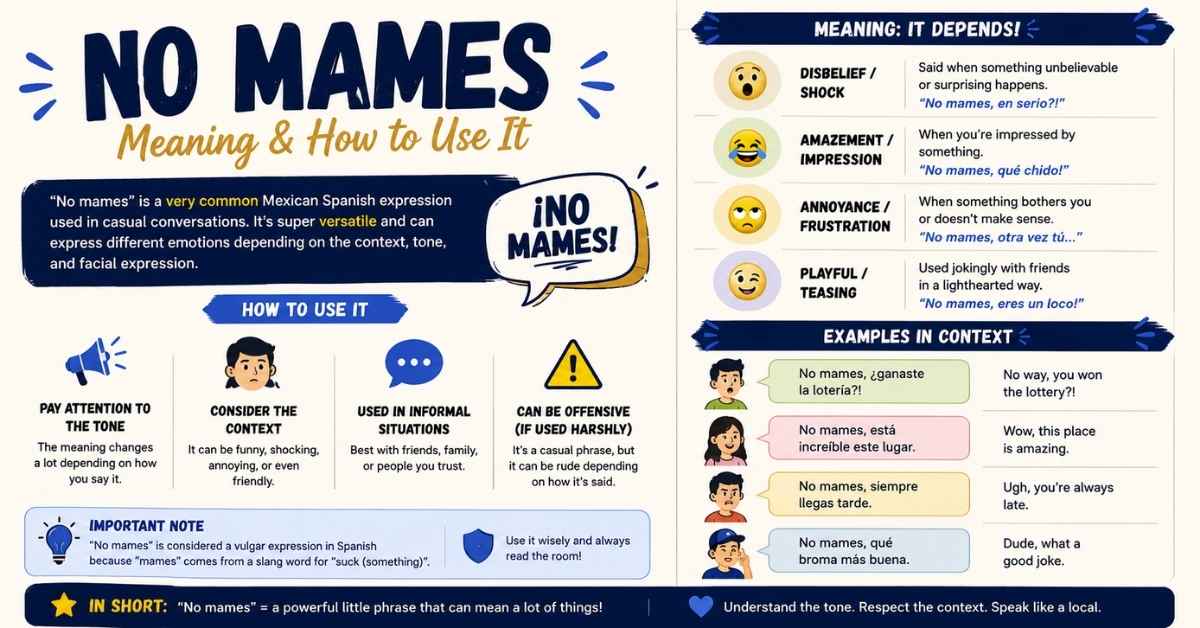
No mames meaning is a popular Mexican Spanish slang expression used to express surprise, disbelief, frustration, excitement, or annoyance, depending on the situation and tone of voice. While its literal translation is vulgar and not commonly translated word for word, native speakers usually use “No mames” to mean “No way!”, “You’re kidding!”, “Seriously?”, “Give me a break!”, or “You’ve got to be joking!” in everyday conversation. It is an informal expression commonly heard in Mexico among friends, family, and peers, but it should generally be avoided in formal or professional settings because it can be considered vulgar or offensive.
In this guide, you’ll learn the no mames meaning in English, its Spanish slang usage, pronunciation, origin, cultural significance, real-life examples, differences from “No Manches,” and when it’s appropriate—or inappropriate—to use it.
What Does “No Mames” Mean?
The phrase “No Mames” is one of the most recognizable expressions in Mexican Spanish slang. It does not have a single fixed English translation because its meaning changes depending on the speaker’s tone, emotion, and context.
In everyday conversation, it often expresses:
- Surprise
- Disbelief
- Excitement
- Frustration
- Annoyance
- Humor
For example, if a friend tells you they won the lottery, someone might respond:
“¡No mames!”
In this situation, it simply means:
“No way!” or “You’re kidding!”
However, if someone says something unreasonable, the same phrase could mean:
“Come on!” or “Give me a break!”
Understanding the context is essential because No Mames is a colloquial expression rather than a direct dictionary phrase.
No Mames Meaning in Simple Words
In simple English, No Mames means:
- No way!
- Seriously?
- You’re joking!
- I can’t believe it!
- Come on!
It is used naturally in casual conversations, especially among native speakers in Mexico.
No Mames Meaning in English
There is no perfect one-word English equivalent.
Depending on the situation, common translations include:
| Spanish Expression | Natural English Meaning |
|---|---|
| No Mames | No way! |
| No Mames | You’re kidding! |
| No Mames | Seriously? |
| No Mames | Give me a break! |
| No Mames | I can’t believe it! |
| No Mames | You’ve got to be joking! |
This is why understanding the contextual meaning is more important than relying on a literal translation.
Literal Meaning vs. Actual Slang Meaning
Literally, the phrase has a vulgar meaning that most native speakers do not intend when using it in casual conversation.
Instead, it functions as an emotional reaction, similar to saying:
- Wow!
- Seriously?
- No way!
- That’s unbelievable!
This difference between literal meaning and figurative meaning is common in many languages, especially with slang.
Why the Meaning Changes Depending on Context
Like many idioms and slang expressions, No Mames depends heavily on:
- Voice tone
- Facial expression
- Relationship between speakers
- Situation
- Cultural context
The same phrase can express excitement in one conversation and frustration in another.
No Mames Meaning Slang
The no mames meaning slang goes beyond a simple translation. It is deeply rooted in Mexican culture and is one of the most commonly used expressions in everyday Mexican Spanish.
Why “No Mames” Is Considered Mexican Spanish Slang
Unlike formal Spanish taught in classrooms, slang develops naturally among native speakers.
“No Mames” became popular because it quickly communicates emotion without requiring a long explanation.
Today, you’ll hear it in:
- Casual conversations
- Social media
- Movies
- Television
- Comedy shows
- Online gaming
- Text messages
- Memes
Common Emotions Expressed by “No Mames”
| Emotion | Example Meaning |
|---|---|
| Surprise | No way! |
| Disbelief | Seriously? |
| Excitement | That’s amazing! |
| Frustration | Give me a break! |
| Shock | I can’t believe it! |
| Humor | You’re joking! |
Because it expresses emotion so naturally, No Mames remains one of the most recognizable pieces of Mexican vocabulary.
How Native Speakers Use It in Everyday Conversations
Here are authentic-style examples:
- Friend 1: “I got tickets to the World Cup Final.”
- Friend 2: “¡No mames! That’s incredible!”
- Friend 1: “I accidentally deleted the entire project.”
- Friend 2: “¡No mames! Seriously?”
- Friend 1: “I ate ten tacos.”
- Friend 2: “¡No mames! How?”
These examples show that the phrase usually expresses a spontaneous emotional reaction.
No Mames Meaning Spanish Slang
The no mames meaning Spanish slang refers specifically to its role within Mexican Spanish, where it is considered an informal colloquial expression.
Is “No Mames” Used Throughout the Spanish-Speaking World?
No.
While many Spanish speakers understand the phrase through movies, music, social media, or Mexican television, it is primarily associated with Mexico.
Other Spanish-speaking countries often have their own slang expressions that communicate similar emotions.
Regional Differences in Usage
| Region | Usage |
|---|---|
| Mexico | Extremely common |
| United States (Mexican communities) | Very common |
| Central America | Sometimes understood |
| South America | Varies by country |
| Spain | Generally uncommon |
Regional dialects influence slang, so expressions that sound natural in one country may sound unfamiliar elsewhere.
Countries Where the Phrase Is Common or Rare
The phrase is widely recognized in:
- Mexico
- Mexican-American communities in the United States
Outside these areas, native speakers may understand the expression but prefer different local slang.
No Mames Meaning in English
The no mames meaning in English depends entirely on the context.
Unlike many dictionary words, there is no single translation that works every time.
Best English Translations
Some of the most natural English equivalents include:
- No way!
- Seriously?
- You’re kidding!
- Come on!
- Give me a break!
- I can’t believe it!
- You’ve got to be joking!
Context-Based English Meanings
| Situation | Best Translation |
|---|---|
| Someone surprises you | No way! |
| Someone tells unbelievable news | Seriously? |
| Someone exaggerates | Come on! |
| Someone says something ridiculous | Give me a break! |
| Friend makes a joke | You’re kidding! |
Choosing the right translation depends on the speaker’s emotion rather than the words alone.
Why There Is No Perfect One-Word Translation
English and Spanish express emotions differently.
Because No Mames functions as an emotional reaction instead of a literal statement, translators usually choose the English phrase that best matches the situation.
Pronunciation and Origin of “No Mames”
Understanding pronunciation and history helps language learners sound more natural.
How to Pronounce “No Mames”
Pronunciation:
noh MAH-mehs
Say it naturally without emphasizing every syllable.
Word-by-Word Breakdown
| Word | Basic Meaning |
|---|---|
| No | No / Don’t |
| Mames | From the verb mamar (literal origin), though the modern slang meaning is largely idiomatic and context-dependent. |
Today, native speakers generally understand the phrase as an emotional expression rather than focusing on its literal origin.
Origin and Evolution of the Expression
Like many colloquial expressions, No Mames evolved through everyday conversation.
Over time, its original literal meaning became less important than its conversational use.
Today it is heard in:
- Daily conversations
- Mexican movies
- Television
- Podcasts
- Stand-up comedy
- YouTube
- TikTok
- Online gaming
- Social media
Its popularity has also grown internationally through Mexican entertainment and internet culture.
Why It Became Popular in Mexican Culture
The phrase is:
- Short
- Emotional
- Easy to remember
- Flexible
- Instantly recognizable
It can fit dozens of different situations without changing the words themselves.
When Do People Say “No Mames”?
One reason the expression remains so popular is its flexibility.
Expressing Surprise
Friend: “I just won a brand-new car.”
Response: “¡No mames!“
Meaning:
“No way!”
Showing Disbelief
Friend: “He finished the marathon in under three hours.”
Response: “¡No mames!“
Meaning:
“Seriously?”
Reacting to Frustration
Friend: “They canceled our flight again.”
Response: “¡No mames!“
Meaning:
“Give me a break!”
Expressing Excitement
Friend: “We’re going to Cancun tomorrow.”
Response: “¡No mames! That’s awesome!”
Friendly Conversations Among Friends
Because the phrase is informal, it is most commonly used between:
- Close friends
- Family members
- Classmates
- Coworkers in casual settings
Using it with strangers, teachers, clients, or in professional environments is generally not recommended.
Is “No Mames” Offensive or Vulgar?
One of the most common questions from Spanish learners is whether this expression is considered offensive.
The answer depends on the relationship between the speakers, the setting, and the tone.
Is It a Bad Word?
Many people consider No Mames mildly vulgar because of its literal origin. However, in everyday Mexican Spanish, it is often used casually among friends without intending to insult anyone.
Is It Considered Profanity?
It can be viewed as profanity or coarse language, especially in formal environments. While it is not among the strongest insults in Spanish, it is generally unsuitable for professional, academic, or respectful public situations.
Formal vs. Informal Situations
| Situation | Should You Use “No Mames”? |
|---|---|
| Talking with close friends | ✅ Usually acceptable |
| Chatting with siblings | ✅ Common |
| Texting friends | ✅ Common |
| Speaking to your boss | ❌ Avoid |
| Classroom presentations | ❌ Avoid |
| Business meetings | ❌ Avoid |
| Formal events | ❌ Avoid |
When You Should Avoid Saying It
Avoid using No Mames when:
- Speaking with people you do not know well.
- Communicating in professional or academic settings.
- Talking to older people who may find the expression disrespectful.
- You are unsure of the local cultural expectations.
When in doubt, choosing a more neutral or polite expression is the safer option.
Real-Life Examples of “No Mames”
Seeing the phrase in context is one of the best ways to understand its meaning.
Examples in Everyday Conversations
| Conversation | Meaning |
|---|---|
| “I met my favorite singer today.” — “¡No mames!“ | No way! |
| “The tickets sold out in five minutes.” — “¡No mames!“ | Seriously? |
| “I forgot my passport at home.” — “¡No mames!“ | Come on! |
Text Message Examples
Friend: I passed my driving test!
You: No mames! Congratulations! 🎉
Friend: They changed the exam date again.
You: No mames 😩
WhatsApp Chat Examples
Carlos: We’re leaving for Mexico City tonight.
Ana: ¡No mames! Have an amazing trip!
TikTok and Social Media Examples
On TikTok, Instagram, YouTube, and memes, No Mames often appears as a reaction to something shocking, funny, or unbelievable. It is commonly paired with emojis such as 😳, 😂, 🤯, or 😅 to emphasize the speaker’s emotional response.
Movie and TV Dialogue Examples
Mexican films, television series, and comedy shows frequently use No Mames to make dialogue sound authentic and natural. Hearing it in entertainment can help learners understand how tone and context influence its meaning.
No Mames vs. No Manches
Many Spanish learners confuse No Mames with No Manches because both are common Mexican expressions that express surprise or disbelief.
What Does “No Manches” Mean?
No Manches has a similar conversational meaning—such as “No way!”, “Seriously?”, or “Come on!”—but it is generally considered milder and more polite than No Mames.
Key Differences Between the Two Expressions
| Feature | No Mames | No Manches |
|---|---|---|
| Tone | More vulgar | Milder |
| Formality | Very informal | Informal but safer |
| Common Emotion | Surprise, frustration, disbelief | Surprise, disbelief |
| Best Used With | Close friends | Friends, family, casual acquaintances |
| Suitable for Learners | Use with caution | Better starting option |
Which One Is More Polite?
No Manches is widely regarded as the more polite alternative. It conveys a similar reaction without sounding as coarse, making it a better choice in mixed company or when you’re unsure how your words will be received.
Which Phrase Should Beginners Use?
For most Spanish learners, No Manches is the safer option. It allows you to sound natural in casual conversation while reducing the risk of unintentionally offending someone.
No Mames vs. Similar Mexican Slang
Mexican Spanish includes many colorful expressions that convey surprise, excitement, frustration, or disbelief. While No Mames is one of the most common, understanding similar phrases helps you communicate more naturally.
No Mames vs. Órale
Órale is another popular Mexican slang expression, but its meaning changes depending on the situation.
| No Mames | Órale |
|---|---|
| Expresses surprise or disbelief | Expresses encouragement, agreement, surprise, or excitement |
| Can sound vulgar | Usually not vulgar |
| Very informal | Informal but more widely acceptable |
| Used among close friends | Used in many casual situations |
Example
Friend: “We’re leaving right now.”
Response: “¡Órale!“
Meaning:
“Let’s go!” or “Awesome!”
No Mames vs. Güey
Güey (sometimes written wey) means “dude,” “mate,” or “bro.”
Unlike No Mames, it is not an exclamation.
Example
“No mames, güey!“
Natural English meaning:
“No way, dude!”
These two expressions are frequently used together in casual Mexican Spanish conversations.
No Mames vs. Cabrón
Cabrón is another common Mexican slang word.
Depending on tone and context, it can mean:
- Friend
- Tough person
- Clever person
- Offensive insult
Because it carries different meanings in different situations, beginners should use it carefully.
Choosing the Right Expression Based on Context
| Situation | Recommended Expression |
|---|---|
| Surprise | No Mames |
| Friendly encouragement | Órale |
| Talking to a close friend | Güey |
| Professional setting | None of the above |
| Family conversation | No Manches |
Understanding context is far more important than memorizing literal translations.
Formal and Polite Alternatives to “No Mames”
Since No Mames can sound vulgar or offensive, native speakers often choose softer alternatives in formal or respectful situations.
Family-Friendly Alternatives
Some commonly used alternatives include:
- No manches
- En serio? (Really?)
- No puede ser. (It can’t be.)
- Qué sorpresa! (What a surprise!)
- Increíble. (Incredible.)
These expressions communicate the same emotion without sounding as strong.
Workplace-Safe Alternatives
In professional environments, it is better to avoid slang entirely.
Instead, consider phrases like:
| Spanish | English Meaning |
|---|---|
| ¿En serio? | Really? |
| No puedo creerlo. | I can’t believe it. |
| Qué interesante. | How interesting. |
| Qué sorpresa. | What a surprise. |
These phrases are appropriate for meetings, presentations, and customer interactions.
Expressions for Professional Conversations
Professional communication values clarity and respect.
Instead of using No Mames, choose language that reflects:
- Professionalism
- Courtesy
- Respect
- Cultural awareness
This is especially important for Spanish learners, travelers, and business professionals.
Everyday Alternatives Used by Native Speakers
Native speakers naturally switch expressions depending on who they are speaking with.
Common alternatives include:
- No manches
- Órale
- ¿En serio?
- No puede ser
- Qué loco
- Qué increíble
Learning several expressions helps your Spanish sound more authentic.
Should Spanish Learners Use “No Mames”?
Many beginners wonder whether they should include No Mames in their vocabulary.
The answer depends on your experience, surroundings, and confidence in understanding Mexican culture.
Advice for Beginners
If you’re just starting to learn Spanish:
- Learn what the phrase means.
- Recognize it in conversations.
- Listen to how native speakers use it.
- Avoid using it until you fully understand the context.
Understanding slang is often more valuable than immediately trying to use it.
Common Mistakes Non-Native Speakers Make
Some frequent mistakes include:
- Using No Mames in formal situations.
- Translating it literally into English.
- Assuming it is appropriate in every Spanish-speaking country.
- Copying phrases from social media without understanding their tone.
- Using slang with strangers or older people.
Being aware of these mistakes helps you communicate respectfully.
When Tourists Should Avoid the Phrase
If you’re visiting Mexico, avoid saying No Mames when speaking with:
- Hotel staff
- Business professionals
- Teachers
- Elderly people
- Government officials
- People you’ve just met
Using neutral Spanish is usually the safest option.
Tips for Sounding Natural Without Being Offensive
If you want to sound more like a native speaker:
- Listen carefully before repeating slang.
- Pay attention to tone and facial expressions.
- Learn polite alternatives.
- Match your language to the situation.
- Remember that context matters more than vocabulary alone.
Cultural Meaning of “No Mames”
Understanding No Mames requires more than knowing its translation.
It also requires understanding Mexican culture, social etiquette, and everyday communication.
Why It Is Popular in Mexican Culture
The phrase has become popular because it is:
- Short
- Expressive
- Memorable
- Flexible
- Easy to understand among native speakers
It appears frequently in:
- Movies
- Television
- Podcasts
- Stand-up comedy
- YouTube videos
- TikTok clips
- Memes
- Everyday conversations
Cultural Context Behind the Expression
Many slang expressions lose their original literal meaning over time.
Today, No Mames is usually interpreted as an emotional reaction rather than a literal statement.
Native speakers often understand the speaker’s intention immediately based on:
- Voice tone
- Facial expression
- Situation
- Relationship between speakers
Tone, Body Language, and Delivery
The same words can communicate completely different emotions.
For example:
Excited tone
“¡No mames! Ganaste la lotería!“
Meaning:
“No way! You won the lottery!”
Frustrated tone
“¡No mames! Otra vez tarde.“
Meaning:
“Come on! Late again.”
Body language and delivery play an important role in how the phrase is understood.
Why Context Is More Important Than Literal Translation
This is one of the biggest lessons for Spanish learners.
Trying to translate No Mames word for word often creates confusion.
Instead, ask yourself:
“What emotion is the speaker expressing?”
Once you understand the emotion, choosing the correct English translation becomes much easier.
Common Myths About “No Mames”
Many misconceptions surround this expression.
Is It Always Offensive?
No.
Among close friends, it is often used casually without causing offense.
However, it may still be inappropriate in formal settings.
Can It Ever Be Respectful?
Generally, it is better to avoid it when speaking respectfully with:
- Teachers
- Employers
- Customers
- Elderly people
- People you do not know well
Choosing a neutral expression demonstrates cultural awareness.
Is It Appropriate for Children?
Because No Mames is considered an informal and potentially vulgar phrase, many parents and teachers discourage children from using it.
Family-friendly alternatives such as No Manches are often preferred.
Is It Used in Business or Formal Settings?
No.
Business communication usually avoids slang.
Professional conversations rely on polite and respectful language instead.
LEARN MORE: Huzz Meaning
Common Synonyms and Related Mexican Expressions
Learning related expressions helps build your Mexican Spanish vocabulary.
Similar Slang Expressions
Some common expressions include:
- No Manches
- Órale
- Qué loco
- No puede ser
- En serio
- Ándale
Expressions That Show Surprise
Native speakers often use:
- ¡Órale!
- ¡No manches!
- ¡En serio!
- ¡Qué increíble!
Expressions That Show Disbelief
Depending on the situation, speakers might say:
- No puede ser.
- ¿De verdad?
- ¿En serio?
- No manches.
Everyday Mexican Slang Worth Knowing
| Expression | Meaning |
|---|---|
| No Mames | No way! |
| No Manches | No way! (Milder) |
| Órale | Let’s go!, Wow!, Okay! |
| Güey | Dude |
| Ándale | Hurry up!, Come on! |
| Qué padre | That’s awesome! |
Frequently Asked Questions About No Mames Meaning
What Does “No Mames” Mean in English?
The most common English translations include “No way!”, “Seriously?”, “You’re kidding!”, “Come on!”, and “I can’t believe it!” The best translation depends on the situation and the speaker’s tone.
Is “No Mames” a Bad Word?
It is generally considered informal and can be vulgar because of its literal origin. Many native speakers use it casually with friends, but it is best avoided in formal settings.
Is “No Mames” Offensive?
It can be. Whether it is offensive depends on context, tone, and the relationship between the people speaking. Around close friends it may be accepted, while in professional or respectful situations it may be inappropriate.
What Is the Difference Between “No Mames” and “No Manches”?
Both express surprise or disbelief, but No Manches is usually considered less vulgar and more suitable when you want to avoid stronger slang.
Can Tourists Say “No Mames”?
Tourists should understand the phrase before using it. If you’re unfamiliar with the cultural context, using more neutral expressions is the safer choice.
Is “No Mames” Used Outside Mexico?
It is primarily associated with Mexican Spanish, although many people in other Spanish-speaking communities recognize it through media and popular culture. Usage varies by region.
How Do You Pronounce “No Mames”?
A simple pronunciation is:
noh MAH-mehs
Listening to native speakers is the best way to learn the natural rhythm and intonation.
What Does “No Mames” Mean in Texting?
In text messages, it often expresses surprise, disbelief, excitement, or frustration. The intended meaning usually becomes clear from the surrounding conversation and any accompanying emojis.
Is It Safe for Spanish Learners to Use?
Beginners are generally better off recognizing the phrase rather than using it immediately. As your understanding of Mexican Spanish, tone, and cultural context improves, you’ll know when it is—or isn’t—appropriate.
Conclusion
No mames meaning goes far beyond a simple dictionary definition. It is a popular Mexican Spanish slang expression used to express surprise, disbelief, frustration, excitement, or annoyance, depending on the context, tone, and relationship between the speakers. Although its literal origin is vulgar, native speakers commonly use it as an emotional reaction rather than a literal statement.
Understanding No Mames meaning in English, its role as Mexican Spanish slang, and the cultural etiquette surrounding its use will help you interpret conversations more accurately and avoid misunderstandings. Learning related expressions such as No Manches, Órale, and Güey also expands your conversational vocabulary and helps you appreciate the richness of everyday Mexican Spanish.
Whether you’re a Spanish learner, traveler, or simply curious about internet slang and popular expressions, remember that successful communication is about more than translation. Paying attention to tone, context, and culture is the key to understanding—and using—expressions like No Mames naturally and respectfully.