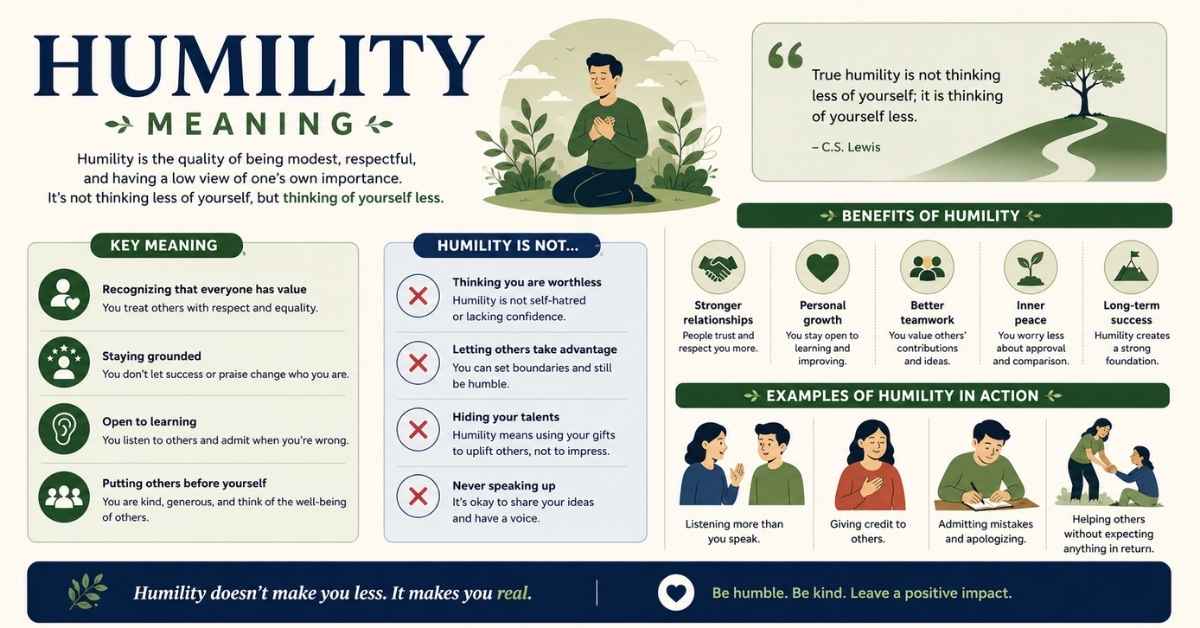
Humility meaning is the quality of being humble, having a realistic view of yourself, and treating others with respect without thinking you are superior. It does not mean thinking less of yourself—it means recognizing your strengths and weaknesses while remaining open to learning from others. Whether in leadership, relationships, education, or personal growth, humility is widely regarded as a valuable character trait that builds trust, encourages self-awareness, and strengthens connections with others.
In this guide, you’ll learn the definition of humility, its importance, real-life examples, differences between humility and similar traits, its role in psychology, leadership, and Christianity, along with practical ways to develop this powerful virtue.
What Is Humility?
Humility is a virtue that reflects modesty, respect, honesty, and freedom from pride or arrogance. A humble person understands their abilities without exaggerating them and values the ideas and contributions of others.
Unlike self-doubt or low self-esteem, humility involves confidence balanced with self-awareness. It allows people to accept feedback, admit mistakes, and continue learning throughout life.
Humility Meaning in Simple Words
In simple terms, humility means being kind, respectful, and not believing you are better than other people. A humble individual celebrates success without boasting and remains open to improvement.
Dictionary Definition of Humility
Most English dictionaries define humility as the quality or state of being humble, often describing it as freedom from pride or arrogance. It is recognized as a positive personality trait that supports healthy relationships and ethical behavior.
Humility Meaning in Everyday Life
Humility appears in everyday situations, such as:
- Saying “I was wrong.”
- Listening without interrupting.
- Appreciating others’ achievements.
- Accepting constructive criticism.
- Helping people without expecting recognition.
These small actions demonstrate that humility is not about weakness—it is about strength, maturity, and respect.
Humility Meaning with Example
Understanding humility becomes easier when you see it in real-life situations.
Examples of Humility at Home
Imagine a parent apologizing to their child after making a mistake. Instead of insisting they are always right, they admit the error and explain how they will do better. This teaches honesty and accountability.
Examples of Humility at School
A student who earns the highest grade but still helps classmates understand the lesson is demonstrating humility. They recognize their achievement while remaining supportive and respectful.
Examples of Humility at Work
An experienced employee who welcomes new ideas from junior colleagues shows humility. Rather than relying only on their experience, they remain open to learning.
Examples of Humility in Leadership
Many respected leaders acknowledge the contributions of their teams instead of taking all the credit themselves. This approach builds trust, strengthens teamwork, and encourages innovation.
Example Sentences Using “Humility”
| Sentence | Meaning |
|---|---|
| She accepted the award with humility. | She remained modest despite her success. |
| His humility earned the respect of his coworkers. | People admired his respectful attitude. |
| Great leaders often lead with humility rather than pride. | Leadership benefits from being humble. |
| Showing humility helps build stronger relationships. | Humility encourages trust and respect. |
Pronunciation, Origin, and Etymology of Humility
Understanding where a word comes from often provides deeper insight into its meaning.
How to Pronounce Humility
The word humility is pronounced as:
hyoo-MIL-uh-tee
The emphasis falls on the second syllable.
Word Origin and Latin Root (Humilis)
The English word humility comes from the Latin word humilis, meaning low, grounded, or close to the earth. This origin reflects the idea of staying grounded rather than elevating oneself above others.
Over time, the meaning evolved to describe someone who is modest, respectful, and free from excessive pride.
Why the History of the Word Matters
Knowing the origin helps explain why humility has been valued for centuries across different cultures and traditions. It has long been associated with wisdom, personal growth, and moral character.
Key Characteristics of a Humble Person
Humility is reflected through consistent actions rather than words alone.
Positive Traits of Humility
A humble person often demonstrates:
- Self-awareness
- Integrity
- Kindness
- Empathy
- Respect
- Patience
- Honesty
- Gratitude
- Openness to learning
- Accountability
These qualities contribute to stronger relationships and better decision-making.
Signs Someone Is Truly Humble
You may recognize humility when someone:
- Gives credit to others.
- Accepts mistakes without making excuses.
- Welcomes constructive feedback.
- Treats everyone with equal respect.
- Continues learning regardless of experience.
- Celebrates others’ success.
Common Behaviors That Reflect Humility
| Behavior | Why It Matters |
|---|---|
| Listening carefully | Shows respect for others’ opinions |
| Admitting mistakes | Builds trust and credibility |
| Helping without expecting praise | Demonstrates genuine kindness |
| Remaining teachable | Encourages lifelong learning |
| Appreciating others | Strengthens relationships |
“Humility is not thinking less of yourself; it is thinking of yourself less.” — Often attributed to C. S. Lewis
This quote captures the essence of humility: maintaining confidence while focusing on others with respect and empathy.
Why Is Humility Important?
Humility influences almost every aspect of life, from personal relationships to professional success.
Benefits of Humility in Daily Life
Research in psychology and leadership consistently suggests that humility can improve communication, cooperation, and emotional well-being.
Some key benefits include:
- Better relationships
- Improved teamwork
- Stronger leadership
- Greater emotional intelligence
- Increased self-awareness
- Better conflict resolution
- Lifelong learning
How Humility Improves Relationships
Humility encourages people to listen, forgive, and communicate honestly. It reduces unnecessary conflict because humble individuals are less focused on proving they are always right.
When both people in a relationship practice humility, trust tends to grow naturally.
The Role of Humility in Personal Growth
Personal growth requires recognizing that there is always something new to learn.
Humble people:
- Accept feedback.
- Learn from failures.
- Reflect on their actions.
- Continue developing their skills.
This mindset supports continuous improvement throughout life.
Why Employers and Leaders Value Humility
Many organizations now recognize humility as an essential leadership quality.
Leaders who practice humility often:
- Encourage collaboration.
- Build trust among employees.
- Accept responsibility.
- Share success with their teams.
- Foster innovation through open communication.
| Area | How Humility Helps |
|---|---|
| Leadership | Builds trust and credibility |
| Workplace | Improves teamwork |
| Family | Encourages healthy communication |
| Education | Supports lifelong learning |
| Friendships | Creates stronger bonds |
Lack of Humility Meaning
The lack of humility meaning refers to an attitude characterized by excessive pride, arrogance, overconfidence, or an unwillingness to recognize one’s own limitations. A person lacking humility often believes they are always right and may dismiss the opinions or achievements of others.
What Does Lack of Humility Look Like?
People who lack humility may:
- Refuse constructive criticism.
- Rarely admit mistakes.
- Constantly seek attention.
- Ignore other people’s ideas.
- Believe they are superior.
These behaviors can damage both personal and professional relationships.
Common Signs of Arrogance and Pride
Although confidence is healthy, arrogance goes beyond confidence.
Common signs include:
- Interrupting conversations.
- Taking credit for others’ work.
- Looking down on people.
- Ignoring advice.
- Refusing to learn new things.
How a Lack of Humility Affects Relationships and Success
Without humility, trust becomes difficult to build.
Teams often struggle when one person refuses to listen, while friendships may weaken because mutual respect is missing.
Successful individuals frequently combine confidence with humility, allowing them to lead effectively while continuing to grow.
False Humility Meaning
The false humility meaning describes behavior where a person pretends to be humble while secretly seeking praise, attention, or admiration. It may appear modest on the surface, but the intention is often to gain approval or compliments.
What Is False Humility?
False humility is different from genuine modesty. For example, someone might repeatedly say, “I’m terrible at this,” hoping others will respond with compliments.
This behavior shifts attention back to the speaker rather than reflecting authentic self-awareness.
False Humility vs Genuine Humility
| Genuine Humility | False Humility |
|---|---|
| Honest self-awareness | Pretending to be modest |
| Accepts praise gracefully | Rejects praise to gain more attention |
| Focuses on learning | Focuses on appearing humble |
| Gives credit sincerely | Seeks recognition indirectly |
| Acts consistently | Often performs humility for approval |
Why People Display False Humility
Several factors can contribute to false humility:
- Fear of appearing arrogant.
- Desire for social approval.
- Low self-confidence.
- Cultural expectations.
- Habit of seeking validation.
Recognizing these motivations can help people develop genuine humility based on honesty rather than appearances.
Real-Life Examples of False Humility
Imagine an employee who consistently says they did “almost nothing” on a successful project, even though they played a major role, expecting coworkers to insist otherwise. This differs from sincerely acknowledging the team’s contributions while accepting appropriate recognition.
Humility vs Similar Concepts
Many people confuse humility with other personality traits. Understanding the differences provides a clearer picture of what humility truly means.
Humility vs Modesty
While both involve avoiding excessive self-promotion, modesty often relates to how a person presents their achievements, whereas humility reflects a deeper mindset of self-awareness, respect, and openness to learning.
Humility vs Pride
Healthy pride can mean taking satisfaction in your accomplishments. However, excessive pride becomes arrogance when it leads someone to believe they are superior to others. Humility balances confidence with respect.
Humility vs Confidence
One of the biggest misconceptions is that humility and confidence cannot exist together. In reality, truly confident people often demonstrate humility because they are secure enough to acknowledge mistakes, seek feedback, and appreciate others’ strengths.
Humility vs Meekness
Although the terms are sometimes used interchangeably, they are not identical.
- Humility is a mindset of self-awareness, respect, and freedom from excessive pride.
- Meekness refers to exercising strength with gentleness and self-control.
A humble person can also be assertive when necessary, while a meek person chooses patience and restraint over aggression.
Humility vs Low Self-Esteem
Humility should never be confused with having low self-esteem.
| Humility | Low Self-Esteem |
|---|---|
| Realistic self-view | Negative self-view |
| Accepts strengths and weaknesses | Focuses mainly on weaknesses |
| Confident yet respectful | Lacks confidence |
| Open to learning | Often fears failure |
| Healthy emotional intelligence | Self-doubt and insecurity |
The key difference is that humility recognizes personal value without feeling superior to others.
Cultural Humility Meaning
Cultural humility meaning refers to the lifelong practice of respecting people from different cultures, backgrounds, beliefs, and experiences while recognizing that no one can fully understand every culture.
Unlike cultural competence, which focuses on acquiring knowledge, cultural humility emphasizes continuous learning, self-reflection, and mutual respect.
What Is Cultural Humility?
Cultural humility encourages people to:
- Listen without making assumptions.
- Respect cultural differences.
- Recognize personal biases.
- Continue learning from others.
- Build meaningful relationships across cultures.
Why Cultural Humility Matters in Modern Society
In today’s connected world, people interact with individuals from many different backgrounds.
Practicing cultural humility helps:
- Improve communication.
- Reduce stereotypes and prejudice.
- Build trust.
- Strengthen communities.
- Promote inclusion and diversity.
Cultural Humility in Healthcare, Education, and the Workplace
Professionals who practice cultural humility are better able to:
| Industry | Benefits |
|---|---|
| Healthcare | Better patient communication |
| Education | More inclusive classrooms |
| Workplace | Stronger teamwork and collaboration |
| Customer Service | Better customer relationships |
Humility Meaning in the Bible
The humility meaning in the Bible centers on recognizing dependence on God, serving others with love, and placing God’s will above personal pride.
In Christianity, humility is considered one of the most important spiritual virtues.
Biblical Definition of Humility
Biblical humility means:
- Trusting God.
- Serving others.
- Living with gratitude.
- Rejecting arrogance.
- Walking in obedience and faith.
Examples of Humility in the Bible
Some well-known examples include:
- Jesus Christ washing His disciples’ feet as an example of servant leadership.
- Moses, described as a humble leader despite guiding the Israelites.
- John the Baptist, who pointed people toward Jesus rather than seeking personal glory.
These examples show that humility is expressed through actions rather than words.
Teachings of Jesus About Humility
Throughout the Gospels, Jesus taught His followers to:
- Serve others.
- Forgive freely.
- Love their neighbors.
- Avoid pride.
- Put others before themselves.
These teachings continue to shape Christian values today.
Why Humility Is Considered a Christian Virtue
Humility allows believers to:
- Grow spiritually.
- Strengthen faith.
- Develop compassion.
- Practice forgiveness.
- Build healthy relationships within their communities.
LEARN MORE: No Mames Meaning
Humility Meaning in Farsi
The humility meaning in Farsi is commonly translated as:
فروتنی (Forutani)
Other related Persian words include:
- تواضع (Tavazo’) – modesty or humility
- فروتن (Forutan) – humble
Pronunciation and Usage in Persian
These words are frequently used to describe someone who behaves respectfully, avoids arrogance, and values others.
Example Sentence in Farsi
او با فروتنی با همه رفتار میکند.
Translation: He/She treats everyone with humility.
Humility Meaning for Kids
Explaining humility to children should be simple and practical.
A Simple Definition Children Can Understand
Humility means being kind, polite, and understanding that everyone is important.
It means saying:
- “Thank you.”
- “I’m sorry.”
- “Can you teach me?”
- “Great job!”
Everyday Examples for Kids
Children show humility when they:
- Share toys.
- Help classmates.
- Admit mistakes.
- Congratulate others.
- Listen to teachers.
- Respect parents.
Fun Ways Parents and Teachers Can Teach Humility
Parents and teachers can encourage humility by:
- Praising kindness instead of only achievements.
- Teaching gratitude.
- Encouraging teamwork.
- Modeling respectful behavior.
- Reading stories with positive moral lessons.
Humility in Psychology
Psychologists describe humility as a healthy balance between confidence and self-awareness.
What Psychologists Say About Humility
Research suggests that humble people are more likely to:
- Learn from mistakes.
- Accept constructive criticism.
- Build stronger relationships.
- Show empathy.
- Continue personal development.
Intellectual Humility Explained
Intellectual humility is recognizing that your knowledge is limited and being willing to change your views when presented with reliable evidence.
It supports:
- Critical thinking.
- Better decision-making.
- Lifelong learning.
- Respectful discussions.
Humility and Emotional Intelligence
Humility is closely connected to emotional intelligence because both involve:
- Empathy.
- Active listening.
- Self-awareness.
- Emotional regulation.
Mental Health Benefits of Being Humble
Practicing humility may contribute to:
- Reduced interpersonal conflict.
- Greater resilience.
- Better stress management.
- Healthier relationships.
- Increased life satisfaction.
Humility in Leadership and the Workplace
Modern leadership increasingly values humility over ego.
Why Great Leaders Practice Humility
Great leaders understand that success comes from teamwork.
Humble leaders:
- Listen first.
- Share credit.
- Admit mistakes.
- Encourage innovation.
- Empower employees.
How Humility Builds Trust
Employees are more likely to trust leaders who:
- Communicate honestly.
- Respect different opinions.
- Accept responsibility.
- Lead by example.
Humility in Teamwork and Collaboration
Teams perform better when members:
- Appreciate each other’s strengths.
- Share knowledge.
- Respect diverse perspectives.
- Solve problems together.
Workplace Examples of Humble Leadership
A manager who publicly recognizes their team’s efforts while accepting responsibility for mistakes demonstrates authentic servant leadership.
How to Practice Humility Every Day
Humility is a habit developed through consistent actions.
Simple Habits That Build Humility
You can practice humility by:
- Listen more than you speak.
- Admit mistakes quickly.
- Thank people sincerely.
- Accept feedback positively.
- Celebrate others’ success.
- Continue learning.
- Help without expecting recognition.
Learning to Accept Feedback
Constructive criticism provides opportunities for growth.
Instead of becoming defensive, ask:
“What can I learn from this?”
Admitting Mistakes with Confidence
Acknowledging mistakes shows maturity, accountability, and integrity rather than weakness.
Practicing Gratitude and Empathy
Gratitude reminds us to appreciate others, while empathy helps us understand different perspectives. Together, they strengthen humility.
Common Misconceptions About Humility
Many misunderstand humility because it is often confused with weakness.
Does Humility Mean Weakness?
No.
Humility requires confidence, courage, and emotional maturity.
Can You Be Confident and Humble?
Absolutely.
Confidence helps you recognize your abilities, while humility prevents arrogance.
Is Humility the Same as Being Shy?
No.
A shy person may avoid attention because of discomfort, while a humble person simply avoids unnecessary self-importance.
Is Humility Always Quiet?
Not at all.
Some humble people are outspoken leaders who advocate for others while remaining respectful and open-minded.
Common Synonyms and Antonyms of Humility
Synonyms of Humility
- Modesty
- Humbleness
- Meekness
- Respectfulness
- Selflessness
- Simplicity
Antonyms of Humility
- Pride
- Arrogance
- Vanity
- Ego
- Conceit
- Self-importance
Words Commonly Confused with Humility
| Word | Difference |
|---|---|
| Modesty | Focuses on not boasting |
| Meekness | Gentle strength and restraint |
| Confidence | Belief in one’s abilities |
| Humility | Balanced self-awareness with respect for others |
Frequently Asked Questions About Humility Meaning
What Is the True Meaning of Humility?
Humility means having a realistic view of yourself, respecting others, and avoiding excessive pride while remaining open to learning.
Why Is Humility Considered a Strength?
Because it encourages personal growth, stronger relationships, better leadership, and wiser decision-making.
What Are the Best Examples of Humility?
Helping others without expecting praise, admitting mistakes, accepting feedback, and giving credit where it is due.
How Can Someone Become More Humble?
Practice gratitude, listen carefully, learn from criticism, celebrate others’ achievements, and continue developing your knowledge.
Is Humility Important in Leadership?
Yes. Humble leaders build trust, inspire collaboration, and create healthier workplace cultures.
What Is the Difference Between Humility and Modesty?
Modesty relates to how someone presents themselves, while humility reflects a deeper mindset of self-awareness, respect, and openness to learning.
What Is Cultural Humility?
Cultural humility is the ongoing practice of respecting different cultures while recognizing that learning about others is a lifelong process.
What Is False Humility?
False humility is pretending to be humble to gain praise or approval rather than acting with genuine sincerity.
What Does Lack of Humility Mean?
A lack of humility refers to excessive pride, arrogance, or an unwillingness to acknowledge mistakes and value the perspectives of others.
Conclusion
Humility meaning goes far beyond a simple dictionary definition. It is the quality of being humble, self-aware, respectful, and free from excessive pride or arrogance. Whether in leadership, relationships, education, psychology, or faith, humility helps people grow, build trust, and connect more deeply with others.
True humility does not require you to underestimate yourself. Instead, it encourages you to recognize your strengths while remaining open to learning, appreciating others, and admitting mistakes when necessary. By practicing gratitude, empathy, honesty, and continuous self-improvement, you can develop a form of humility that strengthens both your personal and professional life.
Ultimately, humility is not about thinking less of yourself—it’s about thinking of yourself accurately while treating everyone with dignity and respect. That balanced perspective is what makes humility one of the most valuable character traits a person can cultivate.