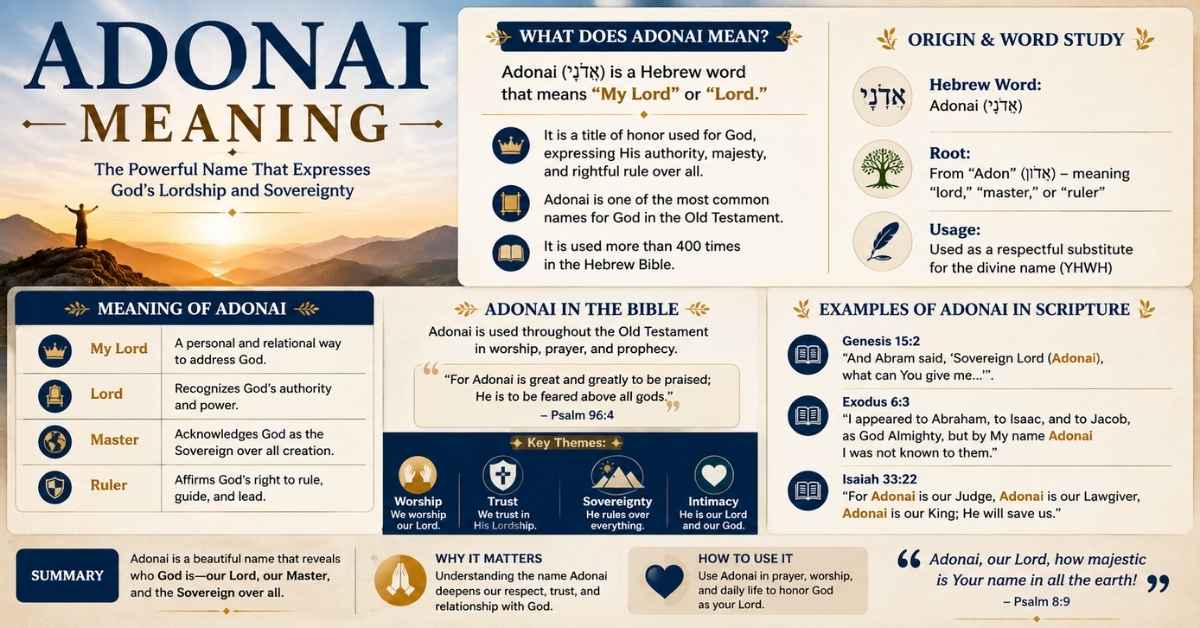
Adonai meaning is “Lord” or “My Lord” in Hebrew and is one of the most important titles used for God in the Bible. The word expresses God’s supreme authority, sovereignty, ownership, and lordship over all creation. In both Judaism and Christianity, Adonai is used as a respectful title that recognizes God as the Master, King, and Sovereign Lord.
In Jewish tradition, it is often spoken instead of the divine name YHWH (Yahweh) out of reverence. Understanding the Adonai meaning in the Bible and Adonai meaning in Hebrew gives deeper insight into God’s character, His relationship with His people, and the significance of worshiping Him as Lord.
Whether you have encountered the word while reading Scripture, attending church, studying biblical Hebrew, or listening to worship music, learning the true meaning of Adonai helps you better understand one of the Bible’s most meaningful names for God.
| Quick Facts About Adonai | Details |
|---|---|
| Hebrew Word | אֲדֹנָי (Adonai) |
| Literal Meaning | My Lord or Lord |
| Language | Hebrew |
| Used For | God as Sovereign Lord |
| First Found | Old Testament |
| Related Names | Yahweh, Elohim, Jehovah, El Shaddai |
| Pronunciation | ah-doh-NYE |
What Does Adonai Mean?
The simplest Adonai definition is:
Adonai means “Lord” or “My Lord,” recognizing God’s absolute authority, ownership, and sovereignty over everything.
Unlike a personal name, Adonai is primarily a title that honors God as the supreme ruler. It reflects a relationship in which believers acknowledge Him as their Master, Creator, and King.
In the Old Testament, the title frequently emphasizes God’s rule over His people and His authority over all creation.
Adonai Meaning in English
In English Bibles, Adonai is usually translated as:
- Lord
- Sovereign Lord
- Lord God (when combined with other Hebrew names)
Although the English word “Lord” is simple, the Hebrew title carries a much richer meaning. It expresses complete authority, reverence, and faithful obedience.
How to Pronounce Adonai
The correct pronunciation is:
ah-doh-NYE
Breaking it into syllables makes it easier:
Ah – Doh – Nye
Many Bible teachers and Hebrew scholars recommend pronouncing it respectfully because of its sacred significance.
Adonai Meaning in Simple Words
If you’re looking for an easy explanation, Adonai means that God is the Lord over everything.
Think of it this way:
- A king rules a kingdom.
- A captain leads a ship.
- A teacher guides students.
- Adonai reminds believers that God lovingly rules over the entire universe.
This title highlights God’s:
- Authority
- Power
- Leadership
- Protection
- Care
- Faithfulness
Adonai Meaning for Kids
For children, the meaning can be explained like this:
Adonai means “Lord.” It reminds us that God loves us, takes care of us, and is the greatest King over everyone and everything.
This simple explanation helps young readers understand why many people pray to God as Lord.
Adonai Meaning in Hebrew
To fully understand Adonai meaning in Hebrew, it helps to explore its linguistic roots.
The word comes from the Hebrew root Adon, which means:
- Lord
- Master
- Owner
- Ruler
When the ending -ai is added, the title becomes Adonai, commonly translated as “My Lord.”
In Scripture, this title expresses honor, submission, and recognition of God’s supreme authority.
Hebrew Spelling
אֲדֹנָי
The Root Word: Adon
The Hebrew word Adon could refer to:
- A king
- A master
- A ruler
- Someone in authority
However, when referring to God, Adonai carries a much deeper meaning, pointing to His unmatched sovereignty.
The Plural of Majesty
One fascinating feature of biblical Hebrew is the plural of majesty.
Although Adonai appears in a plural grammatical form, it refers to one God, emphasizing His greatness rather than suggesting multiple gods. Similar grammatical patterns are also seen with Elohim, another important biblical title for God.
Adonai Meaning in the Bible
The Adonai meaning in the Bible goes beyond simply calling God “Lord.” It reveals His relationship with humanity as the Creator, Protector, Judge, and Sovereign King.
Throughout the Old Testament, believers addressed God as Adonai to express deep respect and complete dependence upon Him.
Why Adonai Is Important in Scripture
The title teaches several important truths:
- God has ultimate authority.
- Everything belongs to Him.
- He faithfully leads His people.
- He deserves worship and obedience.
- His rule is righteous and eternal.
These themes appear repeatedly across the Hebrew Bible.
First Appearance in Scripture
The title appears early in the Old Testament and continues throughout books such as:
- Genesis
- Exodus
- Deuteronomy
- Psalms
- Isaiah
- Ezekiel
- Daniel
Each occurrence reinforces God’s authority, covenant relationship, and faithful guidance.
Why Is God Called Adonai?
One of the most common questions readers ask is:
Why is God called Adonai?
The answer lies in what the title communicates about God’s character.
God Is the Sovereign Lord
Calling God Adonai acknowledges that He rules over all creation.
He is:
- King of kings
- Lord of lords
- Creator of heaven and earth
- Supreme authority
- Owner of all things
This title reminds believers that no earthly ruler has authority greater than God.
God Is Master
The word Master reflects a relationship built on trust and obedience rather than fear.
Believers recognize God’s wisdom and willingly follow His guidance because He is perfectly just, loving, and faithful.
God Is Owner
Everything belongs to God:
- The earth
- Humanity
- Nature
- Time
- Life itself
Recognizing God as Adonai encourages humility and gratitude, reminding believers that life is a gift entrusted to them.
Historical Background of Adonai
Understanding the historical background provides deeper insight into why this title became so significant.
Ancient Israel
In ancient Israel, God’s people treated His name with profound reverence.
Rather than casually speaking the sacred divine name represented by YHWH, many Jewish readers would respectfully say Adonai while reading Scripture aloud.
This tradition continues in many Jewish communities today.
The Tetragrammaton (YHWH)
The four Hebrew letters YHWH are known as the Tetragrammaton, the personal covenant name of God.
Because of deep reverence for this sacred name, Jewish tradition developed the custom of pronouncing Adonai whenever readers encountered YHWH in the biblical text.
As a result, many English Bible translations render YHWH as LORD (written in capital letters), reflecting this longstanding tradition.
Jewish Tradition and Worship
In synagogue worship and public Scripture readings, using Adonai became a way to honor God’s holiness while avoiding casual pronunciation of the divine name.
This practice highlights the importance of reverence, humility, and worship in biblical faith.
Adonai in Judaism and Christianity
Although Judaism and Christianity share the Hebrew Scriptures, each tradition emphasizes Adonai in slightly different ways.
Judaism
In Judaism, Adonai is a sacred title used in prayer, worship, and Scripture reading. It reflects profound respect for God’s holiness and sovereignty, particularly when reading passages containing the divine name YHWH.
Christianity
In Christianity, Adonai is understood as a title that highlights God’s lordship, authority, and covenant relationship with His people. Many Christians also connect the concept of Lord to Jesus Christ, emphasizing His divine authority and role as Savior.
Despite these differences in emphasis, both traditions recognize Adonai as a title expressing reverence, worship, and submission to God.
Adonai Compared With Other Names of God
The Bible uses many names and titles for God, and each one highlights a different aspect of His character. While Adonai emphasizes God’s lordship and authority, other names reveal His power, covenant, provision, and faithfulness.
Understanding these differences helps readers interpret Scripture more accurately.
| Name | Meaning | Main Emphasis |
|---|---|---|
| Adonai | Lord, My Lord | God’s authority and sovereignty |
| Yahweh (YHWH) | I AM WHO I AM | God’s eternal covenant name |
| Elohim | God | Creator and Almighty Power |
| Jehovah | Traditional rendering of YHWH | God’s covenant relationship |
| El Shaddai | God Almighty | God’s strength and provision |
Jehovah Adonai Meaning
The phrase Jehovah Adonai combines two important biblical titles for God.
- Jehovah (Yahweh) emphasizes God’s eternal, self-existent nature and His covenant with His people.
- Adonai highlights His role as Lord, Master, and Sovereign Ruler.
Together, the phrase reminds believers that God is both the eternal covenant God and the Lord who reigns over all creation.
Although the exact phrase does not commonly appear as a standalone title in the Hebrew Bible, it reflects two complementary truths about God’s identity.
Elohim Adonai Meaning
Elohim Adonai joins two Hebrew titles:
- Elohim means God, especially emphasizing His creative power and majesty.
- Adonai means Lord or My Lord, emphasizing authority and ownership.
When studied together, they present God as both:
- The Creator of everything
- The Sovereign Lord over everything
This combination beautifully illustrates God’s power and His personal relationship with His people.
El Shaddai Adonai Meaning
El Shaddai Adonai combines two well-known biblical names.
- El Shaddai means God Almighty.
- Adonai means Lord.
Together they emphasize that God is:
- Almighty in power
- Perfect in authority
- Faithful in provision
- Worthy of worship
Believers often encounter these names while studying God’s promises to Abraham and throughout the Old Testament.
Adonai vs. Yahweh
Many people confuse Adonai with Yahweh, but they are not identical.
| Adonai | Yahweh |
|---|---|
| Means Lord | Personal covenant name of God |
| A title | A divine name |
| Emphasizes authority | Emphasizes God’s eternal existence |
| Used in worship | Revealed to Moses |
| Highlights lordship | Highlights God’s covenant relationship |
In Jewish tradition, readers often pronounce Adonai whenever the biblical text contains YHWH.
Adonai vs. Elohim
These two Hebrew words describe different aspects of God.
| Adonai | Elohim |
|---|---|
| Lord | God |
| Authority | Creative power |
| Master | Creator |
| Relationship | Majesty |
| Sovereignty | Omnipotence |
Both titles frequently appear together in Scripture as Adonai Elohim, commonly translated as Lord God.
Adonai vs. Jehovah
The comparison between Adonai and Jehovah often causes confusion.
Adonai
- Means Lord.
- Focuses on God’s authority.
- Used as a respectful title.
Jehovah
- Represents a traditional English rendering of YHWH.
- Refers to God’s covenant relationship with Israel.
- Highlights God’s eternal nature.
Rather than competing meanings, these titles complement one another.
Adonai Elohim Explained
One of the most meaningful biblical expressions is Adonai Elohim.
It combines:
- Adonai = Lord
- Elohim = God
English Bibles usually translate this phrase as:
Lord God
The title emphasizes both God’s:
- Supreme authority
- Creative power
- Holiness
- Covenant faithfulness
Throughout the Old Testament, Adonai Elohim reminds believers that the Creator of the universe is also their personal Lord.
Common Hebrew Worship Phrases
Several Hebrew expressions include Adonai and are still widely used in Jewish worship, prayer, and biblical studies.
Understanding these phrases helps readers appreciate their historical and spiritual significance.
Baruch Ata Adonai Meaning
One of the best-known Jewish blessings begins with:
Baruch Ata Adonai
Its English meaning is:
Blessed are You, Lord
This phrase appears at the beginning of many traditional Jewish prayers before meals, festivals, and religious ceremonies.
Baruch Atah Adonai Meaning
Baruch Atah Adonai is another transliteration of the same Hebrew phrase.
It also means:
Blessed are You, O Lord
Both spellings are correct because Hebrew words can be transliterated into English in different ways.
Baruch Adonai Meaning
Baruch Adonai simply means:
Blessed be the Lord
This expression appears in biblical worship and praise, acknowledging God’s greatness and faithfulness.
Baruch Hashem Adonai Meaning
The phrase Baruch Hashem Adonai combines two expressions of praise.
Its meaning can be understood as:
Blessed be the name of the Lord
In Jewish tradition, Hashem literally means “The Name” and is often used respectfully in place of the divine name.
Bible Verses About Adonai
Although English translations usually render Adonai as Lord, the Hebrew title appears throughout the Old Testament.
Some books where it occurs include:
| Book | Main Theme |
|---|---|
| Genesis | God’s covenant with Abraham |
| Exodus | God’s deliverance of Israel |
| Deuteronomy | God’s commandments |
| Psalms | Worship and praise |
| Isaiah | God’s holiness and kingship |
| Ezekiel | God’s sovereignty |
| Daniel | God’s rule over nations |
These passages consistently portray God as the Sovereign Lord, Master, and Faithful King.
What Does Adonai Reveal About God’s Character?
Every name of God teaches something unique.
The title Adonai reveals several important characteristics.
God’s Sovereignty
Nothing exists outside God’s authority.
He rules over:
- Nations
- Kings
- Creation
- History
- Every human life
God’s Holiness
The use of Adonai reflects deep respect for God’s holiness.
Jewish tradition demonstrates this reverence by substituting Adonai when reading the sacred name YHWH aloud.
God’s Faithfulness
Throughout Scripture, God consistently keeps His promises.
Calling Him Adonai reminds believers that their Lord never abandons His covenant people.
God’s Mercy and Grace
Although God possesses absolute authority, He exercises it with compassion.
His lordship is marked by:
- Mercy
- Love
- Justice
- Patience
- Forgiveness
These qualities inspire believers to trust Him fully.
God’s Leadership
Unlike earthly rulers, God’s leadership is perfect.
He guides His people with:
- Wisdom
- Truth
- Justice
- Compassion
- Faithfulness
Following Adonai means placing confidence in His perfect leadership rather than relying solely on human understanding.
Adonai in Prayer and Worship
The title Adonai remains meaningful for many believers today.
During prayer, it reminds worshippers that God is:
- Their Lord
- Their King
- Their Protector
- Their Shepherd
- Their Redeemer
Using the title encourages humility and dependence on God’s wisdom.
Many modern worship songs also include the name Adonai to emphasize God’s majesty and authority.
Applying the Meaning of Adonai in Daily Life
Understanding Adonai meaning should influence everyday living, not just Bible study.
Practical ways believers apply this truth include:
- Trusting God’s direction during difficult times.
- Living in obedience to His teachings.
- Worshiping Him with reverence.
- Serving others with humility.
- Remembering that God remains in control, even during uncertainty.
Recognizing God as Adonai encourages a life rooted in faith, gratitude, and faithful obedience.
Common Misconceptions About Adonai
Because Adonai is one of the most recognized Hebrew names of God, many people misunderstand its meaning. Clearing up these misconceptions helps readers understand the title in its proper biblical and historical context.
Is Adonai God’s Actual Name?
Not exactly. Adonai is generally understood as a title meaning “Lord” or “My Lord.” God’s personal covenant name in the Hebrew Bible is represented by the four Hebrew letters YHWH, often called the Tetragrammaton.
Is Adonai the Same as Yahweh?
No. Although they are closely connected, they are not identical.
- Adonai emphasizes God’s lordship and authority.
- Yahweh is God’s personal covenant name, revealed to Moses.
In Jewish tradition, Adonai is spoken aloud when readers encounter YHWH in Scripture as a sign of reverence.
Is Adonai Plural?
The word has a plural grammatical form in Hebrew, but when referring to God, it functions as a singular title expressing majesty, honor, and greatness. This is often described as the plural of majesty.
Can Christians Use the Name Adonai?
Yes. Many Christians use Adonai during Bible study, worship, prayer, and teaching to emphasize God’s authority and sovereignty. While it is more commonly heard in Hebrew studies and worship music, its use is widely accepted within Christianity.
Does Adonai Only Appear in the Old Testament?
The title Adonai is primarily associated with the Old Testament because it comes from biblical Hebrew. However, the New Testament repeatedly presents Jesus Christ as Lord, reflecting the same theme of divine authority and lordship.
Interesting Facts About Adonai
Here are a few fascinating facts that deepen your understanding of this important biblical title:
| Fact | Explanation |
|---|---|
| Hebrew Spelling | אֲדֹנָי |
| Literal Translation | My Lord or Lord |
| Language | Biblical Hebrew |
| Main Theme | God’s sovereignty and authority |
| Common English Translation | Lord |
| Frequently Associated With | YHWH, Elohim, Jehovah, El Shaddai |
| Used In | Prayer, worship, Scripture reading, Bible study |
Additional facts include:
- Adonai appears hundreds of times throughout the Old Testament.
- Jewish readers traditionally pronounce Adonai instead of the divine name YHWH when reading Scripture aloud.
- The title highlights God’s authority, kingship, ownership, and leadership.
- Many Hebrew prayers begin with expressions containing Adonai, demonstrating its continued importance in worship.
LEARN MORE: DWI Meaning
Quick Comparison of God’s Names
Understanding how Adonai relates to other biblical names of God makes Bible study easier.
| Name | Meaning | Primary Emphasis | Common Usage |
|---|---|---|---|
| Adonai | Lord, My Lord | Authority and Lordship | Worship, prayer, Scripture |
| Yahweh (YHWH) | I AM WHO I AM | Covenant relationship | Old Testament |
| Elohim | God | Creator and Power | Creation and divine majesty |
| Jehovah | Traditional rendering of YHWH | God’s faithfulness | English Bible traditions |
| El Shaddai | God Almighty | Strength and provision | Patriarchal narratives |
Each title reveals a different aspect of God’s character, helping believers gain a fuller understanding of His nature.
Frequently Asked Questions
What does Adonai mean?
Adonai means “Lord” or “My Lord” in Hebrew. It is a title that recognizes God’s supreme authority, sovereignty, and ownership over all creation.
What is Adonai meaning in Hebrew?
The Adonai meaning in Hebrew comes from the root word Adon, meaning master, lord, or owner. It expresses honor, respect, and submission to God’s authority.
What is Adonai meaning in the Bible?
In the Bible, Adonai describes God as the Sovereign Lord, emphasizing His authority, leadership, faithfulness, and covenant relationship with His people.
Why is God called Adonai?
God is called Adonai because He is recognized as the Master, King, and Lord of all creation. The title reflects His divine authority and the worship due to Him.
What is Jehovah Adonai meaning?
Jehovah Adonai combines God’s covenant identity with His lordship. Together, the terms emphasize that the eternal God is also the sovereign Lord who rules over His people.
What is Elohim Adonai meaning?
Elohim Adonai means Lord God. It combines Elohim, highlighting God’s creative power, with Adonai, emphasizing His authority and kingship.
What is El Shaddai Adonai meaning?
The combination El Shaddai Adonai points to God as both Almighty and Lord, revealing His strength, provision, and sovereign rule.
What is Baruch Ata Adonai meaning?
Baruch Ata Adonai translates to “Blessed are You, Lord.” It begins many traditional Jewish prayers and blessings.
What is Baruch Atah Adonai meaning?
Baruch Atah Adonai has the same meaning as Baruch Ata Adonai. The spelling differs because Hebrew words can be transliterated into English in different ways.
What is Baruch Adonai meaning?
Baruch Adonai means “Blessed be the Lord.” It is an expression of praise and gratitude toward God.
What is Baruch Hashem Adonai meaning?
Baruch Hashem Adonai means “Blessed be the name of the Lord.” In Jewish tradition, Hashem (“The Name”) is a respectful way of referring to God.
What is Adonai Elohim?
Adonai Elohim is commonly translated as “Lord God.” It combines God’s authority (Adonai) with His identity as the Creator (Elohim).
What is the difference between Adonai and Yahweh?
Adonai is a title meaning Lord, while Yahweh is God’s personal covenant name. The two are closely connected but serve different purposes in Scripture.
How do you pronounce Adonai?
The standard pronunciation is:
ah-doh-NYE
Is Adonai another name for God?
Yes. Although technically a title rather than a personal name, Adonai is one of the most important biblical titles used to refer to God.
Why do Jews say Adonai instead of YHWH?
Out of deep reverence for God’s sacred covenant name (YHWH), Jewish tradition developed the practice of saying Adonai when reading Scripture aloud.
Key Takeaways
Here are the most important points to remember:
- Adonai means “Lord” or “My Lord.”
- It comes from the Hebrew word Adon, meaning master or owner.
- The title emphasizes God’s authority, sovereignty, and lordship.
- In Jewish tradition, Adonai is spoken instead of YHWH during Scripture reading.
- The Bible frequently pairs Adonai with Elohim, resulting in the familiar expression Lord God.
- Understanding Adonai, Yahweh, Jehovah, Elohim, and El Shaddai provides a richer understanding of God’s character.
- Hebrew worship phrases such as Baruch Ata Adonai, Baruch Atah Adonai, Baruch Adonai, and Baruch Hashem Adonai all express reverence and praise for God.
“Recognizing God as Adonai is more than understanding a Hebrew word—it is acknowledging Him as the Sovereign Lord whose authority, faithfulness, and love shape the lives of those who trust Him.”
Conclusion
Adonai meaning goes far beyond the simple translation of “Lord.” It is a profound biblical title that reveals God’s sovereignty, authority, ownership, holiness, and covenant relationship with His people. From its Hebrew origin to its frequent use throughout the Old Testament, Adonai reminds believers that God is the Supreme Master, Creator, and King worthy of worship, obedience, and trust.
Whether you’re exploring Adonai meaning in Hebrew, Adonai meaning in the Bible, comparing it with Yahweh, Elohim, Jehovah, and El Shaddai, or seeking the meaning of phrases like Baruch Ata Adonai and Baruch Hashem Adonai, the central message remains the same: God is the Sovereign Lord who faithfully rules over all creation with wisdom, justice, mercy, and love.
Understanding this title not only enriches Bible study but also encourages a deeper appreciation of God’s character and inspires believers to live with faith, humility, and wholehearted devotion.