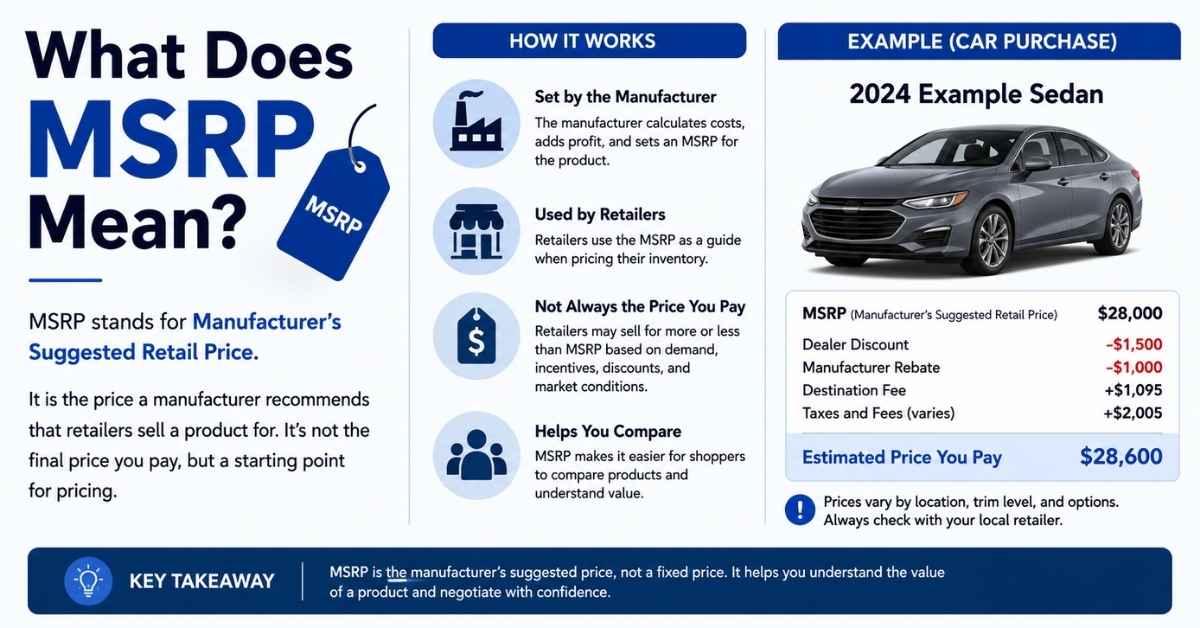
What does MSRP mean? It stands for Manufacturer’s Suggested Retail Price. It is the recommended selling price that a manufacturer suggests a retailer or dealer charge for a product. However, the MSRP is not a mandatory price. Depending on market demand, inventory, competition, promotions, and pricing strategy, the actual selling price may be lower or higher than the MSRP. Whether you’re shopping for a car, smartphone, television, appliance, gaming console, furniture, or luxury item, understanding It helps you determine whether you’re getting a fair deal and avoid paying more than necessary.
If you’ve ever seen an MSRP listed on a product page or vehicle window sticker and wondered whether that’s the price you should pay, you’re not alone. Many shoppers confuse MSRP, sticker price, invoice price, and market price, making it difficult to know if they’re getting good value. This guide explains everything you need to know—from how MSRP works and why manufacturers use it to when you should negotiate and when paying MSRP is perfectly reasonable.
What Does MSRP Stand For?
Before learning how pricing works, it’s helpful to understand what each part of the acronym actually means.
Breaking Down the Acronym
MSRP = Manufacturer’s Suggested Retail Price
Let’s look at each word individually.
Manufacturer
A manufacturer is the company that designs or produces a product. Examples include car makers, electronics companies, appliance brands, furniture manufacturers, and toy companies.
For example:
- A car manufacturer produces a new SUV.
- A smartphone manufacturer launches its latest flagship phone.
- A television manufacturer releases a new OLED model.
The manufacturer determines the product’s recommended launch price based on production costs, research, competition, brand positioning, and expected demand.
Suggested
The word “suggested” is extremely important.
It means the manufacturer is recommending a retail price—not forcing retailers to sell at that amount.
In most markets, retailers are free to charge:
- Below MSRP
- Exactly at MSRP
- Above MSRP
This flexibility allows businesses to respond to changes in supply and demand, inventory levels, local competition, and customer demand.
Retail
A retailer is the business that sells products directly to consumers.
Examples include:
- Car dealerships
- Electronics stores
- Furniture retailers
- Online marketplaces
- Department stores
Retailers purchase products through distributors or directly from manufacturers and decide their final selling prices.
Price
The price represents the recommended amount consumers are expected to pay before additional charges such as taxes, registration fees, shipping costs, or optional add-ons, depending on the product category.
Meaning in Plain English
In simple terms, MSRP is the manufacturer’s recommended selling price for a new product. Think of it as a pricing benchmark rather than a fixed rule.
For example:
A laptop launches with an MSRP of $1,200.
One retailer sells it for:
- $1,200 (at MSRP)
Another retailer offers:
- $1,099 during a seasonal promotion.
A third retailer lists it at:
- $1,299 because inventory is limited and demand is high.
All three prices can be legitimate because the MSRP serves as a reference point, not a legally required selling price.
Quick Takeaway: MSRP tells you what the manufacturer believes is a fair starting price, but the actual market price depends on competition, demand, and retailer pricing decisions.
What Is It and How Does It Work?
Now that you know the MSRP definition, let’s explore how it fits into the broader retail pricing system.
Many shoppers assume the manufacturer controls the final price. In reality, the process is much more dynamic.
Who Sets the MSRP?
The manufacturer sets the MSRP after evaluating multiple business factors, including:
- Production costs
- Research and development expenses
- Material costs
- Transportation costs
- Brand positioning
- Competitor pricing
- Consumer demand
- Expected profit margins
- Market trends
For example, if a smartphone company launches a premium device with cutting-edge features, it may set an MSRP of $999 to position the product alongside competing flagship models.
Similarly, a vehicle manufacturer may establish the MSRP of a new SUV after considering manufacturing costs, optional equipment, destination charges, and expected demand.
Why Manufacturers Recommend a Price Instead of Setting One
One of the most common questions is:
Why don’t manufacturers simply require every retailer to charge the same price?
The answer lies in market competition.
Retailers operate in different markets with varying expenses, customer demand, and inventory levels. Allowing pricing flexibility encourages healthy competition while giving retailers the freedom to adjust prices based on local conditions.
For example:
A retailer with excess inventory may lower prices to increase sales.
Another retailer experiencing limited stock may charge above MSRP because buyers are willing to pay more.
This pricing flexibility benefits both businesses and consumers by allowing prices to reflect real market conditions.
Why Retailers Can Charge More or Less Than That
Retailers evaluate several factors before deciding on the final selling price.
These include:
Supply and Demand
When demand exceeds supply, products often sell above MSRP.
Examples include:
- Newly released gaming consoles
- Limited-edition sneakers
- Popular graphics cards
- Highly anticipated smartphones
Conversely, when supply exceeds demand, retailers may discount products below MSRP to clear inventory.
Inventory Levels
Inventory plays a major role in pricing.
If a retailer has hundreds of unsold televisions after the holiday season, they may reduce prices significantly below It.
However, if only a few units remain during peak demand, prices may increase.
Competition
Retailers constantly monitor competitors.
If multiple stores sell the same appliance, each retailer may lower prices to attract more customers.
Competitive pricing often pushes the actual selling price below the manufacturer’s suggested retail price.
Seasonal Promotions
Events such as:
- Black Friday
- Cyber Monday
- Back-to-school sales
- Holiday promotions
- End-of-year clearance events
often result in prices well below It.
Product Popularity
Products with exceptional demand frequently exceed MSRP during launch periods.
For example:
A gaming console released with an MSRP of $499 might temporarily sell for $650 due to limited availability and strong consumer demand.
Expert Insight: It Is a Pricing Benchmark—Not a Price Guarantee
Many consumers mistakenly believe It represents the “correct” price.
In reality, it’s simply the manufacturer’s recommended benchmark.
Think of This as the starting point in a pricing conversation.
The final price depends on several real-world factors:
- Inventory availability
- Local competition
- Consumer demand
- Retail operating costs
- Promotions
- Manufacturer incentives
- Economic conditions
Understanding this distinction helps shoppers make better purchasing decisions instead of assuming every product should sell at MSRP.
Why This Exists: The Business Strategy Behind the Price
MSRP isn’t chosen randomly.
It plays an important role in a company’s overall pricing strategy, helping manufacturers, retailers, and consumers establish a common reference point.
How It Benefits Manufacturers
Manufacturers use It to create consistency across different retailers.
Benefits include:
- Supporting brand positioning
- Preventing pricing confusion
- Providing retailers with guidance
- Establishing perceived product value
- Helping consumers compare products more easily
Without an MSRP, identical products could launch at dramatically different prices, creating confusion and potentially damaging brand perception.
How Retailers Use This
Retailers use It in several ways.
They may:
- Display discounts relative to MSRP.
- Compare current promotions with the suggested retail price.
- Demonstrate customer savings during sales events.
- Position premium products against competing brands.
For example:
MSRP: $800
Sale Price: $650
The visible discount makes the promotion appear more attractive because shoppers naturally compare the sale price with the original MSRP.
Why Consumers Should Care
For shoppers, It serves as a valuable pricing reference.
Knowing this allows you to:
- Judge whether a discount is genuine.
- Compare offers across multiple retailers.
- Recognize inflated markups.
- Make more informed purchasing decisions.
- Understand product value before negotiating.
Instead of accepting the first advertised price, consumers can compare it with the manufacturer’s recommendation and prevailing market prices.
How MSRP Shapes Buyer Perception (Price Anchoring)
One reason It is so influential is a concept known as price anchoring.
In behavioral economics, the first price people see often becomes the mental benchmark against which they evaluate future offers.
Imagine a refrigerator with:
MSRP: $1,500
Current Price: $1,149
Even if you don’t know the retailer’s costs, the lower price feels like a significant bargain because your mind compares it to the original MSRP.
Retailers frequently use this psychological principle in advertisements, promotional banners, and online product listings to emphasize perceived savings.
Understanding price anchoring helps consumers evaluate deals more objectively rather than relying solely on the advertised discount.
Is This the Price You’ll Actually Pay?
One of the biggest misconceptions is that MSRP equals the final purchase price.
In reality, the actual selling price often differs from the manufacturer’s suggested retail price due to market conditions, retailer strategies, and consumer demand.
The amount you ultimately pay can be lower, equal to, or higher than MSRP, depending on the situation.
When Products Sell Below It
Many shoppers assume that if a product has an MSRP of $1,000, they’ll have to pay exactly that amount. In reality, retailers frequently sell products below MSRP to stay competitive, clear inventory, or attract more customers.
Here are the most common reasons why products are discounted below the Manufacturer’s Suggested Retail Price.
Seasonal Sales and Promotions
Retailers often reduce prices during major shopping events such as:
- Black Friday
- Cyber Monday
- Holiday sales
- End-of-season clearance
- Back-to-school promotions
- Anniversary sales
For example:
| Product | MSRP | Sale Price |
|---|---|---|
| 65-inch Smart TV | $1,299 | $949 |
| Gaming Laptop | $1,499 | $1,249 |
| Washing Machine | $899 | $749 |
Although the MSRP remains the same, temporary promotions make the product more affordable.
Excess Inventory
If a retailer has more stock than expected, lowering the price helps free up warehouse space and improve cash flow.
For instance, last year’s smartphone model may have an MSRP of $899, but after the new version launches, retailers might reduce the price to $649 to clear remaining inventory.
Strong Market Competition
Competition is another major reason products sell below It.
Imagine three electronics stores selling the same laptop:
- Store A: $1,199
- Store B: $1,149
- Store C: $1,099
Although the MSRP is $1,299, each retailer adjusts pricing to remain competitive.
Manufacturer Incentives and Rebates
Sometimes manufacturers encourage retailers to offer lower prices by providing:
- Cashback offers
- Instant rebates
- Limited-time incentives
- Trade-in bonuses
- Promotional financing
In these situations, consumers enjoy lower prices while retailers maintain healthy profit margins.
When Products Sell Above It
The opposite also happens.
A retailer may charge more than MSRP when demand significantly exceeds supply.
This often surprises shoppers, but it is common in industries where products are scarce or highly desirable.
Product Launches
New releases frequently command premium prices.
Examples include:
- Flagship smartphones
- Gaming consoles
- High-performance graphics cards
- Luxury watches
- Limited-edition sneakers
If demand greatly exceeds available inventory, retailers may increase prices above the manufacturer’s recommendation.
Supply Chain Disruptions
Shortages caused by manufacturing delays, shipping issues, or global supply constraints can push prices above It.
For example:
A graphics card with an MSRP of $599 may temporarily sell for $850 because supply cannot meet consumer demand.
Dealer Market Adjustments
This is especially common in the automotive industry.
A dealership may advertise:
Vehicle MSRP: $42,000
Market Adjustment: +$4,000
Selling Price: $46,000
These adjustments reflect local demand rather than changes made by the manufacturer.
Limited Editions and High Demand
Collectors’ items often exceed MSRP almost immediately after release.
Examples include:
- Limited-edition LEGO® sets
- Rare trading cards
- Exclusive sneakers
- Collector’s gaming consoles
Because supply is intentionally limited, retailers and resellers often charge well above MSRP.
Learn More: Moss Agate Meaning
How Market Conditions Influence Pricing
The relationship between supply and demand is one of the biggest factors affecting the actual selling price.
High Demand + Low Supply
Result:
Prices often rise above MSRP.
Examples:
- Newly released gaming consoles
- Popular electric vehicles
- Luxury watches
- Limited-edition products
Low Demand + High Supply
Result:
Prices frequently fall below MSRP.
Examples:
- Older smartphone models
- Last season’s appliances
- Overstocked furniture
- End-of-year vehicle inventory
Expert Insight
MSRP should never be viewed in isolation.
Smart buyers compare:
- MSRP
- Current market price
- Historical pricing
- Competitor pricing
- Available promotions
- Product demand
Looking at all these factors provides a much clearer picture of whether you’re getting a good deal.
Other Common Pricing Terms
Many consumers confuse MSRP with other pricing terms. Understanding the differences can help you compare offers more effectively and avoid paying more than necessary.
| Pricing Term | Meaning | Who Sets It? | Can It Change? | Best Used For |
|---|---|---|---|---|
| MSRP | Manufacturer’s recommended selling price | Manufacturer | No (as a recommendation) | Comparing prices |
| Invoice Price | Amount the retailer or dealer typically pays the manufacturer | Manufacturer | Usually fixed | Negotiation reference |
| Sticker Price | Price displayed on the product or vehicle | Dealer/Retailer | Yes | Initial comparison |
| Market Price | Current price based on supply and demand | Market | Constantly | Determining fair value |
| Sale Price | Discounted promotional price | Retailer | Yes | Finding savings |
| Wholesale Price | Price paid by distributors or retailers | Manufacturer | Varies | Business transactions |
| Out-the-Door Price | Final amount after taxes, fees, and add-ons | Dealer/Retailer | Yes | Final purchase decision |
| MAP (Minimum Advertised Price) | Lowest price a retailer may advertise under supplier agreements | Manufacturer/Brand | Varies | Advertising policies |
| RRP (Recommended Retail Price) | Common term outside North America; similar to MSRP | Manufacturer | No (recommendation) | International pricing |
| SRP (Suggested Retail Price) | Another term for MSRP used by some brands | Manufacturer | No (recommendation) | General retail pricing |
Key Point: MSRP, RRP, and SRP are similar concepts, while invoice price, market price, and out-the-door price serve different purposes in the buying process.
Which Price Should Buyers Focus On?
There isn’t a single “best” price to evaluate.
Instead, compare several pricing benchmarks before making a purchase.
For example:
- Use MSRP to understand the manufacturer’s recommended value.
- Compare the market price to see what most retailers currently charge.
- Review historical pricing to determine whether today’s price is unusually high or low.
- Ask for the out-the-door price when buying a vehicle to account for taxes, destination fees, registration, and dealer add-ons.
The more information you have, the better equipped you’ll be to judge whether an offer represents real value.
Does It Apply Only to Cars?
A common misconception is that is only used in the automotive industry.
In reality, Manufacturer’s Suggested Retail Price is used across many industries whenever manufacturers recommend a selling price for retailers.
Understanding this broader application helps shoppers make informed decisions regardless of what they’re buying.
Cars and Trucks
Vehicles are where most consumers first encounter MSRP.
A vehicle’s window sticker (often called the Monroney sticker) typically displays:
- Base MSRP
- Optional equipment
- Destination charge
- Fuel economy information
- Safety ratings
- Total suggested retail price
Because vehicle purchases often involve negotiation, MSRP serves as an important starting point—not necessarily the final price.
Consumer Electronics
It is commonly displayed for:
- Smartphones
- Laptops
- Tablets
- Televisions
- Cameras
- Smartwatches
- Headphones
Retailers frequently discount these products during promotional events, making MSRP a useful benchmark for evaluating savings.
Home Appliances
Major appliances such as:
- Refrigerators
- Dishwashers
- Washing machines
- Dryers
- Ovens
often carry that helps consumers compare prices across different retailers.
Furniture
Furniture manufacturers also recommend retail prices for:
- Sofas
- Dining tables
- Office chairs
- Mattresses
- Bedroom sets
However, furniture is frequently sold below MSRP due to seasonal promotions and showroom clearance events.
Luxury Goods
Premium brands may maintain pricing close to MSRP to protect brand value.
Examples include:
- Designer handbags
- Luxury watches
- High-end luggage
- Premium audio equipment
Discounts are often less common in these categories.
Toys and Collectibles
Especially important for:
- Action figures
- LEGO® sets
- Trading cards
- Limited-edition collectibles
When demand spikes, these items may sell significantly above MSRP in both retail and resale markets.
Online Shopping
Even online marketplaces use MSRP as a reference point.
When browsing products, you may see:
MSRP: $399
Today’s Price: $319
This comparison helps shoppers quickly evaluate perceived savings, although it’s still wise to compare prices across multiple retailers rather than relying solely on the advertised discount.
Should You Pay MSRP? A Smart Buyer’s Decision Framework
One of the most common questions isn’t just “What does MSRP mean?”—it’s “Should I actually pay MSRP?”
The answer depends on the product, market conditions, and timing.
There is no universal rule, but there are clear situations where paying MSRP makes sense and others where negotiating or waiting could save you money.
Situations Where Paying It Makes Sense
Paying is often reasonable when:
- A product has just launched and demand is exceptionally high.
- Inventory is limited.
- The item rarely goes on sale.
- The manufacturer tightly controls distribution.
- You’re purchasing from an authorized retailer with strong customer support and warranty coverage.
Examples include newly released smartphones, popular electric vehicles, and limited-edition luxury products.
When You Should Negotiate
Negotiation is more likely to succeed when:
- Inventory levels are high.
- The product has been on the market for several months.
- Competitors advertise lower prices.
- End-of-season or model-year clearance events are underway.
- Retailers are offering manufacturer incentives or rebates.
Vehicle purchases are one of the best examples where negotiation below MSRP is often possible.
When Waiting Could Save You Money
Patience can pay off.
Consider waiting if:
- A newer model is expected soon.
- Holiday sales are approaching.
- The product is widely available.
- Demand is starting to decline.
Many electronics, appliances, and furniture items experience predictable price drops throughout the year.
Signs You May Be Paying Too Much
Before completing a purchase, ask yourself:
- Is the price well above MSRP without a clear reason?
- Are comparable retailers charging less?
- Are dealer add-ons significantly increasing the total cost?
- Has the product historically sold for much less?
- Is the retailer creating artificial urgency?
If several of these apply, it’s worth researching further or negotiating a better price.
Smart Buyer’s Checklist
Before purchasing any product, compare:
- Manufacturer’s Suggested Retail Price (MSRP)
- Current market price
- Competitor pricing
- Historical price trends
- Available rebates or incentives
- Shipping costs
- Taxes and additional fees
- Warranty and after-sales support
Following this simple framework helps you focus on overall value, not just the sticker price.
How to Use to Get a Better Deal
Understanding Manufacturer’s Suggested Retail Price (MSRP) is only valuable if you know how to use it during your purchase. Smart shoppers don’t rely on MSRP alone—they use it as one of several pricing benchmarks to determine whether they’re getting genuine value.
Here are practical strategies that can help you save money and make more informed buying decisions.
Compare With the Current Market Price
The first step is to compare the MSRP with the current market price.
If multiple retailers are selling a product well below MSRP, the suggested retail price is no longer the best indicator of its true value.
For example:
| Product | MSRP | Average Market Price | Smart Decision |
|---|---|---|---|
| Laptop | $1,299 | $1,099 | Buy at market price rather than paying full MSRP |
| Smart TV | $899 | $749 | Sale represents real savings |
| Refrigerator | $1,699 | $1,549 | Compare retailers before purchasing |
The market price often provides a more realistic picture of what consumers are actually paying.
Check Historical Pricing
Don’t assume today’s “discount” is the best available.
Many products—especially electronics, furniture, and appliances—follow predictable pricing cycles.
Research whether:
- The product has recently been cheaper.
- A newer model is expected soon.
- Seasonal sales are approaching.
- The current promotion is genuinely exceptional.
Looking at historical pricing helps you distinguish a true bargain from clever marketing.
Shop Around
Retailers rarely charge identical prices.
Compare:
- Authorized retailers
- Local stores
- Online marketplaces
- Warehouse clubs
- Brand websites
The same product can vary significantly in price even when the MSRP remains unchanged.
Ask About Incentives and Rebates
Many buyers focus only on the advertised price and overlook additional savings.
Ask whether the retailer offers:
- Manufacturer rebates
- Cashback promotions
- Student discounts
- Military discounts
- Trade-in programs
- Financing incentives
- Bundle discounts
These offers can reduce your total cost without changing the MSRP itself.
Use During Negotiations
When negotiating—particularly for vehicles, furniture, or appliances—MSRP provides a useful starting point.
Instead of asking for “a discount,” explain that you’ve compared:
- MSRP
- Competing offers
- Current market pricing
- Available promotions
A well-informed buyer often has stronger negotiating power than someone focused only on the sticker price.
Real-World Negotiation Example
Imagine you’re purchasing a new SUV.
- MSRP: $38,500
- Dealer A Price: $38,500
- Dealer B Price: $37,100
- Dealer C Price: $36,800 plus manufacturer rebate
Rather than accepting the first offer, you can politely mention competing prices and ask whether the dealer can match or improve them.
The same strategy works for furniture, appliances, and many consumer electronics sold through multiple retailers.
Common Myths
There are several misconceptions surrounding MSRP. Understanding the facts can help you avoid costly mistakes.
| Myth | Fact |
|---|---|
| MSRP is the final price. | MSRP is only a recommended selling price. |
| Every retailer must charge MSRP. | Retailers can often sell above or below MSRP. |
| MSRP includes taxes. | Taxes are usually added separately. |
| Paying MSRP always means you’re overpaying. | In high-demand markets, paying MSRP may actually be a fair deal. |
| Products below MSRP are always bargains. | Compare the current market price before assuming a discount is genuine. |
| MSRP and invoice price are the same. | Invoice price is generally what the retailer pays the manufacturer, while MSRP is the recommended retail price. |
Real-World Examples Across Different Industries
One weakness of many competing articles is that they focus almost exclusively on automobiles. In reality, Manufacturer’s Suggested Retail Price is used across a wide range of industries.
Example 1: Buying a New Car
A sedan has an:
- MSRP: $32,000
One dealership offers:
- Selling Price: $31,200
Another charges:
- $33,500 due to limited inventory.
This illustrates how market conditions influence the final selling price.
Example 2: Purchasing a Smartphone
A flagship smartphone launches with an:
- MSRP: $999
Six months later, retailers compete aggressively.
Current prices range from:
- $849
- $879
- $899
Waiting a few months results in meaningful savings.
Example 3: Buying a Television
A premium OLED television has an:
- MSRP: $2,199
During Black Friday:
- Retail Price: $1,699
Here, MSRP acts as a benchmark that helps consumers recognize a substantial promotional discount.
Example 4: Shopping for Furniture
A dining table carries an:
- MSRP: $1,200
During a showroom clearance:
- Selling Price: $850
Furniture is frequently discounted because retailers regularly refresh inventory.
Example 5: Limited-Edition Collectibles
A collector’s item launches with an:
- MSRP: $250
Because supply is limited, resellers list it for:
- $450
- $600
- $750
This demonstrates how scarcity can push prices well above MSRP.
See More: PLLC Meaning
Mistakes Buyers Make When Interpreting
Even experienced shoppers sometimes misunderstand what MSRP represents.
Avoid these common mistakes.
Assuming It Is the “Correct” Price
It is a recommendation—not a guarantee of value.
Always compare:
- Current market price
- Competing retailers
- Product demand
Ignoring Additional Fees
When buying a vehicle, don’t focus solely on MSRP.
Consider:
- Destination charges
- Registration fees
- Documentation fees
- Dealer add-ons
- Taxes
The out-the-door price provides a more accurate picture of your total cost.
Believing Every Discount Is Genuine
Some retailers advertise large discounts by comparing today’s price with MSRP—even if the product has been selling below MSRP for months.
Research the typical market price before assuming a sale is exceptional.
Comparing Only One Retailer
Prices can vary dramatically.
Always compare several retailers before making a purchase.
A few minutes of research can save hundreds of dollars.
Overlooking Warranty and Service
The lowest price isn’t always the best value.
Consider:
- Warranty coverage
- Return policy
- Customer service
- Installation
- After-sales support
Sometimes paying slightly more results in a significantly better ownership experience.
Frequently Asked Questions
What does This mean on a car?
On a vehicle, MSRP refers to the Manufacturer’s Suggested Retail Price, which appears on the Monroney (window) sticker. It includes the base vehicle price and, depending on the listing, may also reflect factory-installed options and destination charges before taxes, registration, and dealer-added fees.
Is It the same as the sticker price?
Not always.
For many vehicles, the sticker price displayed on the window includes the MSRP plus factory options and destination charges. For other retail products, the sticker price may simply be the retailer’s displayed selling price.
Can retailers charge more than This?
Yes.
Retailers and dealerships can often charge above MSRP when demand exceeds supply or inventory is limited.
Is It legally binding?
Generally, no.
In most markets, MSRP is a recommended selling price rather than a legally enforceable requirement.
Does It include taxes?
No.
Sales tax is typically added separately at checkout.
Does MSRP include shipping or destination fees?
It depends on the product.
For vehicles, the advertised MSRP may be shown alongside a separate destination charge, while for many retail products, shipping costs depend on the retailer.
Can you negotiate below It?
Often, yes.
Negotiation is common for:
- Vehicles
- Furniture
- Appliances
- Some power equipment
For products with strong competition and healthy inventory, retailers may be willing to lower the price.
Why do some products sell above MSRP?
Products often exceed MSRP because of:
- Limited inventory
- High demand
- Product launches
- Supply chain disruptions
- Market adjustments
Why are many products sold below That?
Retailers frequently discount products to:
- Increase sales
- Clear inventory
- Match competitors
- Run seasonal promotions
What is the difference between MSRP and invoice price?
MSRP is the manufacturer’s recommended selling price for consumers.
Invoice price generally represents the amount the retailer or dealer pays the manufacturer before additional incentives or rebates.
Does MSRP apply to online shopping?
Yes.
Many online retailers display the MSRP alongside the current selling price to highlight discounts and help shoppers compare offers.
Is MSRP used outside the United States?
Yes, although the terminology may differ.
Many countries use terms such as RRP (Recommended Retail Price) or SRP (Suggested Retail Price), which serve a similar purpose.
Finals:
Understanding what MSRP means gives you a valuable advantage whenever you’re shopping.
Remember these essential points:
- MSRP stands for Manufacturer’s Suggested Retail Price.
- It serves as a pricing benchmark, not a mandatory selling price.
- Retailers can legally sell products below or above MSRP depending on supply, demand, competition, and inventory.
- Comparing MSRP, market price, invoice price, and the out-the-door price helps you evaluate whether an offer is genuinely competitive.
- Looking beyond the sticker price—by considering rebates, warranties, historical pricing, and total ownership costs—leads to smarter purchasing decisions.
Whether you’re buying a new car, smartphone, television, appliance, furniture, or another consumer product, MSRP should be viewed as a reference point rather than the final word on value. The best deal is the one that balances price, quality, service, and your specific needs, helping you purchase with confidence instead of uncertainty.