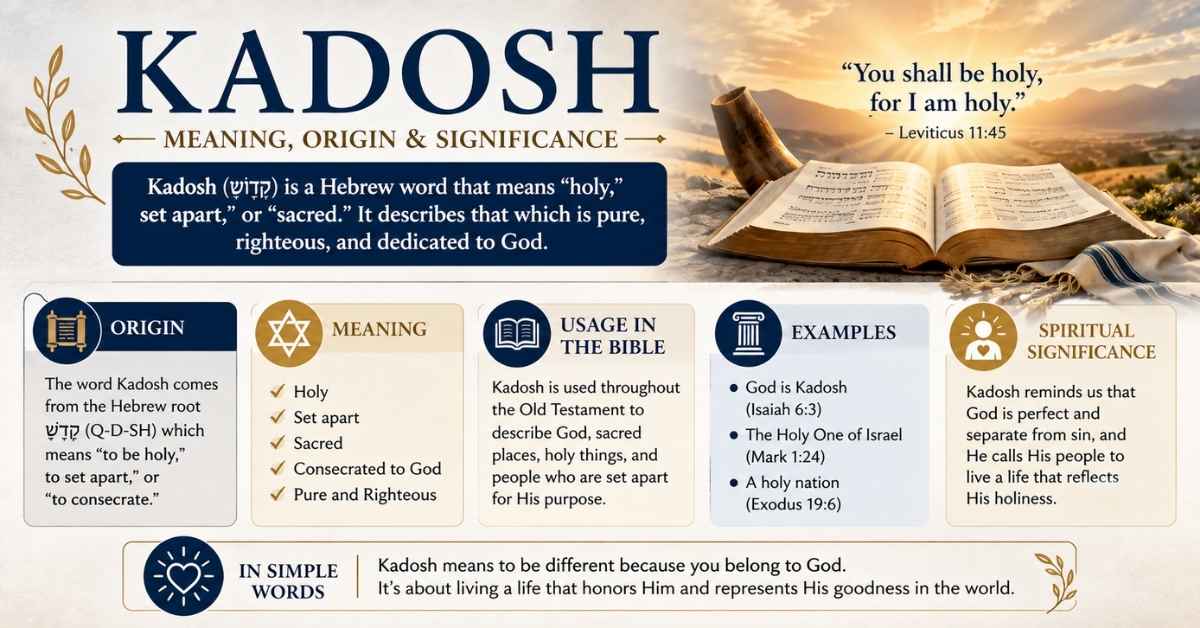
Kadosh meaning is “holy,” “set apart,” or “sacred.” The word Kadosh (קָדוֹשׁ), also transliterated as Qadosh, is a Hebrew word used throughout the Old Testament to describe God’s absolute holiness and anything devoted exclusively to Him. It comes from the Hebrew root ק-ד-ש (Q-D-Sh), which conveys the idea of being separated, consecrated, or dedicated for a divine purpose rather than simply being morally good.
Understanding Kadosh meaning in Hebrew opens the door to a richer appreciation of the Bible. While English translations often render the word as “holy,” the original Hebrew carries a deeper sense of being distinct, sacred, and uniquely set apart. Whether you’re studying Scripture, learning Biblical Hebrew, hearing the word in worship, or simply wondering what does Kadosh mean, this guide explores its literal definition, biblical significance, pronunciation, Hebrew roots, and practical relevance in a way that is both accessible and deeply informative.
What Does Kadosh Mean in Hebrew?
At its core, Kadosh means holy, sacred, or set apart. However, reducing it to a single English word misses much of its richness. In Biblical Hebrew, words often carry layers of meaning rooted in culture, worship, and history.
The idea behind Kadosh is not simply moral perfection. Instead, it describes someone or something separated from ordinary use and dedicated entirely to God. This concept applies to God Himself, but also to people, places, objects, and even time that have been devoted to His purposes.
For example:
- God is Kadosh because He is completely unique, perfect, and unlike anyone or anything else.
- Israel is called to be a holy nation, meaning a people set apart to represent God.
- The Temple is considered holy because it is dedicated to God’s presence.
- The Sabbath is holy because it is set apart from the other days of the week.
This broader understanding explains why many Bible teachers describe Kadosh biblical meaning as “set apart for God’s purpose.”
A Quick Definition
| Term | Meaning |
|---|---|
| Kadosh (קָדוֹשׁ) | Holy, sacred, set apart |
| Language | Biblical Hebrew |
| Root | ק-ד-ש (Q-D-Sh) |
| Literal Idea | Separate for a sacred purpose |
| Common Translation | Holy |
| Biblical Focus | God’s holiness and dedication to divine purposes |
This concise definition answers the common question “What does Kadosh mean in the Bible?” while introducing the deeper theological and linguistic significance that unfolds throughout Scripture.
Hebrew Spelling and Transliteration
One of the fascinating aspects of Biblical Hebrew is that the same word may appear in several English spellings while retaining the same meaning.
Hebrew Spelling
קָדוֹשׁ
Common English Spellings
- Kadosh
- Qadosh
- Qādôš (academic transliteration)
The variation comes from different methods of transliterating Hebrew into the Latin alphabet. The first Hebrew letter, Qof (ק), technically produces a deeper sound than the English K, so many scholars prefer Qadosh. However, Kadosh is the spelling most English readers encounter in Bible studies, worship music, and online searches.
No matter which spelling is used, the meaning remains the same.
How to Pronounce Kadosh
Many readers searching for Kadosh pronunciation are unsure how to say the word correctly.
A simple pronunciation is:
kah-DOHSH
The emphasis falls on the second syllable.
Breaking it down:
- Ka — sounds like “kah”
- Dosh — rhymes loosely with “gosh”
If you hear Hebrew speakers pronounce Qadosh, you’ll notice the first consonant is produced slightly farther back in the throat than a standard English “K.” In everyday English conversation, however, Kadosh is widely accepted and easily understood.
Learning the pronunciation helps when reading passages such as Isaiah 6, participating in Bible studies, or singing worship songs that include the phrase “Kadosh, Kadosh, Kadosh.”
The Hebrew Root Behind Kadosh: Why Three Letters Matter
One reason Hebrew is such a powerful language is its use of three-letter roots. Instead of learning isolated vocabulary words, understanding a root unlocks the meanings of an entire family of related terms.
The word Kadosh comes from the Hebrew root:
ק-ד-ש (Q-D-Sh)
This root expresses the central idea of:
- Holiness
- Sacredness
- Separation
- Consecration
- Dedication to God
Once you understand Q-D-Sh, you’ll begin recognizing many other Hebrew words connected to holiness throughout the Bible.
Rather than describing an abstract quality, the root often communicates purpose. Something becomes holy because it has been set apart for God’s service.
This distinction is one of the biggest reasons many scholars argue that translating Kadosh simply as “holy” doesn’t fully capture the original Hebrew meaning.
The Hebrew Word Family of Q-D-Sh
The Hebrew language builds several important words from the same root.
| Hebrew Word | Meaning | Biblical Significance |
|---|---|---|
| Kadosh | Holy | Describes God, people, places, and objects |
| Kodesh | Holiness or holy place | Often refers to sacred spaces and objects |
| Kedushah | Holiness | Describes the quality or state of holiness |
| Kiddush | Sanctification | A blessing that sanctifies the Sabbath and festivals |
| Mikdash | Sanctuary | Refers to God’s sanctuary or temple |
Seeing these words together helps readers recognize the consistent biblical theme of holiness through dedication rather than mere separation.
This semantic relationship is often overlooked in shorter dictionary entries but is essential for understanding how Biblical Hebrew conveys meaning.
Why “Set Apart” Is a Better Explanation Than Simply “Holy”
When modern readers hear the word holy, they often think only of moral goodness.
The Hebrew concept is much broader.
Imagine a treasured family heirloom displayed only on special occasions. It isn’t necessarily better made than other objects, but it has been reserved for a unique purpose.
Likewise, in Scripture:
- The Temple was holy because it belonged to God.
- The Sabbath was holy because God designated it as distinct from ordinary time.
- The Ark of the Covenant was holy because it represented God’s covenant presence.
- The priests were holy because they were consecrated for sacred service.
Even Israel was called to be a holy nation, not because every individual was morally perfect, but because God had chosen them for a unique covenant relationship.
Understanding this idea transforms the way many passages are read. Holiness in the Bible is not merely about avoiding wrongdoing—it is fundamentally about belonging to God and living according to His purposes.
Where Does Kadosh Appear in the Bible?
The concept of Kadosh runs throughout the Old Testament, shaping how readers understand God’s character, worship, covenant, and identity.
Although the exact word appears in different grammatical forms, its underlying idea is woven into nearly every major section of the Hebrew Scriptures.
Rather than describing only God, the Bible applies the concept of holiness to:
- God
- People
- Places
- Sacred objects
- Festivals
- The Sabbath
- Worship practices
Each use reinforces the central biblical theme that what belongs to God is set apart from ordinary use.
Kadosh as a Description of God
The Bible most powerfully uses Kadosh to describe God Himself.
Unlike human holiness, God’s holiness is absolute. He is completely distinct from creation—perfect in character, unmatched in power, and incomparable in glory.
This truth reaches its highest expression in Isaiah’s vision of heaven.
The prophet sees heavenly beings surrounding God’s throne, continually declaring:
“Holy, Holy, Holy is the Lord Almighty.”
The threefold repetition emphasizes the fullness and perfection of God’s holiness. In Hebrew literature, repeating a word intensifies its meaning. Saying “Kadosh, Kadosh, Kadosh” communicates God’s supreme and incomparable holiness.
This passage has shaped Jewish prayers, Christian worship, hymns, and theology for centuries, making it one of the most recognizable uses of Kadosh in Scripture.
Kadosh Applied to God’s People
Holiness is not reserved only for God.
Throughout the Bible, God repeatedly calls His people to become holy because they belong to Him.
This does not imply sinless perfection. Instead, it means living as a people set apart from surrounding cultures through faithful obedience, justice, compassion, and worship.
Israel’s calling demonstrates that holiness is relational—it flows from belonging to God rather than earning His favor.
This idea later becomes foundational to both Jewish identity and Christian teaching about sanctification.
Holy Places in Scripture
The Bible also uses the concept of Kadosh for places where God’s presence is uniquely revealed.
Important examples include:
- Mount Sinai, where God gave the Law.
- The Tabernacle, Israel’s portable place of worship.
- The Temple in Jerusalem, God’s dwelling among His people.
- The Holy of Holies, the innermost sanctuary entered only under specific conditions.
These locations were considered sacred, not because of the materials used to build them, but because they had been dedicated to God’s presence and purposes.
Their holiness reminds readers that God’s presence transforms ordinary places into sacred spaces.
Holy Objects and Sacred Time
The Bible extends the idea of Kadosh beyond God, people, and places to include objects and time that were dedicated to God’s service. This reinforces an important biblical truth: holiness is about purpose and dedication, not merely appearance or value.
Several objects were considered Kadosh because they played a unique role in Israel’s worship.
These included:
- The Ark of the Covenant
- The altar
- The golden lampstand (Menorah)
- The incense altar
- The priestly garments
- Sacred offerings used in worship
These items were not magical or inherently powerful. They were holy because God had set them apart for a sacred purpose.
The same principle applied to time.
Unlike other days of the week, the Sabbath was declared Kadosh. It became a holy day, separated from ordinary work and devoted to worship, rest, and remembering God’s covenant.
This broader application helps readers understand that Kadosh meaning in Hebrew is not limited to describing God alone. Instead, it represents anything that has been consecrated, sanctified, and reserved for God’s purposes.
Why Do the Angels Say “Holy, Holy, Holy”?
One of the most famous biblical passages featuring Kadosh appears in Isaiah 6, where the prophet receives a vision of God’s heavenly throne.
He describes seraphim—heavenly beings—calling to one another:
“Holy, Holy, Holy is the Lord Almighty; the whole earth is full of His glory.”
This declaration has inspired centuries of Jewish liturgy, Christian worship, hymns, and theological reflection.
But why is Kadosh repeated three times?
The answer lies in Hebrew literary style.
The Power of Threefold Repetition
In Biblical Hebrew, repetition emphasizes importance.
Instead of using words like very or extremely, Hebrew writers often repeated a word to communicate intensity.
Examples include expressions that emphasize certainty, urgency, or greatness through repetition.
When the seraphim proclaim:
Kadosh.
Kadosh.
And Kadosh.
they are not simply repeating themselves.
They are declaring that God’s holiness is absolute, unmatched, and beyond comparison.
Many biblical scholars also note that this threefold declaration communicates God’s complete perfection and transcendence, although interpretations may vary across religious traditions.
Regardless of theological perspective, the repeated word highlights one central truth:
God is utterly distinct from all creation.
Isaiah’s Vision Explained
Isaiah’s vision is one of the Bible’s most dramatic scenes.
He sees the Lord seated on His throne while the temple fills with smoke.
The seraphim cover their faces and feet with their wings, acknowledging God’s overwhelming holiness.
The foundations shake.
The room fills with God’s glory.
Isaiah immediately becomes aware of his own human limitations and responds with humility.
This moment demonstrates an important aspect of Kadosh biblical meaning:
The closer people come to God’s holiness, the more clearly they recognize His greatness and their dependence on Him.
The passage is not intended to create fear alone.
Instead, it reveals that God’s holiness inspires:
- Awe
- Reverence
- Worship
- Transformation
- Humility
These emotional dimensions are often overlooked in shorter dictionary definitions.
Learn More: Gasses or Gases
Why “Holy, Holy, Holy” Still Matters Today
The phrase continues to influence worship around the world.
You’ll hear it in:
- Traditional church hymns
- Contemporary worship songs
- Jewish prayers
- Bible studies
- Sermons
- Hebrew worship gatherings
For many believers, understanding what does Kadosh mean transforms these familiar words from a repeated phrase into a profound declaration about God’s unique character.
Instead of hearing only “holy,” readers begin to understand:
God is completely set apart, perfectly pure, and unlike anyone or anything else.
Does Kadosh Mean More Than “Holy”?
One of the biggest misconceptions about Kadosh is that it simply translates to “holy.”
While that translation is correct, it is also incomplete.
English often compresses several Hebrew ideas into one word.
The original Hebrew carries much richer meaning.
Why “Holy” Isn’t Always Enough
When modern readers hear “holy,” they often imagine:
- Moral perfection
- Religious behavior
- Goodness
- Spiritual purity
These ideas certainly relate to Kadosh, but they don’t tell the whole story.
The Hebrew concept also includes:
- Being set apart
- Being dedicated
- Belonging to God
- Having a sacred purpose
- Being distinct from ordinary use
This explains why:
- The Temple was holy.
- The Sabbath was holy.
- Sacred vessels were holy.
- Israel was called holy.
None of these examples suggest moral perfection in the same way they describe God’s perfect holiness.
Instead, they point to God’s act of setting something apart for Himself.
Holiness vs. Moral Perfection
Many readers assume holiness and perfection are identical.
The Bible paints a more nuanced picture.
God alone possesses absolute holiness.
People become holy by entering a covenant relationship with Him and living according to His purposes.
In other words:
Holiness begins with belonging before it becomes behavior.
This perspective helps explain many passages in Leviticus, Exodus, and the Torah, where people, clothing, utensils, sacrifices, and festivals are described as holy.
Their holiness comes from God’s designation, not their inherent qualities.
An Everyday Illustration
Imagine a family Bible that has been passed down for generations.
It may look like any other book.
Yet your family treats it differently because of what it represents.
It occupies a unique place in your home.
Similarly, a wedding ring is made from ordinary materials, but its meaning makes it special.
These illustrations are not perfect parallels, but they help explain the biblical idea behind Kadosh.
The object itself changes little.
Its purpose, relationship, and dedication make it distinct.
That is the heart of the Hebrew concept.
Kadosh in Judaism and Christianity: Shared Roots, Different Emphases
Because Kadosh appears throughout the Hebrew Bible, it plays an important role in both Judaism and Christianity.
Both traditions agree on the word’s fundamental linguistic meaning.
However, they often emphasize different theological themes.
Understanding these perspectives provides a fuller appreciation of Kadosh meaning in the Bible.
How Judaism Understands Kadosh
In Judaism, Kadosh expresses God’s absolute holiness and the calling of Israel to live as a holy people.
The idea appears throughout:
- The Torah
- Jewish prayer
- Temple worship
- The Sabbath
- Biblical festivals
- Daily blessings
One well-known example is the Kedushah, a central prayer in Jewish liturgy that proclaims God’s holiness using language inspired by Isaiah 6.
Holiness also shapes Jewish life through practices that distinguish sacred time, sacred space, and sacred responsibilities.
How Christianity Understands Kadosh
Christian teaching embraces the Hebrew understanding of holiness while connecting it with themes such as:
- God’s perfect nature
- Sanctification
- Spiritual transformation
- Living a life devoted to God
The New Testament continues this theme by encouraging believers to reflect God’s holiness in their character and actions.
Many Christian teachers explain Kadosh as both God’s unique nature and the invitation for believers to live lives set apart for Him.
Where Both Traditions Agree
Although theological interpretations may differ, Judaism and Christianity share several foundational ideas about Kadosh:
- God alone is perfectly holy.
- Holiness involves being set apart.
- Holiness shapes worship.
- God calls people to live differently.
- Sacredness is connected with God’s presence and purpose.
Recognizing these shared foundations helps readers appreciate the richness of the Hebrew word without reducing it to a single definition.
Kadosh in Modern Hebrew and Everyday Life
Many people wonder whether Kadosh is only an ancient biblical word.
The answer is no.
Although its deepest meaning comes from Biblical Hebrew, the word continues to appear in Modern Hebrew and contemporary religious life.
Is Kadosh Still Used Today?
Yes.
Modern Hebrew speakers continue using Kadosh in religious contexts.
You may encounter it in:
- Synagogue services
- Church worship
- Hebrew Bible studies
- Religious education
- Sacred music
- Modern Hebrew literature discussing faith
While everyday conversations more often use contemporary vocabulary, Kadosh remains instantly recognizable because of its deep biblical heritage.
Where You Might Hear the Word Today
If you’ve attended worship services or listened to Hebrew-inspired music, you’ve likely encountered Kadosh without realizing its full meaning.
Common settings include:
- Singing “Holy, Holy, Holy”
- Reading Isaiah 6
- Jewish liturgical prayers
- Christian sermons
- Bible study groups
- Hebrew language classes
Understanding Kadosh pronunciation, its Hebrew root Q-D-Sh, and its biblical significance allows these familiar moments to take on new depth.
Instead of seeing Kadosh as simply another religious word, readers begin to recognize it as one of the Bible’s most profound descriptions of God’s holiness, sacred purpose, and the call to live a life set apart.
Common Misconceptions About Kadosh
Despite its frequent appearance in the Bible, Kadosh is often misunderstood. Many online articles provide only a dictionary definition, leaving readers with an incomplete picture of one of the most significant words in Biblical Hebrew.
Let’s clear up some of the most common misconceptions.
Misconception 1: Kadosh Only Means “Holy”
While holy is the standard English translation, Kadosh also carries the ideas of being set apart, consecrated, dedicated, and sacred.
The Hebrew concept focuses on purpose and relationship, not just moral excellence.
Misconception 2: Only God Can Be Called Kadosh
God alone possesses perfect and absolute holiness, but the Bible also describes:
- People dedicated to God’s service
- The nation of Israel
- The Sabbath
- The Temple
- The Holy of Holies
- Sacred offerings
- Priestly garments
Their holiness comes from being set apart by God, not from possessing God’s divine nature.
Misconception 3: Holiness Means Being Perfect
Another common misunderstanding is that holiness simply means never making mistakes.
In Scripture, holiness begins with belonging to God. Moral transformation is an important result of that relationship, but the biblical idea of Kadosh first emphasizes being dedicated to God’s purposes.
Misconception 4: Kadosh Is an Obsolete Word
Although Kadosh originates in Biblical Hebrew, it remains relevant today.
You’ll still encounter the word in:
- Jewish prayers
- Christian worship
- Hebrew language studies
- Worship songs
- Bible commentaries
- Modern discussions of faith
Its message continues to resonate because it speaks to the timeless themes of God’s holiness, worship, and devotion.
See More: In Process or In Progress
Why Understanding Kadosh Changes the Way You Read the Bible
Learning Kadosh meaning isn’t simply about expanding your vocabulary—it changes how you understand many passages throughout the Old Testament.
Once you recognize the Hebrew root ק-ד-ש (Q-D-Sh), you’ll begin noticing a recurring biblical theme: God sets apart people, places, objects, and time for His purposes.
For example:
- The Sabbath becomes more than a day off—it is holy time.
- The Temple becomes more than a building—it is holy space.
- Israel becomes more than a nation—it is a people called to reflect God’s character.
- Worship becomes more than rituals—it becomes a response to God’s holiness.
Seeing these connections helps readers move beyond isolated verses and appreciate the Bible’s unified message about holiness.
Reading Scripture with Hebrew Context
Many English translations accurately communicate the meaning of Scripture, but understanding key Hebrew words often adds valuable depth.
When reading books such as:
- Genesis
- Exodus
- Leviticus
- Isaiah
- Ezekiel
- Psalms
look for references to:
- Holy places
- Holy people
- Sacred objects
- Consecration
- Sanctification
- God’s presence
You’ll begin recognizing how the concept of Kadosh ties these themes together.
Simple Bible Study Tips
If you’re interested in exploring Biblical Hebrew, you don’t need to become a language expert overnight.
Here are a few practical habits:
- Notice repeated words and themes.
- Compare multiple Bible translations.
- Learn common Hebrew root words like Q-D-Sh.
- Read passages in their historical and literary context.
- Focus on understanding the author’s intended message rather than isolated word meanings.
These simple practices can make Bible study more meaningful and help you appreciate the richness of the original language.
Kadosh vs. Similar Hebrew Words
Many readers confuse Kadosh with several related Hebrew words. Although they share the same root, each has a distinct meaning.
| Word | Meaning | Primary Use | Key Difference |
|---|---|---|---|
| Kadosh (קָדוֹשׁ) | Holy, set apart | Describes God, people, places, and objects | Adjective describing holiness |
| Kodesh (קֹדֶשׁ) | Holiness, holy place | Sacred spaces and holy things | Noun referring to holiness or sacred places |
| Kedushah (קְדוּשָׁה) | Holiness | Prayer, worship, and the quality of holiness | Abstract concept of holiness |
| Kiddush (קִדּוּשׁ) | Sanctification | Blessing over the Sabbath and festivals | Liturgical blessing |
| Mikdash (מִקְדָּשׁ) | Sanctuary | Temple or sacred sanctuary | Holy location dedicated to worship |
| Tahor (טָהוֹר) | Pure | Ritual purity | Refers to cleanliness or purity rather than holiness |
| Chasid (חָסִיד) | Faithful, devout | Godly person | Focuses on devotion rather than sacredness |
Understanding these related terms provides a broader picture of the Hebrew language and prevents common misunderstandings.
Quick Facts About Kadosh
| Fact | Answer |
|---|---|
| Language | Biblical Hebrew |
| Hebrew Spelling | קָדוֹשׁ |
| Transliteration | Kadosh / Qadosh |
| Pronunciation | kah-DOHSH |
| Literal Meaning | Holy, sacred, set apart |
| Hebrew Root | ק-ד-ש (Q-D-Sh) |
| Primary Theme | Holiness through dedication to God |
| Biblical Usage | God, people, places, objects, and sacred time |
| Related Words | Kodesh, Kedushah, Kiddush, Mikdash |
| Common Bible Contexts | Isaiah, Exodus, Leviticus, Temple worship, Sabbath |
Frequently Asked Questions
What does Kadosh literally mean?
Kadosh literally means holy, set apart, or sacred. It describes someone or something dedicated to God’s purposes.
Is Kadosh the Hebrew word for holy?
Yes. Kadosh (קָדוֹשׁ) is the primary Hebrew word for “holy”, although its meaning also includes being consecrated and set apart.
How do you pronounce Kadosh?
It is commonly pronounced:
kah-DOHSH
The emphasis falls on the second syllable.
What is the Hebrew root of Kadosh?
The word comes from the Hebrew root:
ק-ד-ש (Q-D-Sh)
This root expresses ideas of holiness, sacredness, and consecration.
Why do angels say “Holy, Holy, Holy”?
In Isaiah 6, the seraphim repeat “Holy, Holy, Holy” to emphasize God’s complete and incomparable holiness. In Hebrew, repetition is a literary device that intensifies meaning.
Is Kadosh still used today?
Yes. Kadosh continues to appear in:
- Jewish worship
- Christian worship
- Hebrew Bible studies
- Religious literature
- Worship music
- Modern Hebrew religious contexts
What is the difference between Kadosh and Kodesh?
Kadosh is an adjective meaning holy or set apart, while Kodesh is a noun referring to holiness or a holy place.
Does Kadosh only describe God?
No. Although God’s holiness is unique, the Bible also uses the concept for people, places, sacred objects, and time that have been dedicated to God’s service.
Conclusion
Kadosh meaning goes far beyond the simple English word “holy.” Rooted in the Hebrew קָדוֹשׁ (Qadosh) and the root ק-ד-ש (Q-D-Sh), it expresses the powerful idea of being set apart, sacred, and devoted to God’s purposes. Throughout the Hebrew Bible, this concept shapes our understanding of God’s character, the calling of Israel, the significance of the Temple, the Sabbath, and every aspect of biblical worship.
Whether you encountered Kadosh while reading Isaiah 6, studying Biblical Hebrew, listening to a worship song, or searching for what does Kadosh mean, its message remains timeless. Holiness is not merely about perfection—it is about belonging to God and living with purpose.
By understanding the deeper meaning behind Kadosh, readers gain a richer appreciation of Scripture, discover the beauty of the Hebrew language, and see how one remarkable word connects themes of holiness, covenant, worship, sanctification, and God’s presence throughout the Bible. This deeper perspective transforms Kadosh from a simple vocabulary term into one of the Bible’s most profound and meaningful concepts.