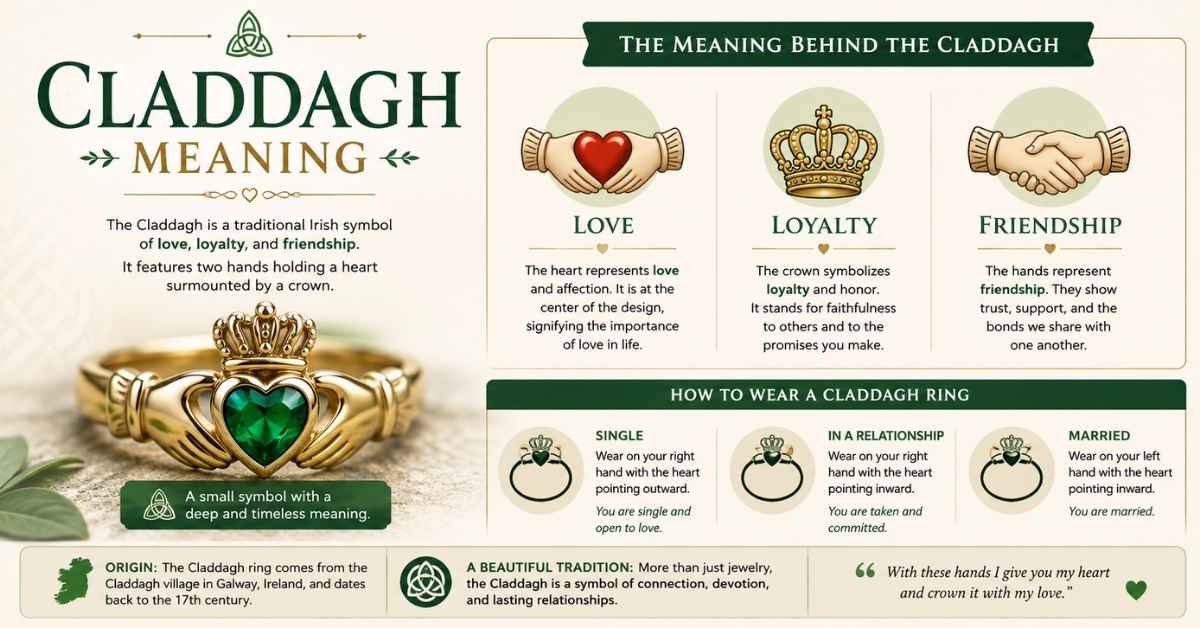
Claddagh meaning is rooted in three timeless values: love, loyalty, and friendship. The iconic Irish Claddagh ring features a heart representing love, hands symbolizing friendship, and a crown signifying loyalty. Originating in the fishing village of Claddagh near Galway, Ireland, this meaningful piece of Irish jewelry has become a cherished symbol of relationships, heritage, and enduring commitment around the world.
Whether you’ve received a Claddagh ring as a gift, are exploring your Irish heritage, shopping for an engagement ring, or simply curious about its symbolism, understanding the story behind this famous ring adds a deeper appreciation for its significance. Beyond its elegant design, the Claddagh reflects centuries of Irish tradition, cultural identity, and heartfelt connections that continue to resonate today.
In this guide, you’ll discover the true meaning of the Claddagh, the fascinating history behind its creation, what each symbol represents, how to wear it correctly, and why it remains one of the world’s most recognizable symbols of love, loyalty, and friendship.
Quick Answer: What Does a Claddagh Ring Mean?
If you’re looking for a quick answer, here’s the essence of the Claddagh ring meaning:
| Claddagh Symbol | Meaning |
|---|---|
| Heart | Love |
| Hands | Friendship |
| Crown | Loyalty |
Together, these three symbols express a simple yet powerful message:
“Let love and friendship reign forever with loyalty.”
For generations, this message has made the Claddagh one of the most treasured symbols in Irish culture and a popular choice for promise rings, engagement rings, wedding bands, anniversary gifts, and meaningful family heirlooms.
What Is a Claddagh Ring?
A Claddagh ring is a traditional Irish ring featuring two hands gently holding a heart topped with a crown. While its appearance is instantly recognizable, its true beauty lies in its symbolism rather than its design alone.
Unlike ordinary jewelry, the Claddagh tells a story. Every element carries a message that reflects the qualities needed for lasting relationships, whether romantic, familial, or platonic.
Today, Claddagh rings are crafted in gold, silver, platinum, and other precious metals. Some modern designs include diamonds or colored gemstones, yet the meaning remains unchanged.
People wear a Claddagh ring to symbolize:
- Romantic love
- Lifelong friendship
- Faithfulness
- Family bonds
- Irish ancestry
- Personal commitment
- Cultural pride
Because of its versatility, the Claddagh has become much more than a piece of jewelry—it serves as a reminder of the values people strive to uphold in their closest relationships.
Why Is It Called a “Claddagh”?
The name Claddagh comes from a historic fishing village located just outside Galway City on Ireland’s west coast.
The Irish word “Cladach” means “rocky shore” or “stony beach,” reflecting the coastal landscape where the community lived for centuries.
This village became famous for its close-knit community, strong family traditions, and skilled fishermen. Over time, the distinctive ring associated with the village came to be known simply as the Claddagh ring.
Today, although the original fishing village has evolved, the Claddagh remains one of Ireland’s most celebrated cultural symbols, representing not only relationships but also a deep connection to Irish history and identity.
Is the Claddagh Irish or Celtic?
One question that often appears in search results is:
Is the Claddagh Irish or Celtic?
The answer is both—but primarily Irish.
The Claddagh ring originated in Ireland, specifically near Galway, making it an authentic part of Irish heritage.
However, because Ireland is one of the Celtic nations, the ring is also closely associated with Celtic traditions. Over the years, many jewelers have incorporated Celtic knotwork and other traditional Irish motifs into Claddagh designs, strengthening this connection.
It’s important to note that while every Claddagh ring is considered Irish, not every Celtic ring is a Claddagh.
Understanding this distinction helps avoid one of the most common misconceptions found online.
What Does Each Part of the Claddagh Symbol Mean?
The enduring popularity of the Claddagh comes from the thoughtful symbolism woven into its design. Rather than using decorative elements, each component conveys an important human value.
Together, these three symbols tell a story about healthy relationships built on trust, affection, and unwavering support.
The Heart: A Universal Symbol of Love
At the center of every Claddagh ring sits a heart, universally recognized as the symbol of love.
In Irish tradition, the heart represents more than romantic affection. It reflects compassion, emotional connection, kindness, and genuine care for another person.
This broader meaning is one reason the Claddagh is suitable for many occasions—not just engagements or weddings.
The heart can symbolize:
- Romantic love
- Family love
- Lifelong friendship
- Compassion
- Emotional commitment
Whether exchanged between partners or passed down through generations, the heart reminds the wearer that authentic relationships begin with love.
The Hands: Friendship, Trust, and Support
The pair of hands gently holding the heart symbolizes friendship.
Rather than tightly gripping the heart, the hands cradle it with care, illustrating that true friendship protects and nurtures love instead of controlling it.
This subtle detail reflects an important lesson from Irish tradition:
Love flourishes best when supported by friendship.
The hands also represent:
- Trust
- Mutual respect
- Partnership
- Protection
- Unity
- Shared experiences
Many modern couples appreciate this symbolism because lasting relationships often grow from strong friendships first.
The Crown: Loyalty Above All
Resting above the heart is the crown, representing loyalty.
Loyalty is the quality that holds love and friendship together over time. While feelings may change and life brings challenges, loyalty reflects the decision to remain faithful, dependable, and supportive.
Within Irish culture, loyalty extends beyond romantic relationships.
It also symbolizes:
- Family devotion
- Community
- Honor
- Commitment
- Integrity
- Trustworthiness
This makes the Claddagh meaningful for parents, siblings, close friends, and anyone who values lifelong relationships.
Why These Three Symbols Create Such a Powerful Message
Many jewelry designs feature a single symbol.
The Claddagh is different because it combines three complementary values into one meaningful design.
Consider what happens if one element is missing:
- Love without loyalty can fade.
- Loyalty without friendship may feel like obligation.
- Friendship without love lacks emotional depth.
Together, these symbols create a balanced message that has resonated for centuries.
This is why the Claddagh remains far more than decorative jewelry—it represents a philosophy of meaningful human relationships.
At its heart, the ring reminds us that the strongest bonds are built on:
- Love that is genuine
- Friendship that is dependable
- Loyalty that lasts through every season of life
That timeless message continues to inspire couples, families, and friends across generations.
Why the Claddagh Ring Still Matters Today
Despite changing fashion trends, the Claddagh has never lost its relevance.
In today’s fast-paced world, people increasingly seek gifts and symbols with genuine meaning rather than fleeting trends. A Claddagh ring offers exactly that—a timeless reminder of the values that strengthen relationships and connect people across generations.
For some, it celebrates Irish ancestry and cultural pride. For others, it marks a milestone such as an engagement, wedding, anniversary, graduation, or lifelong friendship. Many families also pass Claddagh rings from one generation to the next, transforming them into treasured family heirlooms filled with personal stories and memories.
What makes the Claddagh truly special is its ability to speak to everyone, regardless of age, background, or relationship status. Its message of love, loyalty, and friendship is universal, making it one of the few traditional symbols that feels just as meaningful today as it did centuries ago.
The History Behind the Claddagh Ring
The history of the Claddagh ring is just as captivating as its symbolism. While the design is instantly recognizable, its origins are rooted in Irish tradition, craftsmanship, and stories that have been passed down for centuries.
Although some details remain the subject of folklore, historians generally agree that the Claddagh ring originated in the 17th century in the small fishing village of Claddagh, located beside Galway City on Ireland’s rugged west coast.
For generations, the ring has represented far more than jewelry. It has symbolized family, heritage, resilience, and enduring relationships, making it one of the most treasured pieces of Irish jewelry in the world.
The Origins in Claddagh Village, Galway
The name Claddagh comes from the historic fishing community that once thrived just outside Galway’s medieval walls.
This close-knit village was known for:
- Skilled fishermen
- Strong family values
- Traditional Irish customs
- Deep community bonds
- Maritime heritage
Life in Claddagh revolved around cooperation and loyalty. Families depended on one another for survival, and trust was essential to everyday life. These values naturally became reflected in the famous ring that would later bear the village’s name.
Today, although the original village has changed over time, Claddagh remains an important part of Irish cultural heritage, attracting visitors interested in the history behind one of Ireland’s most recognizable symbols.
The Richard Joyce Story: Legend vs. Historical Evidence
No discussion of the Claddagh meaning is complete without mentioning Richard Joyce, the man most often associated with the ring’s creation.
According to Irish tradition, Richard Joyce was a young man from Galway who left Ireland in the late 1600s to work overseas. During his journey, his ship was reportedly captured by pirates, and he was sold into slavery in North Africa.
There, Joyce is said to have been apprenticed to a skilled goldsmith. Over the years, he mastered the art of jewelry making and eventually created the first Claddagh ring while dreaming of returning home to his beloved.
When King William III negotiated the release of many British and Irish captives, Joyce returned to Galway. Legend says he presented the beautifully crafted ring to the woman who had faithfully waited for him, and the two were married.
Whether every detail of this story is historically accurate remains uncertain. While records confirm that Richard Joyce was indeed a Galway goldsmith, historians continue to debate how much of the romantic tale is fact and how much has been embellished over time.
Fact vs. Legend
| Historical Fact | Traditional Legend |
|---|---|
| Richard Joyce was a real goldsmith from Galway. | He designed the ring while enslaved by pirates. |
| Claddagh rings date back to the 17th century. | The first ring was created for his fiancée. |
| The design became popular throughout Ireland. | His love story inspired every Claddagh ring that followed. |
Whether legend or reality, the Richard Joyce story has become part of Irish folklore, adding emotional depth to the ring’s already powerful symbolism.
Learn More: Kadosh Meaning
How the Claddagh Became an International Symbol
Originally, Claddagh rings were exchanged within families and local communities around Galway.
Over the centuries, however, millions of Irish people emigrated to countries such as:
- United States
- Canada
- Australia
- England
- New Zealand
These emigrants carried their traditions with them, including the Claddagh ring.
Today, people around the world wear Claddagh rings to celebrate:
- Irish ancestry
- Family heritage
- Marriage
- Friendship
- Personal milestones
- Cultural identity
Many individuals with no Irish background also choose the Claddagh because its message of love, loyalty, and friendship is universally understood.
The Evolution of the Claddagh Ring Through the Centuries
Although the symbolism has remained unchanged, the ring itself has evolved significantly.
Traditional Designs
Early Claddagh rings were handcrafted from yellow gold with simple, elegant details.
These rings emphasized symbolism over decoration.
Modern Designs
Today’s jewelers create Claddagh rings in a wide variety of materials, including:
- Gold
- White gold
- Rose gold
- Sterling silver
- Platinum
Modern versions may also feature:
- Diamonds
- Emeralds
- Sapphires
- Birthstones
- Celtic knot engravings
- Personalized inscriptions
Despite these design updates, the core message remains unchanged.
A Claddagh ring continues to represent love, loyalty, and friendship, regardless of its style or material.
How to Wear a Claddagh Ring Correctly
One of the most common questions people ask is:
“How do you wear a Claddagh ring?”
Unlike ordinary rings, the orientation of a Claddagh ring traditionally communicates a person’s relationship status.
Although these customs are not strict rules today, many people enjoy following them as part of Irish tradition.
Right Hand, Heart Facing Outward
Meaning: Single and open to love.
When worn on the right hand with the heart pointing away from your body, the wearer is traditionally considered available and open to a romantic relationship.
Think of the heart as looking outward toward future possibilities.
Right Hand, Heart Facing Inward
Meaning: In a committed relationship.
Turning the heart inward on the right hand traditionally indicates that someone’s heart has already been captured.
They may be dating someone seriously or in an exclusive relationship.
Left Hand, Heart Facing Outward
Although less commonly referenced, some traditions associate this position with engagement or a transition toward marriage.
Modern interpretations vary, and many couples simply wear the ring in the way that feels most meaningful to them.
Left Hand, Heart Facing Inward
This is the most widely recognized way to wear a Claddagh ring after marriage.
The inward-facing heart symbolizes that love has found its permanent home.
Many married couples proudly wear the Claddagh this way as an alternative to a traditional wedding band.
Claddagh Ring Wearing Guide
| Ring Position | Traditional Meaning |
|---|---|
| Right hand, heart outward | Single and open to love |
| Right hand, heart inward | In a committed relationship |
| Left hand, heart outward | Engaged (varies by tradition) |
| Left hand, heart inward | Married |
Important: These traditions are cultural customs rather than strict rules. Today, many people choose to wear their Claddagh ring in whatever way best reflects their personal story.
Do These Traditions Still Matter Today?
The answer depends on the wearer.
For some families, especially those with strong Irish heritage, these traditions remain meaningful and are passed down through generations.
Others simply appreciate the symbolism and wear the ring based on comfort or style rather than relationship status.
Neither approach is considered wrong.
The true significance of the Claddagh lies not in strict etiquette but in the values it represents.
Can Anyone Wear a Claddagh Ring?
Absolutely.
A common misconception is that only Irish people should wear a Claddagh ring.
In reality, anyone who respects its symbolism can wear one.
The Claddagh’s message is universal, making it appropriate for people from every culture and background.
Is It Only for Irish People?
No.
Although the Claddagh is proudly Irish in origin, its values—love, loyalty, and friendship—are shared across cultures.
Many people wear the ring to celebrate:
- Irish ancestry
- Appreciation of Irish culture
- Personal relationships
- Family traditions
- Meaningful milestones
Respect for the tradition matters far more than ethnicity.
Can You Wear One If You’re Single?
Yes.
In fact, traditional Claddagh customs specifically include a way for single people to wear the ring.
Wearing it on the right hand with the heart facing outward symbolizes openness to future love.
Many people also choose to wear a Claddagh as a reminder to value self-love, meaningful friendships, and personal growth before entering a relationship.
Can Men Wear a Claddagh Ring?
Absolutely.
Historically, both men and women have worn Claddagh rings.
Modern jewelers produce designs ranging from delicate, classic styles to bold, masculine versions with wider bands and intricate Celtic detailing.
The symbolism remains identical regardless of who wears it.
Can Friends Exchange Claddagh Rings?
Yes.
Although often associated with romance, the Claddagh’s message extends beyond romantic relationships.
Close friends sometimes exchange Claddagh rings as symbols of:
- Lifelong friendship
- Trust
- Loyalty
- Shared memories
- Mutual respect
Because friendship is one of the ring’s three defining values, this tradition feels especially fitting.
Can You Buy a Claddagh Ring for Yourself?
Another popular question is:
“Can I buy my own Claddagh ring?”
The answer is yes.
While some people receive one as a gift, many purchase a Claddagh ring for themselves to celebrate:
- Personal achievements
- Irish heritage
- Self-love
- A new chapter in life
- A meaningful connection to Irish culture
Ultimately, the value of the Claddagh lies in the meaning you attach to it, not in how you acquired it.
Is a Claddagh Ring a Promise, Engagement, or Wedding Ring?
One of the reasons the Claddagh ring has remained popular for centuries is its versatility. Unlike many pieces of jewelry that serve a single purpose, a Claddagh ring can represent different stages of a relationship depending on how it is given and worn.
Rather than being limited to one tradition, it evolves with the wearer’s journey, making it one of the most meaningful symbols in Irish culture.
As a Promise Ring
A Claddagh ring is commonly exchanged as a promise ring to represent a commitment before engagement.
Couples often choose it to symbolize:
- Love
- Loyalty
- Mutual respect
- A shared future
- Trust and friendship
Unlike a traditional promise ring, the Claddagh carries centuries of history and symbolism, making the gesture even more meaningful.
As an Engagement Ring
Many couples use a Claddagh engagement ring instead of a conventional diamond ring.
Its symbolism naturally reflects the qualities that form the foundation of marriage:
- Love
- Loyalty
- Friendship
Modern engagement designs often feature:
- Diamonds
- Emeralds
- Sapphires
- Moissanite
- Birthstones
These additions personalize the ring while preserving its traditional meaning.
As a Wedding Ring
For many families with Irish heritage, the Claddagh serves as a cherished wedding ring.
Traditionally, it is worn on the left hand with the heart facing inward, symbolizing that the wearer’s heart belongs to their spouse.
Its enduring symbolism makes it an ideal wedding band because it represents not only romance but also the friendship and loyalty that sustain a lifelong marriage.
A Family Heirloom Across Generations
One of the most beautiful traditions surrounding the Claddagh is passing it from one generation to the next.
Parents, grandparents, and relatives often gift Claddagh rings to younger family members during milestones such as:
- Graduations
- Weddings
- Birthdays
- Family reunions
- Heritage celebrations
Over time, the ring becomes more than jewelry—it becomes a treasured family heirloom carrying stories, memories, and traditions.
The Deeper Cultural Meaning of the Claddagh
Although many people recognize the Claddagh as a romantic symbol, its cultural significance extends much further.
For generations, it has represented the values that helped Irish communities thrive: trust, resilience, family, and belonging.
A Symbol of Irish Identity
For many people, wearing a Claddagh ring is a way to honor their Irish heritage.
Whether they live in Ireland or are part of the global Irish diaspora, the ring serves as a reminder of family roots and cultural pride.
Its symbolism has endured because it reflects values that transcend time and geography.
The Irish Diaspora and the Claddagh
As Irish families emigrated around the world, they carried cherished traditions with them, including the Claddagh ring.
Today, it is worn across countries such as:
- United States
- Canada
- Australia
- United Kingdom
- New Zealand
This worldwide presence has transformed the Claddagh into a universal emblem of connection while preserving its distinctly Irish identity.
Why the Claddagh Still Resonates Today
In an era of fast fashion and fleeting trends, people increasingly seek meaningful possessions that tell a story.
The Claddagh continues to resonate because it reminds us that lasting relationships are built on:
- Love
- Friendship
- Loyalty
- Trust
- Commitment
These values remain just as relevant today as they were centuries ago.
Common Myths and Misconceptions About the Claddagh Ring
The popularity of the Claddagh has also led to several misconceptions. Let’s separate myth from reality.
| Myth | Fact |
|---|---|
| Only Irish people can wear a Claddagh ring. | Anyone can wear one with appreciation and respect for its tradition. |
| Wearing it the wrong way brings bad luck. | The wearing positions are traditional customs, not universal rules. |
| It is only for romantic relationships. | It also symbolizes friendship, family, loyalty, and heritage. |
| Every Claddagh ring is Celtic. | Every Claddagh is Irish, but not every Celtic ring is a Claddagh. |
| The Richard Joyce story is fully documented history. | Parts of the story are supported by history, while others remain cherished folklore. |
See More: In Process or In Progress
How to Choose the Right Claddagh Ring
If you’re considering buying a Claddagh ring, look beyond appearance. The right ring should reflect both your style and the meaning you want it to carry.
Consider the Metal
- Yellow Gold – Classic, traditional, and timeless.
- White Gold – Elegant with a contemporary feel.
- Rose Gold – Warm, romantic, and distinctive.
- Sterling Silver – Affordable and versatile.
- Platinum – Durable and ideal for everyday wear.
Gemstones and Personalization
Adding gemstones does not change the traditional symbolism. Instead, they can make the ring more personal.
Popular choices include:
- Emerald (Ireland’s iconic green gemstone)
- Diamond
- Sapphire
- Birthstones
- Family stones
Traditional vs. Modern Designs
Traditional Claddagh rings feature clean, simple lines, while modern designs may incorporate:
- Celtic knotwork
- Engraved messages
- Diamond accents
- Vintage finishes
- Contemporary styling
Choose the design that best reflects your personality while honoring the ring’s heritage.
Claddagh Ring vs. Other Symbolic Rings
| Feature | Claddagh Ring | Fede Ring | Gimmel Ring |
|---|---|---|---|
| Origin | Ireland | Ancient Rome | Medieval Europe |
| Main Symbol | Heart, Hands, Crown | Clasped Hands | Interlocking Bands |
| Primary Meaning | Love, Loyalty, Friendship | Love and Trust | Marriage and Unity |
| Common Use | Promise, Engagement, Wedding, Friendship | Engagement | Wedding |
Understanding these distinctions helps explain why the Claddagh has become one of the most recognizable symbols of meaningful relationships.
Real-Life Moments When a Claddagh Ring Makes the Perfect Gift
The versatility of the Claddagh makes it suitable for many occasions, including:
| Occasion | Why It’s Meaningful |
|---|---|
| Engagement | Represents love, loyalty, and lifelong commitment. |
| Wedding | Celebrates a marriage built on friendship and trust. |
| Anniversary | Honors years of shared memories and devotion. |
| Graduation | Marks a new chapter with encouragement and support. |
| Birthday | A thoughtful gift symbolizing enduring relationships. |
| Friendship | Celebrates loyalty and lasting bonds. |
| Family Heirloom | Preserves traditions for future generations. |
| Irish Heritage Celebration | Connects the wearer to Irish history and culture. |
A Claddagh ring is not just a gift—it is a meaningful expression of the values that strengthen our closest relationships.
Frequently Asked Questions About Claddagh Meaning
What does a Claddagh ring mean?
A Claddagh ring symbolizes love, loyalty, and friendship. The heart represents love, the hands signify friendship, and the crown stands for loyalty.
Which hand should you wear a Claddagh ring on?
Traditionally:
- Right hand, heart outward: Single.
- Right hand, heart inward: In a relationship.
- Left hand, heart outward: Often associated with engagement.
- Left hand, heart inward: Married.
Today, many people wear it in whichever way feels most meaningful to them.
Can unmarried people wear a Claddagh ring?
Yes. In fact, traditional Irish customs include a position specifically for single wearers.
Can non-Irish people wear a Claddagh ring?
Absolutely. Anyone who appreciates its symbolism and respects its cultural heritage can wear a Claddagh ring.
Is it bad luck to wear a Claddagh ring incorrectly?
No. While traditional wearing customs exist, they are cultural conventions rather than strict rules.
Can I buy a Claddagh ring for myself?
Yes. Many people purchase one to celebrate personal milestones, Irish ancestry, or as a reminder of the values they wish to live by.
Does the metal change the meaning?
No. Whether made of gold, silver, platinum, or another metal, the Claddagh’s symbolism remains the same.
Final Thoughts
In a world where trends come and go, the Claddagh ring has endured because its symbolism speaks to something universal. It celebrates the relationships that shape our lives, the traditions that connect us to our past, and the hope that love, loyalty, and friendship can stand the test of time.
Whether you’re discovering the Claddagh for the first time or continuing a family tradition, understanding its meaning allows you to appreciate not only its elegant design but also the rich history and heartfelt values it represents.