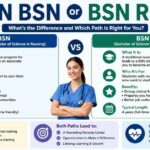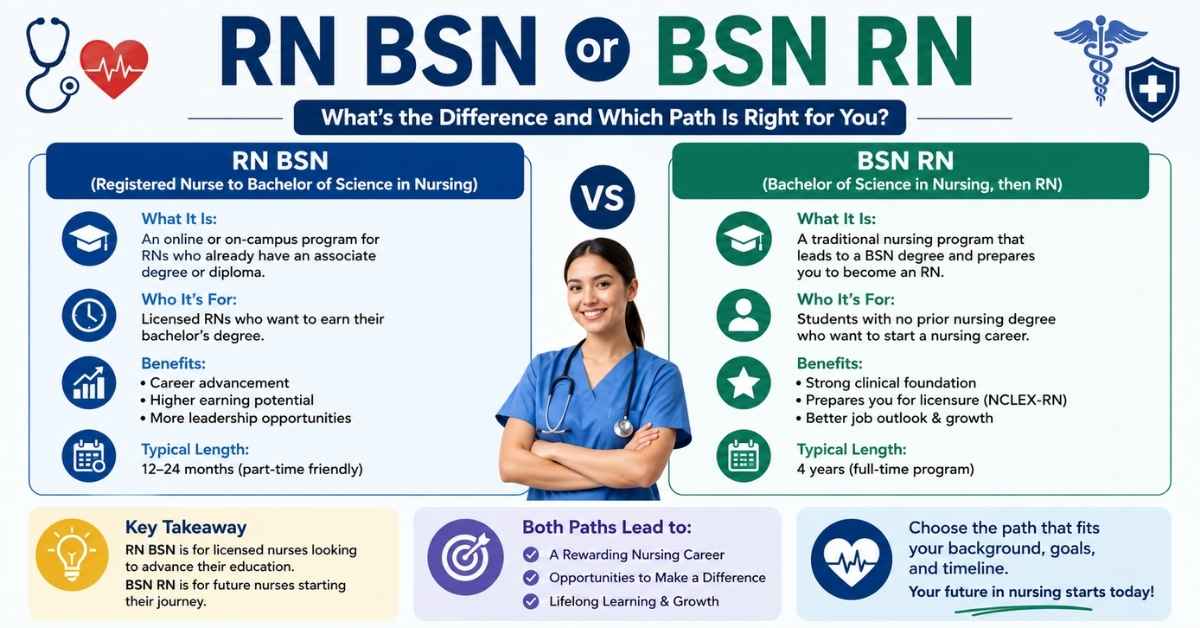
RN BSN or BSN RN? If you’re wondering which credential order is correct, the recommended professional format is BSN, RN. According to widely recognized nursing credential guidelines, academic degrees are listed before professional licenses, which means Bachelor of Science in Nursing (BSN) comes before Registered Nurse (RN). That said, you’ll still see RN, BSN used in hospitals, email signatures, and online profiles because many employers and nurses continue to follow long-standing workplace conventions.
If you’ve recently passed the NCLEX, completed an RN-to-BSN program, or are updating your LinkedIn profile, résumé, or professional email signature, you’re not alone. Thousands of nurses search for the correct nursing credential order every year because conflicting advice online can make a simple formatting decision feel surprisingly confusing.
The good news is that once you understand the difference between an academic degree and a professional nursing license, the credential order becomes much easier to remember. In this guide, you’ll learn why BSN, RN is generally preferred, when you may still see RN, BSN, how to list multiple nursing credentials correctly, and how to present yourself professionally in every situation—from job applications to conference bios.
Why This Question Confuses So Many Nurses
If you’ve searched “rn bsn or bsn rn”, chances are you’ve already encountered different answers. One hospital badge says RN, BSN, a colleague’s LinkedIn profile shows BSN, RN, and another nurse signs emails with only RN. It’s no wonder the topic creates confusion.
The uncertainty usually begins after one of these milestones:
- Graduating from a BSN program
- Passing the NCLEX-RN
- Completing an RN-to-BSN bridge program
- Applying for a new nursing position
- Updating a résumé or LinkedIn profile
- Ordering business cards
- Creating a professional email signature
- Submitting a conference biography or journal article
Many nurses worry about making a mistake that could appear unprofessional. After investing years in earning a nursing degree and obtaining licensure, no one wants to display their credentials incorrectly.
The reality is that both formats exist in everyday practice, but they don’t always represent the same purpose. Understanding the reasoning behind credential order—not just memorizing it—will help you use the right format with confidence.
Degree vs. License: The Difference That Determines the Order
The easiest way to understand proper nursing credentials is to know what each credential actually represents.
What Is a BSN?
A Bachelor of Science in Nursing (BSN) is an academic degree awarded by an accredited college or university after successfully completing a nursing program.
Unlike a nursing license, your degree is a permanent educational achievement. Once you’ve earned it, it doesn’t expire, although your knowledge and skills should continue to grow through lifelong learning.
A BSN program typically includes:
- Advanced nursing theory
- Evidence-based practice
- Community and public health nursing
- Leadership and management
- Nursing research
- Clinical rotations across multiple specialties
Many healthcare organizations now prefer or require nurses to hold a BSN degree, particularly in Magnet-recognized hospitals and leadership roles.
Why a BSN Matters
Beyond qualifying you for many nursing positions, a BSN can also:
- Improve career advancement opportunities
- Open pathways to graduate education such as an MSN or DNP
- Strengthen leadership and critical-thinking skills
- Increase eligibility for specialized nursing positions
Because a BSN reflects your educational achievement, it appears before your professional license in the recommended credential hierarchy.
What Is an RN?
Registered Nurse (RN) refers to your professional nursing license, not your education.
To become an RN in the United States, you generally must:
- Complete an approved nursing education program.
- Pass the NCLEX-RN examination.
- Meet your state’s licensing requirements through the appropriate Board of Nursing.
Unlike a degree, an RN license must be maintained.
Depending on your state, this may involve:
- License renewal
- Continuing education
- Practice hour requirements
- Compliance with professional regulations
This distinction is important because licenses can lapse or expire, while degrees remain earned for life.
That difference forms the foundation of the recommended credential order.
Why Degrees Come Before Licenses
Many articles simply tell readers that BSN comes before RN without explaining why.
The reasoning is actually quite logical.
Think of your professional qualifications as layers.
Your education comes first because it represents what you’ve permanently achieved academically.
Your license comes next because it grants legal permission to practice.
After that come any specialty certifications, followed by professional honors or fellowships.
This creates a consistent hierarchy that reflects your professional development.
The Credential Hierarchy
Highest Academic Degree → Professional License → State Designation (if applicable) → National Certifications → Professional Honors
For example:
- BSN, RN
- MSN, RN
- DNP, APRN, FNP-BC
- PhD, RN, CCRN
- MSN, RN, CEN
Once you understand this hierarchy, it becomes much easier to organize additional nursing credentials throughout your career.
The Official Credential Order Explained
One of the biggest misconceptions surrounding RN BSN or BSN RN is that there isn’t an accepted professional standard.
In reality, professional nursing organizations have long recommended a logical sequence for listing credentials after your name.
Rather than arranging credentials randomly, the order reflects your education, legal authority to practice, and specialized expertise.
A simplified version looks like this:
| Credential Type | Examples |
|---|---|
| Academic Degree | BSN, MSN, DNP, PhD |
| Professional License | RN, APRN |
| State Designation (if applicable) | APRN recognition in some jurisdictions |
| National Certification | CCRN, RN-BC, CEN, FNP-BC |
| Awards & Honors | FAAN and similar distinctions |
This framework explains why BSN, RN is generally considered the preferred professional format.
A Simple Rule You’ll Never Forget
If you only remember one thing from this guide, remember this formula:
Highest Degree → Nursing License → Certification → Honors
Whenever you earn a new credential, ask yourself one question:
Is this a degree, a license, a certification, or an honor?
Once you know the category, placing it correctly becomes straightforward.
For example:
| Credential | Category |
|---|---|
| BSN | Academic Degree |
| MSN | Academic Degree |
| DNP | Academic Degree |
| RN | Professional License |
| APRN | Advanced Practice License |
| CCRN | Specialty Certification |
| CEN | Emergency Nursing Certification |
| RN-BC | Board Certification |
| FAAN | Professional Honor |
This approach is far easier than memorizing dozens of credential combinations.
When Should You Use BSN, RN?
Although the discussion often centers on rn bsn or bsn rn, the real question is where your credentials will appear.
In most professional settings, BSN, RN is appropriate for:
- Professional email signatures
- Résumés and CVs
- LinkedIn profiles
- Business cards
- Conference biographies
- Professional networking platforms
- Healthcare presentations
- Published nursing articles
- Committee memberships
- Professional association directories
Using a consistent format across these platforms helps reinforce your professional identity while making your qualifications easy to understand.
It also demonstrates attention to detail—an important quality in nursing practice.
Professional Example
Imagine you’ve recently completed your RN-to-BSN program and are updating every professional profile.
Instead of using different formats everywhere, keep your credentials consistent:
Email Signature
Sarah Johnson, BSN, RN
LinkedIn Profile
Sarah Johnson, BSN, RN
Business Card
Sarah Johnson, BSN, RN
Conference Speaker Bio
Sarah Johnson, BSN, RN
Maintaining consistency strengthens your personal brand and avoids unnecessary confusion.
Why This Matters More Than You Think
At first glance, credential order may seem like a minor detail. After all, whether you write RN, BSN or BSN, RN, people will still recognize that you’re a registered nurse with a bachelor’s degree.
However, professional presentation is often about consistency, credibility, and attention to detail rather than perfection alone.
When employers, colleagues, recruiters, or conference organizers review your résumé, email signature, or professional profile, clear and consistent credential formatting reflects a polished professional image. It also shows that you understand widely accepted nursing conventions while respecting any workplace-specific formatting requirements.
Most importantly, knowing why the order exists allows you to make informed decisions instead of simply copying what others do.
Why You Still See RN, BSN Everywhere
After learning that BSN, RN is the recommended professional credential order, many nurses ask another important question:
“If BSN, RN is preferred, why do I keep seeing RN, BSN?”
The answer is simple: professional standards and everyday workplace habits don’t always match.
In healthcare, traditions often continue for years—even after professional recommendations evolve. Hospitals, clinics, universities, and healthcare systems may each have their own formatting preferences. As a result, you’ll see both RN, BSN and BSN, RN used in real life.
That doesn’t necessarily mean one organization is “wrong.” It usually reflects internal style guides, legacy practices, or branding standards.
Why RN, BSN Is Still Common
There are several reasons why RN, BSN remains widespread:
- Hospital badge templates may automatically place the nursing license first.
- HR systems often follow older formatting conventions.
- Many nurses simply continue using the format they learned years ago.
- Professional networking sites may display credentials exactly as users enter them.
- Some employers prioritize identifying licensed staff quickly, especially in patient-facing environments.
This explains why you may work alongside highly experienced nurses who proudly use RN, BSN, even though BSN, RN is generally considered the preferred professional sequence.
The key takeaway is this:
Follow your employer’s formatting requirements for workplace materials, but use a consistent, professionally recognized format for your personal résumé, LinkedIn profile, business cards, publications, and email signature unless instructed otherwise.
Is RN, BSN Actually Wrong?
One of the biggest myths online is that RN, BSN is completely incorrect.
The reality is more nuanced.
Think of it this way:
- BSN, RN reflects the commonly recommended credential hierarchy because it places your academic degree before your professional license.
- RN, BSN is still commonly used in many workplaces, organizations, and professional communities.
In other words:
- BSN, RN = preferred professional formatting
- RN, BSN = commonly seen in practice
Understanding this distinction helps eliminate unnecessary stress.
Rather than criticizing colleagues for using a different format, recognize that workplace conventions often differ from broader professional recommendations.
Real Examples You Can Copy
Knowing the rule is helpful.
Knowing how to apply it is even better.
Below are practical examples you can use immediately.
Professional Email Signature
Your email signature is often the first thing patients, colleagues, recruiters, and healthcare organizations see.
A clean, professional format looks like this:
Emily Carter, BSN, RN
Staff Nurse
Medical-Surgical Unit
City General Hospital
Phone Number
Professional Email
This format is simple, recognizable, and easy to read.
LinkedIn Profile
Many nurses wonder:
Should I put my credentials in my LinkedIn name?
If your profile is used for professional networking, it’s perfectly reasonable to display them consistently.
Example:
Emily Carter, BSN, RN
Your headline can then describe your role.
Registered Nurse | Medical-Surgical Nursing | Patient Advocate
This keeps your profile professional while improving visibility for nursing-related searches.
Résumé Header
Your résumé should immediately communicate your qualifications.
Example:
Emily Carter, BSN, RN
Registered Nurse
Phone
This layout keeps the focus on your professional identity without overwhelming recruiters.
Business Card
Professional business cards benefit from concise credential formatting.
Example:
Emily Carter, BSN, RN
Registered Nurse
Community Health Services
Simple formatting creates a polished impression.
Conference Biography
If you’re presenting at a nursing conference, your credentials often appear beneath your name.
Example:
Emily Carter, BSN, RN
Emily Carter is a registered nurse with experience in medical-surgical nursing, patient education, and quality improvement initiatives.
Journal Publication
Academic publications generally use professional credential formatting.
Example:
Emily Carter, BSN, RN
This helps readers immediately understand the author’s educational and professional background.
Hospital Name Badge
Hospital badges are different.
Many organizations have standardized badge templates.
Some display:
Emily Carter RN
Others display:
Emily Carter RN, BSN
Others use:
Emily Carter BSN, RN
In this situation, follow your employer’s policy.
Internal workplace requirements always take priority for identification badges.
Credential Order for Advanced Nursing Degrees
Your credentials will naturally evolve throughout your nursing career.
Understanding the hierarchy now will make future updates much easier.
If You Earn an MSN
Once you complete a Master of Science in Nursing (MSN), it becomes your highest academic degree.
Example:
Emily Carter, MSN, RN
Notice that the highest degree appears first.
If You Earn a DNP
A Doctor of Nursing Practice (DNP) becomes your highest academic credential.
Example:
Emily Carter, DNP, RN
If you also hold advanced certifications:
Emily Carter, DNP, APRN, FNP-BC
Each credential follows the professional hierarchy.
If You Earn a PhD
Nurse researchers often use:
Emily Carter, PhD, RN
The doctoral degree comes before the nursing license.
What About Dual Degrees?
Some nurses earn multiple academic degrees.
Examples include:
- BSN + MBA
- MSN + MPH
- DNP + MBA
- PhD + MSN
Your highest or most relevant academic degree generally comes first, followed by your nursing license and certifications.
Examples:
Emily Carter, MSN, RN
Emily Carter, MBA, BSN, RN (when both degrees are relevant)
Always consider the context and any employer or publication-specific style requirements.
Where Do Nursing Certifications Go?
Many nurses earn specialty certifications after gaining clinical experience.
These credentials demonstrate advanced knowledge in a specific area of practice.
Common certifications include:
- CCRN
- CEN
- PCCN
- RN-BC
- FNP-BC
- AGACNP-BC
- CMSRN
- OCN
These certifications are listed after your nursing license.
Examples:
BSN, RN, CCRN
MSN, RN, CEN
DNP, APRN, FNP-BC
This sequence reflects your education, licensure, and specialty expertise.
Examples of Complete Credential Combinations
Here are several practical examples that nurses frequently search for.
| Professional Background | Example |
|---|---|
| Bachelor-prepared nurse | BSN, RN |
| Master’s-prepared nurse | MSN, RN |
| BSN with critical care certification | BSN, RN, CCRN |
| MSN with emergency certification | MSN, RN, CEN |
| Nurse practitioner | MSN, APRN, FNP-BC |
| Doctor of Nursing Practice | DNP, APRN, FNP-BC |
| Nurse educator | PhD, RN |
| Board-certified nurse | BSN, RN, RN-BC |
Using consistent formatting makes credentials easier to read and demonstrates professionalism.
Common Credential Mistakes Nurses Make
Even experienced nurses occasionally make formatting mistakes.
Fortunately, most are easy to avoid.
1. Listing the License Before Every Degree
Many nurses automatically write:
RN, BSN
without understanding why.
Learning the credential hierarchy helps eliminate this habit when using professional formatting.
2. Listing Every Degree You’ve Ever Earned
Your credentials don’t need to become a paragraph.
Instead of listing every educational milestone, focus on your highest relevant degree and professional credentials.
Clarity is more valuable than length.
3. Forgetting to Update Credentials
After completing an RN-to-BSN or BSN-to-MSN program, many nurses continue using outdated credentials for months—or even years.
Review your:
- LinkedIn profile
- Résumé
- Email signature
- Professional association profiles
- Conference biographies
- Business cards
Consistency strengthens your professional image.
4. Using Different Formats Everywhere
One profile says:
RN, BSN
Another says:
BSN RN
Another uses periods.
Another doesn’t.
This inconsistency can create unnecessary confusion.
Choose one professional format and use it consistently unless an employer requires something different.
5. Including Credentials That Aren’t Relevant
Not every certificate belongs after your name.
Professional credentials should communicate qualifications—not overwhelm readers.
Focus on:
- Academic degrees
- Nursing licenses
- Recognized specialty certifications
- Professional honors
What Employers Actually Care About
Many nurses worry that using the “wrong” credential order could hurt their chances of getting hired.
In reality, employers care far more about:
- Active nursing licensure
- Clinical experience
- Certifications
- Professional conduct
- Communication skills
- Continuing education
- Attention to detail
Credential formatting alone is unlikely to determine whether you receive a job offer.
However, presenting yourself consistently and professionally creates a positive first impression.
Recruiters often review dozens—or even hundreds—of résumés. Clear formatting makes your qualifications easier to identify quickly.
Different Situations Call for Different Formatting
Although BSN, RN is generally recommended, context matters.
| Situation | Recommended Approach |
|---|---|
| Professional résumé | BSN, RN |
| LinkedIn profile | BSN, RN |
| Email signature | BSN, RN |
| Business card | BSN, RN |
| Conference biography | BSN, RN |
| Research publication | Follow publisher guidelines |
| Hospital ID badge | Follow employer policy |
| Internal staff directory | Follow organizational standards |
This flexible approach helps you maintain professionalism while respecting workplace expectations.
Myths vs. Facts About Nursing Credential Order
There are plenty of misconceptions about rn bsn or bsn rn. Some come from outdated workplace habits, while others spread through social media and online forums. Let’s separate fact from fiction.
| Myth | Fact |
|---|---|
| RN, BSN is always wrong. | BSN, RN is the generally recommended professional order, but RN, BSN is still commonly used in many workplaces and by some employers. |
| You must list every degree you’ve earned. | Usually, your highest relevant academic degree, professional license, and applicable specialty certifications are sufficient. |
| Certifications should come before RN. | Specialty certifications typically follow your professional nursing license. |
| Every hospital follows the same credential format. | Healthcare organizations often have their own internal style guides for badges, directories, and email signatures. |
| Credential order affects your nursing license. | Your credential order does not change your legal licensure status. It simply reflects a professional formatting convention. |
| Once you choose one format, it can never change. | You may need to adapt your formatting for employer requirements, journal submissions, or conference guidelines. |
Expert Tips for Looking More Professional
Correct credential order is only one part of presenting yourself professionally. Small details can make a significant difference in how your qualifications are perceived.
1. Keep Your Credentials Consistent
Use the same formatting across your:
- LinkedIn profile
- Résumé or CV
- Professional email signature
- Business cards
- Professional association memberships
- Conference speaker biographies
Consistency strengthens your professional identity.
2. Update Your Credentials Promptly
Whenever you earn a new qualification—whether it’s a BSN, MSN, DNP, or a specialty certification like CCRN or CEN—update your professional profiles as soon as possible.
Outdated credentials can unintentionally underrepresent your qualifications.
3. Follow Employer Policies
Some employers require a specific credential format for:
- Employee badges
- Internal email signatures
- Staff directories
- Nameplates
- Organizational websites
When you’re representing your employer, always follow their formatting requirements.
4. Avoid Credential Overload
Just because you’ve earned multiple certificates doesn’t mean every one belongs after your name.
Too many abbreviations can make your credentials difficult to read.
Instead, prioritize:
- Highest academic degree
- Professional nursing license
- Relevant specialty certifications
- Recognized honors
Simple, organized credentials create a stronger first impression.
5. Review Your Professional Profiles Annually
Set aside time each year to review your:
- Professional memberships
- LinkedIn profile
- Online portfolios
- Speaker biographies
- Email signature
- Résumé
Keeping everything current demonstrates attention to detail.
Quick Credential Order Cheat Sheet
If you’re ever unsure about the proper sequence, remember this simple framework.
Credential Order Formula
Highest Academic Degree → Professional Nursing License → State Designation (if applicable) → National Certification → Professional Honors
Examples
| Correct Professional Format | Example |
|---|---|
| Degree + License | BSN, RN |
| Master’s Degree + License | MSN, RN |
| Doctorate + License | DNP, RN |
| Degree + License + Certification | BSN, RN, CCRN |
| Advanced Practice Nurse | DNP, APRN, FNP-BC |
| Research Nurse | PhD, RN |
Think of your credentials as building blocks:
- Education
- License
- Certification
- Professional Honors
This order works for the vast majority of professional situations.
When Should You Follow Employer Formatting Instead?
Although BSN, It is widely recognized as the recommended professional order, there are situations where your employer’s policy should take precedence.
Examples include:
- Hospital identification badges
- Internal staff directories
- Employee email signatures
- Electronic health record (EHR) displays
- Organization-issued business cards
Likewise, academic journals, conference organizers, and professional associations may have their own formatting rules. Always review their author or submission guidelines before publishing or presenting.
The best approach is simple:
- Follow organizational requirements when representing that organization.
- Maintain a consistent professional format on your personal résumé, LinkedIn profile, portfolio, and networking materials unless a specific guideline says otherwise.
Frequently Asked Questions
Is it RN BSN or BSN RN?
For most professional situations, BSN, RN is the preferred order because it places your academic degree before your nursing license. However, RN, BSN is still commonly seen in many healthcare organizations.
Why does the BSN come before the RN?
A BSN is a permanent academic degree, while an RN is a professional license that must be maintained and renewed. Listing degrees before licenses follows the commonly accepted credential hierarchy.
Is RN, BSN considered incorrect?
Not necessarily. While BSN, RN is generally recommended, RN, BSN remains common in workplaces, legacy systems, and employer-specific formats. It’s better to understand the reason behind each format than assume one is universally wrong.
Should I list my ADN after earning a BSN?
In most cases, no. Once you’ve earned a BSN, it’s generally appropriate to list your highest relevant nursing degree rather than every nursing degree you’ve completed.
How do I list MSN and RN together?
A common professional format is:
MSN, RN
Your highest academic degree appears before your nursing license.
Where do nursing certifications go?
Specialty certifications are generally listed after your nursing license.
Examples include:
- BSN, RN, CCRN
- MSN, RN, CEN
- DNP, APRN, FNP-BC
Should I include credentials on LinkedIn?
Yes. Displaying your relevant professional credentials can make your profile clearer and more recognizable to recruiters, employers, and professional contacts. Keep the format consistent across your professional platforms.
Do email signatures follow the same credential order?
Yes. Many nurses use the same professional formatting in their email signatures that they use on their résumés and business cards. If your employer has a required signature format, follow that policy.
What if my employer requires RN, BSN?
Employer policies take priority for workplace materials such as ID badges, directories, and official email signatures. For your personal professional branding, you can maintain a consistent format that aligns with recognized credential-order guidance unless instructed otherwise.
Does credential order matter outside the United States?
Credential conventions vary by country, licensing authority, and healthcare system. If you practice internationally, follow the standards and regulations used in your jurisdiction or by your employer.
Final Thoughts
Whether you searched “rn bsn or bsn rn,” “BSN RN,” “RN BSN,” “proper nursing credential order,” or “how to list nursing credentials,” the most important takeaway is understanding the logic behind the order—not simply memorizing it.
For most professional settings, BSN, RN reflects the widely recognized sequence of academic degree followed by professional license. As your career grows, you can continue building your credentials by adding specialty certifications, advanced degrees, and professional honors in the appropriate order.
At the same time, remember that real-world practice isn’t always identical to professional recommendations. Hospitals, universities, journals, and healthcare organizations may have their own formatting policies, and following those requirements is part of being a professional.
The easiest rule to remember is:
Highest Academic Degree → Professional Nursing License → State Designation (if applicable) → National Certification → Professional Honors
Using this framework will help you present your qualifications clearly, professionally, and consistently—whether you’re updating your résumé, creating a LinkedIn profile, writing a conference biography, or signing a professional email.