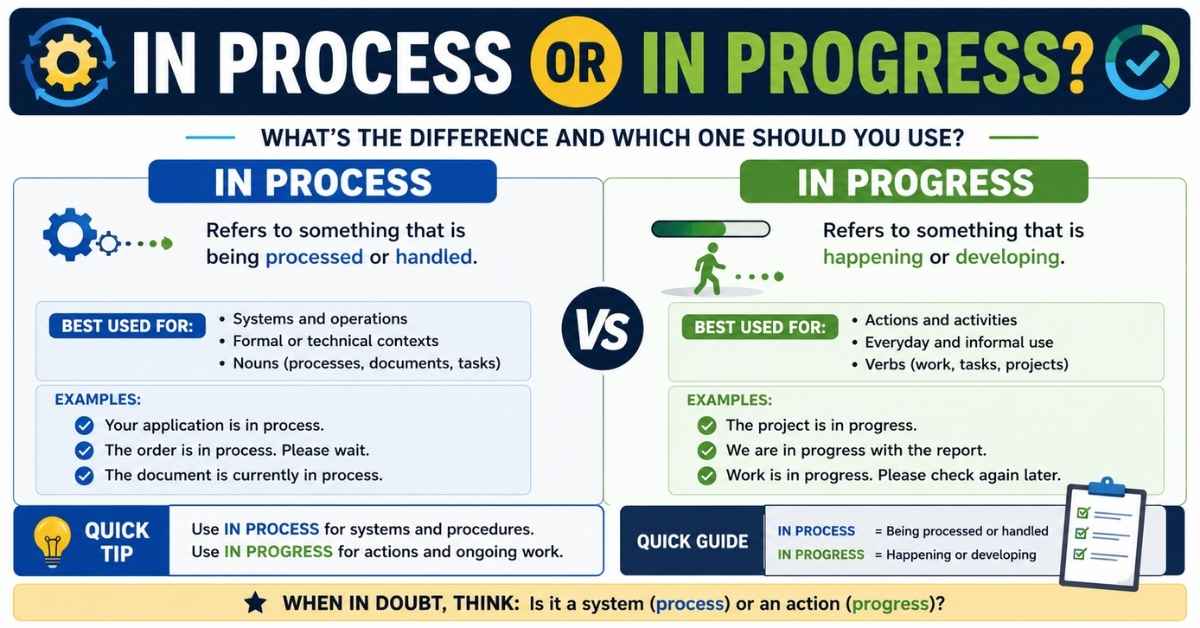
In process or in progress—which phrase is actually correct? The short answer is that both are grammatically correct, but they are not always interchangeable. In most everyday conversations and professional writing, “in progress” is the natural and widely accepted expression used to describe work, projects, or activities that are currently happening. On the other hand, “in process” is typically used in technical, manufacturing, HR, administrative, and workflow-related contexts to indicate that something is moving through a specific procedure or system.
If you’ve ever paused while writing an email, updating a project status, or checking a job application, you’re not alone. Many people wonder whether they should write “the project is in progress” or “the application is in process.” The confusion arises because both phrases involve something that has started but isn’t finished yet. However, the difference lies in what is happening—an activity or a procedure.
In this guide, you’ll learn the exact difference between in process vs. in progress, discover when each phrase is appropriate, explore real-life examples, avoid common grammar mistakes, and gain practical writing tips that native English speakers naturally follow. By the end, you’ll know exactly which phrase to use in emails, reports, project updates, business communication, and everyday English.
Quick Answer: In Process or In Progress?
If you’re looking for the fastest answer, here’s the rule:
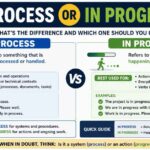
Use “in progress” when describing work, activities, or projects that are actively happening. Use “in process” when referring to something moving through a formal procedure, workflow, or administrative system.
For example:
- ✅ The bridge construction is in progress.
- ✅ Your job application is in process.
- ✅ The software update is in progress.
- ✅ The insurance claim is currently in process.
In general, “in progress” is the safer choice for everyday English, while “in process” is more common in business operations, manufacturing, logistics, customer support, banking, healthcare, and Human Resources (HR).
Quick Comparison Table
| Feature | In Progress | In Process |
|---|---|---|
| Meaning | An activity or task is actively happening. | An item is moving through a defined procedure or workflow. |
| Everyday English | Very common | Less common |
| Business Communication | Frequently used | Common in workflow discussions |
| HR & Recruitment | Occasionally used | Very common |
| Manufacturing | Used for ongoing work | Standard terminology |
| Project Management | Preferred | Used for process-related tasks |
| Emails & Reports | Natural choice | Appropriate for administrative updates |
| Grammar | Standard idiomatic English | Correct in specific contexts |
| Typical Examples | Project, research, construction, repairs | Application, payment, claim, order |
Why People Confuse “In Process” and “In Progress”
At first glance, these expressions seem almost identical. Both describe something that has started but hasn’t been completed. This similarity is exactly why so many English learners—and even native speakers—mix them up.
The confusion also comes from the fact that the words process and progress share similar spelling and are often associated with movement or advancement. However, they describe different concepts.
- Progress focuses on forward movement or ongoing activity.
- Process focuses on a sequence of steps or procedures.
Think of it this way:
- A project moves forward, so it’s in progress.
- An application moves through a hiring workflow, so it’s in process.
Understanding this distinction makes choosing the correct phrase much easier.
Why Workplace Software Adds to the Confusion
Many people first encounter “in process” while checking the status of a job application or online order.
Popular business platforms and Applicant Tracking Systems (ATS) often display statuses such as:
- Application In Process
- Payment In Process
- Order In Process
- Claim In Process
These phrases aren’t grammatical mistakes. Instead, they’re part of workflow terminology, indicating that an item is currently passing through a company’s internal procedure.
In contrast, when giving a project update, you’ll usually hear:
- The renovation is in progress.
- Software development is in progress.
- Construction work is in progress.
This difference reflects the purpose of each phrase rather than a rule about correctness.
The Native English Speaker Perspective
Native English speakers instinctively choose “in progress” in everyday conversation because it sounds more natural when discussing ongoing activities.
For example:
- “The meeting is in progress.”
- “Repairs are in progress.”
- “Our research is in progress.”
Saying these activities are “in process” would sound unusual unless you’re specifically discussing an organizational workflow or technical procedure.
What Does “In Progress” Mean?
In progress means that an activity, project, task, or event has started and is actively continuing but has not yet been completed.
It emphasizes ongoing work rather than the procedure behind it.
In everyday English, in progress is one of the most common ways to describe something that’s currently happening.
Simple Definition
If something is in progress, people are actively working on it, and it hasn’t reached its final stage.
Imagine seeing a road sign that says:
Road Work in Progress
The sign tells you that construction workers are currently repairing or building the road. The work has begun, but it isn’t finished.
Similarly:
- A research study can be in progress.
- A meeting can be in progress.
- A software update can be in progress.
- A home renovation can be in progress.
In each example, the focus is on the activity itself.
When Should You Use “In Progress”?
Use in progress whenever you’re talking about an action or activity that is currently underway.
This includes:
- Projects
- Construction
- Research
- Meetings
- Assignments
- Software development
- Repairs
- Product development
- Investigations
- Training programs
Think of it as describing something that’s actively moving toward completion.
Common Situations Where “In Progress” Is Correct
1. Project Management
Project managers regularly update stakeholders by saying:
- The website redesign is in progress.
- The product launch is in progress.
- The migration project is in progress.
The emphasis is on ongoing work rather than the administrative process.
2. Construction
Construction companies commonly use:
- Construction is in progress.
- Bridge repairs are in progress.
- Road improvements are in progress.
You’ll often see these phrases on public signs because they’re clear and widely understood.
3. Academic Research
Universities frequently announce:
- The study is in progress.
- Research is in progress.
- The experiment is currently in progress.
Again, the focus is on active work rather than a procedural workflow.
4. Software Development
Development teams often write:
- Feature development is in progress.
- Bug fixes are in progress.
- System testing is in progress.
These updates indicate that programmers are actively working on the project.
5. Home Improvement
If someone asks about your house renovation, you would naturally say:
- The kitchen renovation is still in progress.
- Painting is currently in progress.
- The extension is in progress.
This sounds much more natural than saying the renovation is in process.
Real-Life Examples of “In Progress”
Here are examples that reflect how native speakers actually use the phrase.
Business Communication
- The annual audit is in progress.
- Staff training is currently in progress.
- Product testing is still in progress.
Everyday Conversation
- Dinner is in progress, so it’ll be ready soon.
- The movie is already in progress.
- Our vacation planning is in progress.
Education
- The science fair preparations are in progress.
- The group presentation is in progress.
- Final exam revisions are in progress.
Healthcare
- Medical research is in progress.
- Clinical trials are in progress.
- Patient assessments are in progress.
Technology
- Server maintenance is in progress.
- Database migration is in progress.
- Security improvements are in progress.
- The mobile app update is in progress.
Common Words That Naturally Pair With “In Progress”
One of the easiest ways to master this phrase is to recognize its natural collocations.
You’ll frequently see in progress with words like:
- Project
- Construction
- Research
- Development
- Meeting
- Investigation
- Repair
- Training
- Migration
- Implementation
- Upgrade
- Improvement
- Maintenance
- Assignment
- Presentation
These combinations are common in Business English, project management, software development, education, and everyday communication because they describe activities that are actively moving forward.
Expert Tip
Whenever you’re unsure whether to use in process or in progress, ask yourself one simple question:
Am I talking about work that’s actively happening, or am I describing something moving through a formal procedure?
If it’s an activity—such as construction, research, development, or a meeting—in progress is almost always the correct and most natural choice.
What Does “In Process” Mean?
Unlike “in progress,” which describes an activity that is actively happening, “in process” refers to something that is moving through a defined procedure, workflow, or series of steps. The emphasis is not on the activity itself but on the system or process that must be completed before the final result is achieved.
This is why you’ll often see “in process” in Human Resources (HR), manufacturing, logistics, banking, insurance, healthcare, customer support, and government services. In these industries, many tasks follow standardized workflows, making “in process” the preferred phrase.
Simple Definition
If something is in process, it has entered a formal procedure and is currently being handled according to established steps.
For example:
- Your job application is in process.
- Your payment is in process.
- The insurance claim is in process.
- The order is in process.
Here, the focus isn’t on people actively working on the task but on the fact that it is moving through an organized system.
Why Businesses Prefer “In Process”
Many companies use software that automatically tracks the status of applications, orders, claims, or requests. These systems often assign stages such as:
- Received
- Under Review
- In Process
- Approved
- Completed
- Closed
The phrase “in process” tells users that their request has entered the organization’s workflow but hasn’t reached its final stage.
This terminology is especially common in:
- Applicant Tracking Systems (ATS)
- Enterprise Resource Planning (ERP) systems
- Customer Relationship Management (CRM) platforms
- Order management systems
- Manufacturing software
- Insurance claim systems
Because these systems are process-oriented, “in process” sounds natural in this context.
Common Industries That Use “In Process”
1. Human Resources (HR)
Recruitment teams often update candidates with statuses such as:
- Your application is in process.
- Your background verification is in process.
- Your interview scheduling is in process.
This means the hiring procedure is continuing.
2. Manufacturing
Manufacturing professionals frequently use terms like:
- Product is in process.
- Materials are in process.
- Components are in process.
This indicates that items are moving through production stages.
3. Banking and Finance
Banks commonly use:
- Payment is in process.
- Loan approval is in process.
- Account verification is in process.
- Wire transfer is in process.
The customer understands the request is being processed according to internal procedures.
4. Healthcare
Hospitals may say:
- Patient registration is in process.
- Insurance authorization is in process.
- Medical record verification is in process.
Again, these involve administrative workflows.
5. Logistics and Shipping
Examples include:
- Your shipment is in process.
- Order fulfillment is in process.
- Package verification is in process.
The shipment hasn’t necessarily started moving—it is progressing through internal processing steps.
Real-Life Examples of “In Process”
Job Applications
- Your application is currently in process.
- The recruitment process is still in process.
- Candidate evaluation is in process.
Customer Service
- Your refund request is in process.
- Your support ticket is in process.
- The warranty claim is in process.
Manufacturing
- The product is in process.
- The quality inspection is in process.
- Raw materials are in process.
Government Services
- Your passport application is in process.
- Visa processing is in process.
- Tax verification is in process.
Learn More: Shiney or Shiny
In Process vs. In Progress: Side-by-Side Comparison
Although both phrases describe something that has started but isn’t finished, they emphasize different ideas.
| Feature | In Progress | In Process |
|---|---|---|
| Primary Meaning | Ongoing activity | Ongoing procedure |
| Focus | Work being done | Workflow being followed |
| Common Usage | Everyday English | Technical and business English |
| Sounds Natural in Conversation | ✅ Yes | Sometimes |
| HR Systems | Occasionally | ✅ Very common |
| Manufacturing | Sometimes | ✅ Standard term |
| Projects | ✅ Preferred | Less common |
| Applications | Rare | ✅ Preferred |
| Orders & Payments | Rare | ✅ Preferred |
| Construction | ✅ Preferred | Uncommon |
| Meetings | ✅ Preferred | Incorrect in most cases |
Which One Should You Use? (Simple Decision Framework)
If you’re still unsure, use this easy framework.
Step 1: Are you talking about an activity that’s happening now?
Examples:
- A meeting
- A project
- Construction
- Research
- Repairs
👉 Use in progress.
Examples:
- The meeting is in progress.
- The renovation is in progress.
Step 2: Are you talking about a formal workflow or procedure?
Examples:
- Job application
- Insurance claim
- Payment
- Order
- Background check
👉 Use in process.
Examples:
- Your application is in process.
- The refund is in process.
Step 3: Is the phrase generated by a business or software system?
Many organizations use workflow terminology.
Examples:
- Applicant Tracking Systems (ATS)
- Enterprise Resource Planning (ERP)
- Customer portals
These systems commonly display:
- Order In Process
- Application In Process
- Claim In Process
Quick Decision Tree
Are you describing active work?
➡ Yes → Use “In Progress.”
⬇
Are you describing a workflow, procedure, or administrative system?
➡ Yes → Use “In Process.”
Common Situations and the Correct Phrase
| Situation | Correct Phrase | Reason |
|---|---|---|
| Job application | In Process | Administrative workflow |
| Insurance claim | In Process | Formal procedure |
| Online order | In Process | Order processing system |
| Payment verification | In Process | Financial workflow |
| Construction project | In Progress | Active work |
| Research study | In Progress | Ongoing activity |
| Home renovation | In Progress | Physical work |
| School assignment | In Progress | Active task |
| Software development | In Progress | Development activity |
| Customer complaint review | In Process | Organizational procedure |
| Recruitment | In Process | Hiring workflow |
| Road repairs | In Progress | Work underway |
Why HR Systems and Companies Often Say “In Process”
If you’ve applied for a job online, you’ve probably noticed statuses like:
- Application In Process
- Interview In Process
- Hiring In Process
This wording exists because HR teams view recruitment as a multi-step process rather than a single activity.
For example, a hiring workflow may include:
- Application received
- Resume screening
- Interview scheduling
- Technical assessment
- Reference checks
- Final approval
- Offer letter
While your application moves through these stages, its status is in process.
Similarly, companies use in process for:
- Purchase approvals
- Invoice processing
- Employee onboarding
- Vendor registration
- Procurement requests
- Compliance reviews
The phrase accurately reflects that an item is progressing through a structured workflow.
Common Mistakes Native and Non-Native Speakers Make
Even experienced English speakers occasionally confuse these expressions. Here are some of the most common mistakes.
Mistake 1
❌ The meeting is in process.
✅ The meeting is in progress.
Why?
A meeting is an activity happening right now—not an administrative procedure.
Mistake 2
❌ The bridge construction is in process.
✅ The bridge construction is in progress.
Construction involves active work, so in progress is the natural choice.
Mistake 3
❌ My homework is in process.
✅ My homework is in progress.
Homework is an ongoing task, not a workflow.
Mistake 4
❌ My payment is in progress.
✅ My payment is in process.
A payment moves through banking and financial systems, making in process more appropriate.
Mistake 5
❌ My passport application is in progress.
✅ My passport application is in process.
Government applications pass through formal review procedures.
Mistake 6
❌ Product manufacturing is in progress.
✅ Both can be correct, depending on the context.
- Manufacturing is in progress refers to the production work currently taking place.
- The product is in process emphasizes that the product is somewhere within the manufacturing workflow.
This subtle distinction highlights why context matters more than memorizing fixed rules.
Expert Insight: Think Activity vs. Procedure
Instead of trying to remember dozens of examples, focus on one key distinction:
- Activity = In Progress
- Procedure = In Process
Ask yourself:
Am I describing people actively doing work, or am I describing something moving through an organized system?
If people are performing the work, in progress is usually the best choice.
If a document, application, order, payment, or product is moving through a workflow, in process is generally the correct expression.
This simple mindset will help you choose the right phrase naturally in emails, reports, project updates, customer communications, and everyday conversations.
Everyday English vs. Technical English
One of the biggest reasons people get confused about in process or in progress is that the preferred phrase changes depending on the context. In everyday English, native speakers almost always choose “in progress” when talking about ongoing work or activities. In contrast, industries such as manufacturing, Human Resources (HR), logistics, banking, healthcare, and government services often use “in process” because they’re referring to a structured workflow rather than the work itself.
Understanding this distinction will help you sound more natural in conversations while also using the correct terminology in professional environments.
| Everyday English | Technical & Business English |
|---|---|
| The meeting is in progress. | Your application is in process. |
| Construction is in progress. | Your order is in process. |
| The presentation is in progress. | Your payment is in process. |
| Research is in progress. | The insurance claim is in process. |
| The renovation is in progress. | Background verification is in process. |
Quick Rule to Remember
- If you’re describing work, action, or an activity, choose in progress.
- If you’re describing a procedure, workflow, or administrative system, choose in process.
Related Expressions You Should Know
Learning a few related expressions will help you communicate even more naturally in Business English and everyday conversation.
1. Work in Progress (WIP)
Work in progress (WIP) is one of the most common business and project management terms. It refers to work that has started but hasn’t been completed yet.
Examples
- The website redesign is a work in progress.
- The report is still a work in progress.
- The software update remains a work in progress.
2. Work in Process (WIP)
Although it looks similar, work in process is a specialized manufacturing and accounting term. It describes products that are currently being manufactured but are not yet finished.
Example
- The factory reported an increase in work in process inventory this quarter.
Outside manufacturing and accounting, work in progress is usually the better choice.
3. Under Review
Used when something is being evaluated.
Examples:
- Your proposal is under review.
- The application is currently under review.
4. Being Processed
This phrase often replaces in process in customer-facing communication because it sounds clearer.
Examples:
- Your payment is being processed.
- Your refund is being processed.
5. Underway
Underway is another natural alternative to in progress.
Examples:
- The investigation is underway.
- Construction is underway.
6. Ongoing
Used for activities that continue over a period of time.
Examples:
- The negotiations are ongoing.
- The maintenance work is ongoing.
7. In Development
Frequently used in technology and product management.
Examples:
- A new feature is in development.
- The mobile application is currently in development.
See More: Gasses or Gases
Examples in Professional Writing
Using the correct phrase in emails, reports, and project updates makes your communication sound more polished and professional.
Business Email
✅ Correct
Your refund request is currently in process. We appreciate your patience while our team completes the required verification steps.
Project Update
✅ Correct
The software migration is in progress, and we expect completion by next Friday.
Construction Report
✅ Correct
Road maintenance is in progress. Temporary traffic delays are expected.
Customer Support
✅ Correct
Your warranty claim is in process. You’ll receive another update once the review is complete.
HR Communication
✅ Correct
Thank you for your application. Your profile is currently in process, and our recruitment team will contact you after the evaluation stage.
Academic Writing
✅ Correct
The research project is still in progress, and the final results will be published later this year.
How Native English Speakers Naturally Use These Phrases
One of the easiest ways to improve your English is to observe how native speakers choose these expressions.
In everyday conversation, people almost always say:
- The movie is in progress.
- Dinner is in progress.
- The repairs are in progress.
- The investigation is in progress.
However, in workplaces, online portals, and automated systems, you’ll commonly encounter:
- Application In Process
- Order In Process
- Payment In Process
- Verification In Process
Neither phrase is wrong. The difference lies in the context and the type of work being described.
Quick Memory Trick
Here’s a simple way to remember the difference forever:
Progress = Activity Moving Forward
Think of people actively doing something.
Examples:
- Project
- Construction
- Homework
- Research
- Meeting
➡ Use “In Progress.”
Process = Procedure or Workflow
Think of an item moving through a system.
Examples:
- Application
- Payment
- Order
- Insurance claim
- Background check
➡ Use “In Process.”
Easy Formula
Activity = In Progress Procedure = In Process
If you remember this one rule, you’ll rarely choose the wrong phrase.
Frequently Asked Questions
Is “in process” grammatically correct?
Yes. In process is grammatically correct, especially when referring to a formal process, workflow, or administrative procedure. It’s widely used in HR, manufacturing, finance, logistics, and customer service.
Which is more common: “in process” or “in progress”?
In progress is much more common in everyday English because it describes activities that are actively happening. In process is more common in business systems and technical environments.
Can “in process” and “in progress” be used interchangeably?
Not always. Although both describe something that has started but isn’t finished, in progress focuses on ongoing work, while in process emphasizes a structured procedure. Choosing the wrong phrase may sound unnatural in certain contexts.
Why do companies say “application in process”?
A job application passes through several stages, such as screening, interviews, background checks, and final approval. Since it’s moving through a defined workflow, companies use in process rather than in progress.
Should I write “project in process” or “project in progress”?
In almost every case, project in progress is the correct and more natural expression because a project represents ongoing work rather than an administrative procedure.
What is the difference between “work in process” and “work in progress”?
Work in process is a manufacturing and accounting term referring to unfinished goods in production. Work in progress is the broader phrase used for unfinished tasks, projects, creative work, and ongoing activities.
Is “in process” used only in business?
No. While it’s most common in business and technical settings, you’ll also find it in healthcare, education, legal services, banking, insurance, logistics, and government administration whenever a structured workflow is involved.
Which phrase sounds more professional in emails?
It depends on the context:
- Use in progress for project updates, meetings, training sessions, research, or construction.
- Use in process for applications, payments, claims, approvals, and administrative requests.
Expert Tips to Avoid This Mistake Forever
Even experienced writers occasionally hesitate between in process and in progress. These practical tips will help you make the right choice every time:
- Identify what you’re describing. Is it an activity or a procedure?
- Think about your audience. Everyday readers expect in progress, while technical audiences may expect in process.
- Read the sentence aloud. If it sounds unnatural, reconsider your word choice.
- Follow industry conventions. HR systems, manufacturing, and finance often use in process because they describe workflows.
- When in doubt, choose “in progress” for general writing, presentations, reports, blog posts, and conversations because it’s the more idiomatic expression.
Conclusion
Understanding the difference between in process or in progress isn’t just about grammar—it’s about communicating clearly and naturally.
If you’re describing an activity that’s actively happening, such as a project, construction work, research, repairs, software development, or a meeting, in progress is almost always the correct and most natural choice.
If you’re referring to something moving through a formal workflow, such as a job application, payment, insurance claim, order, background check, or administrative procedure, in process is the better option.
The easiest way to remember the difference is this:
- Activity = In Progress
- Procedure = In Process
By focusing on the context instead of memorizing isolated rules, you’ll write more confidently, communicate more professionally, and choose the correct phrase naturally in emails, reports, project updates, customer communications, and everyday conversations.