AOP meaning refers to different definitions depending on the industry or context in which the acronym is used. The most common meanings of AOP include Annual Operating Plan (business), Aspect-Oriented Programming (software development), Association of Persons (tax and law), and Adverse Outcome Pathway (environmental science and toxicology). If you’ve come across AOP in an email, business meeting, programming documentation, financial report, or scientific paper, the surrounding context determines its correct interpretation.
Unlike many abbreviations that have a single accepted definition, AOP is a multi-purpose acronym used across a wide range of industries. That often leaves people wondering, “What does AOP stand for?” or “Which AOP meaning applies to my situation?” This guide answers those questions by explaining the most common AOP full forms, showing real-world examples, and helping you quickly identify the correct meaning without confusion.
Whether you’re a business professional preparing an Annual Operating Plan, a developer learning Aspect-Oriented Programming, a student researching an Association of Persons, or simply curious after seeing AOP in a document, you’ll find a clear, practical explanation below.
Quick Answer: What Does AOP Mean?
The table below provides a quick overview of the most common AOP meanings across different industries.
| If You Saw AOP In… | It Usually Means |
|---|---|
| Business or Finance | Annual Operating Plan |
| Software Development | Aspect-Oriented Programming |
| Tax and Law | Association of Persons |
| Environmental Science | Adverse Outcome Pathway |
| Apparel Industry | All Over Print |
| Healthcare | Varies depending on the medical specialty |
| Water Treatment | Advanced Oxidation Process |
| Military | Air Observation Post |
Quick Tip: If you’re unsure which definition is correct, don’t focus on the acronym alone. Instead, look at where you encountered it—the surrounding topic almost always reveals the intended meaning.
Why Does AOP Have So Many Meanings?
One of the biggest reasons people search for “AOP meaning” is that the acronym appears in completely different industries. Businesses, software developers, tax professionals, scientists, manufacturers, and healthcare organizations have all adopted the same three letters for entirely different concepts.
For example:
- During a budget meeting, AOP almost always refers to an Annual Operating Plan.
- In a Java programming tutorial, it nearly always means Aspect-Oriented Programming.
- In an income tax document, it commonly stands for Association of Persons.
- In toxicology research, it usually means Adverse Outcome Pathway.
Understanding this simple principle saves time and prevents misunderstandings in professional communication.
Expert Insight: Never assume that an acronym has one universal meaning. The industry, document type, and surrounding sentence provide the strongest clues.
How to Identify the Correct AOP Meaning in Seconds
Instead of memorizing every possible definition, use this simple three-step method whenever you encounter AOP.
Step 1: Identify the Industry
Ask yourself where you found the acronym.
- Business presentation
- Company budget
- Programming tutorial
- Financial statement
- Tax document
- Healthcare record
- Scientific publication
- Manufacturing report
- Government form
The industry immediately narrows down the possible meanings.
Step 2: Read the Surrounding Sentence
Context is everything.
For example:
“The leadership team finalized next year’s AOP before the quarterly board meeting.”
This clearly points to Annual Operating Plan because the discussion involves planning and budgeting.
Another example:
“Spring Boot uses AOP to separate logging from business logic.”
Here, the mention of Spring Boot indicates Aspect-Oriented Programming.
Step 3: Match the Context
Use the table below as a quick decision guide.
| Context | Most Likely Meaning |
|---|---|
| Budget planning | Annual Operating Plan |
| Java or Spring Framework | Aspect-Oriented Programming |
| Tax law | Association of Persons |
| Toxicology | Adverse Outcome Pathway |
| Clothing design | All Over Print |
| Water purification | Advanced Oxidation Process |
This simple approach helps you identify the correct AOP abbreviation in just a few seconds.
The Most Common Meanings of AOP
Although AOP has dozens of interpretations across different industries, only a handful are widely used in everyday professional communication. Below, we’ll explore each major meaning in detail, starting with the one most commonly encountered in the corporate world.
AOP Meaning in Business
What Is an Annual Operating Plan (AOP)?
In business, AOP meaning most commonly refers to an Annual Operating Plan. It is a detailed document that outlines a company’s financial goals, operational priorities, revenue targets, budgets, strategic initiatives, and key performance indicators (KPIs) for the upcoming fiscal year.
Think of an Annual Operating Plan as a practical roadmap. While a company’s long-term strategy may cover three to five years, the AOP translates those broader objectives into specific annual actions that departments can execute and measure.
Without a clear AOP, organizations often struggle with inconsistent priorities, inefficient resource allocation, and unclear performance expectations.
Why Companies Use an Annual Operating Plan
Successful organizations don’t rely on guesswork. They use an Annual Operating Plan to ensure every department works toward the same objectives.
An effective AOP helps businesses:
- Define annual revenue and profit goals
- Allocate budgets effectively
- Set measurable KPIs
- Prioritize strategic initiatives
- Improve collaboration between departments
- Monitor financial performance throughout the year
- Reduce operational risks
- Support informed decision-making
Whether it’s a startup, a mid-sized company, or a multinational corporation, having a structured AOP creates alignment across the organization.
Key Components of an Annual Operating Plan
Although every organization creates its AOP differently, most plans include several core sections.
1. Business Objectives
The first section defines what the organization hopes to accomplish during the year.
Examples include:
- Expanding into new markets
- Increasing annual revenue
- Improving customer retention
- Launching new products
- Reducing operating costs
Clear objectives provide direction for every team.
2. Financial Forecast
The financial section estimates:
- Revenue
- Expenses
- Profit margins
- Cash flow
- Capital investments
These forecasts help executives prepare for expected opportunities and challenges.
3. Department Goals
Each department contributes its own objectives.
For example:
Sales
- Increase annual sales by 18%
- Improve conversion rates
- Expand enterprise accounts
Marketing
- Generate qualified leads
- Increase organic website traffic
- Improve brand awareness
Operations
- Reduce production costs
- Improve delivery times
- Increase operational efficiency
Human Resources
- Improve employee retention
- Expand leadership training
- Hire specialized talent
Every department’s goals support the broader business strategy.
4. Budget Planning
Budget planning is one of the most important parts of an AOP.
It determines how financial resources will be distributed across:
- Marketing
- Product development
- Research
- Technology
- Human resources
- Operations
- Customer support
A realistic budget ensures that strategic initiatives remain financially sustainable.
5. Key Performance Indicators (KPIs)
KPIs measure whether the organization is achieving its objectives.
Common KPIs include:
- Revenue growth
- Gross profit
- Customer acquisition cost (CAC)
- Customer lifetime value (CLV)
- Employee turnover
- Net Promoter Score (NPS)
- Production efficiency
- Website traffic
- Lead conversion rate
Tracking these metrics throughout the year allows leaders to adjust strategies when needed.
Real-World Example of an Annual Operating Plan
Imagine a software company preparing for the upcoming fiscal year.
Its leadership team creates an AOP with the following goals:
| Business Area | Annual Goal |
|---|---|
| Revenue | Increase by 20% |
| Product Development | Launch two new SaaS features |
| Marketing | Grow organic traffic by 35% |
| Customer Success | Reduce churn by 12% |
| HR | Recruit 25 software engineers |
| Finance | Reduce operating expenses by 8% |
Every department understands its responsibilities because they are documented within the Annual Operating Plan.
Rather than working independently, all teams contribute toward shared organizational objectives.
Benefits of an Annual Operating Plan
Organizations that consistently develop and monitor their AOP often experience several advantages.
Better Strategic Alignment
Employees understand how their work contributes to company goals.
Improved Financial Planning
Budgets become more predictable and easier to manage.
Stronger Accountability
Each department has measurable targets.
Faster Decision-Making
Leaders can evaluate performance using predefined metrics instead of relying on assumptions.
Enhanced Collaboration
Departments coordinate their efforts around common objectives instead of competing priorities.
Annual Operating Plan vs. Business Plan
These two documents are frequently confused, but they serve different purposes.
| Annual Operating Plan | Business Plan |
|---|---|
| Covers one fiscal year | Focuses on long-term vision |
| Operational and tactical | Strategic and comprehensive |
| Used internally | Often shared with investors and lenders |
| Includes annual budgets and KPIs | Includes market analysis, business model, and funding strategy |
| Updated every year | Updated less frequently |
A business plan explains where the company wants to go, while an Annual Operating Plan explains how it will get there during the next year.
Annual Operating Plan vs. Strategic Plan
Another common source of confusion is the difference between an AOP and a strategic plan.
A strategic plan typically outlines long-term objectives spanning three to five years or more. It focuses on vision, competitive positioning, market expansion, and major organizational goals.
An Annual Operating Plan, on the other hand, translates that strategy into specific annual actions, budgets, timelines, responsibilities, and measurable outcomes.
In simple terms:
- Strategic Plan = Long-term direction
- Annual Operating Plan = Annual execution plan
The two documents work together, ensuring that long-term ambitions are supported by realistic yearly priorities.
AOP Meaning in Programming
What Is Aspect-Oriented Programming (AOP)?
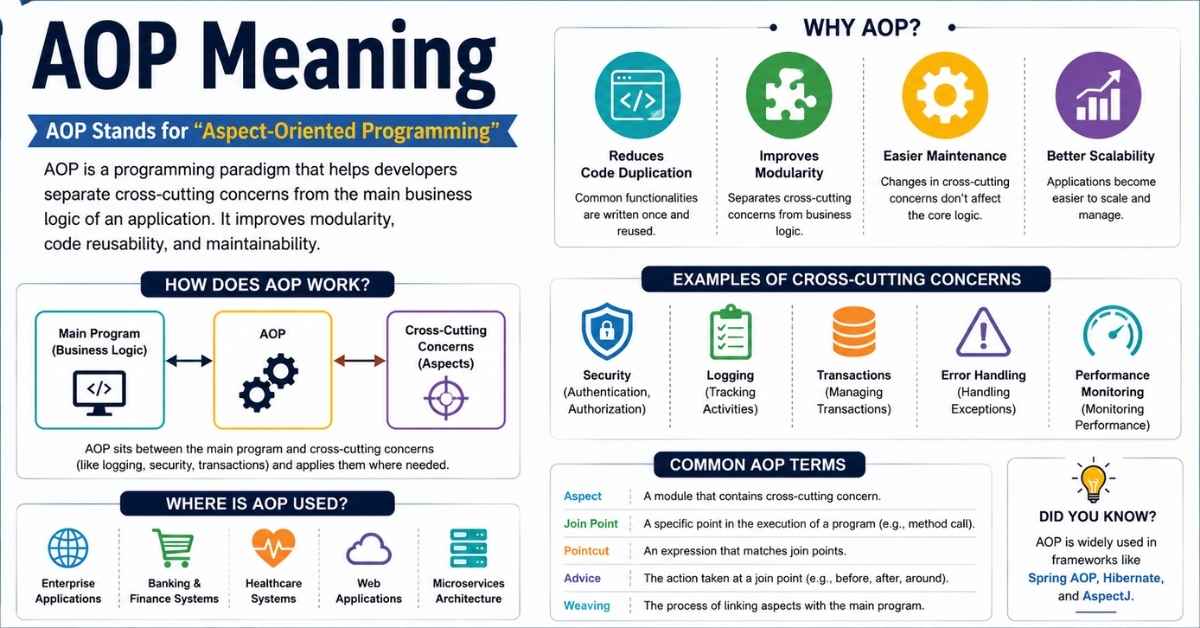
In software development, AOP meaning stands for Aspect-Oriented Programming, a programming paradigm that helps developers organize code by separating cross-cutting concerns from the application’s core business logic.
At first glance, this may sound technical, but the concept is straightforward.
Imagine you’re building an online banking application. Every time a customer logs in, transfers money, or updates their account, the system needs to:
- Record activity (logging)
- Verify permissions (security)
- Start and end database transactions
- Handle exceptions
- Monitor performance
If you manually add this code to every function, your application quickly becomes cluttered and difficult to maintain. Aspect-Oriented Programming solves this problem by allowing these common tasks to be written once and automatically applied wherever they’re needed.
This makes applications cleaner, more modular, and easier to maintain.
Why Developers Use Aspect-Oriented Programming
As software projects grow, repeating the same code across dozens—or even hundreds—of files becomes a maintenance nightmare.
Developers use AOP to:
- Reduce duplicate code
- Improve maintainability
- Separate business logic from technical concerns
- Increase code reusability
- Simplify debugging
- Enhance scalability
- Keep applications organized
Rather than mixing security, logging, and monitoring with business rules, AOP keeps these responsibilities separate.
Understanding Cross-Cutting Concerns
One of the most important concepts in Aspect-Oriented Programming is the idea of cross-cutting concerns.
These are functions that affect many different parts of an application.
Examples include:
- Logging
- Authentication
- Authorization
- Performance monitoring
- Error handling
- Caching
- Database transactions
- Auditing
Without AOP, developers often copy similar code into multiple classes and methods. With AOP, these concerns are centralized into reusable aspects.
Learn More: HPI Meaning
Key Components of Aspect-Oriented Programming
To understand Aspect-Oriented Programming, it’s helpful to know a few common terms.
Aspect
An aspect contains reusable code for a cross-cutting concern, such as logging or security.
Join Point
A join point is a specific point during program execution where an aspect can be applied.
Examples include:
- Calling a method
- Executing a function
- Throwing an exception
Pointcut
A pointcut defines where an aspect should run.
For example:
- Before every login method
- After every payment transaction
- Around every API request
Advice
Advice specifies what action should occur at a selected join point.
Common advice types include:
- Before
- After
- Around
- After Returning
- After Throwing
Weaving
Weaving is the process of combining aspects with the application’s main code.
Depending on the framework, weaving may happen:
- During compilation
- At load time
- While the application is running
AOP and the Spring Framework
If you’ve searched “AOP meaning in programming”, you’ve probably encountered Spring Framework.
Spring is one of the world’s most widely used Java frameworks, and it includes powerful support for Aspect-Oriented Programming.
Developers commonly use Spring AOP for:
- Logging application activity
- Managing transactions
- Applying security rules
- Measuring execution time
- Exception handling
- Monitoring APIs
Instead of writing repetitive code inside every service class, Spring automatically applies aspects where needed.
This results in cleaner and more maintainable applications.
Real Programming Example
Imagine an e-commerce application.
Whenever customers place an order, the system should:
- Save the order
- Log the activity
- Check permissions
- Measure execution time
- Record analytics
Without AOP:
Every service method contains repetitive logging and security code.
With AOP:
The service focuses only on processing orders while reusable aspects handle logging, security, and monitoring automatically.
This separation makes future updates much easier.
Advantages of Aspect-Oriented Programming
Organizations using Aspect-Oriented Programming often experience several benefits.
Cleaner Code
Business logic remains focused on solving business problems.
Better Reusability
Common functionality can be reused across many modules.
Simpler Maintenance
Updating one aspect automatically affects all applicable locations.
Improved Testing
Smaller, modular code is easier to test.
Higher Productivity
Developers spend less time writing repetitive infrastructure code.
Limitations of AOP
Although powerful, AOP isn’t always the right solution.
Potential drawbacks include:
- Increased complexity for beginners
- Harder debugging if aspects are poorly designed
- Hidden program flow
- Overuse can reduce code readability
- Requires understanding framework behavior
Experienced software architects generally recommend using AOP only for genuine cross-cutting concerns rather than everyday business logic.
AOP vs. Object-Oriented Programming (OOP)
Many beginners confuse Aspect-Oriented Programming with Object-Oriented Programming because of their similar abbreviations.
| Aspect-Oriented Programming (AOP) | Object-Oriented Programming (OOP) |
|---|---|
| Separates cross-cutting concerns | Organizes code into objects and classes |
| Focuses on reusable technical functions | Focuses on modeling real-world entities |
| Reduces duplicated infrastructure code | Improves software structure through encapsulation |
| Frequently used with Spring Framework | Used across nearly all modern programming languages |
| Complements OOP rather than replacing it | Forms the foundation of many software systems |
The two approaches work together rather than competing with each other.
AOP Meaning in Tax and Law
What Is an Association of Persons (AOP)?
In taxation and legal contexts, AOP meaning refers to an Association of Persons.
An Association of Persons is a group of individuals or entities that come together for a common purpose—often to earn income, own property, or undertake a business activity—without necessarily forming a registered company.
Many tax systems recognize an AOP as a separate taxable entity under specific circumstances.
Where Is Association of Persons Used?
The term commonly appears in:
- Income tax regulations
- Legal agreements
- Financial documents
- Property ownership arrangements
- Joint ventures
- Investment groups
- Partnership-like business activities
If you encounter AOP in a tax notice or legal document, it almost certainly refers to Association of Persons.
Examples of an Association of Persons
Here are a few practical scenarios.
Joint Property Ownership
Several family members jointly own rental property and share the income.
Depending on local tax laws, this group may be treated as an Association of Persons.
Business Venture
A group of consultants works together on a major project without establishing a corporation.
The tax authority may classify them as an AOP.
Investment Group
Multiple investors pool funds to purchase commercial real estate.
Again, the arrangement may qualify as an Association of Persons under applicable regulations.
Why Understanding AOP Matters in Tax
Misinterpreting tax terminology can lead to filing mistakes, compliance issues, or confusion about legal responsibilities.
If you’re reading an income tax document, always confirm whether AOP refers to an Association of Persons, as the meaning differs completely from its business or programming uses.
Common Misunderstandings
Many people mistakenly assume that an Association of Persons is the same as:
- A corporation
- A partnership
- A limited liability company
- A nonprofit organization
While there can be similarities, the legal definition and tax treatment depend on the laws of the relevant country.
Consulting local regulations or a qualified tax professional is advisable when interpreting legal documents.
AOP Meaning in Environmental Science
What Is an Adverse Outcome Pathway (AOP)?
In environmental science, toxicology, and chemical safety, AOP meaning stands for Adverse Outcome Pathway.
An Adverse Outcome Pathway is a scientific framework that explains how exposure to a chemical or biological stressor leads to harmful effects in an organism.
Rather than focusing only on the final outcome, researchers map the entire sequence of biological events.
This approach helps scientists better understand risk and predict the potential impact of substances on humans, animals, and ecosystems.
Why Scientists Use Adverse Outcome Pathways
Modern toxicology increasingly relies on AOPs to improve chemical risk assessment.
Researchers use them to:
- Evaluate chemical safety
- Predict adverse health effects
- Reduce animal testing where appropriate
- Improve environmental protection
- Support regulatory decision-making
- Guide public health policies
Organizations involved in chemical safety often use internationally recognized frameworks to standardize AOP research.
How an Adverse Outcome Pathway Works
An AOP generally follows a logical sequence.
- Molecular Initiating Event
- A chemical interacts with a biological target.
- Key Events
- A series of measurable biological changes occur.
- Adverse Outcome
- The organism experiences a harmful effect, such as impaired reproduction, disease, or developmental toxicity.
This structured approach helps scientists understand cause-and-effect relationships rather than examining isolated observations.
Applications of Adverse Outcome Pathways
AOPs play an important role in several fields.
Chemical Risk Assessment
Scientists evaluate whether industrial chemicals may pose health or environmental risks.
Pharmaceutical Research
Researchers investigate possible side effects before new medicines reach the market.
Environmental Protection
Government agencies assess pollutants that could affect wildlife or ecosystems.
Regulatory Science
Scientific evidence from AOP frameworks supports informed regulatory decisions and safety evaluations.
Example of an Adverse Outcome Pathway
Imagine researchers studying a newly developed agricultural pesticide.
Instead of waiting years to observe environmental damage, they examine how the chemical interacts with cells, triggers biological changes, and may eventually affect fish reproduction or ecosystem health.
This structured analysis allows earlier identification of potential hazards and supports more informed decision-making.
Why This Meaning Is Less Common
Although Adverse Outcome Pathway is a well-established scientific term, most people searching for “AOP meaning” are more likely looking for:
- Annual Operating Plan
- Aspect-Oriented Programming
- Association of Persons
However, professionals working in toxicology, environmental science, or chemical safety frequently encounter this definition in research papers, regulatory guidance, and scientific reports.
Other Common Meanings of AOP
Although Annual Operating Plan, Aspect-Oriented Programming, Association of Persons, and Adverse Outcome Pathway are the most frequently searched definitions, AOP also appears in several specialized industries. Knowing these less common meanings can help you interpret documents more accurately.
| Industry | AOP Meaning | Example |
|---|---|---|
| Apparel & Printing | All Over Print | “The clothing brand released a new AOP hoodie featuring a floral design.” |
| Water Treatment | Advanced Oxidation Process | “The treatment plant adopted an AOP to remove contaminants from drinking water.” |
| Military | Air Observation Post | “The Air Observation Post provided intelligence during the mission.” |
| Family Law | Acknowledgment of Paternity | “The parents signed the AOP shortly after the child’s birth.” |
| Eye Care | Association of Optometrists | “The optometrist attended an AOP professional conference.” |
| Food & Agriculture | Appellation d’Origine Protégée | “The cheese carries an AOP certification, confirming its protected origin.” |
Although these definitions are less common in general web searches, they are widely recognized within their respective professions.
Real-World Examples of AOP in Different Contexts
Understanding AOP meaning becomes much easier when you see how the acronym is used in everyday communication.
Business Example
“The executive team approved next year’s AOP before presenting it to shareholders.”
Meaning: Annual Operating Plan
Programming Example
“Spring Boot uses AOP to handle transaction management and logging.”
Meaning: Aspect-Oriented Programming
Tax Example
“The rental income was assessed under the rules applicable to an AOP.”
Meaning: Association of Persons
Environmental Science Example
“Researchers developed a new AOP to evaluate chemical toxicity.”
Meaning: Adverse Outcome Pathway
Printing Example
“The manufacturer specializes in AOP T-shirts with edge-to-edge designs.”
Meaning: All Over Print
Water Treatment Example
“The municipality installed an Advanced Oxidation Process (AOP) to improve water quality.”
These examples demonstrate why understanding the context is more important than memorizing every possible expansion.
See More: SNM Meaning
AOP vs. Similar Acronyms
Many professionals confuse AOP with other common workplace and technology abbreviations. Here’s a quick comparison.
| Acronym | Meaning | Primary Use |
|---|---|---|
| AOP | Annual Operating Plan / Aspect-Oriented Programming / Association of Persons | Business, Technology, Tax |
| OOP | Object-Oriented Programming | Software Development |
| SOP | Standard Operating Procedure | Business Operations |
| KPI | Key Performance Indicator | Performance Measurement |
| OKR | Objectives and Key Results | Goal Management |
| BOP | Beginning of Period (Finance) or Balance of Payments (Economics) | Finance & Economics |
Understanding these distinctions helps avoid misunderstandings in meetings, reports, and technical discussions.
How Professionals Determine the Correct AOP Meaning
Experienced professionals rarely rely on the acronym alone. Instead, they consider the surrounding context.
Business Managers
When discussing budgets, forecasts, or annual targets, AOP almost always refers to an Annual Operating Plan.
Software Developers
If the conversation involves Java, Spring Framework, logging, or transactions, Aspect-Oriented Programming is the likely interpretation.
Accountants and Tax Consultants
In financial statements or tax regulations, Association of Persons is the standard meaning.
Environmental Scientists
Research papers discussing toxicity, chemicals, ecosystems, or biological pathways typically use Adverse Outcome Pathway.
Graphic Designers and Apparel Manufacturers
When discussing clothing, merchandise, or textile printing, All Over Print is the correct definition.
Common Mistakes When Interpreting AOP
Even experienced professionals occasionally misunderstand acronyms. Here are some common mistakes to avoid.
Assuming Every Industry Uses the Same Definition
One of the biggest misconceptions is believing AOP has only one meaning.
Ignoring the Surrounding Context
The same acronym can mean something completely different in another profession.
Confusing AOP with OOP
New programmers often mistake Aspect-Oriented Programming for Object-Oriented Programming.
Using the Wrong Expansion in Meetings
Mentioning “Aspect-Oriented Programming” during a finance meeting could confuse everyone in the room if the discussion is actually about an Annual Operating Plan.
Relying on Acronym Dictionaries Alone
Many online acronym databases list dozens of definitions without explaining when each one applies. Context-based understanding is much more useful.
Quick Reference Cheat Sheet
If you need a fast answer, use this summary table.
| Industry | AOP Meaning | Most Common Usage |
|---|---|---|
| Business | Annual Operating Plan | Budgeting and strategic execution |
| Software Development | Aspect-Oriented Programming | Java, Spring Framework, enterprise applications |
| Tax & Law | Association of Persons | Tax regulations and legal structures |
| Environmental Science | Adverse Outcome Pathway | Toxicology and risk assessment |
| Apparel | All Over Print | Clothing and textile design |
| Water Treatment | Advanced Oxidation Process | Water purification |
| Military | Air Observation Post | Reconnaissance operations |
| Family Law | Acknowledgment of Paternity | Legal parentage documentation |
Frequently Asked Questions
What does AOP stand for?
AOP stands for different terms depending on the context. The most common are Annual Operating Plan, Aspect-Oriented Programming, Association of Persons, and Adverse Outcome Pathway.
What is the most common AOP meaning?
For most professionals, Annual Operating Plan (business) and Aspect-Oriented Programming (software development) are the two most frequently encountered meanings.
What does AOP mean in business?
In business, AOP means Annual Operating Plan, a document that outlines an organization’s yearly financial goals, budgets, operational priorities, and performance targets.
What does AOP mean in programming?
In software development, AOP refers to Aspect-Oriented Programming, a technique for separating cross-cutting concerns such as logging, security, and transaction management from business logic.
What does AOP mean in tax?
In taxation, AOP generally stands for Association of Persons, referring to a group of individuals or entities that come together for a common purpose and may be treated as a taxable entity under applicable laws.
What does AOP mean in healthcare?
There is no single healthcare definition. Depending on the medical specialty, AOP may represent different terms. Always interpret it using the surrounding clinical or scientific context.
Is AOP the same as OOP?
No. Aspect-Oriented Programming (AOP) and Object-Oriented Programming (OOP) are different software development paradigms. AOP complements OOP by handling cross-cutting concerns without changing the application’s core business logic.
Why does AOP have multiple meanings?
Like many acronyms, AOP has been adopted independently by different industries over time. The correct interpretation depends entirely on where and how the acronym is used.
How can I quickly identify the correct AOP meaning?
Start by identifying the industry or document type, then read the surrounding sentence. In most cases, the context immediately reveals the intended definition.
Can AOP have different meanings in different industries?
Yes. AOP is a context-dependent acronym. It can represent entirely different concepts in business, software engineering, taxation, environmental science, apparel, military operations, and several other fields.
Conclusion
AOP meaning isn’t limited to a single definition. It represents several important concepts across business, technology, taxation, environmental science, healthcare, manufacturing, and other industries. While Annual Operating Plan and Aspect-Oriented Programming are the most widely recognized meanings, the correct interpretation always depends on context.
Whether you’re reviewing a company budget, learning Java with the Spring Framework, reading a tax document, or studying toxicology, understanding the surrounding topic is the fastest way to identify the right meaning.
The next time you encounter AOP, don’t assume—look at the industry, the document, and the sentence around it. That small step will help you interpret the acronym accurately and confidently in almost any situation.