Introduction
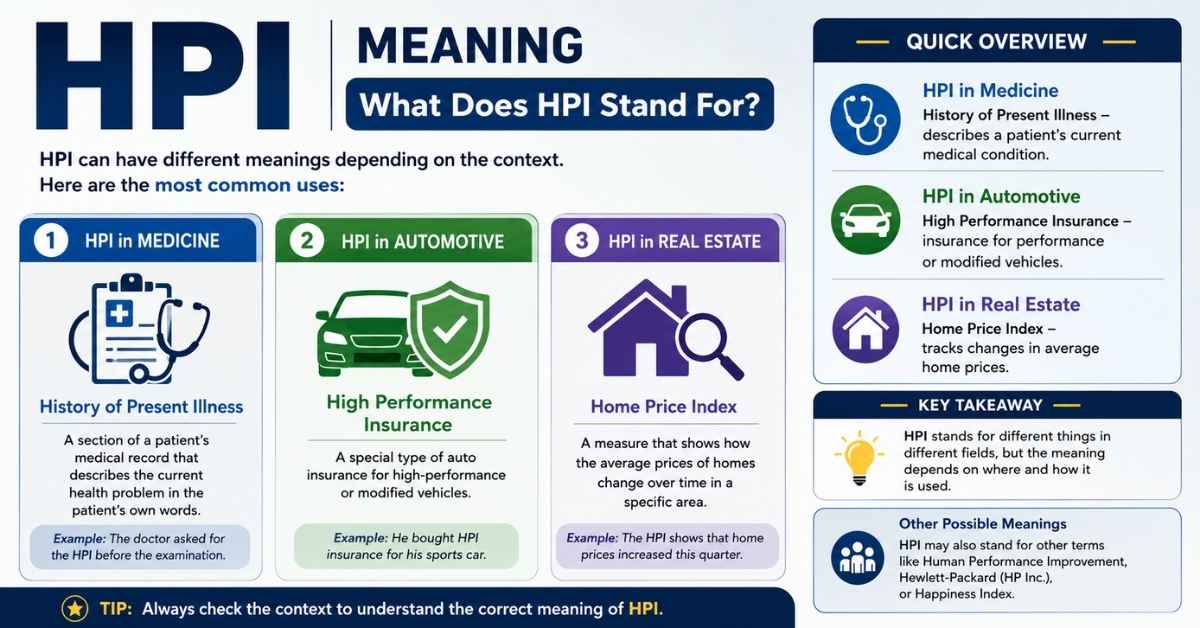
HPI meaning depends on the context in which the acronym is used. The most common meaning of HPI is “History of Present Illness” in healthcare, where doctors and other medical professionals use it to document a patient’s current health problem. However, HPI can also refer to an HPI Check in the automotive industry, a House Price Index in real estate and economics, or even other industry-specific terms like the Human Poverty Index.
Because this abbreviation appears across multiple fields, it’s easy to feel confused when you encounter it in a medical record, a used car advertisement, or a housing market report. The key is understanding the surrounding context. Once you know where the acronym is being used, identifying the correct HPI meaning becomes much easier.
In this comprehensive guide, you’ll learn the different meanings of HPI, when each one is used, practical examples, common mistakes to avoid, and expert insights that help you understand the term with confidence.
What Does HPI Mean?
The abbreviation HPI has several meanings, but the correct definition depends entirely on the industry or situation.
Below is a quick overview of the most common uses.
| Context | HPI Meaning | Who Uses It? | Why It Matters |
|---|---|---|---|
| Healthcare | History of Present Illness | Doctors, nurses, medical students | Records the patient’s current condition before diagnosis and treatment |
| Automotive | HPI Check | Car buyers, dealerships, sellers | Verifies a vehicle’s history before purchase |
| Housing & Economics | House Price Index | Economists, buyers, investors | Measures changes in residential property prices |
| Global Development | Human Poverty Index | Researchers, policy analysts | Measures poverty using multiple social indicators |
| Other Industries | Various meanings | Business, technology, education | Depends on the specific field |
Quick Tip: If you’re reading medical notes, HPI almost always means History of Present Illness. If you’re buying a used car, it usually refers to an HPI Check.
How to Identify Which HPI Meaning Applies
One of the biggest reasons people search for “What does HPI mean?” is because they see the acronym without enough context. Fortunately, you can usually determine the correct meaning by asking a simple question:
Where did you see the term HPI?
If you found HPI in a medical record…
It almost certainly means History of Present Illness. This is one of the most frequently used abbreviations in healthcare documentation and appears in hospital records, clinic notes, electronic health records (EHRs), and patient assessments.
If you saw HPI while buying a used car…
It most likely refers to an HPI Check, which is a vehicle history check that helps buyers uncover important information about a car before completing a purchase.
If you read HPI in a property or finance article…
The abbreviation generally stands for House Price Index, a metric used to monitor changes in property values over time.
If you encountered HPI in research or development reports…
It may refer to the Human Poverty Index, an indicator historically used to measure multiple dimensions of poverty.
A Simple Rule to Remember
| Where You Saw HPI | Most Likely Meaning |
|---|---|
| Medical records | History of Present Illness |
| Hospital or clinic | History of Present Illness |
| Used car listing | HPI Check |
| Vehicle dealership | HPI Check |
| Housing report | House Price Index |
| Economics article | House Price Index |
| Development report | Human Poverty Index |
Understanding the context first saves time and prevents misunderstandings.
HPI Meaning in Medical Terms (The Most Common Definition)
Among all its definitions, History of Present Illness is the most widely recognized medical meaning of HPI. Healthcare professionals use it every day to document the patient’s current problem in a structured and organized way.
If you’ve ever reviewed a doctor’s note, visited a hospital, or studied medicine or nursing, you’ve probably seen this abbreviation.
What Is History of Present Illness (HPI)?
History of Present Illness (HPI) is a detailed description of the patient’s current medical problem. It explains why the patient is seeking medical care, how the symptoms began, how they have changed over time, and any factors that make them better or worse.
Unlike a patient’s complete medical history, the HPI focuses only on the current illness or complaint.
Think of it as the story behind today’s visit.
For example, if a patient arrives with severe headaches, the doctor doesn’t simply write:
“Patient has a headache.”
Instead, the HPI provides important details such as:
- When the headache started
- How severe it is
- Where the pain is located
- Whether anything makes it worse
- Whether medication provides relief
- Other symptoms occurring at the same time
These details help healthcare providers develop an accurate diagnosis and treatment plan.
Why Is the HPI So Important?
A well-written History of Present Illness is much more than paperwork. It forms the foundation of safe and effective patient care.
It Helps Doctors Reach an Accurate Diagnosis
Every symptom tells part of the patient’s story. The HPI organizes those symptoms into a logical timeline, making it easier to identify the underlying cause.
For example, chest pain that started suddenly after heavy exercise may suggest something very different from chest pain that has gradually worsened over several weeks.
It Improves Communication Between Healthcare Professionals
Patients often receive care from multiple professionals, including physicians, nurses, specialists, and emergency staff.
A detailed HPI ensures everyone understands:
- Why the patient came in
- How symptoms developed
- What has already been tried
- Which concerns require immediate attention
This shared understanding improves continuity of care.
It Supports Better Treatment Decisions
Without an accurate HPI, even experienced clinicians may struggle to recommend the most appropriate investigations or treatments.
A complete history often reveals clues that laboratory tests alone cannot provide.
It Creates Reliable Medical Documentation
The HPI becomes part of the patient’s permanent electronic health record (EHR) and may be reviewed during future appointments, referrals, or follow-up visits.
Accurate documentation also supports medical coding, insurance claims, and quality healthcare standards.
What Information Is Included in an HPI?
Healthcare professionals generally collect several key details while documenting the History of Present Illness.
Although the format may vary between hospitals and clinics, most HPIs answer similar questions.
1. Chief Complaint
Why did the patient seek medical attention today?
Example:
“Persistent lower back pain.”
2. Symptom Onset
When did the problem begin?
Example:
“Pain started three days ago.”
3. Location
Where is the symptom occurring?
Examples:
- Lower abdomen
- Right shoulder
- Chest
- Left knee
4. Duration
How long has the symptom lasted?
Example:
“The pain has been constant for approximately 48 hours.”
5. Severity
How serious is the symptom?
Doctors often ask patients to rate pain on a scale from 0 to 10.
Example:
“Pain rated 8/10.”
6. Timing
Does the symptom occur continuously or at specific times?
Example:
“Symptoms become worse during the evening.”
7. Modifying Factors
What makes the symptom better or worse?
Examples include:
- Rest
- Exercise
- Food
- Medication
- Body position
8. Associated Symptoms
What other symptoms occur at the same time?
Examples:
- Fever
- Nausea
- Dizziness
- Fatigue
- Shortness of breath
Considering these related symptoms helps clinicians narrow down possible diagnoses.
Real Example of an HPI
Reading an example often makes the concept much easier to understand.
Imagine a patient visiting a clinic because of chest discomfort.
Example
Chief Complaint: Chest pain.
History of Present Illness:
The patient reports experiencing intermittent chest pain for the past three days. The discomfort began after lifting heavy boxes at work and is described as a sharp pain located in the center of the chest. The pain worsens with deep breathing and certain movements but improves slightly with rest. The patient rates the pain as 6 out of 10 and denies fever, nausea, or dizziness. Mild shortness of breath occurs during physical activity.
Notice how this HPI answers several important questions:
- When did it begin?
- Where is the pain?
- How severe is it?
- What worsens it?
- What improves it?
- What associated symptoms are present?
Instead of relying on vague information, the clinician now has a structured picture of the patient’s current condition.
Expert Insight: Why Medical Students Struggle With HPI
Many medical and nursing students initially believe that the HPI is simply a list of symptoms. In reality, experienced clinicians view it as a patient’s story told in chronological order.
A strong HPI doesn’t just record facts—it explains how the illness developed, highlights significant changes over time, and provides the context needed for sound clinical reasoning. Learning to organize information this way is one of the most valuable skills in medical documentation.
Learn More: SNM Meaning
HPI Meaning in Cars: What Is an HPI Check?
Outside healthcare, HPI meaning is commonly associated with an HPI Check in the automotive industry. If you’re planning to buy a used car, you’ve likely come across this term in advertisements or dealership conversations.
An HPI Check is a vehicle history report that helps buyers verify important details about a car before completing a purchase. Instead of relying only on the seller’s description, the report provides information that may reveal hidden problems or legal issues.
While different countries have their own vehicle history services, the term HPI Check has become widely recognized as a way to verify a used vehicle’s background.
What Does an HPI Check Reveal?
A comprehensive vehicle history check may include information such as:
- Outstanding finance on the vehicle
- Stolen vehicle records
- Insurance write-off history
- Mileage inconsistencies
- Previous ownership details (where available)
- Registration information
- Vehicle identification details (VIN)
This information helps buyers make informed decisions and avoid costly mistakes.
Expert Tip: Never assume a vehicle is problem-free simply because it looks well-maintained. A history check can reveal issues that aren’t visible during a physical inspection.
Why Is an HPI Check Important?
Buying a used vehicle involves a significant financial decision. An attractive price doesn’t always mean you’re getting a good deal.
An HPI Check can help you:
- Reduce the risk of fraud
- Confirm the vehicle’s identity
- Detect hidden financial obligations
- Identify previous accident damage
- Increase confidence before making a purchase
Real-Life Example
Imagine you find a used car at a price much lower than similar models.
Everything appears perfect during the test drive.
However, after ordering an HPI Check, you discover the vehicle still has outstanding finance attached to it.
Without checking the vehicle’s history, you might have unknowingly purchased a car with legal complications.
This simple step could save thousands of dollars and prevent future disputes.
Common Myths About HPI Checks
Many first-time buyers misunderstand what an HPI Check can and cannot do.
Myth 1: Every Vehicle History Report Is Identical
Different providers may offer different levels of information depending on the country, available databases, and reporting standards.
Myth 2: A Clean HPI Check Guarantees a Perfect Car
A vehicle history report reduces risk, but it doesn’t replace a professional mechanical inspection.
Myth 3: Only Expensive Cars Need an HPI Check
Whether you’re buying a luxury vehicle or an affordable family car, verifying its history is always a smart precaution.
HPI Meaning in Housing and Economics
Another common HPI meaning is House Price Index.
If you’ve read financial news, mortgage reports, or property market updates, you’ve probably encountered this version of HPI.
The House Price Index (HPI) measures how residential property prices change over time.
Governments, banks, economists, investors, and homebuyers use this indicator to understand housing market trends.
Why Is the House Price Index Important?
Property values rarely remain constant.
The House Price Index helps answer questions like:
- Are home prices increasing?
- Is the market slowing down?
- How have prices changed compared to last year?
- Is it a good time to buy or sell property?
Rather than looking at individual homes, the index tracks overall market movement.
Simple Example
Suppose the House Price Index shows that residential property prices increased by 8% over the past year.
This doesn’t necessarily mean every home increased by exactly 8%.
Instead, it indicates that the overall housing market experienced average price growth, helping buyers and investors understand broader market conditions.
Who Uses the House Price Index?
The HPI is useful for many groups, including:
- Homebuyers comparing market conditions.
- Property investors analyzing investment opportunities.
- Banks and lenders assessing mortgage trends.
- Government agencies monitoring housing affordability.
- Economists studying inflation and economic performance.
Other Common Meanings of HPI
Although History of Present Illness, HPI Check, and House Price Index are the meanings most people encounter, the acronym appears in several other industries.
The correct interpretation always depends on the surrounding context.
| HPI Meaning | Industry | Purpose |
|---|---|---|
| Human Poverty Index | Development & Economics | Measures multiple dimensions of poverty |
| Happy Planet Index | Sustainability | Evaluates well-being alongside environmental impact |
| Hasso Plattner Institute | Education & Technology | Research institute specializing in digital engineering |
| High Potential Incident | Workplace Safety | Describes an incident with serious risk potential |
| Hardware Performance Indicator | Technology | Refers to system or hardware performance metrics in certain technical environments |
Although these meanings are less common for general users, understanding them can prevent confusion when reading academic papers, technical documentation, or industry reports.
Common Mistakes People Make About HPI
Because HPI is an acronym used in many fields, misunderstandings are common.
Here are the mistakes people make most often.
Assuming HPI Always Means the Same Thing
This is the biggest misconception.
Someone reading a hospital record and someone shopping for a used car are almost certainly referring to different meanings of HPI.
Always consider the context before interpreting the abbreviation.
Confusing HPI With a Patient’s Entire Medical History
In healthcare, History of Present Illness focuses only on the patient’s current condition.
It does not include everything about the patient’s past medical history.
Believing an HPI Check Replaces a Mechanical Inspection
An HPI Check verifies historical and legal information about a vehicle.
It does not evaluate:
- Engine condition
- Brake performance
- Suspension
- Electrical systems
- Mechanical wear
Both a vehicle history report and a professional inspection are valuable before purchasing a used car.
Ignoring Context When Reading the Acronym
Many readers immediately search:
“What does HPI stand for?”
A better question is:
“What does HPI mean in this situation?”
That simple shift usually leads to the correct interpretation much faster.
Quick Comparison of the Most Common HPI Meanings
The table below summarizes the major definitions you’ll encounter.
| Full Form | Industry | Typical Users | Primary Purpose | Example |
|---|---|---|---|---|
| History of Present Illness | Healthcare | Doctors, nurses, medical students | Records the patient’s current illness | Clinical notes |
| HPI Check | Automotive | Car buyers, dealerships | Reviews vehicle history before purchase | Used car report |
| House Price Index | Real Estate & Economics | Economists, buyers, investors | Measures housing price trends | Housing market reports |
| Human Poverty Index | Development | Researchers, policymakers | Measures poverty indicators | International reports |
| Happy Planet Index | Sustainability | Environmental researchers | Measures sustainable well-being | Global sustainability studies |
This comparison highlights why context is essential when interpreting the abbreviation.
Pro Tips for Remembering the Different HPI Meanings
If you frequently encounter the acronym in different settings, these memory shortcuts can help.
Medical
Think:
Patient → Symptoms → History of Present Illness
Cars
Think:
Vehicle → History → HPI Check
Housing
Think:
Homes → Prices → House Price Index
Development
Think:
People → Poverty → Human Poverty Index
Creating these mental associations makes it much easier to recall the correct definition when you see HPI in the future.
Did You Know?
Many abbreviations in healthcare, finance, engineering, and technology have multiple accepted meanings.
That’s why professionals rarely interpret an acronym without reading the surrounding sentence or document first.
The same principle applies to HPI.
Understanding where you encountered the term is often more important than memorizing every possible expansion.
HPI vs. PMH vs. CC vs. ROS: Understanding Common Medical Abbreviations
If you’re reading a medical record for the first time, you’ll often see several abbreviations together. While they all relate to patient care, they serve different purposes. Knowing the difference helps you understand clinical notes more accurately.
| Abbreviation | Full Form | Purpose | Example |
|---|---|---|---|
| HPI | History of Present Illness | Describes the patient’s current illness or symptoms | “The patient has had a cough for five days.” |
| CC | Chief Complaint | States the main reason for the visit | “Severe headache.” |
| PMH | Past Medical History | Lists previous illnesses, surgeries, and chronic conditions | Diabetes, asthma, hypertension |
| ROS | Review of Systems | Reviews symptoms affecting different body systems | Fever, nausea, dizziness, fatigue |
A Simple Way to Remember
Think of a doctor’s consultation as a story:
- CC answers: Why did the patient come today?
- HPI explains: What happened and how did the illness develop?
- PMH provides: What medical conditions has the patient had before?
- ROS checks: Are there any other symptoms affecting the body?
Together, these sections help healthcare professionals build a complete picture before diagnosing or treating a patient.
When Should You Use Each HPI Meaning?
Since HPI has several accepted meanings, here’s a quick guide to help you identify the correct one.
| Situation | Correct HPI Meaning |
|---|---|
| Reading hospital notes | History of Present Illness |
| Studying medicine or nursing | History of Present Illness |
| Buying a used vehicle | HPI Check |
| Comparing housing prices | House Price Index |
| Reading development reports | Human Poverty Index |
| Reading sustainability studies | Happy Planet Index |
Remember: The surrounding topic almost always tells you which definition is correct.
Frequently Asked Questions
What does HPI stand for?
HPI stands for different things depending on the context. The most common meanings are History of Present Illness in healthcare, HPI Check in the automotive industry, and House Price Index in real estate and economics.
What does HPI mean in medical terms?
In medicine, HPI means History of Present Illness. It is a structured description of the patient’s current symptoms, how they started, how they have progressed, and any factors that make them better or worse.
Why is the History of Present Illness important?
The History of Present Illness helps healthcare providers understand the patient’s current condition, supports accurate diagnosis, improves communication among medical teams, and guides treatment decisions. It also becomes part of the patient’s permanent electronic health record (EHR).
What information is included in an HPI?
A complete HPI typically includes:
- Chief complaint
- Symptom onset
- Location
- Duration
- Severity
- Timing
- Modifying factors
- Associated symptoms
These details create a chronological picture of the patient’s illness.
Is HPI the same as a patient’s medical history?
No.
The History of Present Illness focuses only on the current health problem, while the Past Medical History (PMH) includes previous illnesses, surgeries, allergies, medications, and chronic conditions.
What is an HPI Check?
An HPI Check is a vehicle history report used before buying a used car. It helps identify issues such as:
- Outstanding finance
- Stolen vehicle records
- Insurance write-offs
- Mileage discrepancies
- Registration history
It reduces the risk of purchasing a vehicle with hidden problems.
Should I get an HPI Check before buying a used car?
Yes. While it doesn’t replace a professional mechanical inspection, an HPI Check provides valuable information about a vehicle’s legal and financial history. It’s a smart step for anyone considering a used car purchase.
What is the House Price Index (HPI)?
The House Price Index measures changes in residential property prices over time. Governments, economists, lenders, and homebuyers use it to monitor housing market trends and evaluate property values.
Can HPI have more than one meaning?
Absolutely. HPI is a context-dependent acronym with multiple accepted definitions across healthcare, automotive, economics, sustainability, technology, education, and other industries. The correct meaning depends on where you encounter it.
How can I quickly identify the correct HPI meaning?
Ask yourself one question:
“What topic am I reading about?”
- Healthcare → History of Present Illness
- Used cars → HPI Check
- Housing → House Price Index
- Development studies → Human Poverty Index
- Sustainability → Happy Planet Index
Context is the fastest and most reliable way to interpret the acronym correctly.
Conclusion
Understanding HPI meaning becomes much easier once you recognize that the acronym is context-specific. Although many people immediately associate HPI with History of Present Illness in healthcare, it also represents important concepts in the automotive, housing, economic, sustainability, and research sectors.
Whether you’re reviewing medical records, studying for a healthcare exam, purchasing a used car, or reading about the housing market, identifying the surrounding context will help you choose the correct definition with confidence.
Rather than memorizing every possible expansion, focus on where the term is being used. This practical approach eliminates confusion and ensures you interpret HPI accurately in both professional and everyday situations.
By understanding the major meanings, related terminology, and real-world applications discussed in this guide, you’ll be well-equipped to recognize HPI wherever you encounter it.