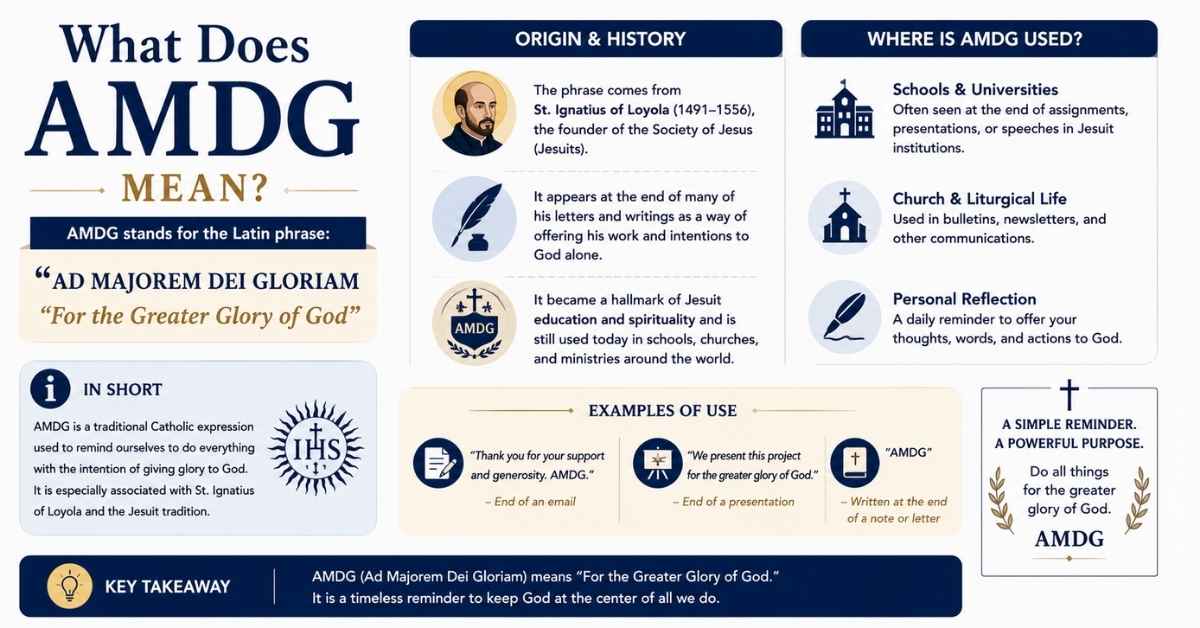
AMDG meaning is “Ad Majorem Dei Gloriam,” a Latin phrase that translates to “For the Greater Glory of God.” It is the traditional motto of the Society of Jesus (Jesuits), founded by St. Ignatius of Loyola, and represents the idea that every action—whether studying, working, serving others, or creating something meaningful—should ultimately honor God. Today, AMDG continues to appear in Jesuit schools, Catholic institutions, personal journals, artwork, and even social media bios as a reminder to live with purpose and faith.
Far more than a simple abbreviation, AMDG reflects a philosophy of intentional living. For centuries, it has inspired people to dedicate their talents, decisions, and daily efforts to something greater than personal recognition. In this guide, you’ll discover what AMDG stands for, its Latin meaning, history, religious significance, modern-day use, and why this timeless motto still resonates with millions around the world.
What Does AMDG Mean?
At first glance, AMDG looks like just another acronym. However, its meaning carries profound historical and spiritual significance.
The abbreviation represents the Latin phrase:
Ad Majorem Dei Gloriam
Its accepted English translation is:
“For the Greater Glory of God.”
This phrase encourages believers to approach every action with the intention of glorifying God rather than seeking personal praise. Whether someone is teaching, studying, writing, serving their community, or performing everyday tasks, AMDG serves as a reminder that ordinary work can have extraordinary purpose.
Unlike many abbreviations that are limited to text messages or internet slang, AMDG has remained relevant for more than four centuries because it expresses a timeless principle rather than a passing trend.
The Full Latin Phrase Explained
Understanding each word makes the phrase even more meaningful.
| Latin Word | English Meaning | Purpose in the Phrase |
|---|---|---|
| Ad | To / Toward | Indicates direction or purpose |
| Majorem | Greater | Emphasizes striving for something higher |
| Dei | Of God | Refers to God |
| Gloriam | Glory | Represents honor, praise, and worship |
When combined, these words form one of Christianity’s most recognized Latin mottos:
Ad Majorem Dei Gloriam — For the Greater Glory of God.
Rather than suggesting that God needs more glory, the phrase reminds believers to ensure that their actions reflect God’s goodness.
What Does the Phrase Really Mean?
The literal translation explains the words, but the deeper message explains the purpose.
AMDG encourages people to ask themselves a simple question before making decisions:
“Will this bring honor to God?”
This perspective transforms everyday activities into opportunities for service and personal growth.
For example:
- A student studies diligently, not merely to earn good grades, but to develop the talents God has given.
- A teacher educates with compassion, believing knowledge should improve lives.
- An artist creates meaningful work that inspires hope.
- A doctor treats patients with kindness and integrity.
- A volunteer serves their community without expecting recognition.
In each case, the action itself becomes an expression of faith and purpose.
How Do You Pronounce AMDG?
Many people recognize the abbreviation but are unsure how to say it aloud.
There are two common ways to pronounce AMDG:
- By saying each individual letter: A-M-D-G
- By reading the complete Latin phrase: Ad Majorem Dei Gloriam
Both are widely accepted, depending on the setting.
In schools, meetings, and conversations, people often simply say “A-M-D-G.” During formal religious discussions or academic settings, speakers may use the full Latin expression.
Pronouncing Ad Majorem Dei Gloriam
A simplified English-friendly pronunciation is:
Ad mah-YOR-em DAY-ee GLOH-ree-ahm
Latin pronunciation can vary slightly depending on whether someone follows classical or ecclesiastical traditions, but both preserve the meaning of the phrase.
The pronunciation matters less than understanding the values it represents.
Common Pronunciation Mistakes
People encountering the phrase for the first time sometimes:
- Pronounce Dei like the English word “day.”
- Read Majorem as “major.”
- Skip syllables in Gloriam.
These minor differences are common and do not change the meaning of the motto.
Where Did AMDG Come From?
To fully understand AMDG meaning, it’s helpful to explore its remarkable history.
Although the words are Latin, the phrase became internationally recognized through the work of the Jesuits, officially known as the Society of Jesus.
Since the sixteenth century, AMDG has symbolized the Jesuit commitment to learning, service, faith, and excellence.
The Origin of the Phrase
Latin served as the language of scholarship, philosophy, and theology throughout much of European history.
Religious communities frequently adopted short Latin mottos that summarized their beliefs.
Among these expressions, Ad Majorem Dei Gloriam became one of the most influential because it emphasized that every human endeavor—from education to charitable work—should ultimately serve God.
Its simplicity made it memorable, while its message made it enduring.
St. Ignatius of Loyola and the Beginning of AMDG
The history of AMDG is inseparable from St. Ignatius of Loyola, the Spanish soldier who later founded the Society of Jesus.
After experiencing a profound spiritual conversion, Ignatius devoted his life to helping others grow through education, discipline, prayer, and service.
Instead of separating faith from daily life, he believed that every action—large or small—could become an act of worship when performed with the right intention.
This philosophy became summarized by the phrase:
Ad Majorem Dei Gloriam.
Over time, it evolved into the guiding principle for Jesuit communities across the world.
Why Did the Society of Jesus Adopt AMDG?
The Jesuits did not choose the motto simply because it sounded impressive.
It perfectly expressed their mission.
Their work focused on:
- Education
- Missionary service
- Scientific research
- Social justice
- Leadership development
- Community service
- Spiritual formation
Rather than seeking personal achievement, Jesuits strive to ensure that their work contributes to the greater glory of God.
This principle continues to shape thousands of Jesuit schools, universities, and charitable organizations worldwide.
A Brief Timeline of AMDG
| Period | Historical Development |
|---|---|
| 1500s | St. Ignatius of Loyola embraces the phrase during the early Jesuit movement. |
| 1540 | The Society of Jesus is officially recognized, and AMDG becomes its guiding motto. |
| 16th–18th centuries | Jesuit missionaries and educators spread the motto across Europe, Asia, Africa, and the Americas. |
| 19th–20th centuries | AMDG appears in schools, universities, churches, books, and educational institutions. |
| Today | The phrase remains a symbol of faith, purpose, education, and service around the world. |
This historical continuity demonstrates why AMDG remains far more than an old Latin abbreviation.
Why Is AMDG So Important in Jesuit Tradition?
To many people, AMDG appears to be just four letters.
Within Ignatian spirituality, however, those letters summarize an entire philosophy of life.
Rather than encouraging extraordinary achievements alone, the motto teaches that ordinary actions performed with love, integrity, and purpose can become extraordinary acts of faith.
This perspective has shaped Jesuit education for centuries.
The Core Idea Behind the Motto
At its heart, AMDG teaches intentional living.
Instead of asking:
“What’s in it for me?”
it encourages a different question:
“How can this action serve God and benefit others?”
This mindset influences every aspect of life—from education and careers to relationships and community service.
It shifts attention away from personal recognition and toward lasting impact.
Living “For the Greater Glory of God”
The phrase doesn’t require someone to perform dramatic or heroic acts every day.
Instead, it encourages excellence in ordinary responsibilities.
Imagine someone who:
- Treats colleagues with respect.
- Studies honestly.
- Helps a neighbor without expecting praise.
- Creates thoughtful work.
- Leads with humility.
- Volunteers within the community.
Each of these actions can reflect the spirit of AMDG because the motivation goes beyond personal success.
In this way, the motto becomes a daily reminder that purpose matters as much as achievement.
How AMDG Shapes Jesuit Education
One reason many people first encounter AMDG is through Jesuit schools and Catholic universities.
In these institutions, education is viewed as more than preparing students for careers.
Students are encouraged to become:
- Critical thinkers
- Compassionate leaders
- Ethical decision-makers
- Lifelong learners
- Responsible global citizens
Academic excellence is important, but so is character.
This balance between knowledge and service explains why AMDG is often displayed on school crests, classroom walls, graduation materials, and institutional publications.
The Relationship Between AMDG and Magis
Another important concept within Ignatian spirituality is Magis, a Latin word meaning “more” or “greater.”
While AMDG focuses on doing everything for the greater glory of God, Magis encourages people to seek the greater good by continually growing in faith, wisdom, compassion, and service.
The two ideas complement one another:
| AMDG | Magis |
|---|---|
| Focuses on the purpose behind our actions. | Focuses on striving for continual growth and excellence. |
| Asks, “Who benefits from my work?” | Asks, “How can I become the best version of myself in service to others?” |
| Encourages honoring God through everyday life. | Encourages ongoing personal and spiritual development. |
Together, these principles have influenced generations of students, educators, leaders, and communities, making AMDG not just a historic motto but a practical guide for living with intention.
Where Will You See AMDG Today?
Although AMDG originated centuries ago, it remains surprisingly visible in the modern world. Many people first encounter the abbreviation without realizing its history or meaning. You might notice it on a school crest, in a handwritten note, or even in someone’s social media profile.
Its continued use shows that Ad Majorem Dei Gloriam is more than a historical Latin phrase—it is a living reminder to approach life with purpose, integrity, and faith.
Jesuit Schools and Universities
One of the most common places to encounter AMDG is within Jesuit schools, colleges, and universities around the world.
Many Jesuit educational institutions display the motto on:
- School emblems
- Classroom walls
- Graduation certificates
- Official documents
- Student planners
- Academic publications
In these settings, AMDG reminds students that education is not simply about earning grades or degrees. Learning is viewed as a way to develop one’s talents so they can positively impact society.
This educational philosophy encourages students to become:
- Ethical leaders
- Critical thinkers
- Compassionate citizens
- Lifelong learners
- People committed to service
Rather than measuring success only by academic achievement, Jesuit education emphasizes character, responsibility, and service to others.
Churches and Religious Buildings
Many Catholic churches, Jesuit chapels, monasteries, and retreat centers feature AMDG as part of their architecture.
You may find it:
- Above church entrances
- Carved into stone walls
- Displayed near altars
- Engraved on stained-glass windows
- Printed in prayer books
Its presence serves as a visual reminder that worship extends beyond church services into everyday life.
Books, Letters, and Personal Journals
Historically, Jesuit priests, scholars, and missionaries often began letters or manuscripts with AMDG.
Today, some people continue this tradition by writing the abbreviation at the beginning of:
- Journals
- Sermon notes
- Study notebooks
- Personal reflections
- Creative writing
- Prayer journals
For them, those four letters represent a quiet commitment to dedicate their work to a purpose greater than themselves.
Artwork and Creative Expression
Artists, musicians, authors, and designers sometimes use AMDG to express that their creative work is offered “For the Greater Glory of God.”
Rather than seeking applause alone, the motto reminds creators to use their talents responsibly.
This idea has influenced:
- Religious paintings
- Sacred music
- Literature
- Architecture
- Educational publications
- Church artwork
It reflects the belief that creativity can also become an act of worship.
Social Media and Personal Profiles
In recent years, AMDG has appeared in:
- Instagram bios
- X (formerly Twitter) profiles
- LinkedIn introductions
- Personal websites
- Email signatures
When someone includes AMDG in a profile, it often signals that faith plays an important role in their personal values or professional mission.
Unlike many internet abbreviations that lose popularity over time, AMDG has retained its significance because it represents a guiding principle rather than a trend.
Everyday Life and Personal Reflection
Perhaps the most meaningful place AMDG appears is in everyday decisions.
People may silently remember the phrase before:
- Beginning a work project
- Studying for an exam
- Volunteering
- Helping a neighbor
- Leading a meeting
- Making an important decision
In these moments, AMDG becomes less about words and more about intention.
Learn More: LMY Meaning
Is AMDG Only for Catholics?
One of the most common questions people ask is whether AMDG belongs exclusively to the Catholic Church.
The answer is not entirely.
Although the phrase is most closely associated with the Jesuits and Catholic tradition, its central message resonates with many Christians who believe their daily actions should honor God.
The Catholic Perspective
Within Catholicism, AMDG is deeply connected to Ignatian spirituality.
Jesuits understand the phrase as a daily reminder that every responsibility—whether teaching, studying, serving, or praying—can become an offering to God.
This perspective influences:
- Education
- Leadership
- Community service
- Missionary work
- Personal prayer
- Social justice initiatives
The Christian Perspective
Many Christians outside the Catholic tradition appreciate the underlying principle behind AMDG.
The belief that life should glorify God is shared across numerous Christian denominations.
For that reason, some Protestant, Anglican, and Orthodox Christians also recognize or use the phrase, even if it is not part of their official tradition.
The emphasis remains the same:
Live with purpose. Serve others. Honor God through your actions.
Can Non-Catholics Use AMDG?
Yes—provided it is used respectfully and with an understanding of its meaning.
Since AMDG expresses a universal Christian ideal rather than membership in a particular organization, many people choose to adopt it as a personal reminder of faith and purpose.
However, using the phrase thoughtfully is important.
Understanding its history, Jesuit roots, and spiritual significance shows respect for the tradition from which it came.
Is AMDG Still Appropriate Today?
Absolutely.
In an age often focused on personal success, recognition, and online visibility, AMDG offers a different perspective.
Instead of asking:
“How can I gain more attention?”
it encourages people to ask:
“How can my work benefit others and honor God?”
This timeless message explains why the phrase continues to inspire students, educators, professionals, artists, and volunteers around the world.
Is AMDG Found in the Bible?
A frequent question is whether AMDG appears directly in Scripture.
The answer is no.
The exact Latin phrase Ad Majorem Dei Gloriam does not appear in the Bible.
However, the principle behind it is deeply rooted in biblical teaching.
Biblical Ideas Behind AMDG
Throughout Scripture, believers are encouraged to live in ways that glorify God.
The Bible repeatedly teaches that faith should influence every area of life—not only worship but also work, relationships, generosity, and service.
In that sense, AMDG summarizes a biblical principle using a memorable Latin expression.
Bible Passages That Reflect the Spirit of AMDG
Several well-known passages communicate the same idea:
| Biblical Theme | Connection to AMDG |
|---|---|
| Glorifying God in daily life | Every action can honor God. |
| Serving others with humility | Service reflects genuine faith. |
| Using talents wisely | Gifts should benefit others. |
| Working wholeheartedly | Ordinary work can have spiritual value. |
These teachings help explain why the phrase continues to resonate across Christian communities.
Why AMDG Aligns With Christian Teaching
Although the wording is Latin rather than biblical Hebrew or Greek, its message reflects core Christian values:
- Humility
- Service
- Faithfulness
- Purpose
- Love
- Stewardship
- Integrity
For many believers, AMDG simply provides a concise reminder of these principles.
AMDG vs. Other Christian and Latin Expressions
Because Christianity has many well-known Latin phrases and abbreviations, people often confuse AMDG with similar expressions.
Understanding the differences helps clarify its unique role.
AMDG vs. SDG (Soli Deo Gloria)
This comparison causes the most confusion.
| AMDG | SDG |
|---|---|
| Ad Majorem Dei Gloriam | Soli Deo Gloria |
| “For the Greater Glory of God” | “Glory to God Alone” |
| Strongly associated with the Jesuits | Closely associated with the Protestant Reformation |
| Focuses on dedicating actions to God’s glory | Emphasizes that all glory belongs solely to God |
Both phrases encourage believers to honor God, but they developed within different historical traditions.
AMDG vs. INRI
INRI appears on many crucifixes.
Unlike AMDG, it is not a personal motto.
It stands for:
Iesus Nazarenus, Rex Iudaeorum
meaning:
“Jesus of Nazareth, King of the Jews.”
Its purpose is historical rather than devotional.
AMDG vs. Deo Gratias
Deo Gratias translates to:
“Thanks be to God.”
While AMDG focuses on intention before or during an action, Deo Gratias expresses gratitude after receiving a blessing or completing something meaningful.
AMDG vs. Pax Christi
Pax Christi means:
“Peace of Christ.”
It is commonly used as a greeting or blessing.
Unlike AMDG, it does not describe a philosophy of work or service.
Which Phrase Fits Different Traditions?
| Phrase | Primary Association | Main Purpose |
|---|---|---|
| AMDG | Jesuit tradition | Dedicating actions to God’s glory |
| SDG | Protestant Reformation | Giving all glory to God |
| Deo Gratias | Christian worship | Expressing gratitude |
| Pax Christi | Christian greeting | Sharing Christ’s peace |
| INRI | Crucifixion narrative | Historical inscription |
Each phrase has its own historical background and spiritual emphasis.
Why Do People Write AMDG on Assignments, Artwork, or Personal Notes?
Many students are surprised to see AMDG written at the top of homework, essays, journals, or creative projects.
This practice has a meaningful purpose.
A Reminder of Intention
Writing AMDG before beginning a task reminds the writer to focus on:
- Excellence
- Honesty
- Service
- Gratitude
- Purpose
Instead of seeking praise, the goal becomes offering one’s best effort.
Dedicating Work to God
Some people view AMDG almost like a quiet prayer.
By writing those four letters, they express a desire for their work to reflect:
- Wisdom
- Compassion
- Integrity
- Humility
Whether the project is academic, artistic, professional, or personal, the underlying intention remains the same.
A Daily Habit Rather Than a Rule
There is no religious requirement to write AMDG.
Many people never do.
Others adopt it as a personal tradition because it helps them remain mindful of their values.
The phrase serves as an invitation—not an obligation.
Modern Personal Uses
Today, people may write AMDG:
- At the beginning of study notes
- Inside journals
- Before speeches
- On creative projects
- In prayer notebooks
- During volunteer work
- On personal planners
Each use reflects a desire to connect ordinary tasks with a deeper sense of purpose.
Common Misconceptions About AMDG
Despite its long history, several misunderstandings continue to circulate.
Myth: AMDG Is Just Another Latin Abbreviation
Fact: It represents a complete spiritual philosophy that has shaped Jesuit education, leadership, and service for centuries.
Myth: Only Priests Can Use AMDG
Fact: Anyone who understands and respects its meaning may choose to use it as a personal reminder of faith and intentional living.
Myth: AMDG Is an Official Church Rule
Fact: The Catholic Church does not require believers to write or display AMDG.
It is a voluntary motto rather than a religious obligation.
Myth: AMDG Means the Same Thing as Every Christian Motto
Fact: While many Christian phrases honor God, AMDG has its own unique historical connection to St. Ignatius of Loyola, the Society of Jesus, and Ignatian spirituality.
Why AMDG Still Matters in Modern Life
Modern life often rewards speed, visibility, and personal achievement.
AMDG encourages a different way of thinking.
It asks people to focus not only on what they accomplish but also why they do it.
Whether someone is leading a business, teaching a classroom, creating art, caring for a family, or volunteering in the community, the phrase reminds them that meaningful work begins with meaningful intention.
For many, this simple Latin motto provides a daily source of motivation to pursue excellence with humility, success with integrity, and service with compassion.
Rather than remaining a phrase from history, AMDG continues to inspire people to connect their everyday actions with a purpose that reaches far beyond themselves.
See More: AOP Meaning
Real-Life Examples of AMDG in Action
Understanding the AMDG meaning becomes much easier when you see how people apply it in everyday life. While the phrase has deep roots in Jesuit tradition and Ignatian spirituality, its message extends beyond classrooms and churches.
The following examples show how “Ad Majorem Dei Gloriam” can inspire intentional living in different situations.
Example 1: A Student Preparing for an Exam
Maria attends a Jesuit school where she often sees AMDG printed on classroom walls.
Before beginning her revision, she writes AMDG at the top of her notebook.
For Maria, those four letters are not a superstition or a ritual. They remind her to study honestly, use her talents wisely, and approach learning with gratitude instead of fear.
Her goal is no longer just to earn the highest grade—it is to grow intellectually and use her education to help others.
Example 2: A Teacher Inspiring Future Leaders
A history teacher begins each school year by explaining the meaning of Ad Majorem Dei Gloriam.
Rather than encouraging students to compete only for awards, the teacher emphasizes:
- Integrity
- Respect
- Compassion
- Curiosity
- Service
Students learn that true success includes developing strong character alongside academic excellence.
Example 3: An Artist Creating Meaningful Work
A painter includes AMDG in the corner of a sketchbook before starting a new project.
The abbreviation reminds them that creativity can inspire hope, beauty, and reflection—not simply admiration or commercial success.
Their work becomes an expression of gratitude rather than self-promotion.
Example 4: A Volunteer Serving the Community
A volunteer spends weekends helping at a local food bank.
Although few people know about their efforts, the volunteer remembers AMDG as a reminder that meaningful service does not require public recognition.
Their motivation comes from helping others rather than seeking praise.
Example 5: A Professional Making Ethical Decisions
An entrepreneur faces a difficult business decision.
Instead of asking,
“What will make me the most money?”
they also consider,
“What decision reflects honesty, fairness, and respect for others?”
For them, AMDG becomes a practical reminder that professional success and ethical responsibility should go hand in hand.
Frequently Asked Questions About AMDG
What does AMDG stand for?
AMDG stands for Ad Majorem Dei Gloriam, a Latin phrase meaning “For the Greater Glory of God.” It is the traditional motto of the Society of Jesus (Jesuits) and encourages people to dedicate their actions to honoring God.
What language is AMDG?
AMDG comes from Latin, the language historically used in the Catholic Church, education, philosophy, and theology throughout much of Europe.
How do you pronounce AMDG?
Most people pronounce the abbreviation by saying each letter individually:
A-M-D-G
The complete Latin phrase is commonly pronounced:
Ad mah-YOR-em DAY-ee GLOH-ree-ahm
Who created AMDG?
Although the words themselves are ancient Latin, the phrase became closely associated with St. Ignatius of Loyola, founder of the Society of Jesus, during the sixteenth century.
Why do Jesuits use AMDG?
Jesuits use AMDG because it summarizes their mission of serving God through education, leadership, faith, service, and intellectual excellence.
It reminds them that every action should contribute to the greater glory of God.
Is AMDG only for Catholics?
No.
Although it has strong roots in Catholic and Jesuit tradition, many Christians from other denominations appreciate its message of living purposefully and honoring God through daily life.
Can non-Catholics use AMDG?
Yes.
Anyone who understands its history and uses it respectfully may adopt it as a personal reminder to pursue meaningful work and faithful living.
Is AMDG found in the Bible?
The exact phrase Ad Majorem Dei Gloriam does not appear in the Bible.
However, the principle behind it—living in a way that glorifies God—is reflected throughout Christian Scripture.
Why is AMDG written on homework?
Many students at Jesuit schools write AMDG at the beginning of assignments as a reminder to study honestly, work diligently, and dedicate their efforts to God.
It is a personal practice rather than a required rule.
Is AMDG still used today?
Yes.
You can still find AMDG in:
- Jesuit schools
- Catholic universities
- Churches
- Retreat centers
- Personal journals
- Prayer books
- Creative projects
- Email signatures
- Social media profiles
Its continued use demonstrates that its message remains relevant in modern life.
What is the difference between AMDG and SDG?
Both are Latin Christian mottos, but they emphasize different ideas.
| AMDG | SDG |
|---|---|
| Ad Majorem Dei Gloriam | Soli Deo Gloria |
| “For the Greater Glory of God” | “Glory to God Alone” |
| Traditionally associated with the Jesuits | Closely associated with the Protestant Reformation |
| Focuses on dedicating one’s work to God | Emphasizes that all glory belongs solely to God |
Can anyone use AMDG respectfully?
Yes.
The most important consideration is understanding its meaning and historical background.
Using AMDG thoughtfully reflects appreciation for its spiritual message rather than simply adopting it as a decorative abbreviation.
Conclusion
The true AMDG meaning extends far beyond four simple letters. Ad Majorem Dei Gloriam, meaning “For the Greater Glory of God,” has inspired generations to view everyday work as an opportunity to serve a higher purpose. From St. Ignatius of Loyola and the founding of the Society of Jesus to modern classrooms, workplaces, churches, and creative communities, this timeless motto continues to shape lives through its emphasis on faith, service, humility, and excellence.
Whether you encountered AMDG on a Jesuit school emblem, in a Catholic publication, on social media, or in a personal journal, understanding its deeper significance reveals why it has endured for centuries. It is not simply a Latin abbreviation or Christian motto—it is a philosophy that encourages every action, no matter how small, to reflect compassion, integrity, and a commitment to something greater than personal success.
In a world that often celebrates recognition and achievement, AMDG offers a timeless reminder that the greatest accomplishments are those guided by purpose, service, and the desire to contribute to the greater glory of God.