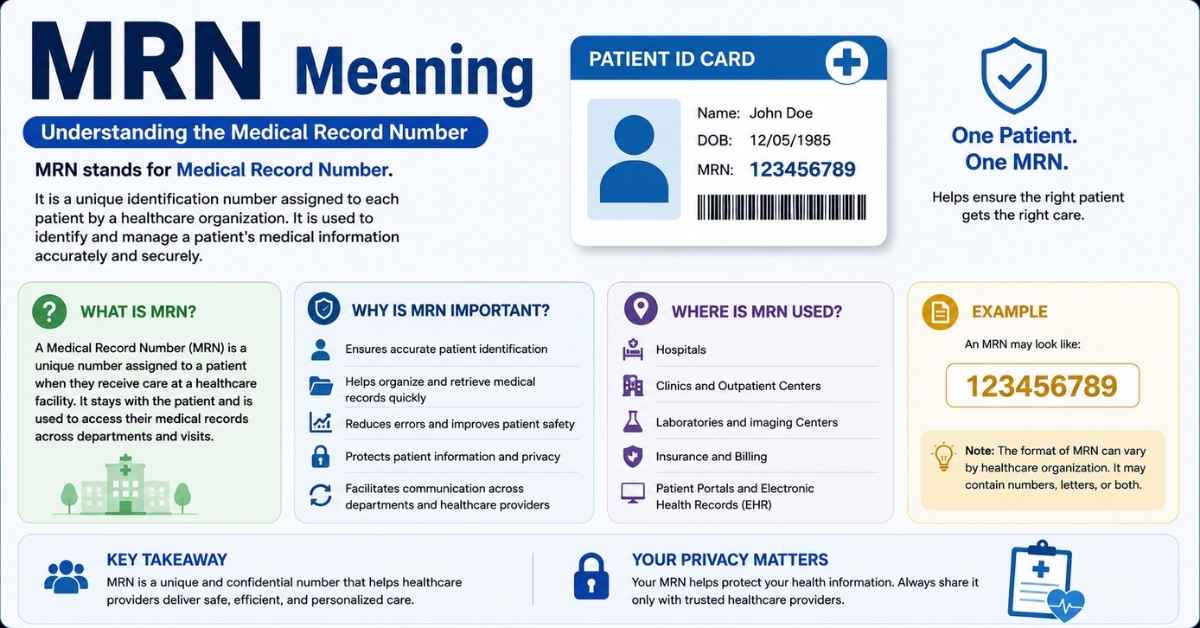
MRN meaning is Medical Record Number. It is a unique identification number assigned to a patient by a hospital, clinic, or other healthcare provider to organize and access their medical records. Every time you visit the same healthcare facility, your MRN number helps doctors, nurses, and administrative staff quickly locate your electronic health record (EHR), ensuring you receive accurate and timely care. Unlike an insurance member ID or patient account number, a Medical Record Number (MRN) is designed specifically to identify your medical history within a healthcare organization’s system.
If you’ve noticed an MRN on your hospital wristband, discharge papers, appointment letter, or patient portal and wondered what it means, you’re not alone. Many people confuse it with other healthcare identifiers. In this guide, you’ll learn what an MRN is, why hospitals use it, where to find it, how it differs from other medical IDs, and why it’s essential for patient safety and efficient healthcare management.
What Does MRN Stand For?
The full form of MRN is Medical Record Number.
A Medical Record Number is a permanent patient identifier assigned by a healthcare facility to distinguish one patient’s records from another. Every hospital or clinic uses this identifier to organize medical information, making it easy for healthcare professionals to retrieve a patient’s history whenever treatment is needed.
Simply put, your MRN meaning in hospital refers to the unique number linked to your medical file—not to your insurance policy or billing account.
A Simple Definition Anyone Can Understand
Imagine a hospital library with thousands of patient files. Instead of searching by name—which could lead to confusion if multiple patients share the same name—the hospital assigns each person a unique MRN number. This number acts like a secure reference code, allowing staff to access the correct medical record within seconds.
Whether you’re visiting for a routine check-up, blood test, surgery, or emergency treatment, your MRN ensures the right information follows you throughout your care journey.
Why Hospitals Use Medical Record Numbers
Modern healthcare depends on accurate information. Hospitals use Medical Record Numbers to:
- Identify patients correctly.
- Maintain complete medical histories.
- Reduce documentation errors.
- Support faster diagnosis and treatment.
- Connect different hospital departments through one patient record.
- Improve communication between healthcare professionals.
Without an effective patient identifier, healthcare providers would face a much higher risk of mixing up patient records, leading to delays or even medical errors.
What Is an MRN Number?
An MRN number is a unique patient identifier created when you first register at a hospital or healthcare organization. It becomes the key reference for all future visits to that facility, allowing doctors and staff to access your Electronic Health Record (EHR) or Electronic Medical Record (EMR) quickly and accurately.
Unlike temporary appointment numbers, an MRN remains associated with your medical history for as long as your records are maintained by that healthcare provider.
How an MRN Works Behind the Scenes
Every time you interact with a hospital, your Medical Record Number links together information collected during your care. Rather than storing separate files for each visit, the hospital connects everything to one record using your MRN.
This centralized approach helps healthcare teams review your history before making important clinical decisions.
For example, your MRN may connect:
- Previous diagnoses
- Blood test results
- X-rays and MRI scans
- Medication history
- Allergies
- Immunization records
- Surgical procedures
- Doctor consultation notes
- Follow-up appointments
- Emergency department visits
This integrated record improves care coordination, reduces duplicate testing, and allows providers to make informed decisions more efficiently.
Who Assigns an MRN?
Your MRN is assigned by the healthcare organization where you first register.
Depending on the facility, this may include:
- Hospitals
- Specialty clinics
- Outpatient centers
- Medical practices
- Healthcare networks
Each organization follows its own registration process, generating a Medical Record Number through its Hospital Information System (HIS) or Health Information Management (HIM) department.
When Do You Receive Your First MRN?
Most patients receive an MRN during their first interaction with a healthcare provider. This often happens when you:
- Register for an outpatient appointment.
- Visit the emergency department.
- Are admitted to a hospital.
- Undergo diagnostic testing.
- Create an account for a patient portal.
Once assigned, the number is typically reused for future visits to the same healthcare organization.
What Information Is Linked to an MRN?
Your Medical Record Number connects nearly every aspect of your healthcare journey.
It may include:
- Personal identification details
- Medical history
- Current diagnoses
- Laboratory reports
- Radiology images
- Prescription records
- Medication allergies
- Vaccination history
- Surgical records
- Physician notes
- Treatment plans
- Hospital admissions
- Discharge summaries
- Referral information
By keeping all this information under one identifier, hospitals can deliver more consistent and safer patient care.
Why Is an MRN Important for Patients?
Although many patients rarely think about their Medical Record Number, it plays a critical role in every stage of healthcare.
It is much more than an administrative number—it’s the foundation of accurate patient identification and effective medical record management.
Prevents Medical Errors
One of the biggest advantages of an MRN is reducing the chance of patient identification mistakes.
Healthcare facilities may treat thousands of people with similar names. Using a unique identifier ensures doctors review the correct medical history before prescribing medications, ordering tests, or performing procedures.
This significantly improves patient safety.
Helps Doctors Access Your Medical History Quickly
Imagine arriving at the emergency department after an accident.
Instead of asking you to remember every medication or previous diagnosis, medical staff can retrieve your Electronic Health Record using your MRN number and immediately review:
- Existing medical conditions
- Allergies
- Previous surgeries
- Current medications
- Diagnostic reports
This saves valuable time when every minute matters.
Supports Emergency Care
In urgent situations, quick access to reliable information can influence treatment decisions.
Your MRN allows emergency physicians to review essential clinical data without unnecessary delays, helping them deliver faster and more informed care.
Improves Continuity of Care
Healthcare often involves multiple specialists.
For example, a patient may see:
- A family physician
- A cardiologist
- A radiologist
- A surgeon
- A physiotherapist
Because all these encounters are linked through the Medical Record Number, each provider has access to a consistent patient history within the same healthcare system.
This continuity reduces duplicate work and improves treatment planning.
Reduces Duplicate Medical Records
Duplicate records are a common challenge in healthcare organizations.
Without a consistent patient identifier, hospitals could accidentally create multiple files for the same person.
A properly managed MRN helps:
- Eliminate duplicate charts.
- Improve record accuracy.
- Reduce administrative costs.
- Prevent clinical confusion.
- Enhance healthcare efficiency.
Expert Insight: Even small identification errors can create significant clinical challenges. That’s why hospitals invest heavily in maintaining accurate Master Patient Index (MPI) systems that organize patient identities across their healthcare network.
Where Can You Find Your MRN?
Many people don’t realize they already have an MRN number until they need it.
Fortunately, it’s usually easy to locate.
Hospital Wristband
If you’ve recently been admitted to a hospital, your wristband often displays your Medical Record Number alongside your name and date of birth.
Healthcare staff scan or reference this number throughout your stay to confirm your identity before medications, tests, or procedures.
Patient Portal
Most modern healthcare organizations provide secure patient portals where you can view:
- Appointments
- Test results
- Medical history
- Billing information
- Personal profile
Many portals also display your MRN within your account details.
Medical Bills
Some healthcare providers include the Medical Record Number on invoices or billing statements, although formatting varies by organization.
Discharge Papers
Hospital discharge summaries frequently include your MRN, making them a convenient place to check after treatment.
Appointment Letters
Printed appointment confirmations may list your MRN number so staff can quickly access your record when you arrive.
Prescription Labels
In certain healthcare systems, prescription labels may reference your Medical Record Number, especially for medications dispensed directly through the hospital pharmacy.
Learn More: AOP Meaning
Contact the Medical Records Department
If you cannot locate your MRN, simply contact the hospital’s Medical Records Department or Health Information Management (HIM) office.
For security reasons, you’ll usually be asked to verify your identity before the number is shared.
Practical Tip: Keep your MRN in a secure place if you visit the same healthcare provider regularly. Having it available can make appointment scheduling, medical record requests, and follow-up care more convenient.
What Does an MRN Look Like?
There is no universal format for an MRN number.
Each healthcare organization designs its own numbering system based on internal policies and information systems.
Numeric vs. Alphanumeric Formats
Some hospitals use only numbers, while others combine letters and numbers.
Examples (for illustration only):
- 005847291
- MRN-458721
- A78394521
The exact format depends on the healthcare provider’s Hospital Information System.
Why MRNs Differ Between Hospitals
Unlike national identification numbers, Medical Record Numbers are generally created independently by each healthcare organization.
That means:
- Different hospitals may assign different MRNs to the same patient.
- The numbering format may vary.
- One healthcare network may use a shared system, while another creates entirely new identifiers.
This is completely normal and helps each organization manage its own patient records efficiently.
How Hospitals Use Your MRN Every Day
Although patients may only notice their MRN occasionally, hospitals rely on it throughout nearly every stage of healthcare delivery.
Patient Registration
When you check in, staff use your Medical Record Number to retrieve your existing record instead of creating a new one.
Laboratory Testing
Blood tests and other laboratory reports are linked to your MRN, ensuring results are added to the correct medical file.
Radiology and Imaging
Whether you need an X-ray, CT scan, MRI, or ultrasound, imaging reports are stored under your Medical Record Number, making them accessible to your healthcare team.
Pharmacy Services
Hospital pharmacies use your MRN to verify prescriptions, medication history, and allergy information before dispensing treatment.
Billing Coordination
Although billing systems often use separate account numbers, your MRN helps connect healthcare services to the correct patient record, reducing administrative errors.
Electronic Health Records (EHR)
Modern Electronic Health Record (EHR) systems rely on the Medical Record Number as the primary link connecting diagnoses, physician notes, laboratory reports, prescriptions, and follow-up care into one comprehensive patient record.
This integrated approach allows healthcare professionals across multiple departments to access consistent, up-to-date information while supporting safer, more coordinated patient care.
See More: AMDG Meaning
Common Myths About MRNs
Because Medical Record Numbers (MRNs) are used behind the scenes in hospitals, many misconceptions surround them. Understanding what’s true—and what’s not—can help you manage your healthcare information with confidence.
Myth: Every Hospital Uses the Same MRN
Fact: In most cases, no.
An MRN is usually unique within a particular healthcare organization. If you receive treatment at different hospitals that do not share the same Electronic Health Record (EHR) system, each facility may assign you a different Medical Record Number.
Some large healthcare networks use a shared Hospital Information System (HIS), allowing the same MRN to work across multiple hospitals within that network. However, this is not universal.
Myth: An MRN Is the Same as an Insurance Number
Fact: These are completely different identifiers.
Your Insurance Member ID is issued by your health insurance provider to manage your coverage and claims.
Your MRN number, on the other hand, is assigned by a hospital or healthcare provider to organize your medical records.
Confusing these numbers can delay registration, billing, or access to your medical history.
Myth: Your MRN Never Changes
Fact: Usually it stays the same within the same healthcare organization, but there are exceptions.
In certain situations, hospitals may:
- Merge duplicate patient records.
- Upgrade to a new health information system.
- Consolidate multiple healthcare facilities.
- Correct historical registration errors.
When changes occur, healthcare organizations carefully preserve your medical history to maintain continuity of care.
Myth: Anyone Can Access My Medical Records Using My MRN
Fact: No.
Knowing your Medical Record Number alone does not usually provide access to your medical information.
Healthcare providers protect Electronic Medical Records (EMRs) and Electronic Health Records (EHRs) through multiple security measures, including:
- Identity verification
- Secure login credentials
- Access controls
- Audit trails
- Privacy regulations
These safeguards help ensure that only authorized individuals can view confidential medical information.
Myth: MRNs Are the Same Worldwide
Fact: Healthcare systems vary from country to country.
Some nations use national patient identifiers, while others rely on hospital-specific Medical Record Numbers.
The way an MRN is created, stored, and managed depends on local healthcare regulations, technology infrastructure, and organizational policies.
Frequently Asked Questions About MRN Meaning
What does MRN mean?
MRN meaning is Medical Record Number. It is a unique identifier assigned by a hospital or healthcare provider to organize, store, and retrieve a patient’s medical records accurately.
What is an MRN number?
An MRN number is a unique patient identification number used within a healthcare organization. It connects your diagnoses, prescriptions, laboratory reports, imaging results, physician notes, and other medical information to one comprehensive patient record.
Where can I find my MRN?
You can usually find your Medical Record Number on:
- Your patient portal
- Hospital wristband
- Appointment confirmation
- Discharge summary
- Medical bill
- Registration paperwork
If you cannot locate it, contact your hospital’s Medical Records Department after completing the required identity verification process.
Is my MRN confidential?
Yes.
Although an MRN is not typically a password, it is linked to your protected medical information. Healthcare providers treat it as confidential and use security measures to prevent unauthorized access.
Can I have more than one MRN?
Yes.
If you visit different hospitals or healthcare organizations, you may receive different Medical Record Numbers because each organization usually manages its own patient records.
Does every hospital assign a different MRN?
Often, yes.
Independent hospitals typically create their own MRN during patient registration. However, hospitals within the same integrated healthcare network may use a shared identifier.
Can my MRN change?
In most cases, your MRN remains the same within a healthcare organization.
However, changes may occur when:
- Duplicate records are merged.
- Healthcare systems are integrated.
- Administrative corrections are made.
These updates are carefully managed to protect your medical history.
Is MRN the same as a Patient ID?
Not always.
Some healthcare systems use the terms interchangeably, while others assign separate identifiers for registration and medical records. The exact terminology depends on the healthcare organization’s information system.
Is MRN the same as an insurance number?
No.
Your MRN identifies your medical record within a healthcare organization, while your insurance member ID identifies your health insurance policy.
Can I access my MRN online?
Yes, in many cases.
Most hospitals now offer secure patient portals where you can view appointments, laboratory results, medical history, and your Medical Record Number.
What should I do if I cannot locate my MRN?
Start by checking your patient portal or recent hospital documents.
If you still cannot find it, contact the hospital’s Health Information Management (HIM) or Medical Records Department. After verifying your identity, staff can usually help you retrieve your MRN number.
Does an MRN expire?
Generally, no.
Most healthcare organizations retain your Medical Record Number for as long as they maintain your medical records, although record-retention policies vary depending on local regulations and organizational requirements.
Conclusion
Understanding MRN meaning is more than simply learning what an acronym stands for—it’s about understanding how modern healthcare keeps your information organized, accurate, and accessible.
A Medical Record Number (MRN) serves as the foundation of your medical history within a healthcare organization. From your first registration to future appointments, laboratory tests, imaging studies, prescriptions, and follow-up care, this unique identifier helps ensure that every piece of clinical information is connected to the correct patient.
As healthcare continues to rely on advanced Electronic Health Record (EHR) systems, Health Information Management (HIM) practices, and secure patient portals, the importance of accurate patient identification will only continue to grow. While an MRN may seem like just another number on your paperwork, it plays a vital role in improving care coordination, reducing administrative errors, protecting patient safety, and supporting better healthcare outcomes.
The next time you see your MRN number on a hospital wristband, appointment letter, discharge summary, or patient portal, you’ll know that it is the key that links your healthcare journey together—helping doctors, nurses, and other healthcare professionals deliver safer, more efficient, and more personalized care.