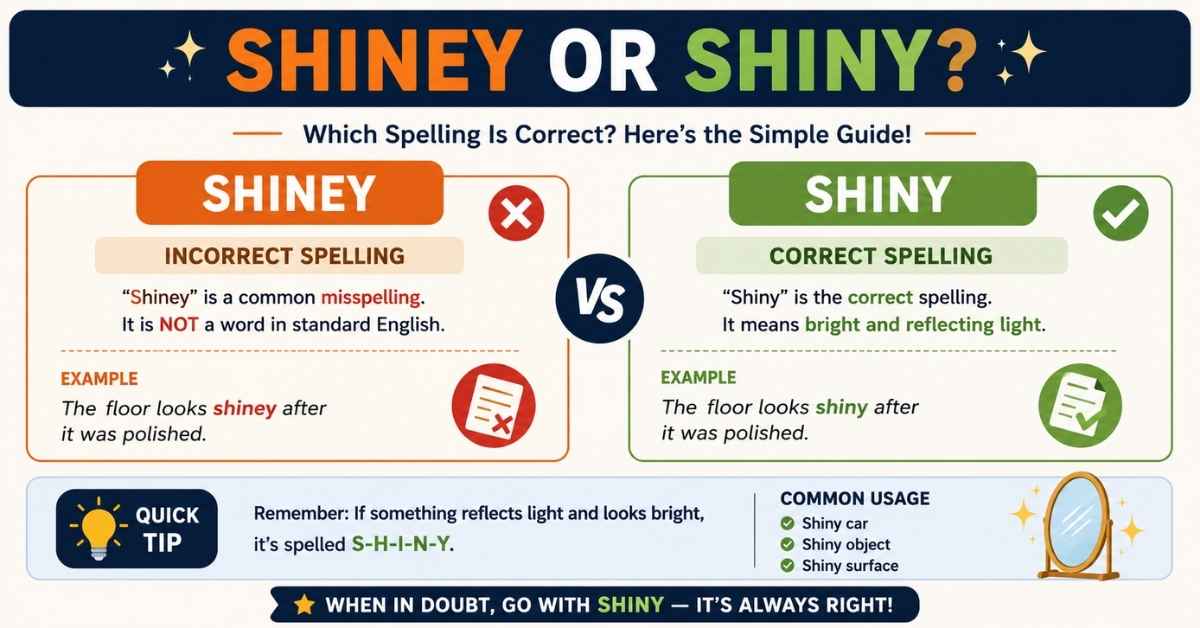
Shiney or shiny—the correct spelling is shiny. The word “shiney” is a common misspelling and is not recognized as the standard spelling in modern English. Whether you’re writing an email, a school assignment, a product description, or a social media post, you should always use shiny. It is the accepted spelling in standard English and appears in major dictionaries and style guides.
If you’ve ever typed “shiney” and had your spellcheck or grammar checker flag it as incorrect, you’re not alone. Thousands of people search for “shiney or shiny,” “is shiney a word,” or “how do you spell shiny correctly” because the two spellings look and sound similar. English spelling rules aren’t always obvious, and many learners—even native speakers—wonder why the silent “e” disappears.
In this guide, you’ll learn why “shiny” is the correct spelling, the grammar rule behind it, how to use it correctly in sentences, why “shiney” became a common typo, and practical tips to help you remember the correct form every time. By the end, you’ll understand not just which spelling is right, but also why it is right.
Quick Answer: Is It Shiney or Shiny?
If you’re looking for a quick answer, here it is:
Shiny is the correct spelling in standard English. Shiney is a misspelling and should be avoided in formal, academic, and professional writing.
Quick Comparison
| Feature | Shiney | Shiny |
|---|---|---|
| Correct spelling | ❌ No | ✅ Yes |
| Standard English | ❌ No | ✅ Yes |
| Accepted by major dictionaries | ❌ No | ✅ Yes |
| Appropriate for professional writing | ❌ No | ✅ Yes |
| Common online usage | Mainly as a typo | Widely accepted |
Whether you’re writing about shiny shoes, shiny hair, a shiny car, or a shiny metal surface, the correct spelling remains shiny.
Why Is “Shiny” the Correct Spelling?
Many people know that shiny is correct, but they don’t know why. Understanding the spelling rule makes it much easier to remember and prevents you from making the same mistake in the future.
Unlike memorizing random words, learning the grammar behind the spelling helps you apply the same pattern to many other English words.
How the Word “Shiny” Is Formed
The adjective shiny comes from the base word shine, which means to reflect light, glow, or appear bright.
When English forms certain adjectives by adding the suffix “-y”, the silent “e” at the end of the base word is usually dropped.
The pattern looks like this:
- shine → shiny
- ice → icy
- slime → slimy
- bone → bony
- juice → juicy
Notice what happens in each example:
The silent “e” disappears before adding “-y.”
This is a common English spelling rule that makes words easier to pronounce and keeps spelling consistent.
Because of this rule, shine + y becomes shiny, not shiney.
Why Do People Write “Shiney”?
If shiny follows a standard spelling rule, why do so many people still type “shiney”?
The answer lies in how our brains process language.
1. The Base Word Ends With an “E”
People naturally see the word shine and assume they should simply add “y.”
That leads to:
shine + y = shiney
While this feels logical, English spelling rules require dropping the silent “e” first.
2. Pronunciation Doesn’t Change
Whether someone writes shiny or shiney, both are often pronounced the same way.
Since pronunciation offers no clue, many writers rely on visual memory instead of spelling rules.
3. Similar-Looking Words Cause Confusion
English contains words that keep the final “e” before adding another ending, while others do not.
For learners, these mixed patterns can be confusing.
Without understanding the rule, it’s easy to assume shiney looks just as correct as shiny.
4. Typing Habits and Autocorrect
Some people accidentally type shiney because they’re typing quickly.
Others have seen the incorrect spelling on:
- blogs
- forums
- online comments
- social media posts
- user-generated content
Repeated exposure makes the typo appear familiar, even though it isn’t accepted in standard English.
5. English Isn’t Always Predictable
English is full of spelling exceptions.
Because writers encounter irregular spellings every day, they sometimes question whether shiney might simply be another accepted variation.
Fortunately, this isn’t one of those cases.
Major dictionaries consistently recognize only shiny.
What Does “Shiny” Mean?
Understanding the meaning of shiny helps you use it naturally in both speaking and writing.
Definition
Shiny is an adjective that describes something that:
- reflects light
- has a smooth, polished surface
- appears bright
- looks glossy or lustrous
A shiny object usually catches your attention because light reflects from its surface.
For example:
- A shiny car looks freshly washed.
- A shiny coin reflects light.
- A shiny floor has been polished.
- A shiny necklace sparkles under sunlight.
Literal Meaning
Most commonly, shiny describes physical appearance.
Examples include:
- shiny shoes
- shiny hair
- shiny metal
- shiny glass
- shiny jewelry
- shiny paint
- shiny furniture
Each example refers to something with a smooth or reflective surface.
Figurative Meaning
Sometimes shiny is used figuratively rather than literally.
For instance:
“The company unveiled its shiny new website.”
The website isn’t physically reflective.
Instead, shiny suggests something:
- new
- attractive
- modern
- impressive
Similarly:
“He bought a shiny new laptop.”
The phrase often implies excitement about something recently purchased.
Is “Shiny” Positive?
In most situations, yes.
The word usually carries positive associations such as:
- clean
- attractive
- polished
- well-maintained
- premium quality
- eye-catching
However, depending on context, it can also imply that something only looks impressive on the surface.
For example:
“The proposal sounded shiny, but it lacked real substance.”
Here, shiny suggests style without depth.
How to Use “Shiny” Correctly in Sentences
Learning a grammar rule is helpful, but seeing the word in real contexts builds confidence and improves your writing.
Here are examples from everyday life.
Around the Home
- The kitchen floor looked shiny after it was polished.
- She cleaned the mirror until it became shiny.
- The dining table has a shiny wooden finish.
Clothing and Fashion
- He wore shiny black shoes to the wedding.
- Her dress had shiny silver details.
- The jacket’s shiny fabric reflected the stage lights.
Cars and Vehicles
- His shiny sports car attracted everyone’s attention.
- A fresh coat of wax keeps your car shiny.
- The motorcycle looked shiny after being detailed.
Technology
- She proudly showed off her shiny new smartphone.
- The laptop’s shiny screen reflected the window.
- Many premium devices feature shiny metallic finishes.
Nature
- Morning dew made the leaves appear shiny.
- The fish had shiny scales that sparkled in the sunlight.
- Rain left the rocks looking smooth and shiny.
Professional Writing
Product descriptions often use shiny to highlight appearance.
Examples include:
- Premium shiny stainless steel finish
- Durable shiny chrome coating
- Elegant shiny ceramic surface
Because the word conveys cleanliness, quality, and attractiveness, it frequently appears in marketing, advertising, and e-commerce product descriptions.
Incorrect vs. Correct Usage
Many writers make simple spelling mistakes without realizing it.
Here’s a quick comparison.
| ❌ Incorrect | ✅ Correct |
|---|---|
| The car looks shiney. | The car looks shiny. |
| She bought shiney shoes. | She bought shiny shoes. |
| His hair looks shiney today. | His hair looks shiny today. |
| I polished the table until it became shiney. | I polished the table until it became shiny. |
A useful habit is to pause and ask yourself:
Does the word come from “shine”? If yes, remember to drop the silent “e” before adding “-y.”
That one simple rule will help you avoid this spelling mistake in almost every situation.
Learn More: MRN Meaning
Why Does “Shiney” Keep Appearing Online?
If “shiny” is the only correct spelling in standard English, why do you still see “shiney” on websites, forums, social media posts, and even product listings?
The answer is simple: popularity doesn’t equal correctness. The internet contains billions of pages, and anyone can publish content without professional editing. As a result, common spelling mistakes often spread and become more visible than they should.
Let’s look at the main reasons behind this confusion.
1. It’s a Common Typographical Error
Many people type quickly on smartphones, tablets, or laptops. Since shine already ends with the letter “e,” it’s easy to instinctively add “-y” without removing the silent “e.”
This results in:
- shine → shiney ❌
- shine → shiny ✅
It’s a natural typing mistake rather than a misunderstanding of meaning.
2. User-Generated Content Isn’t Always Edited
You’ll often find “shiney” in:
- Social media posts
- Blog comments
- Online forums
- Product reviews
- Gaming discussions
- Community websites
These platforms rarely have professional editors checking every post. As a result, incorrect spellings remain visible and may appear legitimate to readers.
3. Search Engines Index Mistakes
Search engines like Google index content exactly as it appears on websites. If enough people search for or publish “shiney,” it may appear in search suggestions or results.
However, visibility does not mean correctness. Search engines often recognize common misspellings and understand that users are actually looking for “shiny.”
4. Our Brains Remember Patterns
People often remember words visually rather than by grammar rules.
Because shine ends with an “e,” many writers assume the adjective should keep it. This mental shortcut feels logical but doesn’t follow the standard spelling rule.
Learning the rule behind the word is much more reliable than relying on visual memory alone.
Is “Shiney” Ever Correct?
One of the most common questions people ask is:
“Is shiney a real word?”
For standard English, the answer is no.
Major dictionaries recognize shiny as the correct adjective. If you’re writing:
- an academic paper,
- a business email,
- a resume,
- a report,
- a blog post,
- or professional content,
you should always use shiny.
Are There Any Exceptions?
There are a few situations where you might encounter “Shiney”, but they don’t change the spelling rule.
These include:
- Personal names or surnames
- Business names
- Brand names
- Usernames or online handles
For example, someone may legally have the surname Shiney, or a company might choose it as a brand name. In those cases, it’s a proper noun, not the standard English adjective.
This distinction is important because proper names follow their own spelling, while common English words follow established grammar and dictionary rules.
A Simple Trick to Remember the Correct Spelling
If you frequently confuse shiney and shiny, don’t worry. There’s an easy way to remember it.
Remember This Rule:
Drop the silent “e” before adding “-y.”
Think of these examples:
| Base Word | Correct Form |
|---|---|
| Shine | Shiny |
| Slime | Slimy |
| Ice | Icy |
| Bone | Bony |
| Juice | Juicy |
Notice the pattern?
The silent “e” disappears before the new ending is added.
Easy Memory Trick
Imagine polishing a shiny object.
As you wipe away the dust, imagine you’re also wiping away the silent “e.”
Shine → (remove e) → Shiny
This simple visualization helps many learners remember the correct spelling instantly.
Common Spelling Mistakes Similar to Shiney or Shiny
If you’ve searched for “shiney or shiny,” chances are you’ve encountered similar English spelling questions.
Here are some common examples:
| Incorrect | Correct |
|---|---|
| Shiney | Shiny |
| Layed | Laid |
| Definately | Definitely |
| Seperate | Separate |
| Recieve | Receive |
| Writting | Writing |
| Grammer | Grammar |
English contains many words that look straightforward but follow specific spelling rules. Learning the patterns behind them can improve both your writing accuracy and your confidence.
Shiny vs. Similar Words
Many people use shiny interchangeably with words like glossy, sparkling, or reflective, but each has a slightly different meaning.
Understanding these differences will help you choose the most accurate word for your writing.
| Word | Meaning | Best Used For |
|---|---|---|
| Shiny | Reflects light because of a smooth surface | Shoes, cars, hair, furniture |
| Glossy | Smooth with a polished finish | Paper, magazines, paint |
| Reflective | Bounces light back | Mirrors, glass, safety clothing |
| Sparkling | Gives off many bright flashes | Jewelry, water, stars |
| Gleaming | Extremely bright and clean | Floors, cars, metal |
| Lustrous | Rich, elegant shine | Pearls, silk, luxury items |
When Should You Use “Shiny”?
Choose shiny when describing something that:
- reflects light,
- looks polished,
- appears clean,
- has a smooth surface,
- catches attention because of its brightness.
Pronunciation Guide
Correct pronunciation is just as important as correct spelling.
Pronunciation
Shiny
Phonetic spelling: SHY-nee
IPA: /ˈʃaɪ.ni/
The word has two syllables:
Shy + nee
Common Pronunciation Mistakes
Some English learners mistakenly pronounce it as:
- “shine-ee”
- “shin-ee”
The correct pronunciation is:
SHY-nee
Listening to native speakers and repeating the word in everyday contexts can help improve both pronunciation and confidence.
Tips for Using Shiny Correctly in Everyday Writing
Whether you’re writing an email, creating product descriptions, or posting on social media, these tips will help you avoid mistakes.
✔ Think About the Base Word
If the word comes from shine, remember to remove the silent “e.”
✔ Let Spellcheck Help You
Modern spellcheck and grammar-checking tools will usually identify shiney as a misspelling.
However, don’t rely on software alone. Understanding the rule makes you a stronger writer.
✔ Read Your Writing Aloud
Proofreading helps you catch spelling mistakes that your brain may skip over during typing.
Reading aloud slows you down and makes errors easier to notice.
✔ Practice With Real Sentences
The more often you use shiny correctly, the more natural it becomes.
Try writing your own examples using everyday objects around you.
Where You’ll Commonly See the Word Shiny
Understanding context makes vocabulary easier to remember.
You’ll often encounter shiny in discussions about:
Cars
- shiny paint
- shiny wheels
- shiny finish
Fashion
- shiny leather shoes
- shiny jackets
- shiny accessories
Beauty
- shiny hair
- shiny nails
- shiny lipstick
Home Improvement
- shiny floors
- shiny countertops
- shiny furniture
Technology
- shiny smartphone
- shiny laptop
- shiny screen
Nature
- shiny leaves
- shiny feathers
- shiny fish scales
These everyday examples reinforce both the meaning and the correct spelling.
See More: AMDG Meaning
Why Correct Spelling Matters
Some people wonder whether using shiney instead of shiny really matters.
In casual text messages, a typo may not have serious consequences. However, in professional and academic settings, correct spelling reflects attention to detail and credibility.
Using shiny correctly can help you:
- Make a stronger first impression.
- Improve the quality of your writing.
- Avoid unnecessary corrections.
- Build trust with readers.
- Communicate more clearly.
Whether you’re a student, professional, blogger, or English learner, mastering common spelling patterns contributes to stronger communication.
Expert Writing Tip
Instead of memorizing thousands of individual spellings, learn the rules behind English word formation.
Once you understand why shine becomes shiny, you’ll recognize similar patterns in many other words. This approach is more effective than rote memorization because it helps you apply the rule to unfamiliar words as well.
Mastering these small grammar patterns may seem minor, but together they have a significant impact on writing accuracy, readability, and confidence.
Frequently Asked Questions
Is shiney a real word?
In standard English, no. Shiney is considered a common misspelling of shiny and does not appear as the standard adjective in major English dictionaries. If you’re writing for school, work, publishing, or online content, always use shiny.
Which spelling is correct: shiney or shiny?
Shiny is the correct spelling. It is the accepted adjective that describes something bright, glossy, polished, or reflective. Shiney should be avoided in standard writing.
Why is shiny spelled without the letter “e”?
The word shiny follows a common English spelling rule. When forming some adjectives by adding the suffix “-y”, the final silent “e” is dropped.
Examples include:
- shine → shiny
- slime → slimy
- ice → icy
- bone → bony
- juice → juicy
Understanding this rule makes it much easier to remember the correct spelling.
Is shiny used in both British and American English?
Yes. Shiny is the accepted spelling in both British English and American English. There is no regional variation such as shiney.
Why does spellcheck mark shiney as incorrect?
Modern spellcheck and grammar-checking tools compare your writing against standard dictionary spellings. Since shiney is not recognized as the correct adjective, writing software flags it as a spelling error and usually suggests shiny instead.
Is shiny an adjective?
Yes. Shiny is an adjective that describes a noun.
Examples:
- shiny shoes
- shiny hair
- shiny car
- shiny floor
- shiny jewelry
It describes something that reflects light, appears bright, or has a smooth, polished surface.
Can shiny be used figuratively?
Absolutely.
Besides describing physical appearance, shiny can also describe something new, attractive, modern, or appealing.
Examples:
- “The company launched a shiny new app.”
- “He arrived with a shiny new bicycle.”
- “Everyone was excited about the shiny new office.”
In these examples, shiny emphasizes freshness and attractiveness rather than literal reflection.
What is the opposite of shiny?
Depending on the context, common antonyms include:
- dull
- matte
- rough
- faded
- dim
- cloudy
- worn
- tarnished
Example:
- Shiny metal
- Dull metal
Is shiny appropriate in formal writing?
Yes.
Because shiny is a standard English adjective, it is perfectly acceptable in:
- Academic writing
- Business communication
- Journalism
- Technical documentation
- Product descriptions
- Marketing copy
- Professional emails
Just ensure it accurately describes the object or situation.
How can I remember the correct spelling?
Use this simple memory trick:
Drop the silent “e,” then add “-y.”
Think of the pattern:
- Shine → Shiny
- Slime → Slimy
- Ice → Icy
Once you remember this spelling rule, you’ll avoid the mistake naturally.
Quick Reference Cheat Sheet
| Question | Answer |
|---|---|
| Correct spelling | Shiny ✅ |
| Incorrect spelling | Shiney ❌ |
| Part of speech | Adjective |
| Meaning | Reflecting light, bright, glossy, polished |
| Standard English | Shiny |
| British English | Shiny |
| American English | Shiny |
| Dictionary accepted | Yes |
| Formal writing | Yes |
| Common mistake | Adding the silent “e” before “-y” |
Common Mistakes to Avoid
Before you finish writing, quickly check for these common errors:
- ❌ Writing shiney instead of shiny
- ❌ Assuming internet usage makes shiney correct
- ❌ Ignoring spellcheck suggestions
- ❌ Forgetting to drop the silent “e”
- ❌ Copying incorrect spellings from social media or forums
A quick proofread can prevent these mistakes and improve the professionalism of your writing.
Final Verdict
If you’re wondering “shiney or shiny”, the answer is clear: shiny is the only correct spelling in standard English. While shiney frequently appears online due to typing mistakes, user-generated content, and misunderstanding of English spelling patterns, it is not the accepted form in dictionaries or professional writing.
The easiest way to remember the correct spelling is to focus on the grammar rule rather than the typo. Since shine drops its silent “e” before adding “-y,” the correct adjective is shiny. Whether you’re describing shiny shoes, shiny hair, a shiny car, or a shiny new phone, using the correct spelling will make your writing more accurate, polished, and credible.
By understanding why the spelling works—not just memorizing it—you’ll improve your overall English writing skills and avoid similar mistakes in the future.