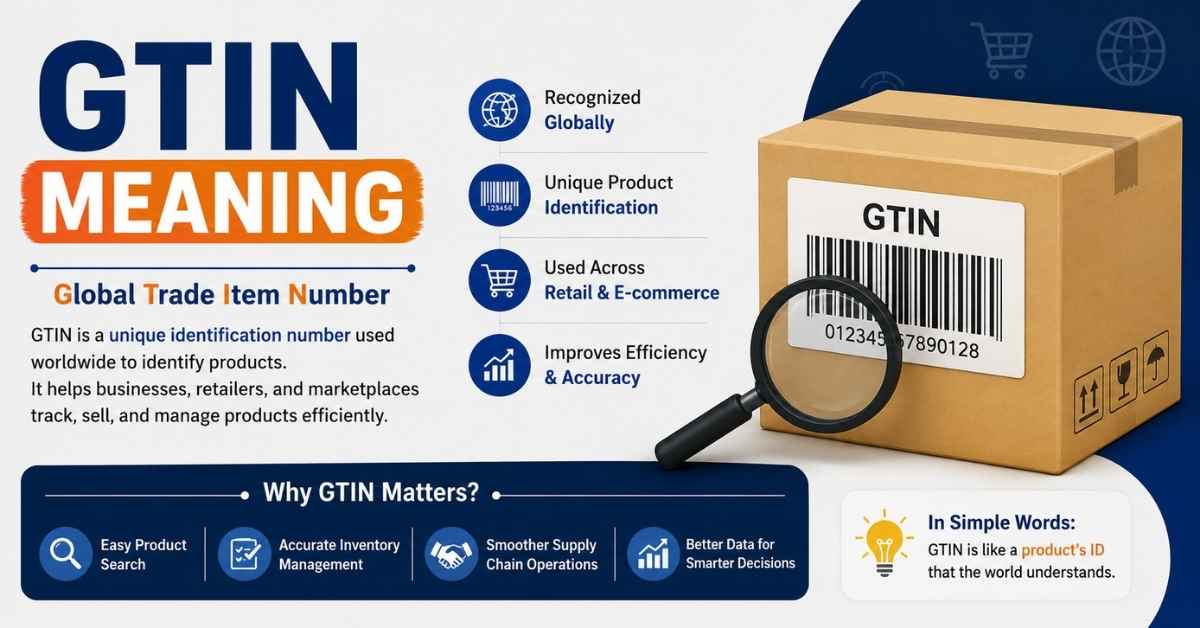
GTIN meaning is Global Trade Item Number, a globally recognized product identifier used to uniquely identify products sold in retail stores, online marketplaces, and supply chains. Managed by GS1, a GTIN helps manufacturers, retailers, distributors, and eCommerce platforms identify products accurately. Depending on the product and region, a GTIN may appear as a UPC, EAN, GTIN-8, GTIN-12, GTIN-13, or GTIN-14.
If you’ve ever listed a product on Amazon Seller Central, Google Merchant Center, Shopify, or another online marketplace and encountered a request for a GTIN, you’re not alone. Many sellers confuse GTIN, barcode, UPC, and SKU, even though they serve different purposes. Understanding GTIN meaning is essential because it ensures accurate product identification, prevents duplicate listings, improves inventory management, and helps your products appear correctly across global retail and eCommerce systems.
In this guide, you’ll learn what a GTIN is, why it matters, the different GTIN formats, how it works, where to find it, and how it compares with identifiers like UPC, EAN, SKU, ISBN, MPN, and ASIN. Whether you’re a first-time seller or an experienced retailer, this article will help you use GTINs confidently.
What Does GTIN Stand For?
At its core, GTIN stands for Global Trade Item Number. While the acronym may sound technical, each word has a specific purpose that explains why this system has become the global standard for product identification.
Breaking Down the Acronym
Global
The word Global reflects the international nature of the system. A GTIN isn’t limited to one country or marketplace. It is recognized worldwide, allowing products to be identified consistently whether they’re sold in a local grocery store, an international supermarket chain, or an online marketplace.
Trade
The term Trade refers to commercial transactions. Any product bought, sold, shipped, stocked, or tracked throughout the supply chain is considered a trade item.
Item
An Item is the individual product being identified. This could be:
- A bottle of shampoo
- A smartphone
- A book
- A box of cereal
- A pair of shoes
- A medical device
Each unique version of a product—such as a different size, flavor, color, or package quantity—typically requires its own GTIN.
Number
Finally, Number refers to the unique numerical code assigned to each trade item. This number is encoded into a barcode, allowing scanners, inventory systems, and online marketplaces to recognize the product instantly.
Expert Insight: A GTIN identifies the product itself, not the business selling it. This distinction is what enables accurate product matching across manufacturers, retailers, distributors, and eCommerce platforms.
What Is a GTIN?
A GTIN (Global Trade Item Number) is a standardized unique product identifier that distinguishes one trade item from another. It forms the foundation of modern retail, inventory tracking, and digital commerce.
Think of a GTIN as a product’s global identity card. Just as every person has a unique identity, every commercially traded product can have its own GTIN, ensuring there is no confusion between similar-looking items.
For example, imagine a company sells the same T-shirt in three sizes:
- Small
- Medium
- Large
Although the design is identical, each size represents a different product variant. As a result, each size receives a different GTIN, enabling retailers and marketplaces to distinguish between them accurately.
This standardized identification reduces errors, improves inventory accuracy, and streamlines product data across multiple systems.
A Simple Definition Anyone Can Understand
If you’re new to product identifiers, here’s an easy way to think about it:
A GTIN is a globally standardized number that uniquely identifies a specific product anywhere in the world.
It allows businesses and computer systems to answer important questions instantly:
- What product is this?
- Who manufactured it?
- Which variation is it?
- Is this the correct item?
- Can it be matched to an existing product catalog?
Without GTINs, every retailer and marketplace would need to create its own identification system, leading to inconsistent product data and duplicate listings.
How GTIN Identifies Products Worldwide
When a manufacturer assigns a GTIN through GS1, that number becomes permanently associated with a specific product configuration.
The GTIN can then be shared across:
- Retail stores
- Online marketplaces
- Warehouses
- Distribution centers
- Point-of-sale (POS) systems
- Inventory management software
- Product Information Management (PIM) systems
- Supply chain databases
Because everyone references the same identifier, products remain consistent across different channels.
For instance, the same GTIN may be recognized by:
- Amazon Seller Central
- Google Merchant Center
- Shopify
- Walmart Marketplace
- Large supermarket chains
- International distributors
This consistency reduces product mismatches and improves customer confidence.
Why Businesses Rely on GTINs Every Day
Modern commerce depends on accurate product data. A single mistake in product identification can lead to:
- Incorrect inventory counts
- Shipping errors
- Duplicate online listings
- Pricing inconsistencies
- Marketplace listing rejections
- Customer returns
By assigning a unique GTIN to each product, businesses create a common language that every participant in the supply chain can understand.
Real-World Example
Imagine a retailer ordering 500 bottles of shampoo.
Without a GTIN, the supplier might accidentally ship:
- A different fragrance
- A travel-size bottle
- A promotional pack
With the correct GTIN, everyone involved knows exactly which product should be supplied.
That’s why GTINs are considered one of the most important standards in global commerce.
Why Is GTIN Important?
Many people assume GTINs exist solely because retailers need barcodes. In reality, they play a much broader role in ensuring accurate product identification across the entire product lifecycle.
Whether a product is manufactured, shipped, stocked, sold, or returned, the GTIN serves as the consistent reference point.
Benefits for Manufacturers
Manufacturers often manage thousands of products, each with multiple variations. Assigning a unique GTIN to every trade item helps them:
- Maintain accurate product catalogs
- Differentiate product variants
- Reduce data inconsistencies
- Improve supply chain communication
- Meet retailer and marketplace requirements
A standardized identifier also makes it easier to introduce new products without disrupting existing inventory records.
Benefits for Retailers
Retailers process thousands of transactions daily. Using GTINs enables them to:
- Scan products quickly at checkout
- Track inventory in real time
- Reduce pricing errors
- Simplify restocking
- Improve warehouse efficiency
- Synchronize product information across multiple stores
Whether it’s a neighborhood supermarket or a global retail chain, GTINs help keep operations running smoothly.
Benefits for Online Sellers
For eCommerce businesses, GTINs are especially valuable because many marketplaces require standardized product identifiers.
Using the correct GTIN can help:
- Match products to existing marketplace catalogs
- Improve listing accuracy
- Reduce duplicate product pages
- Increase product visibility
- Enhance customer trust
- Minimize listing errors
Many sellers first encounter GTINs while creating listings on platforms like Amazon or submitting product feeds to Google Shopping.
Benefits for Consumers
Although shoppers rarely think about GTINs, they benefit from them every day.
Accurate product identification helps customers:
- Receive the correct product
- Compare products more easily
- Read accurate specifications
- Avoid misleading listings
- Experience faster checkout processes
Ultimately, GTINs contribute to a smoother shopping experience both online and in physical stores.
How GTIN Improves Supply Chain Efficiency
Every stage of the supply chain depends on reliable product identification.
A GTIN enables:
- Manufacturers to produce the correct items
- Warehouses to track stock accurately
- Logistics providers to verify shipments
- Retailers to manage inventory
- Online marketplaces to organize product catalogs
Without a common identification standard, every organization would need to translate product numbers manually—leading to delays, errors, and unnecessary costs.
Expert Tip: Think of a GTIN as the universal language that connects manufacturers, retailers, logistics companies, marketplaces, and consumers.
Where Can You Find a GTIN?
One of the most common questions people ask after learning GTIN meaning is:
“Where do I find my GTIN?”
The answer depends on whether you’re a consumer, retailer, or product manufacturer.
On Product Packaging
For most retail products, the GTIN appears on the product packaging as part of the barcode.
Common examples include:
- Food packaging
- Electronics boxes
- Cosmetic products
- Household items
- Clothing tags
- Books
In many cases, the visible number printed beneath the barcode represents the product’s GTIN format, such as a UPC or EAN.
Under the Barcode
Look closely beneath the barcode on a product package.
You’ll usually see a sequence of numbers.
Depending on your region and product type, these numbers may represent:
- GTIN-12 (UPC) — Common in the United States and Canada
- GTIN-13 (EAN) — Widely used internationally
- GTIN-8 — Used for very small retail items
- GTIN-14 — Often used for grouped packaging or logistics units
These formats are all part of the broader GTIN system.
Inside Product Listings
If you sell products online, you may also find the GTIN in:
- Product management dashboards
- Inventory software
- ERP systems
- Product Information Management (PIM) platforms
- Marketplace product feeds
- Manufacturer product databases
Many eCommerce platforms display the GTIN alongside attributes like SKU, MPN, and Brand to help maintain consistent product information.
In Retail and Inventory Systems
Businesses often store GTINs within their inventory and sales systems to:
- Track stock levels
- Manage product catalogs
- Process orders
- Generate shipping labels
- Synchronize product data across channels
This ensures that every department—from purchasing to fulfillment—references the same product identifier.
Learn More: Claddagh Meaning
Understanding the Different GTIN Formats
One reason many people find GTIN meaning confusing is that GTIN isn’t a single barcode format. Instead, it’s a family of globally recognized numbering standards designed for different products and packaging needs.
The four main GTIN formats are:
- GTIN-8
- GTIN-12 (UPC)
- GTIN-13 (EAN)
- GTIN-14
Each serves a specific purpose while following the same principle: uniquely identifying a trade item.
| GTIN Format | Digits | Common Name | Typical Use Case | Common Regions |
|---|---|---|---|---|
| GTIN-8 | 8 | EAN-8 | Very small retail products | Global |
| GTIN-12 | 12 | UPC | Consumer retail products | United States & Canada |
| GTIN-13 | 13 | EAN | International retail products | Europe, Asia, and many other regions |
| GTIN-14 | 14 | ITF-14 / Logistics GTIN | Cartons, cases, and grouped trade items | Global |
GTIN vs UPC vs EAN vs SKU vs ISBN vs ASIN vs MPN
One of the biggest reasons people search for GTIN meaning is because they encounter several product identifiers at once. You might see GTIN, UPC, EAN, SKU, ISBN, ASIN, or MPN on a product listing and wonder whether they’re all the same.
The short answer is no. While these identifiers are related, they serve different purposes. Understanding the differences can help you avoid listing errors, improve inventory management, and meet the requirements of platforms like Amazon Seller Central, Google Merchant Center, and Shopify.
Comparison Table: GTIN vs Other Product Identifiers
| Identifier | Purpose | Assigned By | Used For | Global Standard? |
|---|---|---|---|---|
| GTIN | Globally identifies a trade item | GS1 | Retail, eCommerce, supply chain | ✅ Yes |
| UPC (GTIN-12) | Identifies retail products | GS1 | Primarily North America | ✅ Yes |
| EAN (GTIN-13) | International retail barcode | GS1 | Global retail | ✅ Yes |
| SKU | Internal inventory tracking | Individual business | Warehouse and inventory management | ❌ No |
| ISBN | Identifies books | ISBN Agency | Publishing industry | ✅ Yes |
| ASIN | Identifies products on Amazon | Amazon | Amazon catalog | ❌ Amazon only |
| MPN | Manufacturer’s product number | Manufacturer | Product catalogs and listings | ❌ No |
GTIN vs UPC
Many people believe GTIN and UPC are identical, but that’s only partly true.
A UPC (Universal Product Code) is actually a GTIN-12. In other words, every UPC is a GTIN, but not every GTIN is a UPC.
For example, products sold in the United States and Canada commonly use 12-digit UPC barcodes, while products sold internationally often use EAN (GTIN-13) codes.
GTIN vs EAN
An EAN (European Article Number) is another format within the GTIN family.
The key difference is regional usage:
- UPC (GTIN-12): Mostly North America.
- EAN (GTIN-13): Common across Europe, Asia, Australia, and many other countries.
Both uniquely identify products and follow GS1 standards.
GTIN vs SKU
This is one of the most misunderstood comparisons.
A SKU (Stock Keeping Unit) is created by an individual business to organize its own inventory. Two different companies can assign completely different SKUs to the same product.
A GTIN, on the other hand, is standardized and recognized globally.
Example:
A black backpack may have:
- GTIN: 9501234567890
- SKU (Store A): BKP-BLK-001
- SKU (Store B): BAG-7821
The GTIN remains the same worldwide, while the SKU changes depending on the retailer.
GTIN vs ISBN
If you buy books, you’ve already seen an ISBN (International Standard Book Number).
ISBNs are specialized identifiers for books and are integrated into the GTIN system for retail scanning. Their purpose is specific to the publishing industry.
GTIN vs ASIN
An ASIN (Amazon Standard Identification Number) is unique to Amazon.
Amazon may associate an ASIN with a product that already has a GTIN. While the GTIN identifies the product globally, the ASIN identifies it within Amazon’s marketplace.
GTIN vs MPN
An MPN (Manufacturer Part Number) is assigned by the manufacturer to distinguish models or parts.
Unlike GTINs, MPNs are not globally standardized and can vary by manufacturer. Many marketplaces request both the GTIN and the MPN to improve product matching.
Expert Insight: Think of GTIN as the product’s universal passport, while SKU, ASIN, and MPN are identifiers used for specific businesses or platforms.
How GTIN Works Behind the Scenes
Most shoppers simply scan a barcode and move on. Behind that quick scan, however, is a sophisticated system that keeps products moving accurately through the global supply chain.
From Manufacturer to Retail Shelf
The journey begins when a manufacturer assigns a GTIN to a product using GS1 standards.
Once assigned, the GTIN becomes part of the product’s identity and travels with it throughout its lifecycle.
The product can then be:
- Manufactured
- Packaged
- Stored
- Shipped
- Distributed
- Sold online
- Sold in physical stores
Every participant in the supply chain recognizes the same identifier.
Barcode Scanning Process
When a barcode is scanned at checkout or in a warehouse, the scanner reads the encoded GTIN.
That number is used to retrieve product information such as:
- Product name
- Brand
- Size
- Color
- Price
- Inventory status
- Packaging details
The barcode itself doesn’t contain all this information. Instead, it acts as a key that links to product databases.
Product Databases
Retailers, manufacturers, and marketplaces maintain product databases that associate each GTIN with detailed product information.
These databases support:
- Product catalogs
- Inventory systems
- Online stores
- Warehouse operations
- Point-of-sale systems
This is why using the correct GTIN is so important. An incorrect identifier can link to the wrong product or cause listing errors.
Inventory Systems
Modern inventory management software relies heavily on GTINs.
A GTIN allows businesses to:
- Track stock accurately
- Monitor sales
- Forecast demand
- Reduce inventory discrepancies
- Improve order fulfillment
This consistency becomes even more important for businesses selling across multiple channels.
Checkout Systems
Every time a cashier scans a product, the Point-of-Sale (POS) system uses the GTIN to retrieve pricing and product details instantly.
This speeds up checkout, reduces pricing mistakes, and improves customer experience.
Online Marketplaces
Platforms like:
- Amazon Seller Central
- Google Merchant Center
- Shopify
- Walmart Marketplace
- eBay
often use GTINs to:
- Match products to existing catalogs
- Prevent duplicate listings
- Improve search accuracy
- Organize product feeds
- Maintain consistent product information
Without standardized identifiers, marketplaces would struggle to identify whether two sellers are offering the same item.
Why Amazon, Google Shopping, and Other Marketplaces Ask for GTIN
If you’ve ever uploaded a product online, you’ve probably seen a field requesting a GTIN.
Many new sellers wonder why it’s required.
The answer is simple: marketplaces need a reliable way to identify products.
Amazon Seller Central
Amazon uses GTINs to:
- Match products to existing ASINs
- Reduce duplicate product pages
- Improve search results
- Verify product authenticity
- Organize catalog data
If a product already exists in Amazon’s catalog, providing the correct GTIN helps Amazon connect your offer to the existing listing.
Google Merchant Center
Google uses GTINs to improve the quality of product data submitted through shopping feeds.
A valid GTIN helps Google:
- Understand exactly which product you’re selling
- Match products across retailers
- Display richer Shopping results
- Improve product visibility
Incorrect or missing GTINs may lead to feed warnings or reduced visibility for eligible products.
Shopify
Although Shopify allows merchants to create products without a GTIN in some cases, adding the correct identifier can improve integrations with marketplaces, inventory systems, and shopping channels.
Walmart Marketplace
Walmart also relies on GTINs to ensure accurate catalog management and reduce duplicate listings.
Standardized product identifiers make it easier for Walmart to match products sold by different sellers.
eBay and Other Platforms
Many online marketplaces encourage or require GTINs because they improve:
- Product discovery
- Catalog accuracy
- Search relevance
- Customer confidence
The more consistent your product data is across channels, the smoother your selling experience becomes.
What Happens If You Enter an Invalid GTIN?
An incorrect GTIN can create several issues:
- Listing rejection
- Product mismatches
- Catalog conflicts
- Feed validation errors
- Customer confusion
- Inventory inconsistencies
Before submitting product information, always verify that the GTIN belongs to the exact product and variant you’re selling.
Do All Products Need a GTIN?
The answer is not always.
While GTINs are widely used, the requirement depends on the type of product, where it’s sold, and the marketplace’s policies.
Products That Usually Require a GTIN
Most commercially manufactured retail products have a GTIN, including:
- Packaged foods
- Electronics
- Household goods
- Toys
- Cosmetics
- Clothing
- Sporting equipment
- Health and beauty products
These items are typically sold through multiple retailers and benefit from standardized product identification.
Products That May Qualify for Exemptions
Some marketplaces allow exemptions for products that don’t have manufacturer-assigned GTINs.
Examples may include:
- Handmade items
- Custom-made products
- One-of-a-kind artwork
- Personalized gifts
Requirements vary by platform, so sellers should review the latest marketplace guidelines before assuming an exemption applies.
Handmade Products
Artisans and small businesses selling handcrafted goods often ask whether they need GTINs.
If the products are unique and not mass-produced, certain marketplaces may permit alternative listing methods instead of requiring a GTIN.
Private Label Products
Private label brands generally obtain their own GTINs when selling products under their own brand name.
Using officially assigned identifiers helps build a reliable product catalog and supports future growth.
Custom Products
Products manufactured specifically for an individual customer may not always require GTINs, depending on how they’re sold.
Digital Products
Digital downloads, software subscriptions, and online services typically don’t use GTINs because they aren’t physical trade items.
Practical Tip: If you plan to expand into retail stores or major online marketplaces, assigning official GTINs early can simplify product management and reduce future listing issues.
How to Get a GTIN
If you’re launching a new product, one of the first questions you’ll ask is:
“How do I get a GTIN?”
The process is straightforward when you follow recognized standards.
Register Through GS1
The most reliable way to obtain GTINs is through your local GS1 organization.
GS1 issues company prefixes that allow businesses to assign unique GTINs to their products while maintaining global uniqueness.
Assigning GTINs Correctly
Every unique product variation generally requires its own GTIN.
For example, if a T-shirt is available in:
- Small
- Medium
- Large
each size should receive a separate GTIN because each represents a distinct trade item.
The same principle applies to different colors, package sizes, or bundled products.
Common Registration Mistakes
Businesses sometimes encounter problems because they:
- Reuse GTINs for different products
- Assign one GTIN to multiple variants
- Purchase unofficial barcode numbers without understanding marketplace acceptance
- Forget to update product information consistently across systems
Avoiding these mistakes helps maintain clean product data and prevents unnecessary listing issues.
Why Official GTINs Matter
Although inexpensive barcode offers may seem attractive, official GTINs provide long-term benefits:
- Better product data consistency
- Greater marketplace compatibility
- Easier inventory management
- Improved retailer confidence
- Support for future business expansion
Expert Tip: A GTIN is more than just a barcode number—it’s a long-term asset that supports accurate product identification throughout the product’s entire lifecycle. Properly managing your GTINs from the beginning can save significant time and effort as your business grows.
How to Check or Validate a GTIN
Whether you’re a manufacturer, retailer, or online seller, it’s important to ensure your GTIN is accurate before using it in a product listing or inventory system. An incorrect Global Trade Item Number can lead to listing errors, inventory mismatches, and marketplace rejections.
Verify the Number Format
The first step is confirming that the GTIN matches the correct format for your product.
| GTIN Format | Number of Digits | Common Use |
|---|---|---|
| GTIN-8 | 8 | Small retail products |
| GTIN-12 (UPC) | 12 | North America |
| GTIN-13 (EAN) | 13 | International retail |
| GTIN-14 | 14 | Cartons and grouped packaging |
If the digit count doesn’t match the expected format, double-check the number before publishing your product.
Check the Barcode
The barcode printed on the product should correspond to the GTIN assigned to that exact product and its specific variant.
Always verify that:
- The barcode is clear and scannable.
- The printed number matches your product records.
- The GTIN belongs to the correct size, color, or packaging variation.
Validate Before Publishing
Before uploading products to Amazon Seller Central, Google Merchant Center, Shopify, or other marketplaces, review your product data carefully.
Confirm that:
- The Brand is correct.
- The GTIN matches the product.
- The MPN, if used, is accurate.
- Product titles and descriptions match the identifier.
A few minutes of verification can prevent hours of troubleshooting later.
Common GTIN Mistakes That Cause Product Listing Problems
Even experienced sellers make mistakes when managing product identifiers. Most issues aren’t caused by the GTIN itself—they happen because it’s used incorrectly.
Using the Wrong Identifier
One of the most common mistakes is entering a SKU or MPN where a GTIN is required.
Remember:
- GTIN = Global product identifier
- SKU = Internal inventory code
- MPN = Manufacturer’s part number
Each serves a different purpose.
Reusing a GTIN
A GTIN should identify one specific trade item.
Reusing the same GTIN for different products can create:
- Duplicate catalog entries
- Inventory confusion
- Incorrect product information
- Marketplace conflicts
Ignoring Product Variants
Every unique variation generally requires its own GTIN.
Examples include:
- Different sizes
- Different colors
- Different package quantities
- Updated product versions
Assigning one GTIN to multiple variants can cause customers to receive the wrong item.
Formatting Errors
Simple typing mistakes can result in invalid product listings.
Always:
- Copy GTINs carefully.
- Avoid extra spaces.
- Check every digit before submission.
Marketplace Rejections
A product listing may be rejected if:
- The GTIN doesn’t match the product.
- The identifier belongs to another brand.
- Product information is inconsistent.
- Required attributes are missing.
Expert Tip: Build a habit of reviewing product data before every new listing. Accurate identifiers improve catalog quality and reduce support requests.
See More: Kadosh Meaning
Real-World Examples of GTIN in Action
Understanding GTIN meaning becomes much easier when you see how it’s used in everyday business.
Example 1: Grocery Store
A cereal box has a GTIN-13 (EAN).
When scanned:
- The cashier instantly sees the product name.
- The correct price appears.
- Inventory decreases automatically.
- Sales reports update in real time.
Example 2: Electronics Retailer
A smartphone is available in:
- Black
- Silver
- Blue
Although it’s the same model, each color receives a different GTIN because each is a separate product variant.
Example 3: Fashion Store
A T-shirt comes in:
- Small
- Medium
- Large
Each size has its own GTIN, allowing inventory systems to track stock accurately and ensuring customers receive the size they ordered.
Example 4: Bookstore
Books use an ISBN, which integrates into the GTIN system for retail scanning.
This allows bookstores and online retailers to identify the correct edition of a book.
Example 5: Private Label Business
A skincare brand launches a new moisturizer under its own label.
The business obtains official GTINs for each product size, helping it:
- Sell on multiple marketplaces.
- Manage inventory efficiently.
- Build a consistent product catalog.
- Expand into retail stores more easily.
GTIN Myths You Should Stop Believing
There are many misconceptions surrounding GTINs. Let’s clear up the most common ones.
Myth 1: GTIN and Barcode Are the Same
A barcode is the machine-readable symbol, while the GTIN is the unique number encoded within it.
Myth 2: Every Product Uses a UPC
UPC is only one GTIN format. Many products outside North America use EAN (GTIN-13) or other GTIN formats.
Myth 3: SKU Can Replace GTIN
A SKU is created internally by a business and cannot replace a globally recognized GTIN where one is required.
Myth 4: One GTIN Works for Every Product Variation
Different sizes, colors, and packaging configurations generally need different GTINs.
Myth 5: GTINs Are Only for Large Companies
Small businesses, startups, and private-label brands also benefit from standardized product identification, especially as they grow.
The Future of GTIN and Product Identification
Product identification continues to evolve alongside retail technology.
Emerging developments include:
- GS1 Digital Link, which connects physical products to digital information through advanced barcode technology.
- 2D barcodes, capable of storing more information than traditional linear barcodes.
- Omnichannel commerce, where consistent product data across online and offline channels becomes increasingly important.
- Smarter inventory systems that use standardized identifiers to improve automation and traceability.
- Greater product transparency, enabling consumers to access richer product information with a simple scan.
Businesses that maintain accurate GTIN data today will be better prepared to adopt these innovations in the future.
Frequently Asked Questions About GTIN Meaning
What does GTIN stand for?
GTIN stands for Global Trade Item Number, a globally recognized identifier used to uniquely identify products.
Is GTIN the same as a barcode?
No. A GTIN is the numerical identifier, while a barcode is the visual representation that allows scanners to read that number.
Is GTIN the same as UPC?
Not exactly. A UPC is a GTIN-12, meaning it is one format within the broader GTIN system.
Is GTIN different from SKU?
Yes. A GTIN is a globally standardized identifier, while a SKU is an internal code created by an individual business for inventory management.
Where can I find my GTIN?
You can usually find it beneath the product barcode, on packaging, in inventory software, or within your product management system.
How many digits can a GTIN have?
Depending on the format, a GTIN may contain 8, 12, 13, or 14 digits.
Do all products require a GTIN?
No. Requirements vary depending on the product type and the marketplace where it’s sold. Some products may qualify for exemptions.
Can I create my own GTIN?
Businesses should obtain GTINs through their local GS1 organization to ensure global uniqueness and marketplace compatibility.
Why was my GTIN rejected?
Common reasons include:
- Incorrect product information
- Typographical errors
- Mismatched brand details
- Using an identifier that belongs to another product
What is a GTIN exemption?
A GTIN exemption allows certain eligible products—such as some handmade or custom items—to be listed without a GTIN on specific marketplaces, subject to each platform’s policies.
Final Thoughts:
Understanding GTIN meaning is essential for anyone involved in modern retail or eCommerce. A Global Trade Item Number (GTIN) is the worldwide standard for uniquely identifying trade items, helping manufacturers, retailers, marketplaces, and consumers work with consistent product information.
Remember these key points:
- GTIN is the umbrella system that includes GTIN-8, GTIN-12 (UPC), GTIN-13 (EAN), and GTIN-14.
- It improves inventory management, product identification, and supply chain efficiency.
- GTIN is different from SKU, MPN, ASIN, and ISBN, each of which serves a distinct purpose.
- Many marketplaces use GTINs to improve catalog accuracy and reduce duplicate listings.
- Proper GTIN management supports long-term business growth, better data quality, and smoother multi-channel selling.
Whether you’re launching your first product or managing a large product catalog, understanding how GTINs work will help you build accurate listings, streamline operations, and prepare your business for the future of global commerce.