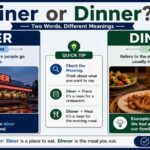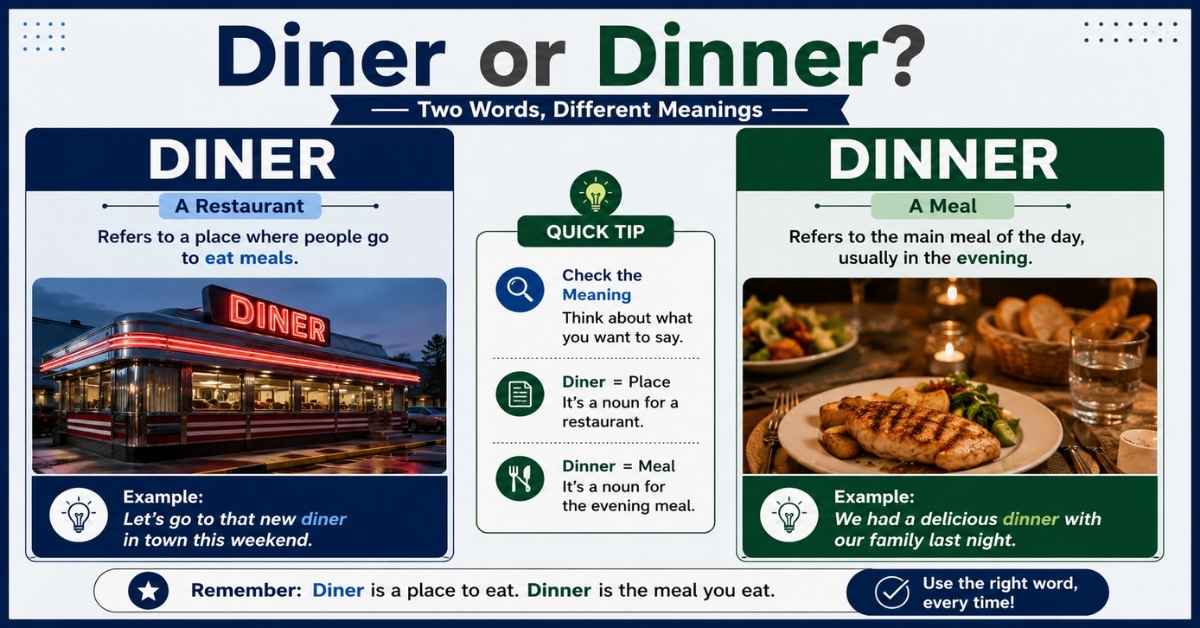
Diner or dinner—the correct word depends on what you’re talking about. A diner is either a person who is eating or a casual restaurant, while dinner is a meal, usually the main meal of the day. Although these two words look and sound similar, they have completely different meanings and are often confused by students, writers, and English learners. If you’ve ever wondered “diner or dinner, which is correct?”, this guide will help you understand the difference with clear explanations, practical examples, and simple memory tricks so you can use each word confidently.
Whether you’re writing an email, completing homework, chatting with friends, or improving your English vocabulary, knowing the difference between diner vs. dinner can make your writing more accurate and professional. Let’s break it down in the simplest way possible.
Why People Confuse “Diner” and “Dinner”
It’s easy to see why diner and dinner are among the most commonly confused words in English. They differ by just one letter, share the same linguistic root, and are often used in conversations about food. However, their meanings are entirely different.
Understanding why they’re confused makes it much easier to remember the correct usage.
They Look Almost Identical
The biggest reason for the confusion is spelling.
Compare the words:
- Diner
- Dinner
At first glance, they seem almost the same. When you’re typing quickly or proofreading your work, it’s surprisingly easy to overlook the extra “n” in dinner.
This is a common mistake for both native English speakers and ESL learners, especially when relying on spell-check tools. Since both words are correctly spelled English words, your computer won’t always flag the mistake.
Example:
❌ We had a delicious diner last night.
✅ We had a delicious dinner last night.
Likewise:
❌ Let’s eat at the new dinner downtown.
✅ Let’s eat at the new diner downtown.
Because both words are valid, only context tells you which one is correct.
Both Words Come From the Same Root
Another reason people mix them up is that both words are connected to the verb dine.
The English word family includes:
- Dine – to eat a meal
- Dining – the act of eating
- Diner – someone who dines or a casual restaurant
- Dinner – the meal itself
Since these words share the same origin, many learners assume they’re interchangeable. In reality, each has developed its own distinct meaning over time.
Think of it this way:
- You dine during dinner.
- A diner is the place where you might go to dine—or a person enjoying the meal.
Recognizing these relationships makes the vocabulary much easier to remember while strengthening your overall understanding of English.
Similar Pronunciation Can Be Misleading
Although diner and dinner aren’t pronounced exactly the same, they sound similar enough that listeners may not immediately notice the difference, especially in fast conversation.
Approximate pronunciations:
- Diner → DY-ner
- Dinner → DIN-er
For non-native speakers, the difference between the long “i” sound in diner and the short “i” sound in dinner can be subtle. That’s why practicing pronunciation alongside spelling is important.
If you’re learning English, reading the words aloud while using them in complete sentences can help you remember both the spelling and the meaning.
Autocorrect Doesn’t Always Save You
One of the biggest misconceptions is that grammar tools catch every mistake.
They don’t.
Most spell-checkers only detect misspelled words. Since diner and dinner are both legitimate English nouns, software often assumes you’ve chosen the correct one.
For example:
We enjoyed a wonderful diner with our grandparents.
The sentence is grammatically correct, but the word choice is wrong. Only a context-aware grammar checker—or your own proofreading—can spot the mistake.
This is why experienced editors recommend reading sentences for meaning rather than relying entirely on technology.
Why English Learners Often Mix Them Up
If English isn’t your first language, confusing these words is completely understandable.
Many languages use a single word to describe both the meal and the act of eating, while English separates these ideas into different words.
Learners also face challenges because:
- Diner has more than one meaning.
- Dinner can refer to different meals depending on culture.
- School textbooks sometimes simplify the definitions.
- Everyday conversations don’t always follow textbook rules.
The good news is that once you understand the difference in context, you’ll rarely confuse them again.
The Psychology Behind Similar Words
Our brains don’t read every letter individually.
Instead, we recognize familiar word patterns.
That’s why words with similar beginnings and endings are easy to confuse when reading quickly.
Examples include:
- accept vs. except
- affect vs. effect
- lose vs. loose
- diner vs. dinner
Professional proofreaders intentionally slow down when reviewing commonly confused words because the brain naturally fills in what it expects to see rather than what is actually written.
A useful habit is to ask yourself one simple question whenever you’re unsure:
Am I talking about a meal, a restaurant, or a person eating?
If it’s the meal, choose dinner.
If it’s the restaurant or the person, choose diner.
That one question can prevent almost every mistake.
Diner vs. Dinner at a Glance
Sometimes, a quick comparison is all you need. The table below highlights the key differences between diner and dinner, making it easy to choose the correct word in any situation.
| Feature | Diner | Dinner |
|---|---|---|
| Meaning | A person who eats or a casual restaurant | The main meal of the day, often eaten in the evening |
| Part of Speech | Noun | Noun |
| Refers To | A person or a place | A meal |
| Common Context | Restaurants, travel, food culture | Family meals, celebrations, daily eating |
| Example | We stopped at a roadside diner. | We had dinner at 7 p.m. |
| Related Words | Dine, dining, restaurant, café, bistro | Meal, supper, lunch, banquet, feast |
| Pronunciation | DY-ner | DIN-er |
| Common Mistake | Using it to describe a meal | Using it to describe a restaurant |
Quick Rule to Remember
- If you’re talking about food you eat, the correct word is dinner.
- If you’re talking about where you eat or someone eating, the correct word is diner.
This simple rule works in almost every everyday situation.
What Does “Diner” Mean?
The word diner has two accepted meanings in English. Understanding both meanings is essential because the context determines which definition applies.
Many people only know one meaning and are surprised to discover that diner doesn’t always refer to a restaurant.
Let’s look at each meaning separately.
Meaning 1: A Diner Is a Person Who Eats
In its original and most literal sense, a diner is a person who is eating a meal.
Although this usage is less common in everyday conversation, you’ll often see it in newspapers, restaurant reviews, hospitality articles, and formal writing.
Examples
- Every diner received a complimentary dessert.
- The restaurant asked each diner to complete a feedback survey.
- Happy diners often leave generous tips.
- Staff members ensured every diner felt welcome.
- The chef personally greeted several diners after the meal.
In these examples, diner refers to people, not restaurants.
When This Meaning Is Common
You’ll frequently encounter this definition in industries such as:
- Hospitality
- Restaurant management
- Food journalism
- Travel writing
- Customer service
For example:
The restaurant accommodates over 300 diners every evening.
Here, diners clearly means customers, not the building itself.
Meaning 2: A Diner Is a Casual Restaurant
Today, the most familiar meaning of diner—especially in American English—is a small, casual restaurant known for serving affordable comfort food in a relaxed setting.
When people say:
“Let’s stop at a diner.”
they’re talking about a restaurant, not the meal.
Classic diners are famous for serving:
- Breakfast all day
- Pancakes
- Eggs and bacon
- Burgers
- Sandwiches
- French fries
- Coffee
- Milkshakes
- Homemade pies
Many diners also feature booth seating, counter stools, friendly service, and a nostalgic atmosphere that has become an iconic part of American food culture.
Real-Life Examples
- We found a cozy diner on our road trip.
- The neighborhood diner serves breakfast all day.
- Tourists often visit classic American diners for the experience.
- That roadside diner is famous for its homemade pie.
- We met at a local diner before heading to work.
Notice that diner always refers to a place in these examples—not the meal itself.
What Makes a Diner Different From Other Restaurants?
Not every restaurant is a diner.
A traditional diner usually has several recognizable features:
- A casual, welcoming atmosphere
- Affordable comfort food
- Quick service
- Booth seating and a counter
- Breakfast served throughout the day
- A varied menu with classic American favorites
Understanding this distinction helps you use the word naturally in conversation and writing.
When Not to Use “Diner”
Avoid using diner when you’re referring to the meal itself.
For example:
❌ We enjoyed a wonderful diner with our family.
✅ We enjoyed a wonderful dinner with our family.
Likewise:
❌ Tonight’s diner was delicious.
✅ Tonight’s dinner was delicious.
Keeping this simple distinction in mind will help you avoid one of the most common English vocabulary mistakes.
What Does “Dinner” Mean?
Unlike diner, which refers to a person or a restaurant, dinner refers to a meal. In most modern English-speaking countries, dinner is the main meal of the day, although exactly when that meal is eaten can vary depending on culture, region, and family tradition.
If you’re wondering “diner or dinner—which word should I use?”, remember this simple rule:
Use “dinner” whenever you’re talking about the meal itself.
Whether it’s a quick family meal on a weekday or a formal holiday feast, the word dinner always describes food being eaten, not the place where it’s served.
The Definition of “Dinner”
The word dinner is a noun that refers to the main meal of the day. In many households, it’s eaten in the evening, but in some cultures and regions, dinner may be served at midday.
Examples include:
- We had dinner at 7:00 p.m.
- Thank you for inviting us to dinner.
- Our family enjoys dinner together every evening.
- The hotel includes dinner with the room reservation.
- Tonight’s dinner was homemade.
In every example, dinner refers to the meal, not a restaurant or a person.
Is Dinner Always the Evening Meal?
Not necessarily.
This is one of the biggest misconceptions English learners have.
In American English, dinner usually means the evening meal, while lunch is eaten around midday.
For example:
- Breakfast
- Lunch
- Dinner
However, in some regions—particularly in parts of the United Kingdom, Ireland, and rural communities—dinner can refer to the largest meal of the day, even if it’s served at noon.
That’s why you may hear phrases like:
- School dinner
- Sunday dinner
- Christmas dinner
- Harvest dinner
The timing isn’t as important as the fact that it’s the main meal.
Regional Usage at a Glance
| Region | Common Meaning of Dinner |
|---|---|
| United States | Evening meal |
| Canada | Usually evening meal |
| Australia | Usually evening meal |
| Many parts of England | Midday or evening meal depending on region |
| Scotland | Can mean the main meal, regardless of time |
Understanding these regional differences helps you interpret conversations more accurately.
Can Dinner Mean Lunch?
Yes—in some contexts.
Historically, dinner referred to the largest meal of the day rather than a specific time. As work schedules and lifestyles changed, many people shifted that main meal to the evening.
Today, you’ll still encounter situations where dinner refers to a midday meal.
Examples include:
- School dinner refers to the meal served at school around lunchtime.
- Sunday dinner may be served in the early afternoon.
- Thanksgiving dinner is often eaten in the afternoon rather than at night.
- Christmas dinner varies by family tradition.
The key takeaway is that dinner describes the primary meal, not necessarily the evening.
Formal and Informal Uses of “Dinner”
The word dinner works in both casual and formal situations.
Everyday Usage
- What’s for dinner tonight?
- We ordered pizza for dinner.
- I usually cook dinner after work.
- They invited us over for dinner.
Formal Usage
- The company hosted an annual awards dinner.
- Guests attended a charity dinner.
- The ambassador organized a state dinner.
- The conference concluded with a networking dinner.
Whether casual or formal, the meaning remains the same: a meal.
Dinner in Everyday Life
The word dinner appears in countless everyday expressions.
Common examples include:
- Dinner table
- Dinner party
- Dinner reservation
- Dinner menu
- Dinner guest
- Dinner invitation
- Dinner plans
- Dinner conversation
- Dinner date
These phrases reinforce that dinner is associated with the meal and the occasion, not the restaurant itself.
Diner or Dinner: How to Choose the Right Word Every Time
If you still hesitate when writing diner or dinner, don’t worry. There’s a simple decision process that professional editors and experienced writers use.
Ask yourself one question:
What am I talking about?
If you’re talking about…
✔ A Meal
Use dinner.
Examples:
- We enjoyed dinner together.
- Dinner is almost ready.
- Tonight’s dinner smells amazing.
- They served a delicious dinner after the ceremony.
✔ A Restaurant
Use diner.
Examples:
- Let’s eat at the new diner.
- That roadside diner is always busy.
- We stopped at a classic American diner.
- The local diner serves breakfast all day.
✔ A Person Who Is Eating
Use diner.
Examples:
- Every diner received a complimentary drink.
- The chef greeted several diners personally.
- Restaurant staff made every diner feel welcome.
A Simple Decision Framework
Use this quick guide whenever you’re unsure:
Are you referring to…
A meal?
➡ Use Dinner
A restaurant?
➡ Use Diner
Someone eating?
➡ Use Diner
You’ll rarely choose the wrong word if you answer this question first.
Learn More: RSVP Full Form
Real-Life Examples You’ll Actually Use
Learning grammar becomes much easier when you see words used in everyday situations.
Below are practical examples showing exactly how diner and dinner are used.
At a Restaurant
- We stopped at a roadside diner during our road trip.
- The diner is famous for its homemade pancakes.
- We ordered dinner after looking at the menu.
- Dinner was served within twenty minutes.
At School
- The students finished dinner before the evening event.
- Every diner in the cafeteria received a dessert.
- School dinner is included in the boarding fee.
In Work
- Our company organized a team dinner on Friday.
- We met clients at a downtown diner.
- Business dinner lasted nearly three hours.
During Travel
- They discovered a charming diner along Route 66.
- The hotel package included dinner.
- Tourists love visiting historic American diners.
With Family
- Grandma cooked dinner for everyone.
- We gather around the dinner table every Sunday.
- After church, we visited our favorite diner.
On Social Media
- “Best dinner I’ve had this year!”
- “This little diner has incredible milkshakes.”
- Date-night dinner was perfect.
In Professional Writing
Correct:
Guests are invited to the annual awards dinner.
Correct:
The newly renovated diner reopened this weekend.
Common Mistakes and How to Fix Them
Because diner and dinner are similar in spelling, they are often used incorrectly. Seeing common mistakes side by side makes it easier to avoid them.
| ❌ Incorrect | ✅ Correct | Why? |
|---|---|---|
| We had a delicious diner. | We had a delicious dinner. | A meal is dinner. |
| Let’s go to dinner on Main Street. | Let’s go to the diner on Main Street. | A restaurant is a diner. |
| The dinner serves breakfast all day. | The diner serves breakfast all day. | Restaurants serve food. |
| Our family loves that small dinner. | Our family loves that small diner. | Referring to a place. |
| Every dinner received free coffee. | Every diner received free coffee. | People are diners. |
| The diner was delicious. | The dinner was delicious. | Meals can be delicious, not restaurants. |
| We reserved a table for our anniversary diner. | We reserved a table for our anniversary dinner. | The event is a meal. |
| Their Thanksgiving diner was amazing. | Their Thanksgiving dinner was amazing. | Holiday meals are dinners. |
| I invited everyone to my birthday diner. | I invited everyone to my birthday dinner. | Celebrations involve meals. |
| That dinner has the best burgers in town. | That diner has the best burgers in town. | A place serving burgers is a diner. |
Why These Mistakes Happen
Most errors occur because:
- The words differ by only one letter.
- Both relate to food and eating.
- Both are correct English words, so spell-check often misses the mistake.
- Fast typing and proofreading can cause your brain to overlook small spelling differences.
- Many English learners haven’t been taught the distinction explicitly.
The easiest way to avoid these mistakes is to focus on meaning, not spelling.
Ask yourself:
Am I talking about the meal, the restaurant, or the person eating?
That quick check will almost always lead you to the correct answer.
Diner vs. Dinner in American and British English
One reason diner or dinner can be confusing is that English isn’t used exactly the same way around the world. While the meaning of diner remains fairly consistent, dinner can refer to different meals depending on the country, region, or even family tradition.
Understanding these regional differences helps you avoid confusion when reading books, watching movies, or speaking with native English speakers.
American English
In American English, the distinction is straightforward.
- Diner = a casual restaurant or a person eating.
- Dinner = the evening meal.
A typical daily schedule looks like this:
- Breakfast – Morning
- Lunch – Midday
- Dinner – Evening
Examples
- We had dinner at 6:30 p.m.
- Let’s stop at a diner before heading home.
- That diner serves breakfast all day.
- Tonight’s dinner is grilled chicken and vegetables.
This is the usage you’ll see most often in the United States and Canada.
British English
In parts of the United Kingdom, the word dinner isn’t always reserved for the evening meal.
Depending on the region:
- Dinner may refer to the largest meal of the day, even if it’s eaten at lunchtime.
- The evening meal may be called tea, supper, or dinner, depending on local customs.
For example:
- School dinner
- Sunday dinner
- Christmas dinner
Someone from northern England may say:
“I’m having dinner at one o’clock.”
This doesn’t mean they’re eating an evening meal—it simply means it’s their main meal of the day.
Australian and New Zealand English
In Australia and New Zealand, dinner generally refers to the evening meal, similar to American usage.
However, some families still use tea for the evening meal, particularly in informal settings.
Why Regional Differences Matter
If you’re reading English from different countries, you might notice what appears to be a contradiction.
For example:
- A British novel may describe children eating school dinner at noon.
- An American novel will almost always use lunch for the midday meal.
Neither is incorrect—they simply reflect different language traditions.
The meaning becomes clear once you consider the context.
Pronunciation Guide
Although diner and dinner look similar, they aren’t pronounced the same.
Understanding the pronunciation makes it easier to remember which word you’re using.
| Word | Approximate Pronunciation | Stress |
|---|---|---|
| Diner | DY-ner | First syllable |
| Dinner | DIN-er | First syllable |
Simple Pronunciation Tip
- Diner begins with the same sound as “die.”
- Dinner begins with the same sound as “did.”
Saying them aloud several times helps train your ear.
Try reading these pairs:
- We ate dinner at the diner.
- The diner served a wonderful dinner.
- Every diner enjoyed the dinner.
These sentences reinforce both pronunciation and meaning.
Common Pronunciation Mistakes
Many English learners accidentally pronounce both words the same way.
To avoid this:
- Slow down.
- Emphasize the first vowel.
- Practice with complete sentences rather than isolated words.
The more often you hear and speak the words naturally, the easier the distinction becomes.
The Word Family: Understanding the Connection
One of the best ways to remember diner and dinner is to understand the word family they belong to.
Although the words have different meanings today, they all relate to the idea of eating.
Dine
Dine is the verb.
It means to eat a meal, especially in a somewhat formal or pleasant setting.
Examples:
- We plan to dine downtown tonight.
- They love to dine outdoors during summer.
Dining
Dining describes the activity or experience of eating.
Examples:
- Fine dining
- Casual dining
- Outdoor dining
- Private dining
You’ll also encounter phrases such as:
- Dining room
- Dining table
- Dining hall
- Dining experience
Diner
As you’ve learned, diner has two meanings:
- A person eating.
- A casual restaurant.
Examples:
- The diners praised the excellent service.
- We stopped at a roadside diner.
Dinner
Dinner is the meal itself.
Examples:
- Family dinner
- Holiday dinner
- Business dinner
- Formal dinner
- Anniversary dinner
Understanding this word family creates a strong mental connection that makes remembering each word much easier.
Memory Tricks That Actually Work
Simple memory devices often work better than memorizing dictionary definitions.
Here are several practical tricks.
Trick 1: Double “N” Means More Food
Dinner has two N’s.
Imagine needing more food, so you need one extra N.
Dinner = Extra N = Extra Food
Trick 2: “-er” Often Refers to a Person
Many English nouns ending in -er describe a person.
Examples:
- Teacher
- Driver
- Runner
- Baker
Likewise:
Diner = Person who dines
Even though diner can also mean a restaurant, this pattern helps reinforce one of its meanings.
Trick 3: Think About the Question
Whenever you’re unsure, ask yourself:
Am I talking about a meal or a place?
Meal?
➡ Dinner
Restaurant?
➡ Diner
Person eating?
➡ Diner
This simple habit eliminates almost every mistake.
Trick 4: Visual Association
Picture this:
🏠 Family gathered around a table eating.
That’s dinner.
Now imagine:
🚗 A roadside restaurant with booths and a neon sign.
That’s a diner.
Visual memories tend to last longer than definitions.
Commonly Confused Words Related to Diner and Dinner
Learning related vocabulary strengthens your understanding and prevents future mistakes.
Dinner vs. Supper
These words are closely related.
Dinner
- Usually the main meal of the day.
- Often more formal.
- Common in restaurants and invitations.
Supper
- Usually a lighter evening meal.
- More common in some regions and families.
- Often informal.
Diner vs. Restaurant
Every diner is a restaurant, but not every restaurant is a diner.
A traditional diner usually features:
- Booth seating
- Counter service
- Breakfast all day
- Comfort food
- Casual atmosphere
Fine dining restaurants, cafés, and bistros aren’t typically called diners.
Dine vs. Eat
Both refer to consuming food.
However:
Eat
- General everyday verb.
Dine
- Slightly more formal.
- Often associated with restaurants or enjoyable meals.
Example:
We ate pizza.
We dined at a five-star restaurant.
Lunch vs. Dinner
The difference depends on time and culture.
Lunch
- Midday meal.
Dinner
- Usually the main meal.
In some cultures, the midday meal is called dinner, which explains why the words sometimes overlap.
Café vs. Diner
A café often focuses on:
- Coffee
- Tea
- Pastries
- Light meals
A diner typically offers:
- Full breakfasts
- Burgers
- Sandwiches
- Comfort food
- All-day meals
Brunch vs. Dinner
These meals occur at different times.
Brunch
- Between breakfast and lunch.
Dinner
- Later in the day and usually more substantial.
Expert Writing Tips
Professional editors rarely rely only on spell-check.
Instead, they check whether the word matches the intended meaning.
Here are a few habits worth adopting.
Read for Meaning
Don’t just scan spelling.
Ask:
Does this sentence make sense?
Read Aloud
Hearing your writing often reveals awkward word choices.
Check the Context
Is the sentence discussing:
- Food?
- A restaurant?
- Customers?
The context usually tells you the correct word immediately.
Don’t Depend Entirely on Spell Check
Remember:
Both diner and dinner are correctly spelled words.
Technology may not recognize the wrong choice if the spelling is valid.
Build Vocabulary Through Reading
The more books, articles, menus, travel guides, and restaurant reviews you read, the more naturally these distinctions become part of your everyday English.
Frequently Asked Questions About
Is diner a restaurant or a person?
Both.
The word diner has two accepted meanings in English:
- A person who is eating a meal.
- A casual restaurant, especially in American English.
The intended meaning depends entirely on the context.
Examples:
- Every diner enjoyed the chef’s special. (Person)
- We stopped at a roadside diner after our road trip. (Restaurant)
Is dinner always a meal?
Yes.
Dinner always refers to a meal, never a restaurant or a person.
In many countries, it’s the main meal of the day, although the exact time varies by culture.
Examples:
- Dinner is ready.
- We had dinner with our grandparents.
- The hotel package includes dinner.
Can diner ever mean a meal?
No.
This is one of the most common English vocabulary mistakes.
❌ We had a delicious diner.
✅ We had a delicious dinner.
A diner is a person or a restaurant, not the food you eat.
Is dinner always eaten in the evening?
Not always.
In American English, dinner usually refers to the evening meal.
However, in parts of the United Kingdom and some other regions, dinner can mean the largest meal of the day, even if it’s served around lunchtime.
That’s why you’ll hear expressions such as:
- School dinner
- Sunday dinner
- Christmas dinner
What’s the easiest way to remember diner vs. dinner?
Use this simple rule:
- Dinner = Meal
- Diner = Restaurant or Person
Or ask yourself:
Am I talking about food, a place, or a person?
- Food? → Dinner
- Restaurant? → Diner
- Person eating? → Diner
This quick mental check prevents almost every mistake.
Why do people confuse diner and dinner?
There are several reasons:
- They differ by only one letter.
- Both relate to eating.
- They come from the same word family (dine, dining, diner, dinner).
- Spell-check doesn’t always catch the error because both are valid English words.
- They’re pronounced similarly, especially in fast speech.
Is “Let’s go to the dinner” correct?
Usually, no.
If you’re referring to a restaurant, the correct sentence is:
✅ Let’s go to the diner.
If you’re referring to a meal, say:
✅ Let’s go for dinner.
The choice depends on whether you’re talking about the place or the meal.
Is supper the same as dinner?
Not exactly.
Both refer to meals, but their meanings vary by region and tradition.
- Dinner is generally the main meal of the day.
- Supper is often a lighter evening meal.
In some families, the two words are interchangeable, while in others they have distinct meanings.
How do Americans use the word diner?
In the United States, a diner usually refers to a casual restaurant serving comfort food such as:
- Pancakes
- Eggs and bacon
- Burgers
- Sandwiches
- Coffee
- Milkshakes
- Homemade pie
Classic American diners are known for their friendly atmosphere, booth seating, and all-day breakfast menus.
Can dinner refer to lunch?
Yes, in some regions.
Historically, dinner meant the largest meal of the day, regardless of the time it was eaten.
Today, some communities still use dinner for the midday meal, while others reserve it for the evening.
Context is the key to understanding the intended meaning.
Are diner and dinner pronounced the same?
No.
Although they’re similar, the vowel sound is different.
- Diner → DY-ner
- Dinner → DIN-er
Practicing these pronunciations helps improve both speaking and listening skills.
Final Verdict
When choosing between diner or dinner, remember this simple rule:
- Choose diner when you’re referring to a casual restaurant or someone who is eating.
- Choose dinner when you’re talking about the meal itself, whether it’s a family dinner, a holiday feast, or an evening meal.
Whenever you’re unsure, ask yourself one question:
Am I talking about a meal, a place, or a person?
That single question will help you pick the correct word every time.