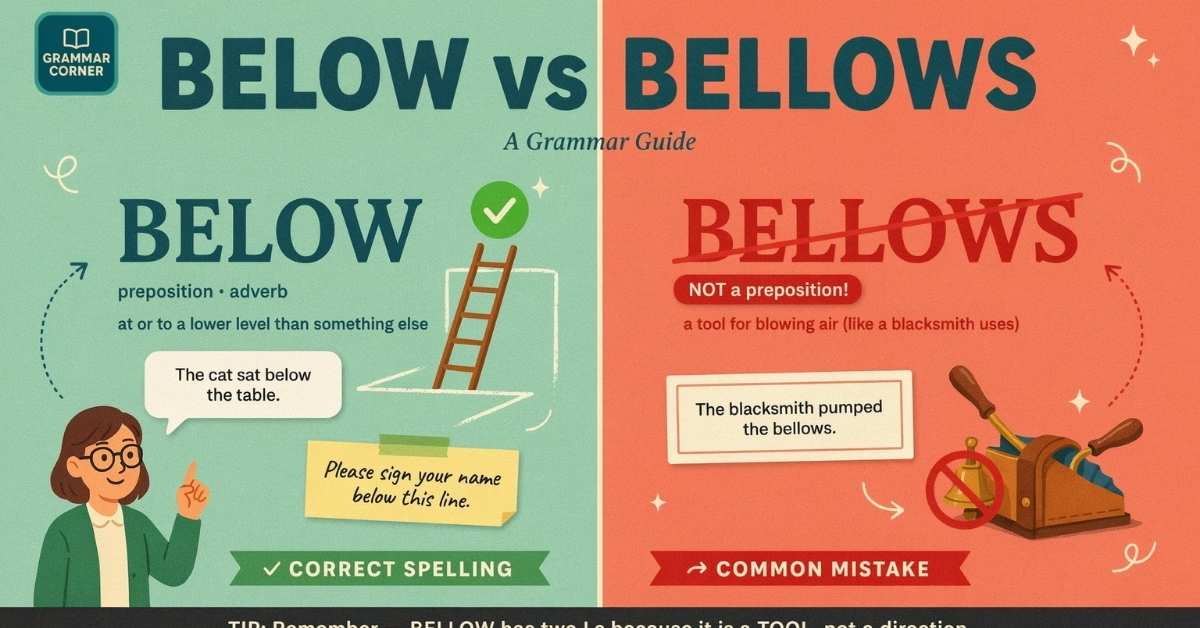
Below or bellow? The correct word depends on what you mean, but in most everyday situations, below is the right choice. Below refers to something lower in position or later in a document, while bellow means to roar, shout, or yell loudly. Although both are real English words, confusing them can completely change the meaning of your sentence. If you’ve ever wondered whether to write “see below” or “see bellow,” you’re not alone—it’s one of the most common spelling mistakes in English.
Whether you’re writing an email, business report, academic assignment, blog post, or social media caption, using the correct word shows attention to detail and improves your writing clarity. In this guide, you’ll learn the difference between below and bellow, how to use each word correctly, why people confuse them, and simple tricks to remember the right spelling every time.
Quick Answer: Below or Bellow?
If you’re looking for a fast answer, here it is:
- ✅ Below means lower than, under, or further down in a document or physical space.
- ✅ Bellow means to shout, roar, or make a deep, loud sound.
- ✅ The correct phrase is “see below.”
- ❌ “See bellow” is incorrect unless you’re talking about someone or something roaring loudly.
Examples
- ✅ Please read the instructions below.
- ✅ The details are listed below.
- ✅ The angry coach bellowed across the field.
- ✅ The bull bellowed loudly at sunrise.
If you’re writing an email, report, or assignment, you’ll almost always use below, not bellow.
Below vs. Bellow: At a Glance
| Feature | Below | Bellow |
| Meaning | Lower than or further down | To roar or shout loudly |
| Part of Speech | Preposition, Adverb | Verb, sometimes Noun |
| Pronunciation | bih-LOH | BEL-oh |
| Used in Emails | ✅ Yes | ❌ No |
| Used in Reports | ✅ Yes | ❌ No |
| Used in Stories | Sometimes | ✅ Frequently |
| Common Phrase | See below | The lion bellowed |
| Common Mistake | Confused with bellow | Confused with below |
| Memory Trick | Think “down below” | Think “loud bellow” |
This simple comparison makes it easier to remember the difference between below and bellow without memorizing complicated grammar rules.
Why Do So Many People Confuse “Below” and “Bellow”?
The confusion between below and bellow isn’t surprising. Even experienced writers occasionally type the wrong word because the two words look similar and sound somewhat alike when spoken quickly.
Several factors contribute to this common word choice mistake.
1. Only One Letter Makes the Difference
The two words differ by just one extra “l.”
- Below
- Bellow
When typing quickly, it’s easy to accidentally add an extra letter without noticing.
2. Both Words Are Correctly Spelled English Words
One reason this mistake slips through is that both words exist in the dictionary.
Unlike obvious typos, writing:
See bellow
doesn’t always trigger a spelling warning because bellow is a legitimate English word. The problem is that it has an entirely different meaning.
This is why proofreading and context matter more than relying only on spellcheck or autocorrect.
3. Pronunciation Can Sound Similar
Although the pronunciation isn’t identical, many speakers pronounce the words quickly, making them sound alike in casual conversation.
This is especially common among:
- English learners
- Fast typists
- People using voice-to-text software
Later in this guide, you’ll learn an easy pronunciation trick that helps distinguish the two words instantly.
4. “See Below” Is Extremely Common
One of the most frequently used phrases in professional communication is:
- See below
- Listed below
- Mentioned below
- Attached below
- Shown below
- Read below
Because these phrases appear so often, people sometimes type “bellow” by habit without realizing the mistake.
5. Spellcheck Doesn’t Always Save You
Many writers assume grammar software catches every error.
Unfortunately, this isn’t always true.
If your sentence says:
Please see the information bellow.
Some basic spelling tools won’t flag it because bellow is correctly spelled—even though it’s the wrong word for the context.
This explains why this mistake appears in:
- Office emails
- University assignments
- Blog posts
- Online articles
- Business reports
Professional editors frequently correct this exact error during the proofreading process.
What Does “Below” Mean?
The word below refers to something at a lower position, level, amount, or place. It can also point readers to information that appears later in a document, webpage, email, or report.
Among the two words, below is by far the more commonly used term in everyday English.
You’ll encounter it in:
- Business communication
- Academic writing
- Websites
- Instruction manuals
- News articles
- Contracts
- Technical documentation
- Books
- Blogs
In almost every professional writing situation, below is the correct choice.
Grammar Role of “Below”
One reason below appears so frequently is that it performs more than one grammatical function.
Below as a Preposition
When used as a preposition, below shows that something is at a lower position than something else.
Examples
- The village lies below the mountain.
- Temperatures dropped below freezing.
- The apartment is below ours.
Below as an Adverb
As an adverb, below tells where something is located without directly referring to another noun.
Examples
- The answers appear below.
- Please scroll below.
- More information is available below.
This is the usage you’ll most often see online.
When Should You Use “Below”?
Use below whenever you’re referring to position, location, or information placed further down.
In Emails
- Please see the schedule below.
- The meeting agenda is provided below.
- The requested documents are listed below.
In Reports
- The financial summary appears below.
- The chart below shows quarterly growth.
- The figures below explain the trend.
And In Academic Writing
- Refer to the diagram below.
- The evidence discussed below supports this argument.
- Complete the exercises below.
On Websites
- Browse the products below.
- Read customer reviews below.
- Complete the form below.
In Everyday Conversation
- The restaurant is just below the hotel.
- Her score was below average.
- Water levels fell below normal.
These examples demonstrate that below is incredibly versatile and naturally fits both formal and informal communication.
Common Phrases That Always Use “Below”
Many people search for “see below or see bellow” because they’re unsure which version is correct.
Here are some of the most common phrases that should always use below:
- See below
- Listed below
- Shown below
- Mentioned below
- Attached below
- Provided below
- Included below
- Read below
- Displayed below
- Explained below
- Outlined below
- Examples below
- Details below
- Table below
- Chart below
Correct Examples
- Please see the pricing table below.
- The answers are provided below.
- The instructions are explained below.
- Additional information appears below.
- Read the section below before continuing.
Using bellow in any of these phrases would be incorrect because none of them involve shouting or roaring.
What Does “Bellow” Mean?
Unlike below, which refers to position or location, bellow is an action word. It means to shout, roar, or make a deep, loud sound, usually with great force or emotion. The word is commonly used to describe people, animals, or even powerful natural sounds.
Although bellow is a perfectly valid English word, it appears far less frequently in everyday writing than below. This is why many people mistakenly type “bellow” when they actually mean “below.”
If you’re writing an email, business document, assignment, or professional report, you’ll almost never need the word bellow.
Grammar Role of “Bellow”
The word bellow can function as both a verb and, less commonly, a noun.
As a Verb
As a verb, bellow means to roar, shout, or cry out loudly.
Examples
- The angry coach bellowed instructions across the field.
- The captain bellowed orders during the storm.
- The lion bellowed to warn other animals.
- The elephant bellowed in distress.
- The crowd bellowed with excitement.
In each example, bellowed describes a loud, forceful sound.
As a Noun
As a noun, bellow refers to a loud roar or shout.
Examples
- We heard a deep bellow from the forest.
- The bull let out a powerful bellow.
Although grammatically correct, this noun form is less common than the verb.
When Should You Use “Bellow”?
Use It only when you’re describing a loud voice, roaring animal, or powerful shout.
Animals
- The bull bellowed loudly.
- The stag bellowed across the valley.
- The elephant bellowed in pain.
People
- The teacher bellowed across the classroom.
- The manager bellowed at the workers.
- The soldier bellowed commands.
Stories and Literature
Authors often use It to create dramatic scenes.
Example:
The giant bellowed with rage before charging toward the castle.
This type of descriptive writing makes stories more vivid and emotional.
Pronunciation Guide
Pronunciation is another reason why people confuse these words. While they look similar, the stress falls on different syllables.
| Word | Pronunciation | Stress |
| Below | bih-LOH | Second syllable |
| Bellow | BEL-oh | First syllable |
Easy Trick
- Below → Stress the end of the word.
- Bellow → Stress the beginning of the word.
Saying the words aloud can help you remember which one fits your sentence.
Learn More: In Process or In Progress
Below vs. Bellow: Side-by-Side Usage Examples
The easiest way to understand the difference between below and bellow is to compare them in real sentences.
| ✅ Correct Sentence | ❌ Incorrect Sentence | Why? |
| Please see below. | Please see bellow. | Refers to information lower in the document. |
| The chart below explains the results. | The chart bellow explains the results. | “Below” indicates location. |
| The lion bellowed loudly. | The lion below loudly. | A lion can roar, not “below.” |
| The coach bellowed instructions. | The coach below instructions. | “Bellowed” means shouted loudly. |
| The details are listed below. | The details are listed bellow. | Standard professional writing phrase. |
Notice how replacing one word with the other completely changes—or even destroys—the meaning of the sentence.
The Most Common Mistakes Writers Make
Many search queries such as “see below or see bellow”, “listed below or listed bellow”, and “below vs bellow” come from people making the same writing mistake.
Here are the errors editors correct most often.
❌ See bellow
✅ See below
❌ Mentioned bellow
✅ Mentioned below
❌ Attached bellow
✅ Attached below
❌ Read bellow
✅ Read below
❌ Table bellow
✅ Table below
❌ Diagram bellow
✅ Diagram below
❌ Information bellow
✅ Information below
❌ Examples bellow
✅ Examples below
These mistakes are especially common in emails, reports, academic writing, and business communication because writers often type quickly and don’t notice the extra “l.”
Why Spellcheck Doesn’t Catch “See Bellow”
One of the biggest frustrations for writers is that spellcheck sometimes accepts “see bellow.”
Why?
Because This is a correctly spelled English word.
Spellcheck checks whether a word exists—not whether it’s the right word for your sentence.
For example:
Please see the details bellow.
There are no spelling errors.
However, there is a context error because the sentence isn’t talking about shouting.
Modern grammar checkers and context-aware proofreading tools are more likely to detect this mistake than traditional spellcheck software.
This is why professional editors always recommend reading your writing one final time before sending it.
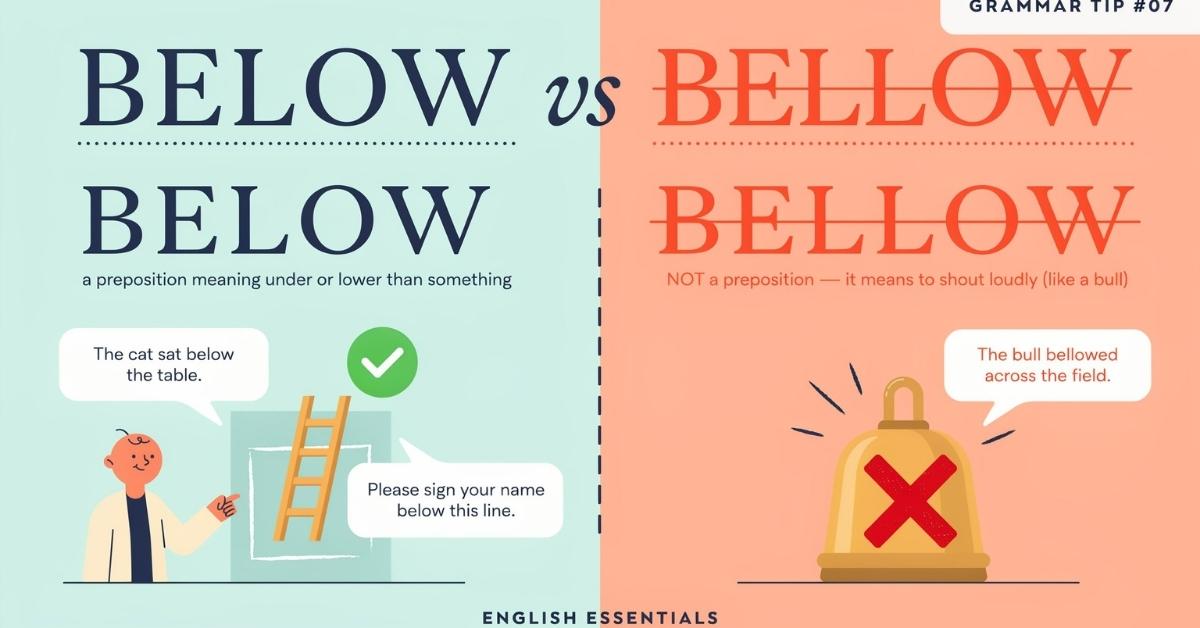
How Professional Editors Catch This Mistake
Experienced editors don’t just look for spelling mistakes—they check whether every word makes sense in context.
A quick proofreading technique is to ask yourself:
Am I talking about position?
If yes, use below.
Am I talking about a loud shout or roar?
If yes, use bellow.
This simple habit can eliminate one of the most common commonly confused words errors.
Memory Tricks You’ll Never Forget
Simple memory techniques are often more effective than memorizing dictionary definitions.
Memory Trick #1: Think “Down Below”
The phrase down below is familiar to most English speakers.
If you’re referring to something underneath or further down a page, the answer is almost always below.
Memory Trick #2: The Extra “L” Means Loud
Notice that bellow has an extra L.
Think:
L = Loud
If someone is shouting loudly, choose bellow.
Memory Trick #3: Imagine a Roaring Bull
Picture a bull standing in a field.
What does it do?
It bellows.
It certainly doesn’t below.
Creating a strong mental image helps your brain remember the correct word.
Memory Trick #4: Ask Yourself One Question
Before choosing the word, ask:
Am I describing a place or a sound?
- Place → Below
- Sound → Bellow
This two-second decision works almost every time.
Real-Life Examples in Different Situations
Understanding how to use below and how to use bellow becomes much easier when you see them in everyday contexts.
Business Email
✅ Please review the agenda below before tomorrow’s meeting.
❌ Please review the agenda bellow before tomorrow’s meeting.
Workplace Chat
✅ I’ve shared the updated schedule below.
❌ I’ve shared the updated schedule bellow.
Academic Assignment
✅ Refer to the figure below for additional evidence.
❌ Refer to the figure bellow for additional evidence.
Website Content
✅ Browse the products below.
✅ Read the customer reviews below.
Instruction Manual
✅ Follow the steps below carefully.
News Article
✅ More information is available below.
Novel or Story
✅ The dragon bellowed before breathing fire.
Sports Commentary
✅ The coach bellowed instructions from the sidelines.
Wildlife Documentary
✅ The elephant bellowed to alert the herd.
Movie Scene
✅ The king bellowed with anger after hearing the news.
These examples clearly show that below belongs in informational writing, while It belongs in situations involving loud sounds or dramatic speech.
Is “Bellow” Ever Correct?
Yes—It is absolutely a real English word.
However, it’s only correct when referring to roaring, shouting, or making a deep, loud sound.
If you’re writing phrases like:
- See below
- Listed below
- Read below
- Mentioned below
- Shown below
See More: Gasses or Gases
Similar Word Pairs People Often Confuse
If you’ve searched for “below or bellow,” chances are you’ve also encountered other commonly confused words. English contains many word pairs that look or sound alike but have completely different meanings.
Learning these differences improves your writing clarity, proofreading skills, and word choice.
| Word Pair | Correct Usage |
| Below vs. Bellow | Position vs. loud roar |
| Then vs. Than | Time vs. comparison |
| Affect vs. Effect | Usually verb vs. noun |
| Their, There, They’re | Possession, place, contraction |
| Everyday vs. Every Day | Adjective vs. phrase |
| Toward vs. Towards | Regional spelling variation |
| Accept vs. Except | Receive vs. exclude |
| Loose vs. Lose | Not tight vs. misplace |
| Principal vs. Principle | Person/primary vs. rule |
| Compliment vs. Complement | Praise vs. complete |
Understanding these differences helps you become a more confident writer and reduces common spelling mistakes in English.
Quick Decision Guide: Should You Use “Below” or “Bellow”?
Whenever you’re unsure, use this simple framework.
Step 1: Are you talking about position or location?
Examples:
- Under something
- Further down a page
- Lower than another object
- Information later in a document
✅ Use Below
Step 2: Are you talking about a loud sound?
Examples:
- Someone shouting
- An animal roaring
- A dramatic cry
- A booming voice
✅ Use Bellow
Quick Cheat Sheet
| If You’re Referring To… | Use |
| Below | |
| Report | Below |
| Assignment | Below |
| Website | Below |
| Table | Below |
| Chart | Below |
| Animal roar | Bellow |
| Loud shouting | Bellow |
| Angry voice | Bellow |
If you’re writing a professional document, there’s an excellent chance the correct word is below.
Expert Editing Tips to Avoid This Mistake
Professional editors don’t rely solely on spellcheck. They use simple habits that catch context errors before a document is published.
Here are a few techniques you can adopt.
Read the Sentence for Meaning
Instead of asking, “Is the word spelled correctly?” ask:
Does this word make sense in this sentence?
This approach catches errors that spellcheck may miss because both below and bellow are legitimate English words.
Slow Down Before Sending Emails
Many mistakes happen because people type quickly.
Before clicking Send, scan for phrases such as:
- See below
- Listed below
- Mentioned below
- Attached below
- Read below
If you see in these contexts, correct it immediately.
Use Context-Aware Grammar Tools
Basic spellcheck only checks spelling.
Modern grammar tools analyze context, making them more likely to detect commonly confused words.
Even so, no software is perfect. A quick human review is still one of the best proofreading techniques.
Create a Personal Proofreading Checklist
Before submitting any important document, check:
- Is every word appropriate for the context?
- Are commonly confused words used correctly?
- Have I read the document aloud?
- Did I double-check headings, captions, and tables?
- Are phrases like “see below” written correctly?
This small habit can dramatically improve the quality of your writing.
Frequently Asked Questions
Is it “below” or “bellow”?
If you’re referring to something lower in position or later in a document, below is correct. Bellow is only correct when describing a loud roar or shout.
Is “see bellow” wrong?
Yes. The correct phrase is “see below.” The word bellow means to roar or shout loudly, so it doesn’t fit this context.
Is “bellow” a real English word?
Yes. Bellow is a legitimate English word that means to roar, shout, or make a deep, loud sound.
Can “bellow” mean underneath?
No. It never means under, lower, or beneath. For those meanings, always use below.
Why doesn’t spellcheck catch this mistake?
Because both below and bellow are valid dictionary words. Traditional spellcheck checks spelling, not meaning or context.
Which word is more common?
Below is far more common in everyday English. It appears frequently in emails, business writing, websites, reports, and academic documents, while bellow is mostly found in stories, news reports, and descriptions of loud voices or animal sounds.
How do you pronounce “below” and “bellow”?
- Below: bih-LOH (stress on the second syllable)
- Bellow: BEL-oh (stress on the first syllable)
Paying attention to the stress pattern can help you remember which word you need.
Can “below” be a verb?
No. Below functions primarily as a preposition and adverb. It is not used as a verb in standard English.
Which word should I use in an email?
Almost always below.
Examples:
- Please see the information below.
- The meeting details are provided below.
- The instructions are listed below.
Conclusion
Choosing between below or bellow is much easier once you understand what each word actually means. Although they differ by only one letter, they serve completely different purposes in the English language.
If you’re referring to something underneath, lower in position, or information appearing later in a document, the correct word is always below. Whether you’re writing an email, business report, assignment, website, or professional document, phrases like “see below,” “listed below,” and “details below” are the standard and correct forms.
On the other hand, bellow should only be used when describing a loud roar, shout, or powerful cry, such as a bull bellowing, a lion roaring, or a coach bellowing instructions.
The easiest way to remember the difference is to think about the meaning first:
- Position or location? → Below
- Loud sound or roar? → Bellow
With that simple habit, you’ll avoid one of the most common commonly confused words in English and write with greater confidence, accuracy, and professionalism every time.