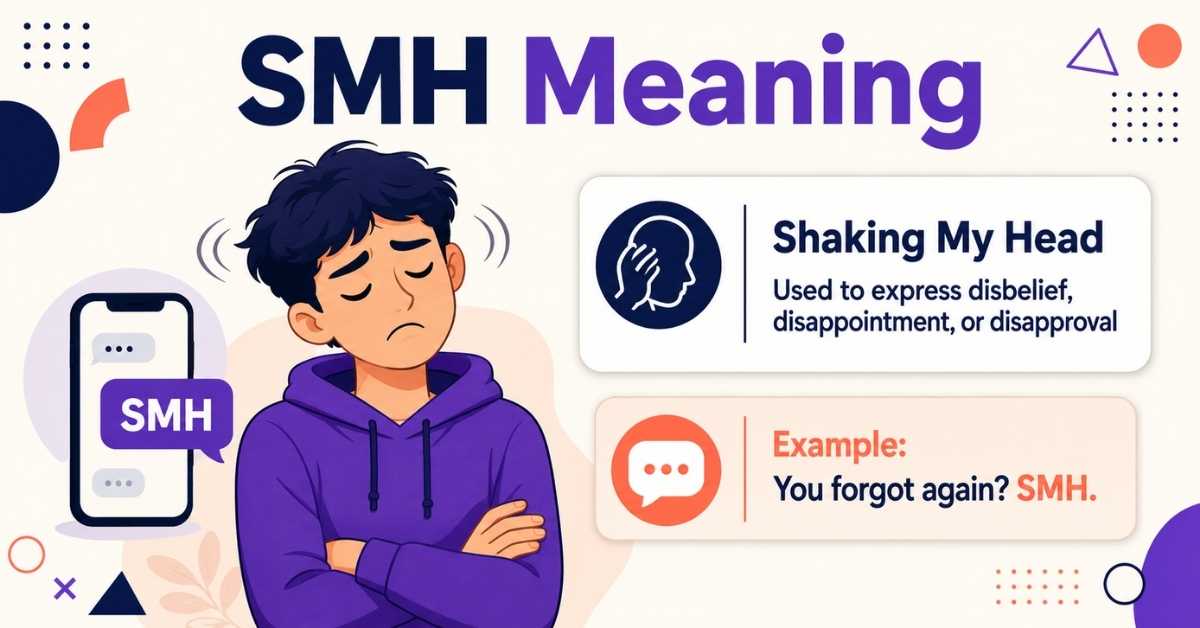
SMH meaning is “shaking my head.” People use this internet slang initialism in texts, chats and social-media comments to express disbelief, disappointment, disapproval, frustration or playful judgment. If someone replies “SMH,” they may be saying, “I can’t believe you did that,” but the seriousness depends on your relationship, the conversation and any accompanying emojis.
That context matters. “You ate the whole cake? smh 😂” sounds like friendly teasing. “You lied to me. SMH.” communicates something much more serious. The letters remain the same, but the emotional message changes.
SMH Meaning at a Glance
| Message | Likely tone | Plain-English translation |
|---|---|---|
| “You forgot again, smh.” | Mild annoyance | That was careless |
| “You ate the whole pizza? smh 😂” | Playful disbelief | You are unbelievable, but this is funny |
| “You broke your promise. SMH.” | Serious disappointment | I expected better |
| “Locked myself out again, smh.” | Self-criticism | I cannot believe I did that |
| “The train is cancelled again. SMH.” | Situational frustration | This is ridiculous |
SMH is generally a negative reaction, but it is not always angry, rude or hostile. Close friends may use it affectionately when teasing each other.
What Does “Shaking My Head” Actually Communicate?
A physical headshake can express disagreement, disbelief or disappointment without spoken words. SMH brings that body language into digital communication.
Instead of typing a complete sentence, the sender can use three letters to suggest:
- “That makes no sense.”
- “You should have known better.”
- “I cannot believe this happened.”
- “That was a poor decision.”
- “This is frustrating.”
- “You are ridiculous, but I’m joking.”
Linguistically, SMH works as a digital stance marker. It shows the writer’s attitude toward a person, decision or situation. It can also be described as emotional shorthand, internet slang or a paralinguistic cue because it replaces body language that is missing from written conversation.
Use the HEAD Method to Decode SMH
When you cannot tell whether SMH is playful or serious, use the HEAD framework.
H — Review the History
Look at what happened earlier in the conversation. Forgetting someone’s fries is different from breaking an important promise.
E — Check the Emoji and Punctuation
A laughing emoji can soften the criticism. A period, capital letters or an eye-roll emoji may make it feel firmer.
A — Consider the Audience Relationship
Friends often use SMH jokingly. A partner, parent, coworker or supervisor may use it with a different emotional weight.
D — Identify the Direction
Determine who or what the sender is criticizing:
- You
- Themselves
- Another person
- A company
- A shared situation
- A public event
“Submitted the wrong file, smh” is self-criticism. “You submitted the wrong file. SMH.” directs the judgment at someone else and may sound harsher.
The Different Emotional Meanings of SMH
Playful Disbelief
Between close friends, SMH can function like a smiling headshake.
“You ate my fries again? smh 😂”
The sender is judging the behavior, but the laughing emoji and harmless subject make the message playful.
Mild Annoyance
People use SMH when a small but frustrating problem happens repeatedly.
“The internet stopped working again, smh.”
The writer is annoyed with the situation rather than seriously angry.
Genuine Disappointment
SMH becomes more serious when it follows dishonesty, broken trust or irresponsible behavior.
“You promised you wouldn’t tell anyone. SMH.”
A humorous reply would be inappropriate here. The sender likely expects acknowledgment or an apology.
Sarcasm and Passive Aggression
SMH can criticize someone indirectly:
“Some people never take responsibility. SMH.”
This type of public or vague criticism can feel passive-aggressive, especially when the target knows the message is about them.
Self-Directed Frustration
People also use SMH to laugh at or criticize themselves.
“I sent the message to the wrong group chat, smh.”
This usually communicates embarrassment or self-deprecating humor rather than hostility.
Shared Frustration
SMH can create agreement between two people reacting to the same problem.
“They increased the subscription price again. SMH.”
In this case, the abbreviation signals shared disapproval.
How Emojis and Punctuation Change SMH Meaning
| Form | Likely impression |
|---|---|
| smh 😂 | Playful disbelief |
| smh 😭 | Amused frustration or exaggerated despair |
| smh 🤦 | Facepalm-style exasperation |
| smh 🙄 | Stronger annoyance or contempt |
| smh 😐 | Flat, serious disapproval |
| smh… | Weariness or resignation |
| SMH. | Firm or potentially dismissive judgment |
| SMH! | Heightened frustration |
| smh lol | Amused criticism |
| smh bro | Casual disbelief, depending on the relationship |
These are clues, not fixed rules. A laughing emoji can make a message friendlier, but it does not automatically erase criticism.
What Does SMH Meaning From a Guy, Girl or Crush?
The SMH meaning from a guy or girl remains “shaking my head.” Gender does not change the definition. These searches are usually driven by uncertainty about attraction, judgment or relationship tension.
SMH may be playful when:
- The sender adds 😂, 😭 or “lol.”
- The mistake is harmless.
- Friendly teasing is normal between you.
- The conversation continues warmly.
It may signal genuine frustration when:
- It follows an argument.
- You broke a promise.
- The message ends with a firm period.
- The sender becomes distant afterward.
- The subject involves trust or respect.
Is SMH Flirty?
SMH is not inherently flirty. A crush or partner may use it during flirtatious teasing, but the abbreviation alone is not evidence of romantic interest.
For example:
“You really think you can beat me? smh 😂”
The flirtatious quality comes from the relationship and conversation—not from SMH itself.
What Does SMH Meaning on Social Media?
The definition remains broadly consistent across platforms. What changes is where and why people use it.
| Platform or setting | Typical use |
|---|---|
| TikTok | Reacting to ridiculous, disappointing or funny videos |
| Snapchat | Casual story replies, frequently paired with emojis |
| Responding to posts, Reels, public drama or bad opinions | |
| Personal conversations with friends and family | |
| Discord | Gaming mistakes, group discussions and playful reactions |
| Expressing disagreement with stories, news or opinions | |
| Dating apps | Playful judgment or disappointment |
| Group chats | Reacting quickly to a mistake or unbelievable story |
The platform does not determine whether SMH is friendly or serious. Conversation history and relationships are more reliable clues.
How to Respond When Someone Says SMH
The best reply depends on the original situation.
If It Is Playful
- “I know 😂”
- “Don’t judge me.”
- “It seemed like a good idea at the time.”
- “You love me anyway.”
You Share Their Frustration
- “Exactly. It makes no sense.”
- “I know, right?”
- “Same. I can’t believe it.”
You Made a Small Mistake
- “Fair enough.”
- “That’s on me.”
- “Lesson learned.”
- “I’ll do better next time.”
the Tone Is Unclear
- “Are you joking or actually annoyed?”
- “Wait—what did I do?”
- “What do you mean by that?”
the Sender Is Genuinely Disappointed
- “You’re right. I handled that badly.”
- “I understand why you’re upset.”
- “I’m sorry. Let me explain what happened.”
It Feels Dismissive
- “If something is wrong, please say it directly.”
- “I would rather discuss it than guess.”
- “Can you explain what disappointed you?”
A short clarification is usually better than becoming defensive about a tone you may have misunderstood.
Is SMH Rude, Offensive or a Bad Word?
SMH is not a bad word and contains no profanity. It is normally harmless when used for friendly teasing, self-criticism, memes or shared frustration.
However, it can sound rude when:
- Someone repeatedly replies with only “SMH.”
- It is used publicly to embarrass another person.
- It appears during a serious argument.
- It dismisses someone instead of explaining the problem.
- A supervisor uses it to criticize an employee.
- It is combined with contemptuous language or 🙄.
SMH may be harmless as vocabulary but still disrespectful through tone and intention.
When and How to Use SMH
SMH fits naturally in:
- Casual text messages
- Social-media comments
- Group chats
- Gaming conversations
- Memes
- Informal captions
Avoid it in:
- Formal emails
- Academic writing
- Legal or medical communication
- Customer-support messages
- Sensitive conversations requiring clarity
- Professional feedback
A coworker writing “The report is late again. SMH.” may sound passive-aggressive. A clearer alternative would be: “The report is late again. Can you confirm when it will be ready?”
Placement and Capitalization
SMH can appear in several positions:
- Beginning: “SMH, why would anyone do that?”
- Ending: “He forgot again, smh.”
- Standalone: “SMH.”
Uppercase SMH and lowercase smh normally have the same definition. Capitals may look more forceful, but online users are inconsistent.
SMH is usually pronounced letter by letter: S-M-H. That makes it an initialism, although people commonly call it an acronym.
LEARN MORE: ASL Meaning
Where Did SMH Come From?
SMH appeared in online communication before modern social media. Current dictionary research documents an internet example from at least 1994, when early discussion groups used many abbreviations to communicate quickly.
The expression later spread through:
- Internet forums
- Chatrooms
- Instant messaging
- SMS texting
- Urban Dictionary
- Reaction GIFs
- Meme culture
- TikTok and other social platforms
The year 2004 is often mentioned because an early Urban Dictionary definition appeared then. That is not the same as the earliest documented use.
SMH belongs to the same broad digital-language tradition as LOL, BRB, OMG, TBH and FWIW.
SMH vs SMDH, SMFH and Facepalm
| Expression | Meaning | Typical intensity |
|---|---|---|
| SMH | Shaking my head | Mild to moderate |
| SMDH | Shaking my damn head | Stronger exasperation |
| SMFH | Profane intensified version | Strong frustration |
| Facepalm/🤦 | Embarrassment or disbelief | Moderate |
| Eye-roll/🙄 | Annoyance or contempt | Moderate to strong |
| Sigh | Weariness or resignation | Mild |
| I can’t even | Overwhelmed disbelief | Humorous or dramatic |
SMDH and SMFH add stronger language, making them less appropriate in formal or family-friendly communication.
Does SMH Have Other Meanings?
Shaking my head is the accepted default meaning in texting and social media. Less common interpretations include:
- Scratching my head
- So much hate
- Smacking my head
These meanings should only be considered when the conversation clearly supports them.
SMH can also identify organizations, publications or financial entities:
- The Sydney Morning Herald in Australian media
- VanEck Semiconductor ETF in financial markets
- Sobhraj Maternity Hospital in Karachi
- Stand Up for Mental Health in nonprofit discussions
Contextual words make the difference. Stock, ETF, and semiconductor indicate finance. Hospital, maternity, and Karachi indicate healthcare.
In bilingual Pakistani conversations, SMH normally keeps its English slang meaning:
“Phir keys bhool gaye? SMH.”
Common SMH Mistakes
- Believing it usually means “so much hate”
- Reading it as “somehow”
- Writing SHM instead of SMH
- Assuming it always communicates anger
- Thinking its definition changes according to gender
- Ignoring emojis and punctuation
- Using it in professional feedback
- Responding defensively without checking context
- Giving rare meanings equal importance
Why Do People Say “SMH My Head”?
“SMH my head” expands to “shaking my head my head,” making it technically redundant. It resembles phrases such as “ATM machine” and “PIN number.”
Some users write it accidentally. Others use it intentionally as an ironic joke.
Frequently Asked Questions
What does SMH mean in text?
SMH stands for “shaking my head.” It usually communicates disbelief, disappointment, frustration or disapproval.
Is SMH always negative?
SMH usually contains some judgment, but it can be playful between friends.
What does SMH with 😂 mean?
It normally expresses amused or playful disbelief rather than serious anger.
Does SMH mean “so much hate”?
“So much hate” is a rare reinterpretation. In ordinary texting, SMH almost always means “shaking my head.”
Is it SMH or SHM?
The correct initialism for “shaking my head” is SMH.
Is SMH appropriate at work?
Generally, no. It can sound dismissive or passive-aggressive. Use clear, professional language instead.
What is the difference between SMH and SMDH?
SMDH means “shaking my damn head” and communicates stronger frustration.
Is SMH still used in 2026?
Yes. It continues to appear in text messages, memes, comments and online conversations.
The SMH Rule Worth Remembering
SMH means “shaking my head,” but context reveals the emotion. Check the conversation history, emojis, relationship and target of the criticism before deciding how serious it sounds.
If you still cannot tell whether the sender is teasing or genuinely disappointed, ask. A clear question is better than an argument caused by misreading three letters.