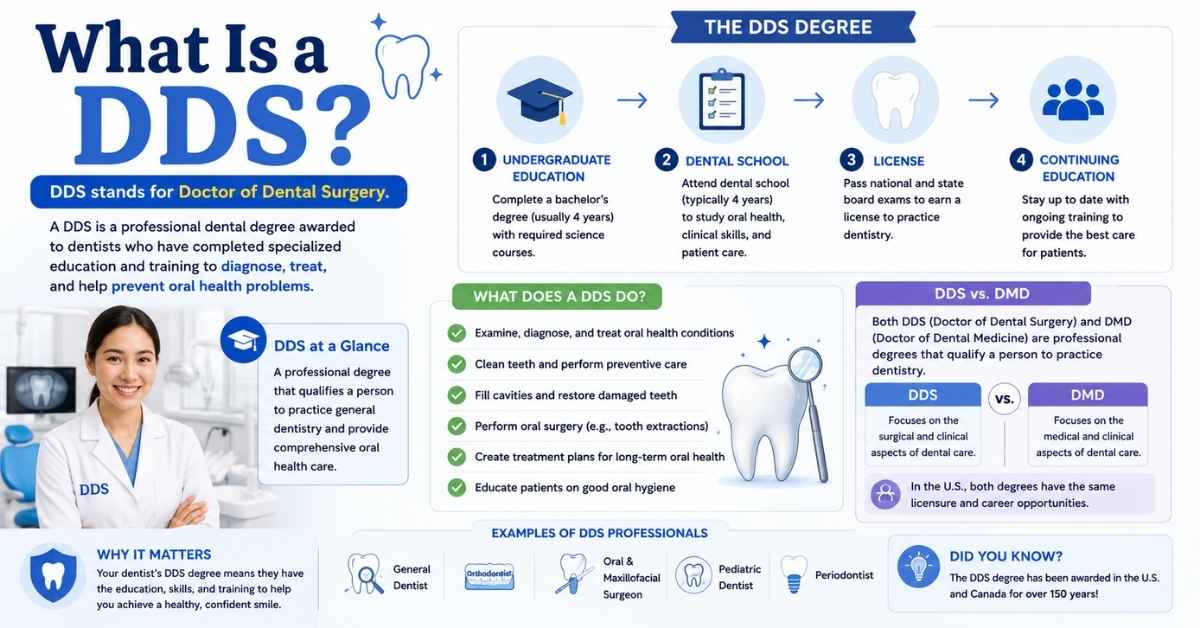
What is a DDS? A DDS (Doctor of Dental Surgery) is a professional dental degree awarded to licensed dentists who have completed an accredited dental education program and met all licensing requirements to practice dentistry. A DDS and a DMD (Doctor of Dental Medicine) are equivalent degrees, meaning both require the same education, clinical training, examinations, and qualifications. The difference is only in the degree title awarded by the dental school—not in the quality of education or the dentist’s ability to provide patient care.
If you’ve ever noticed the letters “DDS” after a dentist’s name, you may have wondered what they mean and whether they indicate a specialist or a higher level of expertise. It’s a common question, especially when comparing dental professionals or choosing a new dentist.
In this guide, you’ll learn what a DDS is, what the credential means, how someone becomes a DDS dentist, how it compares to a DMD, what treatments a DDS can perform, and why these initials matter far less than a dentist’s experience, licensing, and commitment to patient care.
Quick Answer:
DDS stands for Doctor of Dental Surgery. It is one of the two professional doctorate degrees awarded to dentists in the United States. After graduating from an accredited dental school, passing national and state licensing examinations, and meeting all legal requirements, a dentist may use the title DDS after their name.
Quick Facts
| Question | Answer |
|---|---|
| Full Form | Doctor of Dental Surgery |
| Degree Type | Professional Doctorate |
| Who Earns It? | Licensed dentists |
| Can a DDS Treat Patients? | Yes |
| Can a DDS Perform Dental Procedures? | Yes |
| Is DDS the Same as DMD? | Yes, both are academically equivalent |
Key Takeaway: A DDS is a fully qualified dentist who has completed professional education, extensive clinical training, and licensing requirements to diagnose, prevent, and treat diseases affecting the teeth, gums, and mouth.
Why Do Dentists Have “DDS” After Their Name?
When you visit a dental clinic, you’ll often see a dentist’s name followed by letters such as DDS or DMD. These letters represent the dentist’s professional degree and indicate that they have successfully completed the education and licensing required to practice dentistry.
Think of it as a professional credential similar to how physicians use MD or pharmacists use PharmD. The initials help patients recognize that the individual has earned a recognized doctoral-level qualification in their profession.
For example:
- Sarah Johnson, DDS
- Michael Lee, DDS
- Emily Carter, DMD
All of these professionals are licensed dentists. The letters simply identify which degree their dental school awarded.
What the DDS Title Represents
A Doctor of Dental Surgery (DDS) degree represents much more than graduating from dental school. It reflects years of rigorous academic study, supervised clinical experience, and professional assessment.
A licensed DDS dentist is trained to:
- Diagnose oral diseases
- Prevent dental problems
- Restore damaged teeth
- Improve oral health
- Educate patients on preventive care
- Develop personalized treatment plans
- Perform many routine and advanced dental procedures
Because dentistry combines science, medicine, engineering, and patient care, earning a DDS degree requires significant dedication and practical experience.
Why Does the Degree Include the Word “Surgery”?
One of the biggest misconceptions is that every DDS is an oral surgeon simply because the degree contains the word “Surgery.”
In reality, the name has historical origins.
When the degree was first introduced, dentistry involved many surgical procedures related to the mouth and jaw. Over time, the profession expanded far beyond surgery to include preventive care, cosmetic dentistry, restorative treatments, oral disease management, and long-term patient care. However, the original degree title remained.
Today, a general DDS performs a wide variety of dental procedures—not just surgery.
Myth vs. Fact
| Myth | Fact |
|---|---|
| Every DDS is an oral surgeon. | False. Most DDS professionals are general dentists. |
| DDS means the dentist performs major surgery every day. | False. Many focus primarily on preventive and restorative care. |
| A DDS cannot perform procedures. | False. General dentists routinely perform many treatments, including fillings, crowns, root canals, and extractions, depending on their training and the regulations in their jurisdiction. |
Is a DDS a Real Doctor?
Yes. A DDS is a real doctor, but not a medical doctor (MD).
The title “Doctor” refers to someone who has earned a doctoral-level professional degree in a specific field. Dentists earn a professional doctorate in dentistry, just as physicians earn a doctorate in medicine.
A DDS specializes in diagnosing, preventing, and treating conditions affecting:
- Teeth
- Gums
- Jaw
- Mouth
- Oral tissues
Although their area of expertise differs from that of a physician, both professions require years of higher education, supervised clinical training, licensing examinations, and ongoing professional development.
Professional Doctorate vs. Medical Doctor
Many patients confuse the titles because both use the word doctor.
Here’s an easy comparison:
| Professional | Degree | Area of Expertise |
|---|---|---|
| Dentist | DDS or DMD | Oral health and dentistry |
| Physician | MD or DO | General medicine |
| Pharmacist | PharmD | Medication management |
| Veterinarian | DVM | Animal healthcare |
Each professional serves a different role while holding a recognized doctoral qualification.
Can a It Diagnose and Treat Patients?
Absolutely.
A licensed DDS dentist is qualified to:
- Examine patients
- Diagnose oral diseases
- Detect tooth decay
- Treat gum disease
- Repair damaged teeth
- Recommend preventive care
- Interpret dental X-rays
- Prescribe certain medications where permitted
- Develop long-term oral health plans
Many people are surprised by how much training dentists receive before practicing independently. Clinical education forms a significant part of every accredited dental program, allowing students to treat patients under close supervision before becoming licensed.
How Does Someone Become ?
Becoming a Doctor of Dental Surgery takes years of education, practical experience, and professional assessment. The journey is demanding because dentists are responsible for diagnosing and treating conditions that directly affect a person’s health, comfort, and quality of life.
Although exact requirements vary by country, the pathway in the United States generally follows these steps.
Step 1: Complete Undergraduate Education
Most future dentists first earn a bachelor’s degree while completing prerequisite courses in subjects such as:
- Biology
- Chemistry
- Physics
- Anatomy
- Physiology
- Biochemistry
Strong academic performance is important because dental schools have competitive admission standards.
Step 2: Gain Admission to Dental School
Applicants typically complete admission requirements set by individual dental schools, which may include entrance examinations, interviews, recommendation letters, and evidence of academic achievement.
Admission is highly competitive because dental education combines advanced scientific knowledge with extensive clinical training.
Step 3: Complete an Accredited Dental Program
Students spend several years studying topics such as:
- Oral anatomy
- Dental materials
- Oral pathology
- Radiology
- Pharmacology
- Prosthodontics
- Endodontics
- Periodontics
- Pediatric dentistry
- Preventive dentistry
- Cosmetic dentistry
- Restorative dentistry
Alongside classroom learning, students gain hands-on experience by treating patients in supervised clinical settings.
This practical training helps future dentists build confidence while learning proper diagnosis, treatment planning, communication, and infection-control procedures.
Step 4: Pass Licensing Requirements
Graduating from dental school alone does not automatically allow someone to practice dentistry.
A future DDS must also satisfy licensing requirements established by the relevant dental regulatory authorities. These requirements generally include written examinations, clinical assessments, and other professional standards designed to ensure safe patient care.
Once licensed, dentists may legally diagnose and treat patients within the scope permitted by their jurisdiction.
Step 5: Continue Learning Throughout Their Career
Dentistry constantly evolves with new technologies, materials, and treatment techniques.
Many dentists regularly participate in:
- Continuing education courses
- Professional workshops
- Clinical training programs
- Scientific conferences
- Advanced certifications
This commitment helps them stay informed about current best practices and provide high-quality patient care.
How Long Does It Take to Become ?
While timelines vary depending on educational pathways and local licensing requirements, becoming a DDS dentist generally requires several years of university education followed by professional dental training and successful completion of licensing requirements.
It’s a career that demands continuous learning, technical skill, precision, and strong communication with patients.
DDS vs. DMD: Is There Any Difference?
One of the most common questions people ask after learning what a DDS is is:
“Is DDS better than DMD?”
The short answer is no.
A DDS (Doctor of Dental Surgery) and a DMD (Doctor of Dental Medicine) are academically and professionally equivalent. Both degrees prepare dentists to provide the same standard of care, complete the same level of education and clinical training, and meet the same licensing requirements.
For patients, there is no difference in the quality of care based solely on whether a dentist has DDS or DMD after their name.
DDS vs. DMD Comparison
| Feature | DDS | DMD |
|---|---|---|
| Professional Degree | Doctor of Dental Surgery | Doctor of Dental Medicine |
| Education | Equivalent | Equivalent |
| Clinical Training | Equivalent | Equivalent |
| Licensing Requirements | Equivalent | Equivalent |
| Scope of Practice | Equivalent | Equivalent |
| Patient Care | Equivalent | Equivalent |
| Career Opportunities | Equivalent | Equivalent |
In practice, the initials simply reflect the naming preference of the dental school that awarded the degree.
Why Do Some Universities Award DDS While Others Award DMD?
The difference is rooted in academic tradition, not educational quality.
Some universities have historically awarded the Doctor of Dental Surgery (DDS) degree, while others chose the Latin-based title Doctor of Dental Medicine (DMD). Over time, both became accepted professional qualifications.
Regardless of which title appears after a dentist’s name, graduates complete comparable coursework, extensive clinical training, and the licensing process required to practice dentistry.
Bottom Line: When choosing a dentist, focus less on whether they have a DDS or DMD and more on their experience, communication, patient reviews, continuing education, and ability to provide the care you need.
What Can He Do?
After understanding what a DDS is, the next question most people ask is, “What can a DDS actually do?”
A DDS (Doctor of Dental Surgery) is qualified to diagnose, prevent, and treat a wide range of oral health conditions. While the exact scope of practice depends on local regulations, additional training, and the dentist’s experience, most general DDS dentists provide comprehensive dental care for patients of all ages.
From routine cleanings to restoring damaged teeth, a DDS plays an important role in maintaining your overall oral health.
Common Dental Services It Provides
A licensed DDS dentist is trained to perform many preventive, restorative, and cosmetic dental procedures.
Routine Dental Exams
Regular dental checkups help identify problems before they become serious.
During an exam, a DDS may:
- Examine your teeth and gums
- Check for cavities
- Screen for oral diseases
- Evaluate your bite
- Assess your overall oral health
- Recommend preventive treatments
Routine examinations are one of the most effective ways to maintain healthy teeth and avoid costly dental procedures in the future.
Professional Teeth Cleaning
Although dental hygienists often perform professional cleanings, the DDS supervises treatment, evaluates your oral health, and develops your long-term care plan.
Professional cleanings help:
- Remove plaque
- Remove tartar
- Prevent gum disease
- Reduce bad breath
- Improve oral hygiene
Dental Fillings
When tooth decay causes cavities, a DDS removes the damaged portion of the tooth and restores it with a filling.
Modern filling materials may include:
- Composite resin
- Ceramic
- Glass ionomer
- Amalgam (where appropriate)
The goal is to restore both function and appearance while preserving as much natural tooth structure as possible.
Dental Crowns
If a tooth is cracked, severely decayed, or weakened after treatment, a dental crown may be recommended.
Crowns help:
- Strengthen damaged teeth
- Restore chewing ability
- Protect weakened teeth
- Improve appearance
Root Canal Treatment
Many people are surprised to learn that some DDS dentists perform root canal therapy, depending on their training and the complexity of the case.
Root canal treatment removes infected tissue inside the tooth while preserving the natural tooth whenever possible.
Tooth Extractions
General dentists commonly perform uncomplicated tooth extractions.
Reasons for extraction include:
- Severe decay
- Infection
- Broken teeth
- Overcrowding
- Advanced gum disease
More complex surgical cases may require referral to an oral and maxillofacial surgeon.
Cosmetic Dentistry
Many DDS dentists also provide cosmetic treatments designed to improve the appearance of your smile.
These may include:
- Teeth whitening
- Veneers
- Tooth bonding
- Smile makeovers
- Cosmetic contouring
Dental Implants
Some DDS professionals place dental implants, particularly if they have received additional implant training.
Others work closely with specialists who perform the surgical portion before completing the final restoration.
When Will a DDS Refer You to a Specialist?
Although general dentists provide a wide range of services, some cases require advanced expertise.
Referral helps ensure patients receive the most appropriate treatment for complex conditions.
Examples include:
| Condition | Specialist |
|---|---|
| Braces and bite correction | Orthodontist |
| Advanced gum disease | Periodontist |
| Complex root canal cases | Endodontist |
| Missing teeth requiring advanced restoration | Prosthodontist |
| Children’s specialized dental care | Pediatric Dentist |
| Complex jaw surgery | Oral and Maxillofacial Surgeon |
A referral does not mean your dentist lacks knowledge. Instead, it reflects a commitment to providing specialized care when needed.
Types of Dentists You May Encounter
Not every dental professional performs the same procedures.
Understanding each specialty helps patients know where to seek treatment.
General Dentist
A general dentist provides routine oral healthcare, including:
- Preventive care
- Fillings
- Crowns
- Routine extractions
- Dental examinations
- Oral health education
Most people visit a general dentist for their regular dental needs.
Orthodontist
An orthodontist specializes in correcting:
- Crooked teeth
- Bite problems
- Jaw alignment
- Braces
- Clear aligners
Periodontist
A periodontist focuses on:
- Gum disease
- Bone loss
- Dental implant support
- Periodontal surgery
Endodontist
An endodontist specializes in treating problems inside the tooth.
They commonly perform:
- Complex root canal procedures
- Endodontic retreatment
- Treatment of dental trauma
Prosthodontist
A prosthodontist restores missing or damaged teeth using:
- Crowns
- Bridges
- Dentures
- Dental implants
- Full-mouth rehabilitation
Pediatric Dentist
A pediatric dentist specializes in caring for infants, children, and teenagers.
They receive additional training in child development, behavior management, and pediatric oral health.
Oral and Maxillofacial Surgeon
This specialist performs complex surgical procedures involving:
- Wisdom teeth removal
- Facial trauma
- Jaw reconstruction
- Corrective jaw surgery
- Certain dental implant surgeries
Other Dental and Medical Credentials
Many people compare DDS with other professional qualifications. Here’s what each title means.
DDS vs. DMD
The most common comparison.
Similarity:
- Same education
- Same licensing
- Same clinical training
- Same patient care
- Same legal authority
The difference is only the degree title awarded by the university.
DDS vs. BDS
BDS (Bachelor of Dental Surgery) is the primary dental qualification awarded in many countries outside the United States.
While the educational pathways differ, both DDS and BDS prepare graduates to become licensed dentists within their respective jurisdictions.
Dentists who earned a BDS and wish to practice in another country may need to complete additional licensing or educational requirements, depending on local regulations.
DDS vs. MD
Although both professionals are doctors, they specialize in different areas.
| DDS | MD |
|---|---|
| Oral health | General medicine |
| Teeth and gums | Entire body |
| Dental procedures | Medical diagnosis and treatment |
| Oral disease prevention | Disease prevention across multiple body systems |
Both professions work together when oral health and general health overlap.
DDS vs. Oral Surgeon
This comparison often causes confusion.
A general DDS treats common dental problems.
An oral and maxillofacial surgeon completes additional years of advanced hospital-based surgical training after dental school.
These specialists manage more complex procedures involving the mouth, face, and jaw.
DDS vs. Dental Hygienist
A dental hygienist focuses on preventive care, including cleanings and patient education.
A DDS:
- Diagnoses disease
- Develops treatment plans
- Performs restorative procedures
- Prescribes medications where permitted
- Oversees patient care
The two professionals work together as part of the dental healthcare team.
DDS vs. Dental Assistant
Dental assistants support dentists by preparing instruments, assisting during procedures, managing patient records, and helping ensure efficient clinical operations.
Unlike a DDS, dental assistants do not diagnose or independently treat patients.
How to Verify a Dentist’s Credentials
Choosing a dentist is about much more than seeing DDS after someone’s name.
A trustworthy dentist should demonstrate professional qualifications, ongoing education, and a commitment to high-quality patient care.
1. Verify Their License
Make sure the dentist holds a valid license issued by the appropriate dental regulatory authority in your region.
Licensing confirms the dentist has met required professional standards.
2. Review Their Education
Learn where the dentist completed dental school and whether they have pursued additional training or certifications relevant to your treatment needs.
3. Ask About Continuing Education
Dentistry changes rapidly.
Dentists who regularly complete continuing education often stay current with new techniques, technologies, and evidence-based practices.
4. Read Patient Reviews Carefully
Online reviews can provide insight into:
- Communication
- Professionalism
- Appointment experience
- Office environment
- Treatment quality
Rather than focusing on one review, look for consistent patterns across many patient experiences.
5. Evaluate the Consultation
During your first appointment, ask yourself:
- Does the dentist explain treatment clearly?
- Are different options discussed?
- Do you feel comfortable asking questions?
- Is the office clean and organized?
- Does the dentist listen carefully?
These practical observations often matter more than the initials after a provider’s name.
What Matters More Than the Letters “DDS”?
Many patients spend time comparing DDS vs. DMD, believing one credential is better than the other.
In reality, the quality of care depends on many other factors.
Look for a dentist who demonstrates:
- Strong clinical experience
- Clear communication
- Compassionate patient care
- Continuing professional education
- Modern technology
- Honest treatment recommendations
- Positive patient feedback
- Respect for your questions and concerns
Choosing the right dentist is about finding someone you trust—not simply comparing degree titles.
A Simple Framework for Choosing the Right Dentist
Before booking an appointment, ask these questions:
- Is the dentist properly licensed?
- Do they explain procedures in simple language?
- Do they recommend preventive care instead of unnecessary treatment?
- Are patient reviews generally positive?
- Does the clinic use modern equipment and maintain high hygiene standards?
If the answer is “yes” to most of these questions, you’re likely making a well-informed decision.
Learn More: What Is a Lip Tie
Common Myths
Misunderstandings about dental credentials are common. Let’s separate fact from fiction.
| Myth | Reality |
|---|---|
| DDS is better than DMD. | Both degrees are academically and professionally equivalent. |
| Every DDS is an oral surgeon. | Most DDS professionals are general dentists. |
| A DDS only performs surgery. | General dentists provide preventive, restorative, and cosmetic care. |
| Dentists are not real doctors. | Dentists earn professional doctoral degrees in dentistry. |
| The degree alone guarantees excellent care. | Experience, communication, ethics, and ongoing education also matter. |
Real-Life Examples:
Routine Dental Checkup
You schedule your six-month cleaning and examination.
Your DDS dentist checks for cavities, gum disease, oral cancer signs, and overall oral health.
Toothache
You develop severe tooth pain.
A DDS diagnoses the cause, takes X-rays if necessary, and recommends treatment such as a filling, crown, or root canal.
Broken Tooth
After accidentally breaking a tooth, your dentist evaluates the damage and restores it using bonding, a crown, or another appropriate treatment.
Cosmetic Smile Improvement
If you’re interested in whitening your teeth or improving your smile, a DDS can discuss cosmetic dentistry options and recommend treatments suited to your goals.
Wisdom Teeth Evaluation
Your dentist evaluates your wisdom teeth and determines whether monitoring, routine extraction, or referral to an oral surgeon is the most appropriate course of action.
Frequently Asked Questions
What does DDS stand for?
DDS stands for Doctor of Dental Surgery, a professional degree awarded to licensed dentists.
Is It is the same as DMD?
Yes. Both degrees require equivalent education, clinical training, and licensing.
Is a DDS considered a doctor?
Yes. A DDS is a doctor of dentistry, although not a medical doctor (MD).
Can a DDS perform surgery?
Yes. Many general dentists perform routine surgical procedures such as tooth extractions, while more complex surgeries may be referred to specialists.
Can a DDS prescribe medication?
Where permitted by law, licensed dentists may prescribe medications related to dental treatment.
How long does it take to become a DDS?
It generally requires several years of university education, professional dental training, and successful completion of licensing requirements.
Can a DDS place dental implants?
Some DDS dentists provide implant treatment after receiving appropriate education and training, while others work with implant specialists.
Is DDS recognized internationally?
The DDS degree is widely recognized in the United States. Other countries may use different dental qualifications, such as BDS, with separate licensing requirements for practice.
Should I choose a DDS or a DMD?
No. Since both degrees are equivalent, focus instead on the dentist’s experience, communication, reputation, and ability to meet your individual oral healthcare needs.
Quick Reference: DDS at a Glance
| Question | Answer |
|---|---|
| What is a DDS? | A Doctor of Dental Surgery, a licensed dentist qualified to diagnose and treat oral health conditions. |
| What does DDS stand for? | Doctor of Dental Surgery. |
| Is a DDS a real doctor? | Yes. A DDS is a doctor of dentistry, though not a medical doctor (MD). |
| Is DDS the same as DMD? | Yes. Both degrees have the same educational and professional requirements. |
| Can a DDS perform dental procedures? | Yes. They provide preventive, restorative, cosmetic, and many routine surgical dental treatments. |
| Can a DDS prescribe medication? | In many jurisdictions, yes, when related to dental treatment and permitted by law. |
| Does DDS mean specialist? | No. Most DDS professionals are general dentists, though some pursue additional specialty training. |
| What matters most when choosing a dentist? | Experience, licensing, communication, patient satisfaction, and quality of care—not whether the degree is DDS or DMD. |
Final Thoughts
Understanding what is a DDS helps you make more informed decisions about your dental care. While the title Doctor of Dental Surgery may sound confusing at first, it simply identifies a licensed dentist who has completed years of higher education, extensive clinical training, and the professional licensing requirements needed to practice dentistry.
One of the biggest misconceptions is that DDS and DMD represent different levels of education or expertise. In reality, they are equivalent dental degrees. Whether your dentist has DDS or DMD after their name, both have completed comparable coursework, hands-on clinical training, and licensing examinations designed to ensure they can safely diagnose, prevent, and treat oral diseases.
When choosing a dentist, don’t focus only on the initials after their name. Instead, consider factors that have a greater impact on your experience and long-term oral health, such as:
- Professional experience
- Clinical expertise
- Patient communication
- Modern technology and treatment options
- Commitment to continuing education
- Positive patient feedback
- A personalized approach to care
A trusted dentist doesn’t just fix teeth—they help you prevent future problems, explain your treatment options clearly, and support your oral health for years to come.
Whether you’re scheduling your first dental appointment, comparing DDS vs. DMD, or simply trying to understand a dentist’s credentials, you can feel confident knowing that a DDS is a highly trained dental professional dedicated to helping patients achieve healthy smiles and better overall well-being.