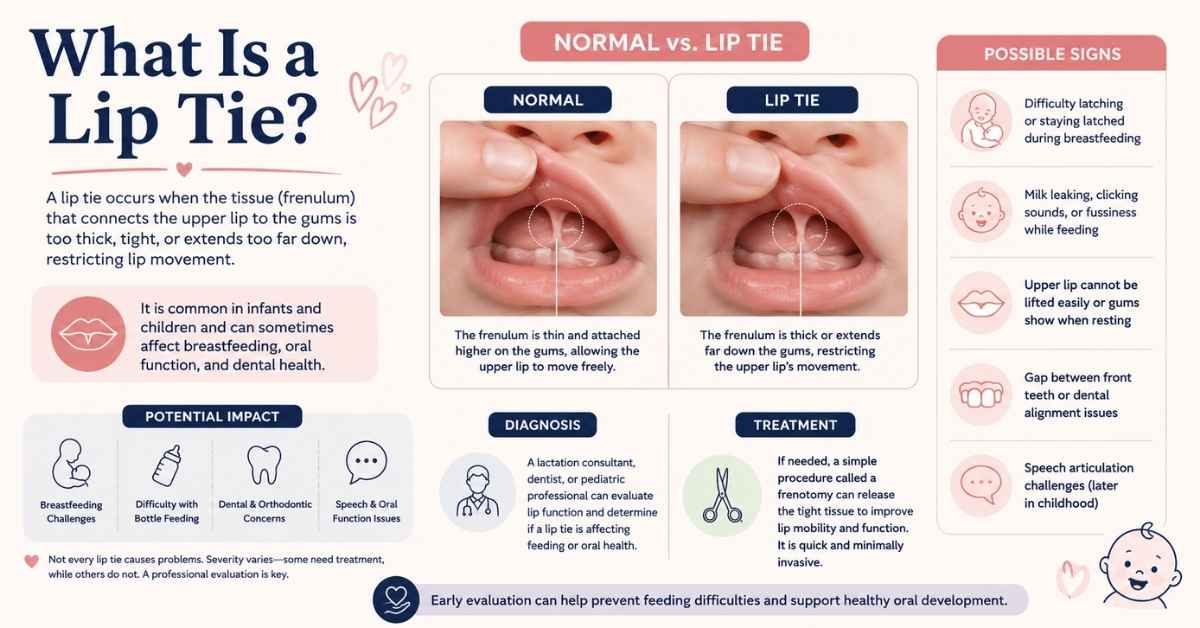
What is a lip tie is a common question many new parents search after noticing breastfeeding difficulties, feeding struggles, or concerns about their baby’s mouth movement. A lip tie is a condition where the tissue connecting the upper lip to the gum, known as the maxillary labial frenulum or upper lip frenulum, is unusually tight, restrictive, or positioned in a way that may affect normal lip movement. However, having a visible frenulum is common in babies, and not every lip tie causes problems or requires treatment. The main concern is usually whether the tissue affects important functions such as breastfeeding, latch, suction, milk transfer, or oral movement.
For many parents, the search for answers begins during everyday moments: a baby who struggles to maintain a latch, makes clicking sounds while feeding, frequently unlatches, or a parent experiencing ongoing nipple discomfort. These challenges can create frustration and worry, especially when families receive conflicting information about whether a lip tie is actually responsible.
Understanding a lip tie in babies requires looking beyond appearance alone. Healthcare professionals typically consider both the physical attachment of the frenulum and how it affects function. This guide explains lip tie symptoms, how lip ties are diagnosed, the connection between lip ties and breastfeeding, treatment options, and what parents should consider before making decisions.
Understanding the Tissue Behind a Lip Tie
Inside a baby’s mouth, a small fold of tissue connects different oral structures. The tissue connecting the upper lip to the gum is called the maxillary frenulum. This normal anatomical structure helps support movement between the lip and upper gum.
Almost every baby has some form of an upper lip frenulum. The presence of this tissue alone does not automatically mean a baby has a problem.
The concern arises when the frenulum is considered restrictive, meaning it may limit the movement needed for certain activities.
What Is the Maxillary Labial Frenulum?
The maxillary labial frenulum is the band of soft tissue located between the inside of the upper lip and the gum area. Its role is part of normal oral anatomy and development.
A typical frenulum allows:
- Normal upper lip movement
- Comfortable feeding
- Proper lip seal
- Effective suction during breastfeeding or bottle feeding
A restrictive lip tie may interfere with these functions in some infants.
Lip Tie vs Normal Frenulum: What Is the Difference?
One of the biggest sources of confusion for parents is understanding the difference between a normal upper lip frenulum and a possible lip tie.
A baby may have a prominent-looking frenulum without experiencing any problems. The key factor is not simply what the tissue looks like but whether it affects oral function.
| Normal Upper Lip Frenulum | Possible Restrictive Lip Tie |
|---|---|
| Common anatomical feature | May restrict lip movement |
| Allows normal feeding function | May contribute to feeding difficulties |
| Does not interfere with suction | May affect lip seal or latch |
| Appearance varies naturally | Evaluated based on symptoms and function |
A healthcare provider may consider factors such as:
- How freely the upper lip moves
- Whether the baby can create an effective seal
- Feeding comfort
- Milk transfer
- Overall feeding progress
This is why experts often emphasize that function matters more than appearance alone.
What Does a Lip Tie Look Like?
Many parents search for “what does a lip tie look like” because they want to compare what they see at home with examples online.
A lip tie may appear as:
- A thick or tight band of tissue connecting the upper lip to the gum
- Limited ability to lift the upper lip
- A frenulum attachment that extends lower along the gum area
However, visual appearance can be misleading.
Two babies may have similar-looking frenulums but completely different experiences:
- One baby may feed comfortably.
- Another may struggle with latch or suction.
This is why online photos and checklists should not replace a professional evaluation.
Why Online Lip Tie Photos Can Be Misleading
Many parents attempt to diagnose a newborn lip tie by searching images online. While pictures can help explain anatomy, they cannot determine whether a baby has a functional problem.
A proper assessment considers:
- Feeding behavior
- Oral movement
- Baby’s growth
- Parent comfort
- Overall feeding experience
A visible frenulum does not automatically mean:
- Breastfeeding will fail
- Treatment is necessary
- A procedure is required
A balanced approach helps prevent unnecessary worry and ensures babies receive appropriate support.
How Do You Know If Your Baby Has a Lip Tie?
Parents often notice a possible lip tie because of feeding-related concerns rather than because of the appearance of the mouth.
Some common signs associated with feeding challenges may include:
Breastfeeding Signs
A baby with a restrictive lip tie may experience difficulties such as:
- Trouble maintaining a deep latch
- Frequent unlatching during feeds
- Clicking sounds while nursing
- Milk leaking from the mouth
- Longer feeding sessions
- Difficulty creating suction
Parents may also experience:
- Pain during breastfeeding
- Nipple soreness
- Frustration during feeding sessions
- Feeling that the baby is unable to feed efficiently
Bottle Feeding Signs
Although lip ties are often discussed in relation to breastfeeding, some babies may experience challenges with bottle feeding as well.
Possible signs include:
- Difficulty forming a strong seal around the bottle nipple
- Dribbling milk
- Feeding fatigue
- Taking unusually long to finish feeds
Why Feeding Problems Are More Complex Than a Lip Tie Alone
An important point many parents need to hear is that feeding difficulties can have many causes.
A lip tie may be one possible factor, but other contributors can include:
- Breastfeeding position
- Latch technique
- Milk supply concerns
- Tongue mobility issues
- Prematurity
- Infant oral coordination
This is why a complete feeding assessment is often more useful than focusing only on one physical feature.
Can a Lip Tie Affect Breastfeeding?
One of the most common reasons parents search for “what is a lip tie” is because they are experiencing breastfeeding challenges and want to understand whether a lip tie could be contributing to the problem.
During breastfeeding, a baby needs coordinated movement of the lips, tongue, jaw, and facial muscles to create an effective latch and maintain suction. The upper lip plays an important role in creating a comfortable seal around the breast.
A restrictive maxillary frenulum may affect some babies by limiting how freely the upper lip moves. This may make it harder for the baby to maintain a deep latch or create efficient suction.
However, it is important to understand that not every baby with a lip tie will experience breastfeeding problems.
A baby’s feeding ability depends on multiple factors, including:
- Lip movement
- Tongue mobility
- Latch technique
- Milk transfer
- Oral coordination
- Breastfeeding position
- Overall health and development
How Lip Tie May Affect Latch and Milk Transfer
A comfortable and effective latch involves more than simply attaching to the breast. The baby needs to coordinate:
- Lip position
- Tongue movement
- Jaw motion
- Sucking rhythm
- Swallowing
If a baby cannot achieve a proper lip seal, some parents may notice:
- Clicking sounds during nursing
- Frequent breaks during feeding
- Milk leaking from the corners of the mouth
- Difficulty staying attached
- Increased feeding time
For the breastfeeding parent, this may lead to:
- Tender nipples
- Pain during feeds
- Frustration
- Stress around feeding sessions
These signs can be concerning, but they do not automatically confirm that a lip tie is the cause.
A thorough evaluation looks at the whole feeding picture, not just the appearance of the frenulum.
Lip Tie and Tongue Tie: Are They the Same?
Parents often search for “lip tie vs tongue tie” because these terms are frequently mentioned together.
Although both involve oral tissues called frenula, they affect different areas of the mouth.
Lip Tie
A lip tie involves the tissue connecting the upper lip to the gum.
It relates primarily to:
- Upper lip movement
- Lip seal
- Oral function during feeding
Tongue Tie
A tongue tie, medically known as ankyloglossia, involves the tissue connecting the underside of the tongue to the floor of the mouth.
It may affect:
- Tongue movement
- Tongue elevation
- Tongue coordination during feeding
Key Differences Between Lip Tie and Tongue Tie
| Lip Tie | Tongue Tie |
|---|---|
| Involves upper lip frenulum | Involves tongue frenulum |
| May affect lip movement and seal | May restrict tongue mobility |
| Connected with feeding concerns in some infants | Often evaluated for tongue function |
| Focuses on upper oral tissue | Focuses on tongue movement |
Some babies may have both conditions, but they should not automatically be assumed to occur together.
How It is Diagnosed?
A common misconception is that a lip tie can be diagnosed simply by looking inside a baby’s mouth.
While appearance can provide clues, a proper evaluation usually considers function, symptoms, and feeding ability.
A healthcare professional may evaluate:
- The appearance of the frenulum
- Upper lip movement
- Feeding behavior
- Latch quality
- Baby’s ability to create suction
- Parent-reported concerns
- Weight gain and growth patterns
Learn More: What Does WBU Mean
Who Can Evaluate It ?
Depending on the situation, different professionals may be involved in evaluating a possible infant lip tie.
Pediatrician
A pediatrician can:
- Review feeding concerns
- Check overall health
- Evaluate growth
- Recommend further assessment if needed
Lactation Consultant
A qualified lactation consultant can help assess:
- Breastfeeding technique
- Latch problems
- Milk transfer
- Feeding patterns
This is often valuable because feeding difficulties may involve several factors beyond anatomy.
Pediatric Dentist
A pediatric dentist with experience in infant oral anatomy may evaluate:
- Frenulum attachment
- Oral movement
- Potential restrictions
ENT Specialist or Other Healthcare Providers
In some cases, an ear, nose, and throat specialist or other qualified provider may participate in assessment and treatment discussions.
Why Diagnosis Should Focus on Function, Not Appearance
One of the most important concepts for parents is this:
A visible lip tie does not always mean a baby has a medical problem.
Many infants have noticeable upper lip frenulums and feed normally.
A stronger evaluation asks:
- Is the baby comfortable while feeding?
- Is milk transfer effective?
- Is growth progressing normally?
- Is there ongoing pain or difficulty?
This approach helps avoid two common mistakes:
Mistake 1:
Assuming every visible frenulum requires treatment.
Mistake 2:
Ignoring genuine feeding problems because the tissue “looks normal.”
The goal is not simply to identify tissue. The goal is to understand whether the tissue affects function.
Does Every Lip Tie Need Treatment?
This is one of the biggest concerns for parents.
The answer is:
No. Not every lip tie requires treatment.
Treatment decisions usually depend on:
- Symptoms
- Feeding difficulties
- Functional limitations
- Professional assessment
- The individual baby’s situation
If a baby:
- Feeds comfortably
- Gains weight appropriately
- Has normal oral movement
a healthcare provider may recommend monitoring rather than intervention.
When Should Parents Consider Professional Support?
Parents may benefit from seeking an evaluation if they notice:
- Persistent breastfeeding pain
- Difficulty maintaining latch
- Poor feeding efficiency
- Baby becoming exhausted during feeds
- Concerns about weight gain
- Ongoing feeding frustration
A consultation does not automatically mean a procedure will be recommended.
Often, the first step is understanding what is happening and exploring possible solutions.
Treatment Options Explained
Treatment for a lip tie in babies depends on the severity of symptoms and professional recommendations.
Options may include:
Feeding Support and Conservative Approaches
Before considering a procedure, some families benefit from:
- Lactation support
- Improving breastfeeding positioning
- Adjusting latch techniques
- Feeding evaluation
- Monitoring progress
These approaches can be helpful because feeding problems are not always caused by oral tissue restrictions.
What Is a Lip Tie Release?
A lip tie release is a procedure intended to reduce restriction caused by the frenulum.
You may hear healthcare professionals use terms such as:
- Frenotomy
- Frenectomy
- Frenulum release
The exact procedure depends on:
- Provider approach
- Baby’s age
- Clinical assessment
- The tissue involved
Laser vs Scissors: Understanding Its Revision Methods
Parents often search:
- “laser lip tie release”
- “lip tie surgery”
- “lip tie revision”
because they want to understand procedure options.
Common methods may include:
Scissors Technique
A provider uses sterile surgical scissors to release the tissue.
Laser Technique
A medical laser may be used to perform the release.
Both approaches have supporters, and the best option depends on professional evaluation, provider experience, and individual circumstances.
Parents should ask:
- Why is this procedure recommended?
- What improvement should we realistically expect?
- What are the risks?
- What follow-up care is needed?
Questions Parents Should Ask Before Lip Tie Revision
Before choosing treatment, parents can ask:
About Diagnosis
- How was the lip tie evaluated?
- Is the concern based on appearance or function?
- Are there other possible causes of feeding problems?
In Treatment
- What are the expected benefits?
- Are there alternatives?
- What are the possible risks?
- What does recovery involve?
About Outcomes
- What changes should we expect after treatment?
- How will improvement be measured?
These questions help parents make informed decisions rather than feeling pressured.
See More: What Does IMO Mean
Common Myths What Parents Should Know
Because lip ties have received increasing attention online, parents often encounter conflicting information. Some sources describe lip ties as the hidden cause of many problems, while others suggest they are rarely significant.
The reality is more balanced.
A lip tie should be evaluated based on function, symptoms, and the baby’s overall feeding experience, not simply on appearance.
Myth 1: Every Baby With a Lip Tie Has Feeding Problems
Reality:
Many babies have a visible upper lip frenulum and feed normally.
The presence of a frenulum alone does not mean a baby will have:
- Breastfeeding problems
- Poor weight gain
- Speech issues
- Developmental concerns
The important question is whether the tissue creates a functional limitation.
Myth 2: Every Lip Tie Needs to Be Released
Reality:
A procedure is not automatically necessary for every baby with a lip tie.
Healthcare providers typically consider:
- Feeding difficulties
- Oral function
- Baby’s growth
- Parent comfort
- Response to other support methods
A careful evaluation helps determine whether intervention is appropriate.
Myth 3: Explains Every Breastfeeding Challenge
Reality:
Breastfeeding difficulties can have many causes.
Possible contributors include:
- Positioning challenges
- Shallow latch
- Milk supply concerns
- Tongue mobility issues
- Prematurity
- Infant coordination difficulties
It may be one possible factor, but it is not always the complete explanation.
Myth 4: A Quick Online Check Can Diagnose a Lip Tie
Reality:
Photos and online checklists may help parents understand anatomy, but they cannot replace professional assessment.
A complete evaluation considers:
- Symptoms
- Feeding patterns
- Oral movement
- Growth
- Functional impact
What Parents Often Wish They Knew Earlier About Lip Ties
Many parents searching “what is a lip tie” are not simply looking for a definition. They are looking for reassurance after a stressful experience.
Here are important things many families wish they had known sooner.
Feeding Struggles Are Real, Even When the Cause Is Unclear
A baby can have feeding difficulties even when there is no obvious explanation.
Parents may notice:
- Baby becoming frustrated during feeds
- Long feeding sessions
- Frequent unlatching
- Discomfort while breastfeeding
These experiences deserve attention.
Finding the Cause May Require Looking at the Whole Picture
A successful feeding assessment does not focus on one single feature.
A healthcare professional may consider:
- Oral anatomy
- Feeding technique
- Baby’s behavior
- Parent comfort
- Growth patterns
This broader approach often leads to better decisions.
Asking Questions Is an Important Part of Care
Parents should feel comfortable asking:
- Why do you think this is affecting feeding?
- Are there other possible explanations?
- What happens if we wait and monitor?
- What are the benefits and risks of treatment?
Being informed helps families feel more confident.
When Should You Talk to a Healthcare Professional?
Parents may consider seeking professional guidance if feeding concerns continue or if they notice:
Baby-Related Signs
- Difficulty staying latched
- Poor feeding efficiency
- Frequent fatigue during feeds
- Difficulty creating suction
- Concerns about weight gain
- Signs of feeding frustration
Parent-Related Signs
- Persistent nipple pain
- Stress or anxiety around feeding
- Feeling that feeding is unusually difficult
- Concerns that something is affecting breastfeeding success
A Practical Parent Checklist: What to Observe Before an Appointment
Before speaking with a healthcare provider, parents may find it useful to note:
Feeding Patterns
- How long feeding sessions usually last
- How often the baby unlatches
- Whether clicking sounds occur
- Whether milk leaks during feeds
Baby Behavior
- Signs of frustration
- Fatigue while feeding
- Preference for certain positions
Parent Experience
- Pain level during breastfeeding
- Difficulty maintaining latch
- Overall feeding confidence
These observations can make conversations with healthcare professionals more productive.
Frequently Asked Questions About Lip Ties
What is a lip tie in a newborn?
A lip tie in a newborn refers to a situation where the tissue connecting the upper lip to the gum, called the maxillary labial frenulum, may restrict lip movement. However, many newborns naturally have a visible frenulum, and not all require treatment.
Are lip ties common in babies?
Visible upper lip frenulums are common in infants. The frequency of clinically significant lip ties varies because healthcare professionals may differ in how they define and evaluate them.
Can a lip tie affect breastfeeding?
A lip tie may affect breastfeeding for some babies if it limits upper lip movement or affects the ability to create a comfortable seal. However, breastfeeding problems can also have other causes.
A complete feeding assessment can help identify the contributing factors.
What are the signs of a lip tie in babies?
Possible signs may include:
- Difficulty maintaining latch
- Clicking sounds during feeding
- Milk leaking from the mouth
- Long feeding sessions
- Breastfeeding discomfort
- Difficulty creating suction
These signs do not confirm a lip tie by themselves.
Can a lip tie go away on its own?
A baby’s oral anatomy changes as they grow, but whether a lip tie improves depends on the individual situation.
Parents should discuss concerns with a qualified healthcare professional rather than relying on appearance alone.
How is a lip tie diagnosed?
A lip tie is evaluated by considering:
- Oral anatomy
- Lip movement
- Feeding function
- Symptoms
- Overall health
A professional may include input from pediatricians, lactation consultants, pediatric dentists, or other specialists.
Is a lip tie release painful for babies?
Parents commonly worry about discomfort during and after a lip tie release.
The experience can vary depending on:
- The baby’s age
- The procedure used
- Individual healing response
Parents should discuss pain management, recovery, and aftercare expectations with their healthcare provider.
What is the difference between frenotomy and frenectomy?
Both terms refer to procedures involving frenulum tissue.
- Frenotomy generally refers to making a small release or cut.
- Frenectomy generally refers to removing or revising frenulum tissue.
The terminology used may vary depending on the provider and procedure.
Is laser lip tie revision better than other methods?
Laser and traditional surgical approaches are both used by some providers.
The best choice depends on:
- Clinical assessment
- Provider experience
- Individual circumstances
- Expected outcomes
Parents should focus on choosing an appropriately qualified provider rather than assuming one method is always superior.
Can adults have a lip tie?
Yes, adults can also have a prominent or restrictive upper lip frenulum.
Adult concerns may involve:
- Oral comfort
- Gum pulling sensations
- Dental considerations
Evaluation depends on symptoms and functional concerns.
Final: Understanding a Lip Tie Without Fear
A lip tie is a variation of oral anatomy involving the tissue connecting the upper lip to the gum, known as the maxillary labial frenulum. While some babies with a restrictive lip tie may experience feeding challenges, many babies with visible frenulums feed normally.
The most important takeaway is:
A lip tie should be evaluated by looking at function, not appearance alone.
If your baby is experiencing feeding difficulties, ongoing discomfort, or concerns about growth, a qualified healthcare professional can help determine the possible causes and appropriate next steps.
Understanding the difference between normal anatomy and a true functional concern allows parents to make informed decisions with confidence.