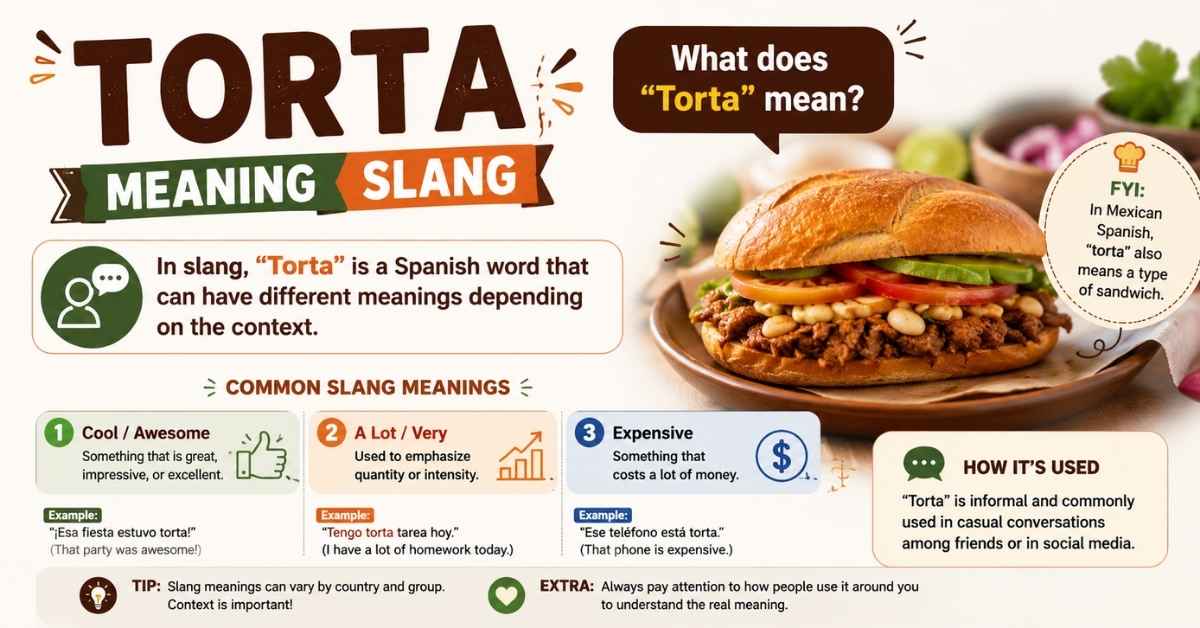
Torta meaning slang depends entirely on where it’s used, who says it, and the context of the conversation. In some Spanish-speaking communities—especially in parts of Mexico—torta can be used as a slang term to describe a heavier or curvier woman, sometimes affectionately and sometimes as an insult. In Argentina, however, the same word may have an entirely different slang meaning. Outside of slang, torta simply refers to a sandwich in Mexico or a cake in many other Spanish-speaking countries. Understanding the speaker’s country, tone, and situation is the key to interpreting the word correctly.
If you’ve seen “torta” in a TikTok comment, text message, WhatsApp chat, Snapchat streak, Instagram caption, or meme, you’re probably wondering whether it was meant as a joke, a compliment, or an insult. This guide goes beyond a simple definition by explaining regional differences, cultural context, internet slang, real-life examples, and when the word may be considered offensive, so you can confidently understand what someone actually meant.
Quick Answer: What Does “Torta” Mean in Slang?
The slang meaning of torta is not universal. Unlike many internet slang words, its meaning changes across Spanish-speaking countries and even between communities within the same country.
In many Mexican slang conversations, torta may refer to a plus-size, heavy, or curvy woman. Depending on the relationship between the people speaking, it can be:
- Playful teasing
- An affectionate nickname
- A body-related description
- A disrespectful insult
In parts of Argentina, the slang meaning is completely different and may refer to a lesbian, making context even more important.
Meanwhile, outside slang, the word has everyday culinary meanings:
- In Mexico, a torta is a traditional sandwich.
- In much of South America, it’s commonly used to mean cake.
That’s why there is no single definition that applies everywhere.
Quick Tip: Before assuming what someone meant by torta, always ask yourself where the speaker is from, what platform you’re on, and what the tone of the conversation was.
Why There Isn’t One Universal Meaning
One of the biggest reasons people become confused after searching “what does torta mean in slang” is that Spanish isn’t spoken the same way everywhere.
Just as English words can have different meanings in the United States, the United Kingdom, Australia, and Canada, Spanish slang also changes from one country to another.
For example:
- A harmless nickname in one country might be considered rude somewhere else.
- A slang term popular on TikTok may not be commonly used in everyday conversations.
- Younger generations often give familiar words entirely new meanings through internet culture, memes, and social media trends.
Language naturally evolves through regional dialects, cultural identity, humor, and online communication, which is why understanding context is often more important than memorizing a dictionary definition.
Literal Meaning vs. Slang Meaning: Don’t Confuse the Two
Many users encounter conflicting explanations because torta has both literal and figurative meanings.
Understanding this distinction helps avoid misunderstandings.
| Literal Meaning | Slang Meaning |
|---|---|
| Refers to food | Refers to a person or characteristic |
| Usually neutral | May be playful, affectionate, or offensive |
| Common in restaurants and recipes | Common in conversations, memes, texting, and social media |
| Doesn’t depend much on context | Depends heavily on tone, region, and relationship |
The same word can carry completely different meanings simply because it’s used in different situations.
What “Torta” Means as Food
Before becoming popular as an internet slang term, torta was—and still is—a very common food-related word.
Its culinary meaning changes depending on the country.
In Mexico
A torta is a famous Mexican sandwich made with crusty bread and filled with ingredients such as:
- Beef
- Chicken
- Ham
- Avocado
- Cheese
- Beans
- Vegetables
If someone says:
“Vamos por una torta.”
They’re almost certainly talking about food, not slang.
In Many South American Countries
In countries like Argentina, Colombia, Chile, Peru, and Uruguay, torta usually refers to a cake.
For example:
“Compré una torta para el cumpleaños.”
This simply means:
“I bought a birthday cake.”
Again, context immediately tells you that the speaker is referring to dessert rather than using slang.
How the Slang Meaning Developed
One reason torta meaning often confuses language learners is that slang evolves differently from formal language.
Over time, communities begin using familiar words in new ways through:
- Humor
- Nicknames
- Metaphors
- Pop culture
- Internet slang
- Meme culture
- Social media
- Regional dialects
This process is known in linguistics as semantic shift, where a word gradually develops additional meanings beyond its original definition.
Instead of replacing the original meaning, the slang meaning exists alongside it.
That’s why today, the same word can mean:
- A sandwich
- A cake
- A playful nickname
- A body-related description
- Something entirely different depending on the country
Why Context Changes Everything
If you remember only one thing from this guide, remember this:
Context is more important than the dictionary definition.
Ask yourself:
- Who said it?
- Where are they from?
- Was it online or in person?
- Were they joking?
- Were they talking about food?
- Was the conversation friendly or argumentative?
These questions often reveal the intended meaning far better than searching for a single universal definition.
For example:
“That torta looks delicious.”
Clearly refers to food.
Whereas:
“Ella es bien torta.”
Could mean something entirely different depending on the speaker’s country and social context.
This is why machine translation sometimes fails to explain slang accurately—it translates words literally but cannot always interpret tone, regional usage, or cultural meaning.
What Does “Torta” Mean in Different Countries?
Perhaps the most important thing to understand is that Spanish slang isn’t standardized.
Different countries—and sometimes even neighboring cities—may use the same word differently.
Let’s look at the most common interpretations.
Mexico
In Mexican Spanish, torta is most commonly recognized as a sandwich. However, in some informal conversations, it may also be used as slang to describe a heavier or curvier woman.
Whether this is considered humorous or offensive depends on:
- The speaker
- The listener
- Their relationship
- The tone of the conversation
Among close friends, it may be used jokingly.
Between strangers, however, the same word could easily be perceived as disrespectful or body-shaming.
Example
“No le hagas caso, siempre dice esas cosas de broma.”
If someone jokingly refers to a friend as torta, the intention might simply be playful teasing rather than genuine criticism.
Argentina
The slang meaning changes significantly in Argentina.
Here, torta has traditionally been used in some contexts as slang for a lesbian. Because this usage is deeply tied to regional culture and personal identity, it’s important not to assume that everyone uses—or appreciates—the term in the same way.
Depending on who says it and how it’s said, the word may be:
- Neutral
- Humorous
- Reclaimed within certain communities
- Offensive when used disrespectfully
This illustrates why understanding regional dialects is essential before interpreting or using slang.
Uruguay
In Uruguay, the literal meaning of torta usually refers to cake, but some slang usage overlaps with neighboring Argentina due to shared cultural and linguistic influences.
That doesn’t necessarily mean every Uruguayan speaker uses the word the same way. Age, location, and social circles all influence slang.
Paraguay
Paraguayan Spanish shares influences from neighboring countries, so the meaning of torta may vary depending on the community and conversational context.
Many speakers primarily understand the word in its food-related sense, while others may recognize regional slang through media or cross-border interactions.
Spain
In Spain, torta generally retains its literal meaning and is not widely used with the same slang interpretations found in parts of Latin America.
This difference highlights an important lesson:
A Spanish word can carry entirely different meanings depending on where it’s spoken.
Assuming every Spanish-speaking country uses slang the same way is one of the most common mistakes language learners make.
Mexican-American Communities in the United States
Within some Mexican-American communities, slang often blends traditional Mexican Spanish, English, and internet culture.
As a result, torta may appear in:
- TikTok videos
- Instagram reels
- Snapchat stories
- WhatsApp chats
- Group texts
- Memes
The intended meaning usually mirrors the speaker’s cultural background rather than following a universal internet definition.
Country Comparison
| Country | Literal Meaning | Common Slang Meaning | May Be Offensive? | Typical Context |
|---|---|---|---|---|
| Mexico | Sandwich | Heavier or curvier woman (in some contexts) | Sometimes | Casual conversation, jokes, social media |
| Argentina | Cake | Slang with a different regional meaning | Context-dependent | Informal conversations |
| Uruguay | Cake | Regional variation influenced by neighboring countries | Depends on context | Everyday speech |
| Paraguay | Cake | Limited regional slang usage | Rarely | Local conversations |
| Spain | Cake/flatbread (depending on region) | Usually no common slang meaning | Rare | Literal usage |
Is Calling Someone “Torta” an Insult or a Compliment?
One of the most common questions people ask after searching “torta meaning slang” is whether the word is offensive. The honest answer is that it depends on the speaker, the relationship, the country, and the tone.
Unlike some slang words that have a fixed meaning, torta can sound friendly in one conversation and disrespectful in another. That’s why understanding the situation is far more important than relying on a single definition.
When It’s Meant as Friendly Teasing
Among close friends or family members, playful nicknames are common in many Spanish-speaking cultures. In these situations, someone might use torta jokingly without intending to hurt anyone’s feelings.
For example:
Friend 1: “¡Ya deja de comer tacos!” Friend 2: “Cállate, torta.”
Depending on the relationship, this exchange may simply reflect lighthearted teasing rather than an insult.
However, humor doesn’t always translate across cultures. If you’re not part of the same social circle, using the same word could easily be misunderstood.
When It Can Be Offensive
In some contexts, calling someone torta can be interpreted as body-shaming or making fun of their appearance.
If the comment is directed at someone you don’t know well, or if it’s said with a mocking tone, it may come across as disrespectful.
For example:
“Mira esa torta.”
Without additional context, this statement could be perceived as insulting because it appears to label someone based on their body.
Whenever a slang term refers to physical appearance, it’s wise to be cautious. Even if the speaker intends it as a joke, the listener may not interpret it that way.
When It’s Used Affectionately
Some communities use appearance-based nicknames affectionately, especially among relatives, childhood friends, or romantic partners.
In these cases, the nickname often reflects familiarity rather than criticism.
For example:
“Hola, torta. ¿Cómo estás?”
If this comes from a close friend who regularly uses playful nicknames, it’s unlikely to be offensive.
Still, context matters. The same phrase from a stranger would feel very different.
How Tone Changes the Meaning
Tone often communicates more than the word itself.
Ask yourself:
- Was the speaker smiling?
- Was everyone laughing?
- Did they say it with affection?
- Was the conversation becoming argumentative?
- Have they used similar nicknames before?
Understanding these clues helps you interpret torta slang much more accurately than reading a dictionary entry.
Expert Tip: If you’re unsure what someone meant, don’t assume the worst. Ask for clarification politely instead of reacting immediately.
What Does “Torta” Mean on TikTok, Instagram, Snapchat, and in Text Messages?
As social media evolves, many traditional words gain new popularity through internet slang, memes, and viral videos. The word torta is no exception.
If you’ve seen it online, the meaning usually depends on who posted it, their cultural background, and the conversation.
Torta Meaning on TikTok
On TikTok, torta often appears in:
- Funny skits
- Relationship videos
- Latino humor
- Lifestyle content
- Meme compilations
- Comment sections
Creators may use the word playfully, sarcastically, or to reflect regional slang.
For example:
“Mi amiga es bien torta 😂”
Without knowing where the creator is from, it’s impossible to assign one universal meaning. This is why TikTok comments can confuse people who rely solely on machine translation.
Instagram Comments
Instagram users frequently use slang in captions and comments.
Examples include:
“Qué torta.”
“Esa torta volvió.”
These comments could reference:
- A joke among friends
- Someone’s appearance
- A regional slang expression
- Food
Looking at the surrounding conversation usually reveals the intended meaning.
Snapchat Conversations
Because Snapchat messages are informal and often disappear quickly, users tend to write casually.
For example:
“JAJA eres una torta.”
This could simply be playful teasing between friends rather than a serious insult.
WhatsApp Chats
Family groups and close friends often use slang naturally in WhatsApp conversations.
Example:
“Ya llegó la torta.”
Depending on the conversation, this might refer to:
- Someone arriving
- A nickname
- Food
- An inside joke
Again, context provides the answer.
Gaming Communities
Online gaming communities often borrow slang from different cultures.
Players may encounter torta in:
- Team chats
- Voice chats
- Discord servers
- Livestreams
Because gamers come from many countries, the meaning can shift from one community to another.
Torta Meaning in Text Messages
When someone sends:
“Torta 😂”
They’re rarely expecting you to interpret it literally.
Instead, consider:
- Who sent it?
- Have they used playful nicknames before?
- Were you discussing food?
- Are they from Mexico, Argentina, or another Spanish-speaking country?
The answers usually make the intended meaning much clearer.
Learn More: What Is a YN in Slang
How to Figure Out What Someone Really Meant
Instead of memorizing every slang definition, learn how native speakers interpret words in real conversations.
Follow this simple framework whenever you encounter torta.
Step 1: Identify the Speaker’s Country
Regional differences matter more than many people realize.
Ask:
- Are they Mexican?
- Argentine?
- Spanish?
- Mexican-American?
- From another Spanish-speaking country?
This alone may completely change the meaning.
Step 2: Look at the Conversation
Read the surrounding messages.
Were they discussing:
- Food?
- A birthday?
- Someone’s appearance?
- A funny video?
- A meme?
Context often eliminates confusion immediately.
Step 3: Consider Your Relationship
Would this person normally tease you?
Close friends frequently use playful nicknames.
Coworkers and strangers usually don’t.
The closer the relationship, the less likely the word is intended as an insult.
Step 4: Pay Attention to Tone
Tone indicators include:
- Laughing emojis 😂
- Smiling emojis 😊
- Sarcastic replies
- Friendly language
- Angry messages
- Capital letters
- Repeated punctuation
These clues help explain the emotional meaning behind the word.
Step 5: Think About the Platform
Different platforms encourage different communication styles.
| Platform | Most Likely Usage |
|---|---|
| TikTok | Humor, memes, trends |
| Casual comments, captions | |
| Snapchat | Friendly conversations |
| Family and friends | |
| Discord | Gaming slang |
| Mixed audiences |
Knowing the platform helps narrow down the intended meaning.
Real Conversation Examples
Current articles rarely explain how torta meaning slang works in everyday conversations. Let’s look at realistic examples.
Example 1: Friends
Carlos: “Otra hamburguesa?” Luis: “Déjame en paz, torta.”
Meaning
Friends joking with each other.
Tone
Playful.
Offensive?
Usually No.
Example 2: Romantic Relationship
“Buenos días, torta ❤️”
Meaning
Could simply be an affectionate nickname.
Tone
Loving.
Offensive?
Usually No, if both people are comfortable with the nickname.
Example 3: Family
“Ven acá, torta.”
Meaning
Some families use humorous nicknames affectionately.
Tone
Warm.
Offensive?
Usually No.
Example 4: Social Media Comment
“Ella sí es torta.”
Meaning
Impossible to interpret without knowing:
- Country
- Creator
- Context
- Conversation
This is exactly why online definitions often appear contradictory.
Example 5: Food Conversation
“Vamos por una torta.”
Meaning
Clearly referring to a Mexican sandwich.
Offensive?
Not at all.
Example 6: Potentially Offensive Context
“No quiero parecer torta.”
Meaning
Could reflect concerns about body image or appearance, depending on the speaker’s intent.
Why Context Matters
This type of usage can be sensitive. Avoid assuming the speaker is making a joke, and be mindful that words related to appearance can affect people differently.
Why “Torta” Has So Many Different Meanings
Many people wonder:
“Why does one word mean so many different things?”
The answer lies in how languages naturally evolve.
Regional Dialects
Spanish is spoken by hundreds of millions of people across dozens of countries.
Each region develops:
- Local expressions
- Unique slang
- Different pronunciations
- Cultural references
Over time, familiar words acquire new meanings.
Semantic Shift
Linguists call this process semantic shift.
It happens when a word gradually expands beyond its original definition.
English has many similar examples:
- Cool
- Sick
- Fire
- Ghost
- Salty
These words now carry meanings that go far beyond their literal definitions.
The same process affects Spanish slang.
Internet Culture
Platforms like TikTok, Instagram, Snapchat, WhatsApp, and YouTube Shorts spread regional expressions much faster than ever before.
A slang word once limited to one community can now appear in videos viewed by millions around the world.
As a result, people often encounter torta online without understanding the cultural background behind it.
Cultural Identity
Slang also reflects identity.
Communities create expressions that strengthen belonging and shared humor.
Because every culture evolves differently, slang naturally develops multiple meanings.
That’s why asking:
“What does torta mean?”
without considering where, who, and how rarely produces one simple answer.
See More: Florida Slang
Common Misunderstandings About the Word “Torta”
Several myths continue to circulate online.
Myth 1: Torta Always Means the Same Thing
Reality: It changes by country, culture, and conversation.
Myth 2: It’s Always an Insult
Reality: Sometimes it’s playful, affectionate, or completely unrelated to appearance.
Myth 3: It Always Refers to Food
Reality: In many situations, it does—but in others, it’s clearly used as slang.
Myth 4: Machine Translation Always Gets It Right
Reality: Translation tools often interpret torta literally and may miss the slang meaning entirely because they cannot reliably detect tone, regional variation, or social context.
Myth 5: Every Spanish Speaker Uses It the Same Way
Reality: Spanish is incredibly diverse. A slang term that’s common in one country may be unfamiliar—or carry a completely different meaning—in another.
Should You Use the Word “Torta”?
After learning the different torta meaning slang interpretations, you may wonder whether it’s a word you should use yourself. The safest answer is only if you fully understand the context and the people you’re speaking with.
Because torta has different meanings across Spanish-speaking countries, using it incorrectly could cause confusion or unintentionally offend someone.
When It’s Generally Safe to Use
You can usually use torta confidently when you’re referring to food.
Examples:
- “Voy a comer una torta.” (In Mexico, this means a sandwich.)
- “Compramos una torta para la fiesta.” (In many South American countries, this means a cake.)
When using the slang meaning, it’s best to reserve it for situations where you’re familiar with the local culture and know the people involved.
When You Should Avoid Using It
Avoid using torta as slang if:
- You’re unsure what it means in that region.
- You’re speaking with someone you don’t know well.
- You’re communicating in a professional setting.
- The conversation involves sensitive topics such as body image or personal identity.
- You’re relying on an online definition without understanding the cultural context.
A simple rule is: if you’re uncertain, don’t assume. Ask politely or choose more neutral language.
Similar Spanish Slang Words Often Confused With “Torta”
Spanish slang is rich and highly regional. Words that seem similar often carry very different meanings.
| Word | General Meaning | Notes |
|---|---|---|
| Gorda | Chubby or overweight | Can be affectionate or offensive depending on tone. |
| Flaca | Skinny | Often used as a friendly nickname in some countries. |
| Güera | Blonde or fair-skinned woman | Common in Mexico. |
| Chula | Cute, pretty, attractive | Usually a compliment. |
| Mija | My girl / dear | Affectionate expression combining mi hija. |
| Vato | Guy, dude | Popular in Mexican slang. |
| Compa | Buddy, friend | Short for compadre. |
| Cabrón | Depends on context | Can mean anything from “friend” to a strong insult. |
The key takeaway is that context always outweighs literal translation. Two people can use the same word in completely different ways based on region, relationship, and tone.
Expert Tips for Understanding Spanish Slang Naturally
Learning slang isn’t about memorizing endless definitions—it’s about understanding how people actually communicate.
Here are a few practical strategies:
1. Learn the Context, Not Just the Word
Instead of asking, “What does this word always mean?” ask:
- Who said it?
- Where are they from?
- What were they talking about?
2. Listen to Native Speakers
Watching videos, podcasts, interviews, or everyday conversations from different Spanish-speaking countries helps you notice how slang changes naturally.
3. Don’t Translate Word-for-Word
Literal translations often miss humor, sarcasm, and cultural references. Slang usually makes sense only within its original context.
4. Remember That Every Country Has Its Own Expressions
A slang term popular in Mexico may sound unusual in Spain, while an expression from Argentina might be unfamiliar elsewhere.
5. When in Doubt, Ask
If someone uses torta in a way you don’t understand, it’s perfectly acceptable to ask:
“What do you mean by that?”
Most native speakers appreciate genuine curiosity more than incorrect assumptions.
Frequently Asked Questions
What does “torta” mean in slang?
Torta meaning slang depends on the country and context. In some Mexican communities, it can describe a heavier or curvier woman, while in parts of Argentina it has a different regional slang meaning. It is not a universal slang term, so always consider who is speaking and where they’re from.
Is “torta” an insult?
Not always. It can be playful, affectionate, descriptive, or offensive depending on the relationship, tone, and cultural background of the speakers.
What does “torta” mean on TikTok?
On TikTok, torta is often used in humorous videos, memes, or casual comments. Its meaning usually reflects the creator’s regional slang rather than a single internet definition.
What does “torta” mean in texting?
In a text message, torta may be a nickname, a joke, a slang expression, or simply a reference to food. Read the surrounding conversation before deciding what it means.
What does “torta” mean in Mexican slang?
In some Mexican slang, torta may refer to a heavier or curvier woman. Depending on the tone, it can be playful, affectionate, or offensive.
What does “torta” mean in Argentina?
Besides its literal meaning of cake, torta has a distinct regional slang meaning in Argentina that differs from Mexican usage. As with many slang terms, interpretation depends on context and the people involved.
Can “torta” be a compliment?
Sometimes. Among close friends or partners, it may be used as an affectionate nickname. However, because meanings vary, it’s best not to assume everyone will receive it positively.
Why do online definitions conflict with each other?
Most websites focus on only one country or one type of usage. Since torta has multiple meanings across Spanish-speaking regions, no single definition explains every situation.
Should non-native Spanish speakers use this word?
It’s better to be cautious. If you don’t understand the regional usage, choose more neutral language until you’re confident about the context.
How can I tell which meaning someone intended?
Look at:
- The speaker’s country
- The conversation
- Your relationship
- The platform (TikTok, WhatsApp, Instagram, etc.)
- The tone of the message
These clues usually reveal the intended meaning much more accurately than a dictionary.
Key Takeaways
If there’s one lesson to remember, it’s that there is no single definition of “torta” in slang.
Here’s what matters most:
- Torta meaning slang changes based on country, culture, and context.
- In Mexico, it may describe a heavier or curvier woman in some informal situations, while also referring to a sandwich.
- In Argentina and some neighboring regions, the slang meaning is different, even though torta commonly means cake literally.
- Social media platforms such as TikTok, Instagram, Snapchat, and WhatsApp have spread regional slang to a global audience, making context more important than ever.
- Before deciding whether the word is friendly, humorous, or offensive, consider who said it, where they’re from, and how it was used.
Understanding these cultural and linguistic differences will help you interpret conversations more accurately and communicate with greater confidence.
Final Thoughts
Language is constantly evolving, and slang is often the fastest-changing part of it. The word torta is a perfect example of how one simple word can carry several meanings depending on geography, culture, relationships, and tone.
Instead of searching for one “correct” definition, focus on the context behind the conversation. Doing so will not only help you understand torta meaning more accurately but also improve your understanding of Spanish slang, internet culture, and real-life communication.