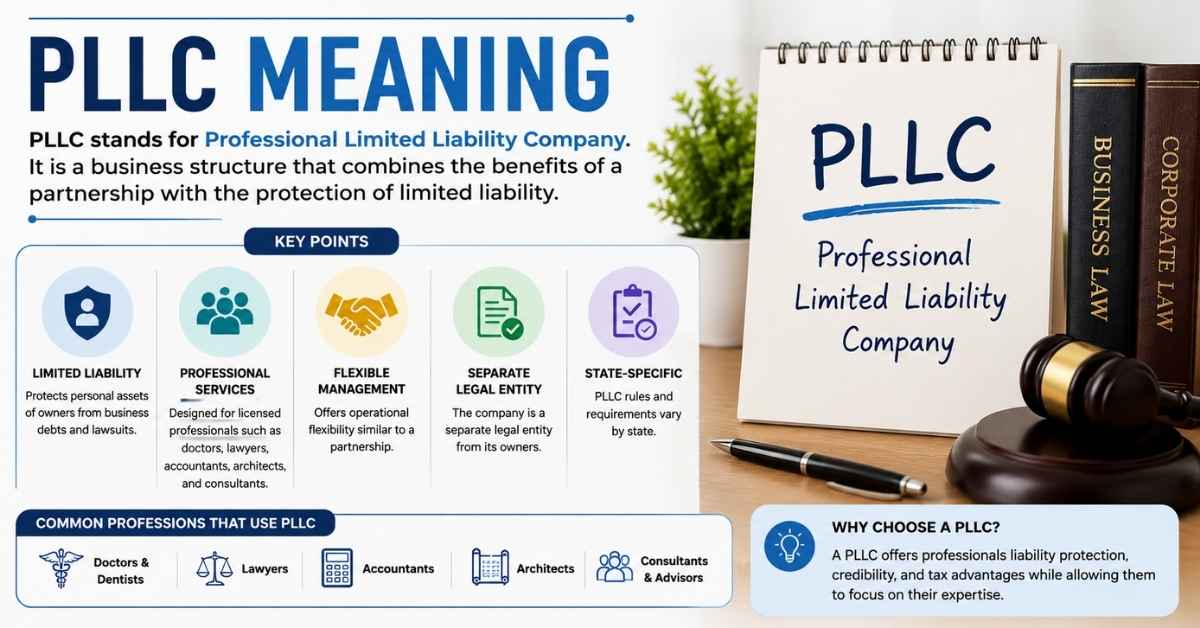
PLLC meaning is Professional Limited Liability Company, a specialized business entity created for licensed professionals such as doctors, lawyers, dentists, accountants, architects, engineers, psychologists, and other regulated occupations. A PLLC combines the liability protection and flexible taxation of a traditional Limited Liability Company (LLC) with professional licensing requirements established by state law. While it protects owners from many business debts and obligations, it generally does not shield them from personal liability for their own professional malpractice or negligence.
If you’re preparing to launch a private practice or professional firm, you’ve probably come across terms like LLC, PLLC, Professional Corporation (PC), and LLP. At first glance, they seem similar, but choosing the wrong business structure can affect your legal compliance, tax options, liability protection, and long-term business growth.
This guide goes beyond simply defining the acronym. You’ll learn what a PLLC is, who can form one, how it differs from an LLC, how it’s taxed, which states allow it, and whether it’s the right choice for your profession. Along the way, we’ll clear up common misconceptions, provide real-world examples, and help you understand the practical implications of forming a Professional Limited Liability Company.
Quick Answer: A PLLC (Professional Limited Liability Company) is a business structure specifically designed for licensed professionals. It offers limited liability protection for business obligations and typically benefits from pass-through taxation, but it does not protect professionals from liability arising from their own malpractice.
What Does PLLC Stand For?
Understanding the acronym makes it easier to grasp why this business structure exists.
| Letter | Meaning | What It Represents |
|---|---|---|
| P | Professional | The business provides licensed professional services. |
| LL | Limited Liability | Owners receive protection from many business debts and obligations. |
| C | Company | A legally recognized business entity owned by one or more members. |
In full, PLLC stands for Professional Limited Liability Company.
Unlike a standard LLC, which almost anyone can form, a PLLC is generally reserved for individuals who hold a valid professional license in occupations regulated by state law. The exact rules vary depending on where your business is located.
Why Was the PLLC Created?
Many professions directly impact public health, safety, finances, or legal rights. Because of this, states often impose stricter regulations on how these professionals operate their businesses.
A Professional Limited Liability Company was introduced to balance two important goals:
- Allow professionals to enjoy the organizational and tax benefits of an LLC.
- Ensure licensed individuals remain personally accountable for the professional services they provide.
For example, if a physician commits medical malpractice or an attorney commits professional negligence, forming a PLLC generally won’t eliminate personal responsibility for those actions. However, the business structure can help protect personal assets from certain business liabilities, contractual obligations, or debts unrelated to professional misconduct.
What Is a PLLC?
A PLLC is a legally recognized business entity designed specifically for people who offer licensed professional services.
Think of it as a version of an LLC that meets the additional requirements imposed by professional licensing boards and state governments.
Instead of simply registering a business, professionals forming a PLLC often need to demonstrate that each owner holds the required professional license before the business can be approved.
Simple Definition
A Professional Limited Liability Company is a company owned by one or more licensed professionals that provides legal protection for many business-related obligations while complying with state licensing laws.
Legal Perspective
Although laws differ between states, most jurisdictions that recognize PLLCs require:
- Owners (members) to hold valid professional licenses.
- Compliance with applicable state licensing boards.
- Filing Articles of Organization with the Secretary of State or another designated state agency.
- Ongoing compliance with professional regulations.
Because each state writes its own business laws, requirements for forming a PLLC can differ significantly. Some states require certain professions to organize as a PLLC, while others allow professionals to choose between a PLLC, LLC, or Professional Corporation (PC).
A Real-World Example
Imagine Dr. Sarah, a licensed dentist, decides to open her own dental clinic.
She initially considers creating a standard LLC because it’s simple and widely used. However, after reviewing her state’s business regulations, she discovers that dentists must register their private practice as a Professional Limited Liability Company.
By forming a PLLC, she gains:
- Limited liability protection for many business obligations.
- A clear legal structure for operating her practice.
- Flexible pass-through taxation.
- Compliance with state licensing requirements.
However, if Dr. Sarah personally commits professional negligence while treating a patient, the PLLC generally won’t protect her from personal liability related to that malpractice claim.
This distinction is one of the biggest misunderstandings surrounding PLLC meaning.
Who Can Form a PLLC?
One of the most common questions people ask is whether anyone can create a Professional Limited Liability Company.
The answer is no.
A PLLC is usually restricted to individuals who hold a valid professional license issued by the appropriate state authority.
Professions That Commonly Use a PLLC
Depending on state law, eligible professionals often include:
- Physicians
- Dentists
- Attorneys
- Certified Public Accountants (CPAs)
- Architects
- Engineers
- Psychologists
- Therapists
- Chiropractors
- Veterinarians
- Optometrists
- Physical Therapists
- Occupational Therapists
- Pharmacists
- Licensed Social Workers
Some states include additional professions, while others have different requirements altogether.
Who Usually Cannot Form a PLLC?
Most businesses that don’t require a professional license generally use other business structures, such as:
- Standard LLC
- Sole Proprietorship
- Partnership
- Corporation
For example:
- Retail stores
- Restaurants
- Marketing agencies
- E-commerce businesses
- Landscaping companies
- Cleaning services
- Construction contractors (depending on state law)
These businesses typically don’t need a Professional Limited Liability Company because they don’t provide regulated professional services.
Can Multiple Licensed Professionals Own the Same PLLC?
Yes, in many states, multiple licensed professionals may own a PLLC together.
However, ownership rules often depend on state law and the profession involved.
For example:
- Two attorneys may own the same law firm.
- Several dentists may jointly operate a dental practice.
- Multiple physicians can form a medical practice together.
Some states also require all members of the business to hold licenses within the same profession, while others allow related licensed professions to operate together under certain conditions.
Understanding these ownership rules before filing your Articles of Organization can prevent expensive mistakes later.
Do You Need a PLLC or Is an LLC Enough?
Many first-time business owners assume a standard Limited Liability Company (LLC) works for every profession. In reality, whether an LLC is enough depends largely on state law and the type of professional services you provide.
If your profession is regulated by a state licensing board, you may be legally required to form a PLLC instead of a traditional LLC.
Situations Where a PLLC Is Commonly Required
You may need a PLLC if you:
- Plan to provide licensed professional services.
- Must maintain an active state-issued professional license.
- Operate in a state that requires licensed professionals to use a Professional Limited Liability Company.
- Intend to establish a private professional practice.
Situations Where an LLC May Be Enough
A traditional LLC is often appropriate when:
- Your business doesn’t require professional licensing.
- You sell products rather than professional services.
- You operate an online business.
- You manage a consulting business that isn’t subject to licensing requirements.
- State law doesn’t require a PLLC for your profession.
What Happens If You Choose the Wrong Business Entity?
Choosing the wrong business structure can create unnecessary complications.
Potential consequences include:
- Delays in business registration.
- Rejected formation documents.
- Licensing compliance issues.
- Additional filing fees.
- Administrative corrections.
- Legal complications if your state requires a PLLC.
Fortunately, researching your state’s business regulations before filing can help you avoid these problems.
Quick Self-Assessment: Do You Need a PLLC?
Answer these questions:
- Does your profession require a government-issued license?
- Will you provide professional services directly to clients?
- Does your state’s licensing board recognize or require PLLCs?
- Are you opening a professional practice rather than a general business?
If you answered yes to most of these questions, a Professional Limited Liability Company may be the correct business structure for your situation.
PLLC vs. LLC: What’s the Difference?
Although they share many similarities, a PLLC and an LLC aren’t interchangeable.
Understanding the differences is essential before registering your business.
| Feature | PLLC | LLC |
|---|---|---|
| Purpose | Licensed professional services | General business activities |
| Eligible Owners | Licensed professionals | Almost anyone |
| Professional License Required | Usually yes | Usually no |
| State Licensing Board Approval | Often required | Rarely required |
| Liability Protection | Business liabilities only; no protection for personal malpractice | Business liabilities |
| Taxation | Usually pass-through taxation; S corporation election may be available | Usually pass-through taxation; S corporation election may be available |
| Formation Documents | Articles of Organization plus profession-specific requirements | Articles of Organization |
| Common Users | Doctors, lawyers, dentists, accountants, architects | Retailers, consultants, freelancers, e-commerce businesses |
Which Structure Is Better?
Neither structure is universally better.
The right choice depends on:
- Your profession.
- State regulations.
- Licensing requirements.
- Long-term business goals.
If your profession requires a Professional Limited Liability Company, forming a standard LLC may not satisfy your state’s legal requirements.
On the other hand, if your business isn’t regulated by a professional licensing board, a traditional LLC often provides the flexibility and liability protection you need without the additional compliance obligations.
PLLC vs. Professional Corporation (PC): Which One Is Better?
After understanding the difference between a PLLC and an LLC, the next question many licensed professionals ask is whether they should choose a Professional Limited Liability Company (PLLC) or a Professional Corporation (PC).
Both business entities are designed for licensed professionals, but they differ in ownership rules, taxation, management, and flexibility.
PLLC vs. PC Comparison
| Feature | PLLC | Professional Corporation (PC) |
|---|---|---|
| Ownership | Licensed professionals | Licensed professionals |
| Management | Flexible member-managed or manager-managed | Board of directors and corporate officers |
| Taxation | Pass-through taxation by default (can often elect S Corporation status) | Corporate taxation unless S Corporation election is available |
| Administrative Requirements | Generally simpler | More corporate formalities |
| Annual Meetings | Often fewer formal requirements | Usually required |
| Recordkeeping | Moderate | More extensive |
| Best For | Small to medium professional practices | Larger or more structured professional firms |
When a PLLC Makes More Sense
A PLLC is often the better option if you:
- Want a simpler management structure.
- Prefer fewer administrative formalities.
- Value operational flexibility.
- Are starting a solo or small professional practice.
When a PC Might Be Better
A Professional Corporation may be more suitable if you:
- Plan to expand significantly.
- Need a traditional corporate structure.
- Have multiple shareholders and a formal governance model.
- Want a structure that aligns with your profession’s regulatory environment.
Expert Insight: There’s no universally “best” business entity. The right choice depends on your profession, growth plans, tax strategy, and your state’s business laws.
PLLC vs. LLP: Understanding Another Common Business Structure
Another acronym that often creates confusion is LLP, or Limited Liability Partnership.
Although both structures offer liability protection, they’re designed for different ownership and management needs.
PLLC vs. LLP at a Glance
| Feature | PLLC | LLP |
|---|---|---|
| Ownership | Members | Partners |
| Ideal For | Licensed professionals forming a company | Professionals operating as partners |
| Legal Structure | Limited Liability Company | Partnership |
| Taxation | Pass-through taxation | Pass-through taxation |
| Management | Flexible | Partner-managed |
| Liability | Business liabilities with limits on personal malpractice protection | Varies by state and partnership laws |
Many law firms and accounting firms historically operated as LLPs, while newer practices may choose a PLLC, depending on state regulations.
What Liability Protection Does a PLLC Actually Provide?
One of the biggest misconceptions about PLLC meaning is that forming this business entity completely protects professionals from lawsuits.
Unfortunately, that’s not how it works.
A Professional Limited Liability Company provides limited liability protection for many business-related obligations, but it does not protect professionals from liability resulting from their own negligence or malpractice.
Understanding this distinction is critical before choosing a business structure.
Protection From Business Debts
A PLLC generally helps separate your personal assets from business obligations such as:
- Office lease agreements
- Business loans
- Vendor contracts
- Equipment financing
- Utility bills
- Certain employee-related obligations
For example, if your accounting firm experiences financial difficulties and cannot repay a business loan, the PLLC structure may help protect your personal savings and other personal assets from many business creditors, subject to applicable laws and circumstances.
Learn More: DBQ Meaning
What a PLLC Does NOT Protect Against
A PLLC generally does not protect you if:
- You commit professional malpractice.
- You provide negligent professional advice.
- You violate professional licensing regulations.
- You engage in fraud or illegal conduct.
- You personally guarantee a business loan.
Real-Life Example
Imagine an architect designs a commercial building and makes a serious structural error that causes significant financial damage.
Even though the business is organized as a Professional Limited Liability Company, the architect can still be personally liable for professional negligence because the claim relates directly to the licensed services they provided.
This is why malpractice insurance (also called professional liability insurance) remains essential.
Why Malpractice Insurance Still Matters
Many professionals mistakenly assume the PLLC replaces insurance.
In reality, the two work together.
A strong risk management strategy usually includes:
- Professional Limited Liability Company
- Professional liability insurance
- General liability insurance
- Business property insurance
- Cyber liability insurance (where appropriate)
- Workers’ compensation insurance
The PLLC helps organize and protect the business, while insurance helps address financial risks associated with professional services.
How Is a PLLC Taxed?
Taxes are another area where confusion is common.
Fortunately, PLLC taxation is generally similar to LLC taxation.
The Internal Revenue Service (IRS) does not automatically tax a PLLC differently simply because it’s a professional entity.
Instead, taxation usually depends on the number of owners and any tax elections the business makes.
Default IRS Tax Treatment
Single-Member PLLC
If one licensed professional owns the business, it’s typically treated as a disregarded entity for federal tax purposes unless another tax election is made.
Business income usually flows directly to the owner’s personal tax return.
Multi-Member PLLC
When multiple members own the PLLC, it’s generally treated as a partnership for federal tax purposes unless another election is made.
Profits and losses typically pass through to each owner’s individual tax return.
Understanding Pass-Through Taxation
One reason professionals choose a PLLC is pass-through taxation.
Instead of paying corporate income tax first, business profits generally “pass through” to the members.
This may reduce double taxation, although the exact tax outcome depends on your circumstances.
Can a PLLC Elect S Corporation Tax Status?
In many situations, yes.
A qualifying PLLC may elect S Corporation taxation if it meets IRS requirements.
Potential advantages can include:
- Tax planning flexibility
- Possible self-employment tax savings in certain situations
- Separation of salary and business distributions
However, S Corporation elections also introduce additional compliance and payroll requirements.
Because tax rules are complex, professionals should discuss this decision with a CPA or qualified tax advisor.
Common Tax Misconceptions
Myth:
A PLLC automatically pays lower taxes.
Reality: The entity itself doesn’t automatically reduce taxes. Tax savings depend on elections, income, deductions, payroll considerations, and individual circumstances.
Myth:
PLLCs are taxed differently from LLCs.
Reality: Most of the time, they follow similar IRS taxation rules.
How to Form a PLLC: Step-by-Step Guide
Although every state has different filing requirements, the formation process generally follows a similar pattern.
Step 1: Verify Your State’s Rules
Before filing anything, confirm whether your state recognizes Professional Limited Liability Companies.
Some states:
- Require PLLCs.
- Allow professionals to choose between an LLC and a PLLC.
- Require a Professional Corporation (PC) instead.
Always review guidance from your Secretary of State and the appropriate state licensing board.
Step 2: Confirm Professional Licensing
Every owner typically needs an active professional license.
Depending on your profession, you may need approval from:
- Medical Board
- Dental Board
- State Bar Association
- Board of Accountancy
- Engineering Board
- Architecture Board
- Psychology Licensing Board
Step 3: Choose a Business Name
Most states require the business name to include wording such as:
- Professional Limited Liability Company
- PLLC
- P.L.L.C.
You should also check that the name is available through your state’s business registry.
Step 4: File Articles of Organization
The next step is submitting Articles of Organization to the Secretary of State (or equivalent agency).
These documents generally include:
- Business name
- Registered agent
- Business address
- Professional purpose
- Member information
Some states also require licensing verification before approval.
Step 5: Create an Operating Agreement
Although not always legally required, an Operating Agreement is strongly recommended.
It outlines:
- Ownership percentages
- Member responsibilities
- Voting rights
- Profit distribution
- Decision-making procedures
- Exit strategies
Having clear internal rules helps prevent future disputes.
Step 6: Obtain an Employer Identification Number (EIN)
An Employer Identification Number (EIN) from the IRS is often necessary for:
- Hiring employees
- Opening a business bank account
- Filing federal taxes
- Payroll reporting
Even single-member PLLCs frequently obtain an EIN for operational convenience.
Step 7: Open a Business Bank Account
Keeping business and personal finances separate is essential.
Separate accounts help:
- Maintain accurate accounting records.
- Simplify tax preparation.
- Demonstrate business legitimacy.
- Support liability protection by avoiding commingling of funds.
Step 8: Obtain Business and Professional Insurance
Insurance shouldn’t be treated as an afterthought.
Many professionals purchase:
- Professional liability insurance
- General liability insurance
- Commercial property insurance
- Cyber insurance
- Workers’ compensation insurance (if employees are hired)
Step 9: Stay Compliant
Forming the PLLC isn’t the final step.
Many states require:
- Annual reports
- License renewals
- Registered agent maintenance
- Tax filings
- Business record updates
Missing these requirements could lead to penalties or administrative dissolution.
How Much Does It Cost to Form and Maintain a PLLC?
The total cost varies significantly by state and profession.
Typical expenses include:
| Expense | Typical Cost |
|---|---|
| State filing fee | Varies by state |
| Registered agent | Annual fee if applicable |
| Professional license renewals | Varies |
| Business insurance | Depends on profession and coverage |
| Annual report fees | State-specific |
| CPA or attorney fees | Optional but often valuable |
Instead of focusing only on formation costs, professionals should also budget for ongoing compliance expenses throughout the life of the business.
States That Allow PLLCs (And Why the Rules Differ)
One of the most overlooked aspects of PLLC meaning is that there is no single nationwide rule governing Professional Limited Liability Companies.
Each state decides:
- Whether PLLCs are recognized.
- Which professions qualify.
- What licensing approvals are required.
- What documents must be filed.
- Whether additional compliance obligations apply.
Some states require licensed professionals to form a PLLC, while others permit a traditional LLC or require a Professional Corporation (PC) instead.
How to Verify Your State’s Requirements
Before registering your business:
- Visit your Secretary of State’s website.
- Review guidance from your state licensing board.
- Confirm entity requirements for your profession.
- Consult a qualified attorney or CPA if you’re unsure.
Taking these steps before filing can save time, money, and unnecessary administrative headaches.
Advantages of Forming a PLLC
Choosing the right business entity isn’t only about meeting legal requirements. It also affects your day-to-day operations, taxes, credibility, and long-term growth. For many licensed professionals, a Professional Limited Liability Company (PLLC) strikes a practical balance between flexibility and compliance.
1. Limited Liability for Business Obligations
One of the biggest benefits of a PLLC is that it generally separates your personal assets from many business-related debts and obligations.
For example, if your practice experiences financial difficulties or faces a contractual dispute, your personal savings, home, or other personal property may receive protection from certain business creditors, subject to applicable laws.
However, remember that this protection does not extend to your own professional malpractice.
2. Pass-Through Taxation
Like a traditional LLC, most PLLCs benefit from pass-through taxation, meaning profits and losses typically flow directly to the members instead of being taxed at both the business and individual levels.
Depending on your circumstances, you may also qualify to elect S Corporation taxation, which can provide additional tax planning opportunities.
3. Professional Credibility
Operating under a Professional Limited Liability Company can increase confidence among:
- Clients
- Patients
- Business partners
- Vendors
- Financial institutions
It demonstrates that your practice is organized as a legally recognized professional entity and complies with applicable licensing requirements.
4. Flexible Management Structure
Unlike many corporations, a PLLC usually offers greater flexibility.
Members can often choose between:
- Member-managed PLLC
- Manager-managed PLLC
This flexibility allows practices to organize management based on their size and operational needs.
5. Business Continuity
A PLLC provides a formal legal structure that can simplify:
- Adding new members
- Transferring ownership interests (subject to state rules)
- Expanding operations
- Opening additional offices
- Establishing long-term succession plans
See More: PNP Meaning
Potential Drawbacks of a PLLC
Although a Professional Limited Liability Company offers many advantages, it isn’t the perfect solution for every professional.
Understanding the limitations can help you make a more informed decision.
1. Personal Malpractice Liability Still Exists
This is the most important limitation.
A PLLC generally does not protect you from liability arising from your own professional negligence or malpractice.
If you personally provide negligent legal, medical, accounting, or engineering services, you can still be held responsible.
2. State Availability Varies
Not every state recognizes PLLCs, and those that do may have different eligibility rules.
Some states:
- Require a PLLC
- Allow both PLLCs and LLCs
- Require a Professional Corporation (PC) instead
Always verify your state’s requirements before filing.
3. Additional Compliance Requirements
Compared with a standard LLC, a PLLC may involve:
- Professional licensing verification
- Additional regulatory approvals
- Annual license renewals
- Compliance with professional boards
- Ongoing reporting requirements
4. Formation and Maintenance Costs
Although formation costs vary, licensed professionals often face additional expenses such as:
- State filing fees
- Professional licensing fees
- Registered agent fees
- Annual reports
- Professional liability insurance
- Accounting or legal services
These costs should be considered when planning your budget.
Common Mistakes First-Time Practice Owners Make
Many professionals focus on launching their practice and unintentionally overlook important legal and administrative details.
Here are some of the most common mistakes—and how to avoid them.
Mistake 1: Assuming a PLLC Eliminates Malpractice Liability
Many first-time business owners believe forming a PLLC protects them from every lawsuit.
It doesn’t.
A Professional Limited Liability Company helps protect against many business liabilities, but professionals remain personally responsible for their own negligent acts.
Mistake 2: Choosing the Wrong Business Entity
Some professionals register a standard LLC without realizing that their state requires a PLLC or another professional entity.
This can lead to:
- Delayed approvals
- Additional filing fees
- Administrative corrections
- Compliance issues
Mistake 3: Ignoring State-Specific Rules
Business formation laws differ significantly from one state to another.
Never assume the rules in another state apply to your own.
Always confirm requirements with:
- Your Secretary of State
- Your state licensing board
- A qualified attorney or CPA when needed
Mistake 4: Mixing Personal and Business Finances
Using the same bank account for personal and business expenses creates accounting challenges and may weaken the legal separation between you and your business.
Opening a dedicated business bank account is one of the simplest ways to maintain organized financial records.
Mistake 5: Forgetting Ongoing Compliance
Many professionals think filing the formation documents is the final step.
In reality, maintaining a PLLC often requires:
- Annual reports
- License renewals
- Tax filings
- Updated business records
- Insurance reviews
Staying compliant helps keep your practice in good standing.
Real-World Examples of When a PLLC Makes Sense
Example 1: A Physician Opening a Medical Practice
Dr. Martinez wants to leave a large hospital and establish a private clinic.
Because her state requires physicians to use a Professional Limited Liability Company, she forms a PLLC, obtains an Employer Identification Number (EIN), opens a business bank account, and purchases professional liability insurance.
The PLLC provides an organized legal structure while allowing her to meet licensing requirements.
Example 2: Two Attorneys Starting a Law Firm
James and Olivia are licensed attorneys who plan to open a law firm together.
Their state permits attorneys to organize as a PLLC.
They create an Operating Agreement, define ownership percentages, establish management responsibilities, and maintain compliance with the state bar association.
Example 3: A CPA Launching an Accounting Firm
After years of working for a national accounting firm, Michael decides to serve small businesses in his community.
He chooses a PLLC because it aligns with his state’s professional licensing rules while offering flexible management and pass-through taxation.
Example 4: An Architect Starting a Design Studio
Emma, a licensed architect, wants to expand her independent consulting work into a full-service design firm.
By organizing her practice as a Professional Limited Liability Company, she satisfies state requirements and creates a formal structure for future growth.
Example 5: A Therapist Opening a Private Practice
A licensed therapist plans to transition from working at a clinic to operating independently.
After reviewing state regulations, they determine a PLLC is the appropriate business structure and pair it with professional liability insurance to manage risk effectively.
Is a PLLC the Right Choice for You?
You’re still deciding, ask yourself these questions:
- Does your profession require a state-issued license?
- Will you provide professional services directly to clients or patients?
- Does your state recognize or require PLLCs?
- Do you want limited liability for business obligations while meeting licensing requirements?
- Are you prepared to maintain ongoing compliance with state regulations?
If you answered yes to most of these questions, a Professional Limited Liability Company may be the right fit for your business.
If you’re unsure, consulting a qualified attorney or CPA before filing can help you avoid costly mistakes.
Frequently Asked Questions About PLLC Meaning
What does PLLC mean?
PLLC stands for Professional Limited Liability Company, a business entity designed for licensed professionals such as doctors, lawyers, dentists, accountants, architects, and other regulated occupations.
Who can form a PLLC?
Only individuals who meet their state’s professional licensing requirements can typically form a PLLC. Eligibility varies depending on state law and profession.
Is a PLLC better than an LLC?
Neither is universally better. A PLLC is generally intended for licensed professionals, while an LLC is suitable for most other businesses. The right choice depends on your profession and your state’s regulations.
Does a PLLC protect against malpractice?
No. A PLLC generally protects members from many business-related liabilities, but it does not protect professionals from liability for their own malpractice or negligence.
Can one person own a PLLC?
Yes. Many states allow single-member PLLCs, provided the owner meets applicable licensing requirements.
Can a PLLC hire employees?
Yes. A Professional Limited Liability Company can hire employees, although employment laws and professional regulations still apply.
Can a PLLC own property?
Yes. Like other business entities, a PLLC can generally own business assets such as office space, equipment, furniture, and vehicles, subject to applicable laws.
Can a PLLC elect S Corporation taxation?
In many cases, yes. If the business meets IRS eligibility requirements, a PLLC may elect S Corporation tax status. Because tax consequences vary, discussing this option with a CPA is recommended.
How much does it cost to start a PLLC?
Formation costs vary depending on your state and profession. Expenses may include filing fees, licensing costs, insurance premiums, registered agent services, and annual compliance fees.
Which states allow PLLCs?
Many states recognize Professional Limited Liability Companies, but the rules differ. Some require them for certain licensed professions, while others allow professionals to choose another entity type or do not authorize PLLCs at all. Always verify current requirements with your state’s filing office and licensing board.
Can an LLC be converted into a PLLC?
Some states permit converting an LLC into a PLLC, while others require forming a new entity. The process depends on state law.
Is malpractice insurance still necessary if I have a PLLC?
Yes. Even with a PLLC, professional liability insurance remains an important safeguard because the business entity generally does not shield professionals from liability for their own negligent acts.
Final Thoughts
Understanding PLLC meaning is about more than learning what the acronym stands for—it’s about choosing a business structure that supports your professional goals while keeping you compliant with state laws.
For many licensed professionals, a Professional Limited Liability Company offers an excellent combination of organizational flexibility, pass-through taxation, and business liability protection. However, it’s not a one-size-fits-all solution. Your profession, your state’s legal requirements, and your long-term plans all play an important role in determining whether a PLLC is the right choice.
Before filing Articles of Organization, obtaining an Employer Identification Number (EIN), or drafting an Operating Agreement, take the time to understand your state’s rules and seek professional advice when necessary. Making an informed decision today can help your practice operate smoothly, remain compliant, and build a strong foundation for future growth.