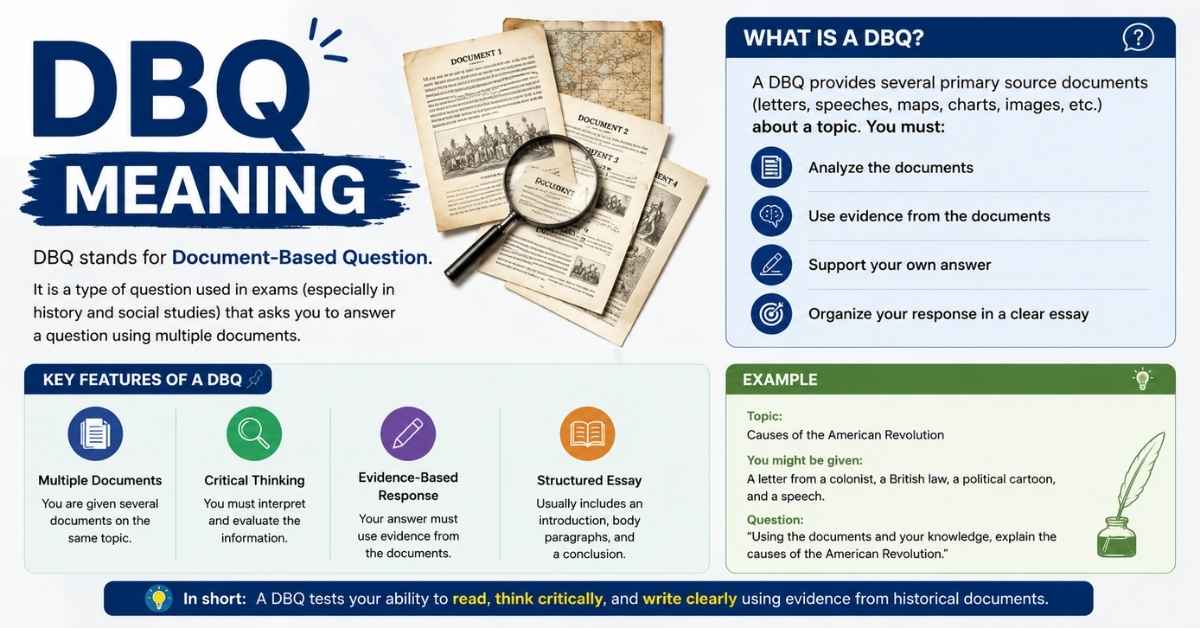
DBQ meaning most commonly refers to Document-Based Question, a type of essay used in AP History courses that asks students to analyze historical documents and use them as evidence to support an argument. However, in a completely different context, DBQ also stands for Disability Benefits Questionnaire, a medical form used by the U.S. Department of Veterans Affairs (VA) to help evaluate disability claims. The correct meaning depends on where you encounter the acronym.
If you’ve searched for “What does DBQ mean?”, you’re likely looking for a quick definition—but understanding the context is just as important. Whether you’re an AP World History student preparing for an exam, a veteran navigating the VA disability claims process, or simply curious after seeing the term online, this guide explains every major meaning of DBQ in clear, practical language.
Unlike many articles that focus on only one definition, this comprehensive guide covers both the educational and Veterans Affairs meanings of DBQ, explains how each one works, and helps you determine which definition applies to your situation.
Quick Answer: What Does DBQ Mean?
| Context | DBQ Meaning | Purpose |
|---|---|---|
| AP History & School | Document-Based Question | An essay that requires students to analyze historical documents and build an evidence-based argument. |
| Veterans Affairs (VA) | Disability Benefits Questionnaire | A medical form used to document health conditions during a VA disability claim. |
| General Usage | Acronym | The meaning depends entirely on the context in which it is used. |
In short: If someone mentions a DBQ in a classroom or history exam, they almost certainly mean a Document-Based Question. If the discussion involves military service, healthcare, or disability compensation, DBQ usually refers to a Disability Benefits Questionnaire.
What Does DBQ Mean?
The acronym DBQ has multiple meanings, but the two most widely recognized definitions are:
- Document-Based Question – used in education, especially Advanced Placement (AP) History courses.
- Disability Benefits Questionnaire – used by the U.S. Department of Veterans Affairs (VA) during the disability claims process.
Although these definitions belong to entirely different fields, both involve analyzing information and supporting conclusions with evidence.
Why Does the Meaning Change?
Like many abbreviations, DBQ is a context-dependent acronym. English contains thousands of abbreviations that represent different phrases depending on where they’re used.
For example:
- In a history classroom, DBQ relates to historical analysis and essay writing.
- In a medical or military setting, DBQ refers to documentation used during a VA disability evaluation.
Understanding the surrounding conversation usually makes the intended meaning obvious.
Why Does DBQ Have More Than One Meaning?
One reason people become confused is that search engines display results from several industries at once. Students searching for DBQ meaning in history may see Veterans Affairs resources, while veterans searching for VA DBQ meaning may encounter educational websites.
This overlap happens because acronyms are often reused across different professions.
Think of it this way:
If you see DBQ in…
| Situation | Most Likely Meaning |
|---|---|
| AP World History class | Document-Based Question |
| APUSH assignment | Document-Based Question |
| AP European History exam | Document-Based Question |
| College Board exam guide | Document-Based Question |
| VA disability paperwork | Disability Benefits Questionnaire |
| Medical examination | Disability Benefits Questionnaire |
| Veterans Benefits Administration documents | Disability Benefits Questionnaire |
A simple rule is:
- School = Document-Based Question
- VA or healthcare = Disability Benefits Questionnaire
This distinction alone answers one of the biggest questions users have when searching for DBQ meaning.
DBQ Meaning in AP History and School
In education, DBQ stands for Document-Based Question.
It is a writing assignment that asks students to examine a collection of primary sources, historical documents, maps, charts, political cartoons, speeches, or letters before writing an analytical essay.
Instead of relying only on memory, students must use evidence from these documents to develop and defend an argument.
This approach encourages critical thinking, historical reasoning, and evidence-based writing rather than simple memorization.
DBQs are commonly used in:
- AP United States History (APUSH)
- AP World History
- AP European History
- Honors history courses
- College-level history classes
Because students must interpret multiple sources, a DBQ is considered one of the most challenging—but also one of the most rewarding—types of history assignments.
What Is a DBQ Essay?
A DBQ essay is a structured response to a Document-Based Question.
Unlike a standard essay, it requires students to build an argument using evidence from provided historical documents while also incorporating their own historical knowledge.
A strong DBQ essay usually includes:
- A clear thesis statement
- Careful analysis of primary sources
- Relevant outside historical evidence
- Logical organization
- Contextual understanding
- Accurate interpretation of documents
- A well-supported conclusion
The goal is not simply to summarize the documents but to explain what they reveal, how they relate to one another, and how they support the writer’s argument.
For example, a prompt might ask:
Evaluate the extent to which industrialization changed society between 1750 and 1900.
Students would receive several historical documents and use them to develop an evidence-based essay that addresses the question directly.
Why Are DBQs Important?
Many students wonder why teachers use DBQs instead of traditional exams.
The answer is simple: DBQs measure how well students think—not just what they remember.
Modern history education emphasizes the ability to analyze information, evaluate sources, and construct logical arguments. A DBQ combines all of these skills into one assignment.
Benefits of DBQs
- Develop critical thinking skills
- Improve analytical writing
- Teach students how to interpret historical evidence
- Encourage logical reasoning
- Build stronger research habits
- Prepare students for college-level writing
- Strengthen argumentation skills
These abilities extend far beyond history classes. Whether you’re studying law, political science, journalism, or social sciences, learning how to analyze evidence and communicate ideas clearly is invaluable.
What Skills Does a DBQ Test?
A Document-Based Question evaluates much more than writing ability. It measures several interconnected academic skills that colleges and educators value.
1. Historical Reasoning
Students must understand the broader historical context rather than viewing documents in isolation.
2. Document Analysis
Each source must be examined carefully to determine:
- Purpose
- Audience
- Point of view
- Reliability
- Historical significance
3. Evidence-Based Writing
Strong essays support every major claim with evidence rather than opinion.
Students learn to connect:
Claim → Evidence → Explanation
This framework helps create persuasive, logical arguments.
4. Critical Thinking
Instead of accepting every document at face value, students evaluate bias, perspective, and historical context.
For instance, a political speech may reflect the speaker’s goals rather than presenting a completely objective account of events.
5. Organization
A successful DBQ essay follows a logical structure with:
- Introduction
- Thesis
- Body paragraphs
- Evidence integration
- Analysis
- Conclusion
Good organization makes arguments easier to follow and demonstrates a clear line of reasoning.
6. Communication Skills
Perhaps the most valuable skill developed through DBQs is the ability to communicate complex ideas clearly and convincingly.
Students learn to:
- Present arguments logically
- Explain evidence effectively
- Connect ideas smoothly
- Write with clarity and precision
These skills benefit not only AP History exams but also university coursework, professional writing, and many future careers.
Common Mistakes Students Make in a DBQ
Even well-prepared students can lose points by making avoidable errors. Some of the most common mistakes include:
- Summarizing documents instead of analyzing them
- Writing a weak or unclear thesis statement
- Ignoring the historical context
- Failing to connect evidence to the main argument
- Relying on only one or two documents
- Forgetting to include outside evidence
- Misinterpreting the author’s point of view
- Spending too much time describing rather than explaining
Recognizing these pitfalls is the first step toward writing a stronger DBQ essay.
Tips for Writing a Strong DBQ
Experienced AP History teachers often recommend the following strategies:
- Read the prompt carefully before looking at the documents.
- Group documents by theme rather than discussing them one by one.
- Develop a clear thesis that directly answers the question.
- Use both document evidence and outside historical knowledge.
- Explain why each piece of evidence matters instead of simply quoting it.
- Consider the author’s perspective, audience, and historical context.
- Leave time to review your essay for clarity and organization.
These practical habits not only improve exam performance but also help students develop stronger analytical and writing skills over time.
Step-by-Step: How to Answer a DBQ Successfully
Writing a DBQ essay can feel overwhelming the first time, but breaking the process into manageable steps makes it much easier. The highest-scoring essays don’t simply summarize documents—they build a persuasive argument supported by evidence and historical reasoning.
Whether you’re preparing for AP World History, AP United States History (APUSH), or AP European History, following a proven process can improve both your confidence and your score.
Step 1: Read the Prompt Carefully
Before reading any documents, focus on the question itself.
Ask yourself:
- What historical period is being discussed?
- What is the task? (Compare, evaluate, analyze, explain, or assess.)
- What argument am I expected to make?
Understanding the prompt first helps you interpret the documents with a clear purpose instead of reading them aimlessly.
Step 2: Examine Every Document
A DBQ typically includes several primary sources, such as:
- Historical letters
- Speeches
- Maps
- Political cartoons
- Charts
- Photographs
- Government records
- Newspaper excerpts
For each document, identify:
- Author
- Audience
- Purpose
- Point of view
- Historical context
- Key evidence
Rather than asking, “What does this document say?” ask, “How does this document help answer the prompt?”
Step 3: Group Documents by Theme
Instead of discussing each document individually, organize them into logical categories.
For example, if the topic is the Industrial Revolution, you might group documents under:
- Economic changes
- Social impacts
- Technological innovations
- Labor conditions
Grouping documents creates a more organized and persuasive essay.
Step 4: Develop a Strong Thesis Statement
Your thesis statement should answer the question directly.
Weak example:
Industrialization changed society.
Better example:
Industrialization transformed society by expanding factory production, accelerating urbanization, and reshaping labor systems, although it also created significant social inequalities.
A strong thesis gives your essay a clear direction.
Step 5: Support Every Claim with Evidence
High-scoring DBQ essays follow a simple structure:
Claim → Evidence → Explanation
Don’t stop after quoting a document. Explain why the evidence matters and how it supports your argument.
Step 6: Include Outside Evidence
One common scoring requirement is using historical knowledge beyond the provided documents.
For example:
- Significant historical events
- Important legislation
- Influential leaders
- Economic developments
- Cultural movements
Adding relevant outside evidence demonstrates a deeper understanding of the topic.
Step 7: Review Before Submitting
Before finishing your essay, check that you have:
- Answered the prompt directly
- Included a clear thesis
- Used multiple documents effectively
- Added outside evidence
- Explained your reasoning
- Organized ideas logically
- Corrected grammar and spelling mistakes
Even a few minutes of review can improve the overall quality of your response.
Learn More: PNP Meaning
Example of a DBQ Question
Seeing a sample prompt makes the concept much easier to understand.
Sample Prompt
Evaluate the extent to which the Industrial Revolution changed the daily lives of people in Europe between 1750 and 1900.
Students might receive documents such as:
- Factory worker testimonies
- Population growth charts
- Photographs of industrial cities
- Government labor reports
- Political cartoons
- Economic data
A successful response would not simply summarize each document. Instead, it would use the evidence to support a central argument about how industrialization transformed European society.
Example Thesis
Although the Industrial Revolution improved economic productivity and technological innovation, it also introduced harsh working conditions and rapid urbanization that dramatically changed everyday life across Europe.
This type of thesis is clear, balanced, and directly addresses the prompt.
DBQ Meaning in Veterans Affairs
Outside the classroom, DBQ meaning takes on an entirely different definition.
In the U.S. Department of Veterans Affairs (VA), DBQ stands for Disability Benefits Questionnaire.
A Disability Benefits Questionnaire is a standardized medical form used to document the severity of a veteran’s medical condition. It provides detailed clinical information that helps the Veterans Benefits Administration (VBA) evaluate disability compensation claims.
Unlike the educational DBQ, this version has nothing to do with essay writing or history.
Instead, it focuses on medical evidence, diagnoses, symptoms, and functional limitations.
What Is a Disability Benefits Questionnaire?
A Disability Benefits Questionnaire (DBQ) is designed to collect consistent medical information for specific health conditions.
The form helps VA decision-makers understand:
- The veteran’s diagnosis
- Current symptoms
- Medical history
- Physical limitations
- Severity of the condition
- Impact on daily life
- Relevant clinical findings
The information provided can influence how a disability claim is evaluated.
Why Is a VA DBQ Important?
Medical evidence is one of the most important parts of a VA disability claim.
A completed DBQ helps ensure that healthcare providers record information in a standardized format, making it easier for claims reviewers to assess the condition consistently.
Depending on the situation, a DBQ may:
- Support existing medical records
- Clarify the severity of a disability
- Document functional impairment
- Assist with disability evaluations
It’s important to remember that a DBQ does not automatically guarantee disability benefits. The VA considers the DBQ alongside other evidence when making a decision.
Who Completes a VA DBQ?
Depending on the type of claim and current VA procedures, a qualified healthcare professional may complete the questionnaire.
This could include:
- VA healthcare providers
- Specialists
- Other licensed medical professionals, where accepted
The exact requirements may vary based on the condition being evaluated and current VA policies.
What Information Does a VA DBQ Include?
Although each questionnaire is tailored to a specific medical condition, most include sections covering:
- Medical diagnosis
- Date of diagnosis
- Symptoms
- Clinical findings
- Test results
- Functional limitations
- Occupational impact
- Medical history
- Treatment information
The goal is to create a complete medical picture that supports an accurate disability evaluation.
Common Misconceptions About VA DBQs
Many people misunderstand how Disability Benefits Questionnaires work.
Myth: A DBQ automatically approves a disability claim.
Reality: A DBQ is only one piece of evidence. The VA reviews all available medical and service-related documentation.
Myth: Every veteran must submit a DBQ.
Reality: Requirements depend on the specific claim and the evidence already available.
Myth: A DBQ replaces all medical records.
Reality: Medical records, examinations, service records, and other supporting documents remain important parts of the evaluation process.
Understanding these distinctions can help veterans approach the claims process with more realistic expectations.
AP History DBQ vs. VA Disability DBQ
Although both use the same acronym, they serve completely different purposes.
| Feature | AP History DBQ | VA Disability DBQ |
|---|---|---|
| Full Form | Document-Based Question | Disability Benefits Questionnaire |
| Purpose | Analyze historical documents and write an essay | Document medical evidence for disability claims |
| Primary Users | Students | Veterans and healthcare providers |
| Field | Education | Healthcare / Veterans Affairs |
| Outcome | Academic assessment | Disability evaluation support |
| Focus | Historical reasoning and evidence | Medical diagnosis and functional limitations |
This comparison helps readers immediately identify which definition applies to their situation.
Other Meanings of DBQ
Although the educational and Veterans Affairs definitions are by far the most common, DBQ can occasionally represent other phrases in specialized industries or organizations.
Examples may include:
- Internal business abbreviations
- Technical project names
- Organization-specific terminology
However, these uses are relatively uncommon and rarely appear in general online searches.
For most people, Document-Based Question and Disability Benefits Questionnaire are the only meanings they need to know.
How to Tell Which DBQ Meaning Someone Is Using
The easiest way to understand DBQ meaning is by looking at the surrounding context.
| If You See DBQ In… | It Most Likely Means… |
|---|---|
| AP World History class | Document-Based Question |
| APUSH homework | Document-Based Question |
| AP European History exam | Document-Based Question |
| College Board materials | Document-Based Question |
| History textbook | Document-Based Question |
| VA paperwork | Disability Benefits Questionnaire |
| Veterans Benefits Administration documents | Disability Benefits Questionnaire |
| Medical evaluation | Disability Benefits Questionnaire |
| Disability compensation discussion | Disability Benefits Questionnaire |
Real-World Examples
Example 1
“Our teacher assigned a DBQ on the French Revolution.”
Meaning:
Document-Based Question
Example 2
“The doctor completed my DBQ before I submitted my VA disability claim.”
Meaning:
Disability Benefits Questionnaire
Example 3
“The APUSH exam includes a DBQ section.”
Meaning:
Document-Based Question
Example 4
“The VA requested additional information through a DBQ.”
Meaning:
Disability Benefits Questionnaire
By paying attention to the topic of the conversation, you can usually determine the correct definition within seconds.
Common Misunderstandings About DBQ
Because DBQ meaning changes depending on the context, it’s easy to misunderstand the acronym. Many people assume it has only one definition, while others confuse the educational and medical versions. Clearing up these misconceptions can save time and help you understand discussions more accurately.
Myth 1: DBQ Always Means the Same Thing
Reality: The acronym DBQ has multiple meanings. The two most common are:
- Document-Based Question in education
- Disability Benefits Questionnaire in Veterans Affairs
Always consider the surrounding context before deciding which definition applies.
Myth 2: Every History Essay Is a DBQ
Reality: A DBQ essay is only one type of history essay.
Students may also write:
- LEQ (Long Essay Question)
- FRQ (Free-Response Question)
- Short-answer responses
- Research essays
A DBQ is unique because it requires students to analyze primary sources and incorporate them into a well-supported argument.
Myth 3: A VA DBQ Guarantees Disability Benefits
Reality: A Disability Benefits Questionnaire is an important piece of medical evidence, but it does not automatically result in disability compensation.
The Veterans Benefits Administration (VBA) reviews:
- Medical records
- Service records
- Clinical examinations
- Supporting documentation
- Applicable laws and regulations
The DBQ is one part of a larger evaluation process.
Myth 4: DBQs Are Only Used in AP History
Reality: While Document-Based Questions are best known from AP World History, AP United States History (APUSH), and AP European History, similar document-analysis assignments are also used in many honors, college, and university history courses.
Myth 5: You Only Need to Summarize the Documents
Reality: High-scoring DBQ essays require analysis, not just summary.
Instead of repeating what each document says, explain:
- Why the document matters
- How it supports your thesis
- What historical significance it has
- How it connects to the broader historical context
This analytical approach is what separates average essays from excellent ones.
See More: PFMS Full Form
Related Terms You Should Know
Understanding a few related concepts makes DBQ meaning much easier to grasp.
APUSH
APUSH stands for Advanced Placement United States History.
It is one of the most common courses where students encounter a Document-Based Question.
AP World History
This course asks students to analyze historical developments across different civilizations and time periods.
The DBQ section measures a student’s ability to interpret historical documents and build evidence-based arguments.
AP European History
Students examine major European political, economic, cultural, and social changes using historical evidence.
DBQs play a significant role in assessing historical reasoning skills.
Primary Sources
A primary source is a document or object created during the historical period being studied.
Examples include:
- Letters
- Diaries
- Government documents
- Maps
- Speeches
- Photographs
- Political cartoons
- Newspapers
These sources form the foundation of a Document-Based Question.
Secondary Sources
Secondary sources interpret or analyze historical events rather than documenting them directly.
Examples include:
- History textbooks
- Scholarly articles
- Biographies
- Academic journals
Understanding the difference between primary and secondary sources is essential when writing a strong DBQ essay.
Historical Reasoning
Historical reasoning involves:
- Evaluating evidence
- Identifying cause and effect
- Comparing historical events
- Recognizing continuity and change
- Understanding historical context
These skills are central to success on AP History exams.
Thesis Statement
Every effective DBQ begins with a clear thesis statement that directly answers the prompt and guides the rest of the essay.
A strong thesis should be:
- Specific
- Arguable
- Evidence-based
- Focused on the question
Historical Context
Context explains the broader circumstances surrounding an event.
For example, when writing about the Industrial Revolution, understanding economic conditions before industrialization provides important background for interpreting the documents.
Outside Evidence
High-scoring DBQ essays often include outside evidence—relevant historical knowledge not found in the provided documents.
This demonstrates a deeper understanding of the topic and strengthens the overall argument.
C&P Exam
In the Veterans Affairs context, a Compensation and Pension (C&P) Exam is a medical evaluation that may be used to assess a veteran’s disability claim.
Although related, a C&P Exam and a Disability Benefits Questionnaire (DBQ) are not the same thing. A DBQ documents medical findings, while a C&P exam is part of the broader evaluation process.
Disability Rating
After reviewing medical evidence—including any relevant DBQs—the VA determines a disability rating, which reflects the severity of a service-connected condition under VA regulations.
Frequently Asked Questions About DBQ Meaning
What does DBQ stand for?
DBQ most commonly stands for Document-Based Question in education and Disability Benefits Questionnaire in Veterans Affairs.
What is a DBQ essay?
A DBQ essay is a history essay that requires students to analyze historical documents and use them as evidence to support a well-developed argument.
Is a DBQ only used in AP History?
No. Although DBQs are most closely associated with AP History courses, similar document-based assignments are also used in many honors and college history classes.
What is a VA DBQ?
A VA DBQ is a Disability Benefits Questionnaire, a standardized medical form used to document a veteran’s health condition during the disability claims process.
Is a DBQ difficult?
Many students find DBQs challenging because they combine reading comprehension, historical analysis, critical thinking, and essay writing. However, with consistent practice and a structured approach, they become much more manageable.
How long is a DBQ essay?
The length depends on the exam or instructor’s requirements. Rather than focusing on word count, students should aim to answer the prompt thoroughly with a clear thesis, strong evidence, and thoughtful analysis.
What’s the difference between a DBQ and an FRQ?
A DBQ requires students to analyze provided historical documents, while an FRQ (Free-Response Question) generally asks students to answer using their own knowledge without relying on a document set.
Can a private physician complete a VA DBQ?
VA policies can change over time, and eligibility depends on the type of claim and current VA requirements. Veterans should always refer to the latest official guidance or consult the VA regarding accepted medical evidence.
Why are DBQs important in AP History?
DBQs encourage students to think like historians by evaluating sources, identifying historical context, and building evidence-based arguments instead of memorizing facts.
How can I improve my DBQ writing skills?
Practice is the key. Focus on:
- Reading historical documents carefully
- Writing clear thesis statements
- Organizing evidence by theme
- Explaining the significance of each document
- Adding relevant outside historical knowledge
- Reviewing sample high-scoring essays
Conclusion
DBQ meaning may seem confusing at first because the acronym is used in two very different fields, but the distinction becomes simple once you know the context. In classrooms, a Document-Based Question helps students develop critical thinking, document analysis, and evidence-based writing skills that extend far beyond history exams. In the Veterans Affairs system, a Disability Benefits Questionnaire provides structured medical information that supports the evaluation of disability claims.
Recognizing which version of DBQ is being discussed allows you to understand conversations, academic materials, and official documents with confidence. Whether you’re an AP History student aiming for a higher exam score or a veteran trying to understand the claims process, knowing the meaning of DBQ is the first step toward making informed decisions.
By understanding both definitions—and the contexts in which they are used—you’ll be better equipped to interpret the acronym correctly whenever you encounter it.