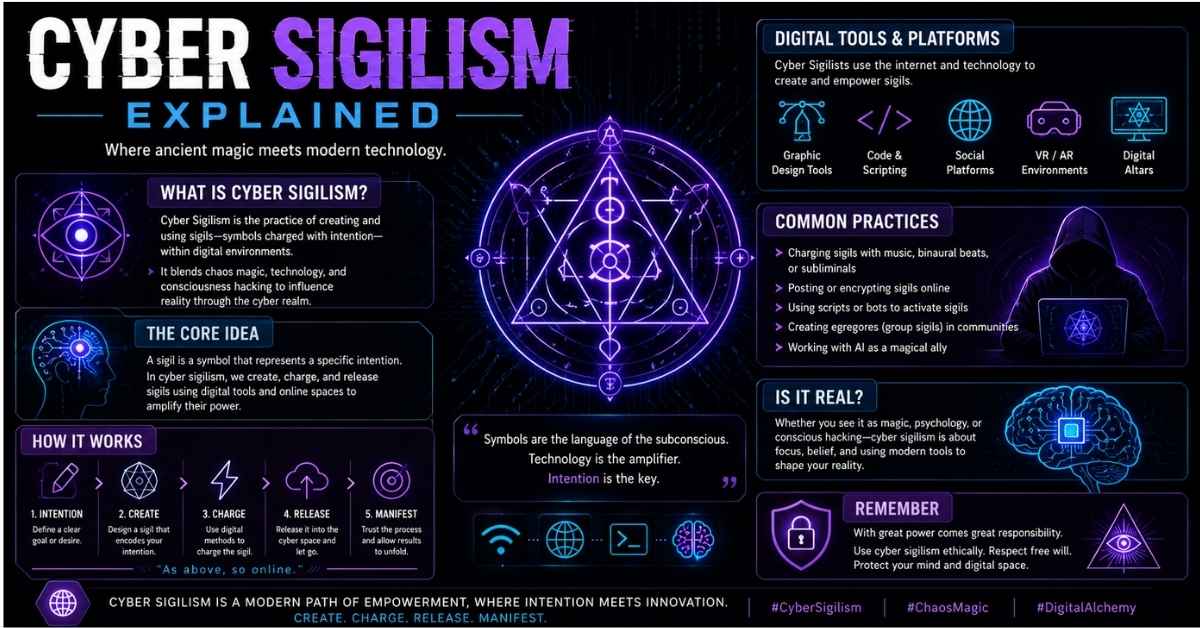
Cyber sigilism is a modern visual art and tattoo aesthetic that blends abstract sigil-inspired linework, futuristic design, cyberpunk influences, and contemporary internet culture into bold, symbolic creations. Unlike traditional tribal tattoos or ancient magical sigils, cyber sigilism focuses more on personal expression, digital-era aesthetics, and unique visual identity than on fixed symbolic meanings. Its popularity has exploded across TikTok, Pinterest, Instagram, and alternative fashion communities, making it one of the most recognizable tattoo and design trends of recent years.
If you’ve seen intricate black line tattoos wrapping around arms, shoulders, or backs and wondered whether they were tribal tattoos, blackwork, or something entirely different, you’re not alone. The rapid rise of cyber sigilism has created plenty of confusion. Some people describe it as an evolution of neo-tribal tattoos, while others see it as an internet-born artistic movement inspired by cyberpunk, digital illustration, and experimental graphic design.
The truth lies somewhere in between. Cyber sigilism isn’t defined by a single rulebook or creator. Instead, it has grown organically through online art communities, tattoo artists, and designers who share an appreciation for flowing linework, abstract symbolism, futuristic aesthetics, and highly personalized artwork.
In this guide, you’ll discover what cyber sigilism really is, where it came from, why it became a global trend, what makes a design authentic, and how it differs from similar tattoo styles. Whether you’re simply curious about the trend or considering your own cyber sigilism tattoo, this article will help you understand the movement beyond the social media hype.
What Is Cyber Sigilism?
At its core, cyber sigilism is an artistic style that combines organic flowing lines, abstract symbols, futuristic forms, and digital-inspired aesthetics into visually striking designs. It appears most commonly in tattoos, but its influence has expanded into graphic design, fashion, album artwork, digital illustration, streetwear, and online visual culture.
Rather than representing one fixed symbol or belief system, cyber sigilism acts as a visual language. Every piece can carry different meanings depending on the artist and the individual wearing or creating it.
Unlike traditional symbolic systems where each mark has an established interpretation, cyber sigilism embraces creative freedom. A design might represent resilience for one person, transformation for another, or simply serve as an expression of artistic taste without any deeper spiritual significance.
Its defining characteristics include:
- Flowing black linework
- Abstract geometric forms
- Layered compositions
- Dynamic movement
- Sharp curves and spikes
- Organic yet futuristic shapes
- High visual contrast
- Minimal use of color
- Strong body-flow integration in tattoo designs
These elements create artwork that feels simultaneously ancient and futuristic—a combination that explains much of its appeal.
A Simple Definition Anyone Can Understand
Think of cyber sigilism as a modern fusion of:
- abstract art
- blackwork tattoos
- digital illustration
- cyberpunk aesthetics
- ornamental body art
- experimental graphic design
Instead of depicting recognizable objects like flowers, animals, or portraits, cyber sigilism uses lines, curves, spikes, symmetry, and negative space to create emotion and movement.
Many people compare these designs to futuristic symbols or alien calligraphy because they often appear unfamiliar while still feeling strangely balanced and intentional.
One of the biggest reasons for its popularity is that every viewer can interpret the artwork differently, making each design feel deeply personal.
Why the Name “Cyber Sigilism” Can Be Misleading
The name itself often causes confusion.
Let’s break it down.
“Cyber”
The word cyber doesn’t necessarily refer to computers or technology directly. Instead, it reflects the futuristic visual style inspired by:
- cyberpunk culture
- digital environments
- science fiction
- virtual identities
- internet aesthetics
These influences give cyber sigilism its sleek, modern appearance.
“Sigil”
Historically, a sigil is a symbol intentionally created to represent an idea, desire, or personal goal. In various historical and artistic traditions, sigils have been used as unique visual representations rather than decorative patterns alone.
Modern cyber sigilism borrows the idea of creating unique symbolic forms but usually does not require any connection to historical occult practices. Most contemporary artists use the term to describe a distinctive visual style rather than a spiritual system.
Understanding this distinction is important because many online articles mistakenly imply that every cyber sigilism design carries mystical or magical meaning. In reality, meanings are usually personal, artistic, or entirely aesthetic.
Is It an Art Style, Tattoo Style, Design Language, or Internet Aesthetic?
The most accurate answer is:
It’s all of them.
Cyber sigilism has evolved beyond tattoos into a broader creative movement.
Today you’ll find cyber sigilism influencing:
- Tattoo design
- Streetwear graphics
- Poster art
- Album covers
- Digital illustration
- Motion graphics
- 3D artwork
- Fashion accessories
- Social media branding
- Experimental typography
This crossover explains why the style continues to grow. It isn’t limited to one medium—it functions as a recognizable visual identity across multiple creative industries.
The Origins of Cyber Sigilism
One of the biggest misconceptions online is that cyber sigilism suddenly appeared on TikTok.
The reality is much more interesting.
While social media accelerated its popularity, the visual influences behind cyber sigilism developed over many years through different artistic movements.
Understanding these influences helps explain why the style feels both futuristic and strangely familiar.
The Meaning Behind “Sigil”
Long before cyber sigilism existed, artists and cultures around the world used symbolic marks to communicate ideas.
A sigil is generally understood as a custom-designed symbol representing a concept, intention, or identity. Over time, artists began exploring sigils less as spiritual tools and more as expressive visual forms.
This shift opened the door for designers to experiment with symbols as purely artistic compositions.
Cyber sigilism inherits this visual philosophy while moving away from standardized meanings.
Instead of asking, “What does this symbol traditionally represent?” artists often ask, “How can this design express movement, identity, or emotion?”
Where the “Cyber” Influence Comes From
The futuristic side of cyber sigilism draws inspiration from several overlapping sources.
These include:
- Cyberpunk visual culture
- Science fiction
- Digital interface design
- Experimental typography
- Video game aesthetics
- Industrial design
- Abstract graphic illustration
Many of these influences emphasize sleek curves, layered compositions, metallic forms, and fluid movement.
Rather than copying machines directly, cyber sigilism captures the feeling of living in an increasingly digital world.
The result is artwork that appears almost alive—flowing across the body or page like futuristic calligraphy.
How Internet Culture Shaped the Style
Without the internet, cyber sigilism would likely have remained a niche artistic experiment.
Instead, platforms like TikTok, Instagram, Pinterest, and digital portfolio communities allowed artists to share highly distinctive work with millions of viewers.
Algorithms rewarded visually unusual content, and cyber sigilism quickly stood out.
Its bold black lines looked striking even in small thumbnails, making it ideal for short-form visual platforms.
As more creators adopted the style, it evolved rapidly.
Tattoo artists introduced new body-flow techniques.
Graphic designers adapted it for branding.
Fashion brands incorporated it into clothing.
Digital illustrators pushed its boundaries even further.
The style became collaborative rather than controlled by a single creator.
Timeline: From Symbolic Marks to a Modern Digital Aesthetic
Although cyber sigilism is a contemporary trend, its evolution can be understood through several stages.
| Period | Influence | Contribution to Cyber Sigilism |
|---|---|---|
| Ancient cultures | Symbolic marks and personal symbols | Visual abstraction and symbolic thinking |
| Late 20th century | Tribal revival and blackwork | Bold flowing linework |
| 1980s–1990s | Cyberpunk art and science fiction | Futuristic visual language |
| Early digital era | Graphic design and digital illustration | Experimental forms and composition |
| Social media era | TikTok, Pinterest, Instagram | Global popularity and rapid stylistic evolution |
This timeline highlights that cyber sigilism is an evolving artistic language, not a style that emerged overnight.
Why Cyber Sigilism Became So Popular
Trends rarely succeed because of appearance alone.
Cyber sigilism resonates because it aligns with how many people want to express themselves today.
Rather than choosing universally recognized symbols, many individuals prefer artwork that feels unique, open to interpretation, and deeply personal.
Cyber sigilism satisfies that desire remarkably well.
The Rise of TikTok and Visual Trends
Modern social media rewards designs that immediately capture attention.
Cyber sigilism’s dramatic black lines, layered compositions, and flowing shapes create instant visual impact.
Unlike highly detailed realism, these designs remain recognizable even in short videos or small mobile screens.
As creators showcased tattoos, sketches, and digital artwork, the aesthetic spread rapidly across online communities.
What began as a niche visual language soon became a global trend.
Why Gen Z Connects With the Style
For many younger audiences, identity is increasingly expressed through aesthetics rather than labels.
Cyber sigilism allows people to wear artwork that doesn’t need immediate explanation.
Its ambiguity becomes part of its appeal.
Instead of communicating one fixed message, each design invites curiosity and conversation.
That sense of individuality explains why so many people see cyber sigilism as more than a tattoo style—it’s a form of personal storytelling.
Individual Identity in the Digital Age
In an era where trends spread globally within days, standing out has become more difficult.
Cyber sigilism offers something different.
Custom designs ensure that no two pieces need to look identical.
Artists often create compositions that follow the body’s natural movement, making each tattoo unique to its wearer.
This emphasis on originality reflects a broader cultural shift toward personalized visual identity.
Why Mysterious Designs Feel More Personal
Interestingly, people often connect more deeply with symbols that don’t have obvious meanings.
When a design leaves room for interpretation, viewers naturally create their own stories.
That emotional engagement is one reason cyber sigilism continues to attract artists, collectors, designers, and fashion enthusiasts alike.
Instead of simply decorating the body, these flowing abstract forms encourage imagination—allowing each piece to become part of the wearer’s own narrative.
What Makes a Design Truly Cyber Sigilism?
As cyber sigilism has become more mainstream, almost every abstract black tattoo is being labeled as “cyber sigilism.” In reality, that’s not accurate.
A true cyber sigilism design isn’t defined by random spikes or decorative lines. Instead, it’s recognized by a combination of composition, movement, body flow, negative space, symmetry (or intentional asymmetry), and futuristic visual language. These elements work together to create artwork that feels alive rather than simply decorative.
The best cyber sigilism pieces look effortless, but they are carefully planned. Every curve, intersection, and empty space contributes to the overall composition.
Signature Characteristics of Cyber Sigilism
Although every artist has a unique approach, most authentic cyber sigilism artwork shares several defining features.
Flowing Linework
The lines guide the viewer’s eye naturally across the design instead of ending abruptly. Whether the artwork is on paper or tattooed on skin, it creates a continuous sense of movement.
Layered Composition
Rather than relying on a single bold shape, cyber sigilism often combines multiple layers of curves, hooks, spikes, and abstract forms. This layering creates depth without overwhelming the design.
Negative Space
One of the most overlooked design principles is negative space—the intentional empty areas between lines. These spaces prevent the artwork from looking cluttered and help every element remain visually distinct.
Organic Yet Futuristic Forms
Cyber sigilism combines natural movement with digital aesthetics. Some shapes resemble vines, wings, flames, or bones, while others feel inspired by futuristic interfaces or alien typography. This balance between organic and technological influences gives the style its distinctive identity.
Visual Rhythm
Just like music has rhythm, strong cyber sigilism artwork has a consistent visual pace. Thick and thin lines, curved sections, sharp points, and open spaces work together to guide the eye smoothly from one area to another.
Expert Insight: Not Every Abstract Black Tattoo Is Cyber Sigilism
This is one of the biggest misconceptions online.
Many tattoos featuring sharp black lines are marketed as cyber sigilism simply because the style is popular. However, a tattoo becomes cyber sigilism through its overall design philosophy, not by copying a few trendy elements.
For example:
- Random spikes alone do not create cyber sigilism.
- Tribal-inspired curves alone do not make it cyber sigilism.
- Abstract blackwork alone isn’t enough.
Instead, the style depends on thoughtful composition, movement, originality, and harmony between all visual elements.
A Quick Checklist to Recognize Authentic Cyber Sigilism
Ask yourself these questions:
- Does the design have a natural visual flow?
- Is there a balance between filled and empty space?
- Do the lines feel intentional rather than random?
- Does the composition suit the body’s natural shape?
- Is the artwork original instead of copied?
- Does it combine futuristic and organic influences?
If the answer to most of these questions is yes, you’re likely looking at genuine cyber sigilism-inspired artwork.
Cyber Sigilism vs. Similar Styles
One reason this aesthetic creates confusion is that it shares visual characteristics with several other tattoo styles. Understanding the differences helps you appreciate what makes cyber sigilism unique.
| Style | Main Characteristics | How It Differs from Cyber Sigilism |
|---|---|---|
| Cyber Sigilism | Flowing abstract linework, futuristic symbolism, body movement | Focuses on digital aesthetics, originality, and symbolic abstraction |
| Neo-Tribal | Modern reinterpretation of tribal patterns | Inspired by tribal traditions but less influenced by futuristic design |
| Traditional Tribal | Cultural symbols with historical significance | Rooted in specific cultures and traditions rather than internet aesthetics |
| Blackwork | Solid black shapes and bold geometric patterns | Emphasizes black ink rather than flowing symbolic composition |
| Cyberpunk Art | Neon colors, technology, dystopian themes | A broader artistic genre rather than a tattoo style |
| Biomechanical Tattoos | Mechanical structures blended with anatomy | Mimics machinery instead of abstract symbolic forms |
While these styles occasionally overlap, cyber sigilism stands apart because it prioritizes movement, symbolism, abstraction, and futuristic visual storytelling.
Learn More: Feral Meaning Explained
Does Cyber Sigilism Have Meaning?
One of the most frequently asked questions is whether cyber sigilism carries a fixed symbolic meaning.
The short answer is not usually.
Unlike ancient symbols with established interpretations, cyber sigilism encourages personal meaning. A design may represent transformation, resilience, freedom, creativity, or simply an appreciation for modern aesthetics.
That’s one reason the style has become so appealing. It allows people to create artwork that feels deeply personal without being limited by traditional symbolism.
Personal Symbolism
Many artists collaborate closely with clients to create designs inspired by:
- Personal growth
- Significant life events
- Emotional healing
- Creativity
- Strength
- Individual identity
- Future aspirations
The resulting artwork becomes meaningful because of the story behind it, not because every viewer interprets it the same way.
Artistic Expression
For some people, cyber sigilism has no hidden message at all.
Instead, it’s valued for:
- Elegant composition
- Visual balance
- Dynamic movement
- Contemporary design
- Abstract beauty
Just as abstract paintings don’t require a literal interpretation, cyber sigilism can exist purely as artistic expression.
Cultural Interpretations
Because the style draws inspiration from many visual traditions, different communities interpret it differently.
Some see influences from:
- Graphic design
- Digital illustration
- Gothic aesthetics
- Contemporary tattoo culture
- Cyberpunk art
- Internet aesthetics
- Experimental typography
These influences enrich the style without giving it one universal meaning.
Myth vs. Fact
| Myth | Reality |
|---|---|
| Every cyber sigil has magical power. | Most modern designs are artistic rather than ritualistic. |
| Cyber sigilism is the same as tribal tattoos. | The two styles have different histories and visual goals. |
| Every artist follows identical design rules. | Individual creativity is central to cyber sigilism. |
| All designs must have hidden symbolism. | Many pieces are created purely for aesthetic expression. |
| Cyber sigilism appeared overnight on TikTok. | Social media accelerated its popularity, but its influences developed over many years. |
Anatomy of a Cyber Sigilism Design
Understanding the building blocks of cyber sigilism helps you appreciate why some designs look balanced while others feel chaotic.
Professional artists rarely begin by drawing random lines. Instead, they think about composition, movement, and body anatomy.
Curves
Curved lines create softness and movement. They guide the viewer’s eye naturally across the artwork and prevent the design from feeling rigid.
Sharp Angles
Spikes, hooks, and pointed edges introduce contrast and energy. Used carefully, they create tension without making the design appear aggressive.
Flow
One of the defining features of cyber sigilism is visual flow.
Every section should connect smoothly, creating the impression that the artwork grows naturally across the body instead of sitting on top of it.
Density
Areas of concentrated detail should be balanced with simpler sections.
Too much detail everywhere can make the tattoo difficult to read from a distance.
Contrast
Strong contrast between black ink and untouched skin creates dramatic visual impact.
The careful use of contrast also helps preserve readability as tattoos age.
Balance
Balance doesn’t always mean perfect symmetry.
Many successful cyber sigilism pieces intentionally use asymmetry while maintaining visual harmony.
Motion
The best designs almost appear to move.
This illusion comes from repeating curves, directional lines, spacing, and gradual changes in line thickness.
Motion is one of the reasons cyber sigilism feels dynamic instead of static.
Cyber Sigilism Tattoos
Cyber sigilism has become especially popular in tattoo culture because it adapts beautifully to the human body.
Instead of forcing artwork into predefined shapes, artists often design around muscles, joints, and natural body movement.
This creates tattoos that feel integrated rather than simply placed on the skin.
Why It Works So Well as Tattoo Art
Several characteristics make cyber sigilism particularly effective for tattoos:
- It follows body contours naturally.
- Black ink creates strong contrast.
- Custom designs emphasize individuality.
- Abstract forms age better than extremely detailed realism in many cases.
- Every composition can be tailored to the wearer.
Best Placement Ideas
Different placements create different visual effects.
Arms
Ideal for flowing designs that wrap around muscles.
Chest
Excellent for symmetrical compositions.
Spine
Perfect for vertical linework emphasizing movement.
Shoulders
Allow organic expansion toward the arms.
Upper Back
Provides enough space for large, highly detailed compositions.
Ribs
Suitable for elongated, elegant designs but generally more painful.
Thighs
Offer broad surfaces for larger artwork with fewer anatomical restrictions.
Small vs. Large Designs
Small tattoos work well for subtle symbolism but may lose intricate detail over time.
Larger designs allow artists to create smoother line flow, stronger composition, and greater visual depth.
Many experienced tattoo artists recommend scaling complex cyber sigilism pieces slightly larger than initially planned to preserve clarity over the years.
Fine Line vs. Bold Line
Fine-line cyber sigilism looks delicate and modern but requires exceptional precision.
Bold linework generally offers:
- Better long-term readability
- Improved contrast
- Less risk of visual blending
- Greater durability as the tattoo ages
The right choice depends on your personal style and your artist’s expertise.
Will a Cyber Sigilism Tattoo Age Well?
This is one of the most practical questions people ask—and one that many trend-focused articles overlook.
The answer depends less on the style itself and more on design quality, placement, skin type, artist skill, and aftercare.
A thoughtfully designed cyber sigilism tattoo can remain visually striking for years, while a poorly planned piece may blur and lose definition more quickly.
Factors That Affect Tattoo Longevity
Several factors influence how well intricate linework holds up over time:
- Line Thickness: Extremely thin lines are more likely to soften as skin changes naturally.
- Spacing: Adequate negative space helps preserve the design’s readability.
- Placement: Areas with less friction and stretching generally retain detail better.
- Artist Technique: Consistent depth and clean execution contribute to long-term results.
- Aftercare: Proper healing and sun protection help maintain contrast and clarity.
When discussing your design with an artist, it’s worth asking how they adjust compositions to ensure they remain attractive years after the tattoo heals.
How to Choose the Right Tattoo Artist
Cyber sigilism demands more than technical tattooing skills—it requires a strong understanding of composition, body flow, and custom design.
Choosing the right artist is often the difference between a timeless piece and one that feels rushed or overly trendy.
Look for These Qualities
- A portfolio featuring original, custom work.
- Smooth, confident linework.
- Examples of healed tattoos, not just fresh ones.
- Experience with blackwork or intricate abstract designs.
- Willingness to collaborate rather than copy existing artwork.
Red Flags to Avoid
- Copying designs directly from Pinterest or social media.
- Inconsistent or shaky lines.
- Overcrowded compositions with little negative space.
- No healed portfolio examples.
- Reluctance to discuss design longevity.
Before Booking an Artist: Practical Checklist
- Review multiple portfolio pieces.
- Ask whether the design will be created specifically for you.
- Request to see healed work.
- Discuss placement and long-term aging.
- Confirm hygiene and studio standards.
- Be open to the artist’s recommendations on size and spacing.
Investing time in choosing the right artist increases the likelihood that your cyber sigilism tattoo will remain visually compelling for years to come.
How Artists Create Cyber Sigilism Designs
One of the biggest misconceptions surrounding cyber sigilism is that artists simply draw random spikes, curves, and abstract lines until the design “looks cool.” In reality, creating a high-quality cyber sigilism piece requires planning, artistic judgment, and a strong understanding of composition, anatomy, visual balance, and line flow.
Experienced tattoo artists and digital illustrators rarely start with details. Instead, they build a design layer by layer, ensuring every element contributes to the overall movement and harmony.
Step 1: Understanding the Client’s Vision
Every successful custom design begins with a conversation.
Rather than asking, “What symbol do you want?” many artists ask questions like:
- What emotions should the design express?
- Do you want something bold or subtle?
- Should the artwork feel aggressive, elegant, mysterious, or futuristic?
- Which body placement are you considering?
- Do you prefer symmetry or an organic composition?
This process helps transform personal ideas into a unique visual language instead of copying existing artwork.
Step 2: Research and Inspiration
Professional artists gather inspiration from multiple sources, including:
- Cyberpunk aesthetics
- Blackwork tattoos
- Neo-tribal art
- Digital illustration
- Abstract graphic design
- Architectural curves
- Natural forms
- Experimental typography
The goal isn’t to imitate another artist but to develop an original concept that reflects the client’s personality.
Step 3: Building the Composition
At this stage, the artist focuses on:
- Body flow
- Negative space
- Visual rhythm
- Line hierarchy
- Balance
- Movement
Every section should naturally guide the viewer’s eye without making the composition feel crowded.
Step 4: Refinement and Tattoo Execution
Once the composition is finalized, the artist adjusts:
- Line thickness
- Spacing
- Curves
- Contrast
- Fine details
These refinements help ensure the tattoo remains readable and visually appealing even years after it has healed.
See More: Torta Girl Meaning
Common Mistakes People Make
This looks effortless when done well, but several common mistakes can reduce both its visual impact and longevity.
Copying Designs from Pinterest or Social Media
Using someone else’s tattoo as an exact reference may seem convenient, but it undermines one of the defining principles of cyber sigilism—originality.
Instead, collect inspiration from multiple sources and collaborate with an artist to create something personal.
Choosing an Artist Without Relevant Experience
Not every talented tattoo artist specializes in abstract linework or blackwork composition.
Review healed tattoos, custom projects, and line consistency before booking an appointment.
Ignoring Body Flow
A design that looks impressive on paper may not work on the human body.
Professional artists adapt every composition to complement muscles, joints, and natural movement rather than forcing artwork into awkward spaces.
Prioritizing Trends Over Personal Meaning
Trends come and go.
If your design reflects your own experiences, interests, or artistic preferences, it’s far more likely to remain meaningful long after the trend fades.
Making the Design Too Small
Intricate cyber sigilism tattoos rely on spacing and readability.
Reducing a complex design too much can cause fine details to blur together over time.
Always discuss sizing with your tattoo artist before making a final decision.
How to Create Your Own Cyber Sigilism-Inspired Concept
You don’t need to be an illustrator to contribute to the creative process.
Here are a few practical steps:
Start with a Theme
Think about the feeling you want the design to communicate.
Examples include:
- Growth
- Freedom
- Transformation
- Curiosity
- Strength
- Balance
- Mystery
- Creativity
Collect Visual References
Instead of saving identical tattoos, gather inspiration from:
- Architecture
- Nature
- Abstract art
- Graphic design
- Fashion
- Science fiction
- Digital interfaces
These references help artists understand your preferences without encouraging direct copying.
Work With Your Artist
Rather than asking for an exact replica, invite collaboration.
Experienced artists often improve an initial concept by refining body flow, spacing, and composition while preserving your original vision.
Prioritize Originality
The strongest Its designs aren’t the most complicated—they’re the most personal.
A custom piece will almost always feel more meaningful than a popular design copied from social media.
Cyber Sigilism Beyond Tattoos
Although tattoos remain the most recognizable expression of cyber sigilism, the aesthetic now extends across multiple creative fields.
Fashion
Streetwear brands increasingly use cyber sigilism-inspired graphics on:
- Hoodies
- Oversized T-shirts
- Jackets
- Accessories
The style’s bold linework complements contemporary alternative fashion.
Graphic Design
Designers incorporate This into:
- Brand identities
- Posters
- Editorial layouts
- Album artwork
- Digital campaigns
Its abstract visual language creates memorable compositions without relying on literal imagery.
Digital Illustration
Many digital artists combine cyber sigilism with:
- 3D rendering
- Motion graphics
- Character design
- Concept art
- Gaming visuals
This crossover demonstrates the style’s versatility beyond body art.
Social Media and Internet Aesthetics
Platforms like TikTok, Pinterest, and Instagram helped transform cyber sigilism from a niche design language into a recognizable internet aesthetic.
Today, creators continue experimenting with the style in photography, branding, animation, and visual storytelling.
Is This Just a Passing Trend?
It’s a fair question.
Many visual trends disappear as quickly as they appear, but cyber sigilism shows signs of becoming more than a short-lived internet phenomenon.
Reasons It May Continue to Grow
- Strong influence from digital culture.
- Adaptability across tattoos, fashion, and graphic design.
- High demand for personalized artistic expression.
- Constant evolution through online creative communities.
Reasons Its Popularity May Change
- Mainstream adoption often leads to oversaturation.
- Overused design clichés may reduce originality.
- New internet aesthetics will inevitably emerge.
The most balanced conclusion is this:
Cyber sigilism as a trend may evolve, but its influence on contemporary visual culture is likely to remain.
Frequently Asked Questions
What does cyber sigilism mean?
Cyber sigilism is a modern artistic style that combines abstract sigil-inspired forms, futuristic aesthetics, black linework, and digital design influences. Rather than following one fixed symbolic system, it emphasizes personal expression, visual identity, and contemporary creativity.
Is It the same as tribal tattoos?
No.
Traditional tribal tattoos are rooted in specific cultural histories and symbolism, while cyber sigilism is a contemporary visual style influenced by internet culture, graphic design, cyberpunk aesthetics, and abstract composition.
Does every cyber sigilism design have spiritual meaning?
Not necessarily.
Some artists create deeply symbolic pieces, while others focus entirely on artistic expression and visual aesthetics.
Can anyone create a cyber sigil?
Absolutely.
Many people work with professional artists to develop original designs inspired by their own experiences and ideas.
Why is This so popular?
Its popularity stems from several factors:
- Social media exposure.
- Highly distinctive visual style.
- Personal customization.
- Strong connection with modern digital culture.
- Appeal to people seeking unique forms of self-expression.
Is It difficult to tattoo?
It can be.
The style requires precision, clean linework, thoughtful composition, and an understanding of how the design interacts with the body’s natural contours. Choosing an experienced tattoo artist is essential.
How much does a tattoo cost?
Pricing depends on several factors, including:
- Artist experience.
- Size.
- Complexity.
- Placement.
- Studio location.
Custom designs generally cost more than standard flash tattoos because they require additional planning and artistic development.
What body placement works best?
Popular placements include:
- Arms
- Shoulders
- Chest
- Spine
- Upper back
- Thighs
- Ribs
The ideal placement depends on the composition and how the design follows the body’s natural movement.
Can cyber sigilism use color?
Yes, although blackwork remains the defining characteristic of most cyber sigilism artwork. Some artists incorporate subtle metallic tones or muted colors, but bold black linework continues to dominate the style.
Final Thoughts
Cyber sigilism is more than a passing internet trend. It represents a growing intersection of art, technology, design, and personal identity, giving artists and enthusiasts a fresh way to explore symbolic expression in the digital age.
Whether you admire the style for its futuristic appearance, its flowing abstract compositions, or the freedom it offers for personal interpretation, the most successful cyber sigilism designs share one quality above all else: originality.
Instead of chasing what’s currently popular, focus on creating artwork that reflects your own experiences, ideas, and creative vision. Trends may evolve, but a thoughtfully designed piece built around authenticity will remain meaningful long after the latest aesthetic has changed.
By understanding the origins, design principles, symbolism, and practical considerations behind cyber sigilism, you’re in a far better position to appreciate the movement—or collaborate with an artist to create something that is uniquely your own.