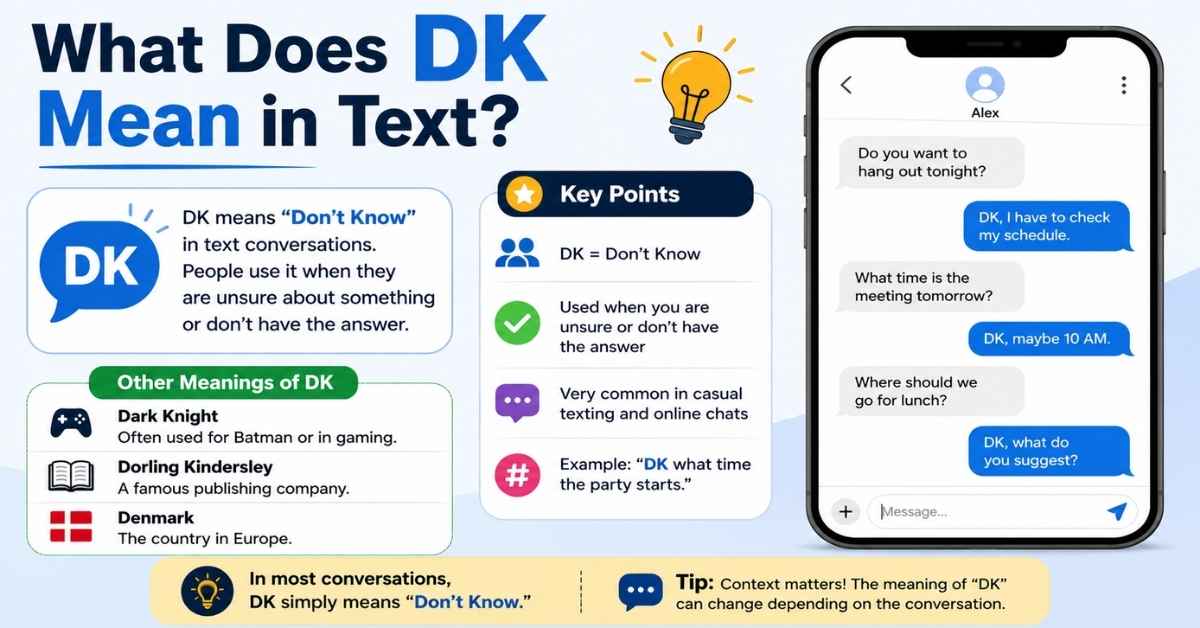
What does DK mean in text? DK most commonly stands for “Don’t Know.” It is a popular texting abbreviation and internet slang used in text messages, social media, online chats, and messaging apps when someone is unsure about something or doesn’t have an answer. Whether you’re chatting on Snapchat, TikTok, Instagram, WhatsApp, Discord, or through regular SMS, DK usually means the same thing. However, its exact tone can change depending on the conversation and the relationship between the people chatting.
What Does DK Mean in Text?
What does DK mean in text? The answer is simple: DK is the shortened form of “Don’t Know.” People use it as a quick and convenient way to say they don’t have the information, aren’t sure about something, or haven’t made a decision yet.
For example:
Friend: Are you coming to the party tonight? You: DK yet. I’ll let you know later.
In this conversation, DK simply means “I don’t know yet.” The reply isn’t rude or dismissive—it just tells the other person that you don’t have an answer at the moment.
As digital communication has evolved, abbreviations like DK, IDK, TBH, SMH, and NVM have become a natural part of everyday conversations. They help people type faster while keeping messages casual and easy to understand. Although IDK (I Don’t Know) is still slightly more common, many people shorten it even further by dropping the “I” and typing DK instead.
The good news is that in most conversations, you don’t need to overthink the meaning. If someone sends DK, they almost always mean “Don’t Know.” Only in rare situations does it stand for something else, and the surrounding context usually makes that clear.
Quick Tip: If you ever see DK in a text message, chat, or social media conversation, read the entire conversation first. The surrounding messages usually make the intended meaning obvious.
Why People Use “DK” in Text Messages
The rise of smartphones and instant messaging has changed the way people communicate. Instead of writing full sentences every time, many people now rely on text abbreviations, internet acronyms, and online slang to save time.
The Simple Meaning Behind DK
At its core, DK is simply a faster way of saying “Don’t Know.”
Instead of typing:
“I don’t know.”
People often write:
DK
or
dk
Both versions have exactly the same meaning. Capitalization usually doesn’t matter in casual conversations.
People commonly use DK when they:
- Don’t have an answer yet
- Need more time to decide
- Haven’t received enough information
- Want to keep the conversation brief
- Are replying quickly while multitasking
Because texting has become faster than ever, abbreviations like DK help conversations flow naturally without requiring long explanations.
Why People Prefer Short Replies
Most people don’t use DK because they’re being rude—they simply want to communicate quickly.
Imagine receiving this message while you’re busy:
“Do you know what time the meeting starts?”
Instead of typing:
“I’m sorry, but I don’t know what time the meeting starts.”
Many people simply reply:
DK
The shorter reply communicates exactly the same information while saving time.
Why Abbreviations Like DK Are So Popular
Modern digital communication is built around speed and convenience. Every day, millions of people exchange short messages across apps like:
- Snapchat
- TikTok
- Facebook Messenger
- Discord
- iMessage
- SMS
These platforms encourage quick conversations, making texting abbreviations more common than ever.
Some of the most widely used abbreviations include:
| Abbreviation | Meaning |
|---|---|
| DK | Don’t Know |
| IDK | I Don’t Know |
| TBH | To Be Honest |
| SMH | Shaking My Head |
| NVM | Never Mind |
| IMO | In My Opinion |
| BRB | Be Right Back |
Learning these common chat abbreviations makes online conversations much easier to understand.
Understanding DK Through Context
One mistake many people make is assuming every abbreviation always has the exact same meaning.
In reality, context is everything.
The letters DK don’t automatically tell you the sender’s emotions. Instead, the conversation around them determines how the message should be interpreted.
Think of DK as a neutral response. The words themselves simply mean “Don’t Know.” However, depending on the situation, they can sound:
- Neutral
- Casual
- Uncertain
- Playful
- Busy
- Slightly dismissive
- Emotionless
Understanding this difference helps avoid unnecessary misunderstandings.
When DK Simply Means “I Don’t Know”
Most of the time, DK carries no hidden meaning.
Example 1
Emma: “Who’s driving tomorrow?”
Noah: “DK yet.”
Meaning
Noah genuinely doesn’t know who will be driving.
There is no attitude or hidden emotion.
Example 2
Friend: “Did the teacher announce the exam date?”
You: “DK.”
Again, the meaning is straightforward.
You simply don’t have the answer.
Example 3
Brother: “Where did Dad put the car keys?”
Sister: “DK.”
This is another natural use of the abbreviation.
When DK Can Sound Cold
Although DK usually means “Don’t Know,” very short replies can sometimes feel less friendly than full sentences.
Consider this conversation.
Example
Alex: “Are you upset with me?”
Jordan: “DK.”
Technically, Jordan is saying:
“I don’t know.”
However, because the question is emotional, the short reply may feel distant or uncaring.
A more thoughtful response might be:
“DK. I need some time to think.”
The meaning stays the same, but the tone becomes much warmer.
This illustrates an important rule of digital communication:
The shorter the message, the more room there is for misunderstanding.
When DK Is Just a Quick Reply
Sometimes people type DK simply because they’re busy.
Imagine someone is:
- Walking
- Driving (hands-free responses only)
- At work
- In class
- Playing an online game
- Multitasking
A short reply doesn’t necessarily mean they don’t care.
Example
Friend: “Want pizza tonight?”
You: “DK. Still working.”
The abbreviation saves time while keeping the conversation moving.
Expert Insight: Context Beats Assumptions
One of the biggest mistakes people make with text messaging is assuming that abbreviations reveal someone’s emotions.
In reality, tone in digital communication depends on several factors:
- Your relationship with the sender
- Previous messages
- The topic being discussed
- Whether the conversation is casual or serious
- Additional clues like emojis or punctuation
For example:
DK 😂
feels much lighter than
DK.
Even though both technically mean “Don’t Know,” the overall tone changes because of the emoji and punctuation.
The takeaway is simple:
Never judge the sender’s emotions based on the abbreviation alone. Always consider the context of the conversation.
Real-Life Examples of DK in Text Conversations
Understanding definitions is helpful, but seeing DK used in real conversations makes it much easier to recognize in everyday life.
Below are realistic examples across different situations.
Friends Chat
Chris: “Are you free this weekend?”
Mia: “DK yet. I might be visiting my cousins.”
Meaning: Mia hasn’t finalized her plans.
Ryan: “Which movie should we watch?”
Jake: “DK. You choose.”
Meaning: Jake doesn’t have a preference or answer.
Olivia: “Did Sarah already leave?”
Emma: “DK. I haven’t seen her today.”
Meaning: Emma genuinely doesn’t know.
Family Conversations
Mom: “What time will your brother be home?”
Dad: “DK. He said he’d text later.”
Meaning: Dad is waiting for more information.
Sister: “Where’s my charger?”
Brother: “DK.”
Meaning: He doesn’t know where it is.
Dating and Relationships
Taylor: “Do you think we should go out Friday?”
Alex: “DK yet. Let me check my schedule.”
Meaning: Alex isn’t rejecting the idea—just hasn’t decided.
Partner: “Why are you so quiet today?”
You: “DK. Just tired, I guess.”
Meaning: You’re uncertain about how you’re feeling rather than being dismissive.
School and College Chats
Classmate: “Did the professor upload today’s notes?”
Student: “DK. I’ll check the portal later.”
Meaning: The student hasn’t looked yet.
Friend: “When’s the assignment due?”
You: “DK. Let me check the syllabus.”
Meaning: You need to verify the information before answering.
These examples show that DK is usually a neutral, practical abbreviation rather than an emotional response. Its meaning stays consistent across most conversations, while the tone depends on context, the relationship between the people involved, and the way the rest of the message is written.
DK on Different Apps: Does the Meaning Change?
Many people search for DK meaning on Snapchat, DK meaning on TikTok, or DK meaning on Instagram because they assume abbreviations have different meanings on different platforms.
In reality, DK almost always means “Don’t Know”, regardless of where you see it. The platform changes, but the meaning usually stays the same.
DK on Snapchat
On Snapchat, people use DK in casual conversations, private chats, and group messages.
Example:
Friend: Are you going to open streaks later? You: DK yet.
Meaning: You haven’t decided or don’t know yet.
DK on Instagram
Whether it’s in a DM, story reply, or group chat, DK generally means “Don’t Know.”
Example:
Friend: Who took that picture? You: DK.
DK on TikTok
TikTok comments move quickly, so users often shorten their replies.
Example:
Comment: Where was this video filmed? Reply: DK.
The reply simply means the person doesn’t know the answer.
DK on WhatsApp
Because WhatsApp is commonly used for conversations with family, friends, and coworkers, DK is often used in informal chats.
Example:
Mom: When will you be home? You: DK. Traffic is terrible.
DK on Discord
Gaming communities and online groups use abbreviations frequently.
Example:
Player: Which map are we playing next? Teammate: DK. Waiting for the host.
DK in SMS and iMessage
Traditional text messages also use DK in exactly the same way.
Whether you’re using Android Messages, iMessage, or another messaging app, the meaning remains consistent.
Platform Comparison Table
| Platform | Most Common Meaning of DK | Typical Usage |
|---|---|---|
| Snapchat | Don’t Know | Casual chats, streak conversations |
| Don’t Know | DMs and replies | |
| TikTok | Don’t Know | Comments and private messages |
| Don’t Know | Friends, family, group chats | |
| Discord | Don’t Know | Gaming and community discussions |
| SMS/iMessage | Don’t Know | Everyday texting |
Key Takeaway: The context of the conversation matters far more than the platform. In almost every case, DK means “Don’t Know.”
DK vs. IDK: What’s the Difference?
One of the most common questions people ask is whether DK and IDK have different meanings.
The short answer is no.
Both abbreviations communicate uncertainty, but there are slight differences in style and usage.
Learn More: Peeked vs Peaked
DK or IDK—Which One Should You Use?
| Feature | DK | IDK |
|---|---|---|
| Meaning | Don’t Know | I Don’t Know |
| Tone | Shorter and quicker | Slightly more natural in conversation |
| Popularity | Common | More common overall |
| Formality | Informal | Informal |
| Best Used In | Fast chats, gaming, texting | Everyday conversations and social media |
Although both versions are acceptable, IDK feels a little more conversational because it includes the subject (“I”).
Why Do Some People Skip the “I”?
People shorten words for the same reason they use abbreviations like:
- TBH
- IMO
- SMH
- BRB
- NVM
It’s all about typing less while saying the same thing.
Instead of:
IDK
Some users simply type:
DK
The message is still understood instantly.
Which Version Sounds More Natural?
There isn’t a universal winner.
Many people naturally write:
IDK what happened.
Others prefer:
DK what happened.
The choice often depends on personal texting habits, age, friend groups, and the speed of the conversation.
If you’re unsure which one to use, IDK is slightly more common and may sound more natural to a wider audience.
Is DK Considered Rude?
This is one of the biggest concerns users have after learning the definition.
The answer is:
Not usually.
The abbreviation itself isn’t rude. However, the way it’s used can change how the other person feels.
When DK Sounds Perfectly Polite
In everyday conversations, DK is simply a neutral response.
Example
Friend: “Who’s bringing snacks?”
You: “DK.”
Nothing about this exchange sounds impolite.
When DK May Feel Cold
Problems arise when someone asks an emotional or important question.
Example
Partner: “Are you still upset?”
Reply: “DK.”
Although the reply literally means “Don’t Know,” it may feel distant because it lacks explanation.
A warmer response would be:
DK. I’m still trying to figure out how I feel.
The meaning stays the same, but the conversation feels more caring.
How Punctuation Changes the Tone
Small details can affect how readers interpret a message.
| Reply | Possible Tone |
|---|---|
| DK | Neutral |
| DK. | Slightly more serious |
| DK lol | Casual and friendly |
| DK 😂 | Playful |
| DK, sorry | Polite and considerate |
This is why digital communication isn’t just about words—it’s also about presentation.
Relationship Matters
The same reply can feel completely different depending on who sends it.
Close Friend
“DK.”
Usually feels normal.
Coworker
“DK.”
Acceptable in casual workplace chats, but a fuller response may be more professional.
Customer
“DK.”
Too abrupt.
A better reply would be:
I’m not sure yet, but I’ll find out and let you know.
Family
Parents and siblings often understand short replies because they’re familiar with each other’s texting habits.
A Simple Rule to Remember
If the conversation is:
- Casual → DK works well.
- Emotional → Add a little more context.
- Professional → Write a complete sentence.
When You Should (and Shouldn’t) Use DK
Understanding when to use DK is just as important as knowing what it means.
Best Situations to Use DK
Casual Conversations
Friends rarely expect formal replies.
Example
“Want to grab coffee?”
“DK yet.”
Group Chats
Fast-moving conversations encourage short responses.
Gaming Chats
Players often type quickly during matches.
“Which server?”
“DK.”
Family Messages
Simple questions often receive simple answers.
“Where’s Dad?”
“DK.”
Situations Where You Should Avoid DK
Although DK is common, it isn’t suitable everywhere.
Professional Emails
Instead of:
DK
Write:
I’m not sure at the moment, but I’ll confirm shortly.
Business Communication
Customers appreciate complete, professional responses.
Job Applications
Never replace full sentences with text abbreviations.
Formal Academic Writing
Assignments, reports, and research papers should avoid internet slang.
Other Meanings of DK
Although “Don’t Know” is by far the most common DK meaning in text, there are situations where the abbreviation represents something else.
Understanding these alternatives helps prevent confusion.
Denmark
In international discussions, DK is commonly used as the country code for Denmark.
Example
“Shipping available in DK.”
Here, DK refers to the country—not the texting abbreviation.
Donkey Kong
Gaming communities may use DK as shorthand for Donkey Kong.
Example
“DK is my favorite Nintendo character.”
Dark Knight
Movie fans occasionally use DK to refer to The Dark Knight.
Example
“DK is still one of the best superhero movies.”
Initials
Sometimes DK simply represents a person’s initials.
Example
“Please ask DK to review the document.”
How to Identify the Correct Meaning
Ask yourself three simple questions:
- What is the conversation about?
- Who is sending the message?
- Does “Don’t Know” make sense here?
If the answer is yes, then DK almost certainly means “Don’t Know.”
Common Mistakes People Make
Even though DK is simple, people sometimes misunderstand it.
Mistake 1: Assuming It Always Means Something Else
Some readers immediately think of Denmark or Donkey Kong, even when the conversation is clearly about texting.
Mistake 2: Thinking DK Is Always Rude
The abbreviation itself is neutral.
Tone comes from context.
Mistake 3: Using DK in Formal Communication
Internet slang belongs in casual conversations—not professional documents.
Mistake 4: Ignoring Context
Reading a single message without considering the rest of the conversation often leads to misunderstandings.
Remember: Context is the key to interpreting DK correctly.
How to Reply When Someone Texts “DK”
Knowing what does DK mean in text is useful, but many people also wonder how they should respond when someone replies with “DK.” The best reply depends on the situation and the tone of the conversation.
If They’re Simply Unsure
Sometimes DK genuinely means the person doesn’t have an answer yet.
Example
You: Are we meeting at 7 PM? Friend: DK yet.
Good Reply:
No worries. Let me know when you find out.
This response is friendly and keeps the conversation moving.
If They Need More Time
Sometimes people use DK because they’re still deciding.
Example
You: Do you want to come with us this weekend? Them: DK.
Good Reply:
That’s okay. Just let me know whenever you decide.
Giving the other person space often leads to a better conversation.
If the Reply Feels Too Short
A one-word response can occasionally seem abrupt, especially in an emotional conversation.
Instead of assuming the worst, ask a polite follow-up question.
Example
You: Everything okay? Them: DK.
Better Reply:
That’s okay. If you want to talk later, I’m here.
This shows empathy without putting pressure on the other person.
If You Need a Clear Answer
Sometimes “DK” isn’t enough because you need more information.
Example
You: Can you confirm today’s meeting time? Them: DK.
Good Reply:
No problem. Could you let me know once you find out?
This keeps the conversation productive and avoids confusion.
Expert Tips for Using Text Abbreviations Naturally
Texting abbreviations like DK, IDK, TBH, IMO, SMH, and NVM make conversations quicker, but using them thoughtfully helps you communicate more clearly.
Match the Other Person’s Style
If someone usually writes in complete sentences, replying only with DK may feel overly brief.
Likewise, if both of you regularly use abbreviations, DK will probably feel perfectly natural.
Add Context When Needed
Instead of replying with:
DK
Try:
DK yet. I’ll check and let you know.
This small addition provides clarity and sounds more helpful.
Think About the Situation
Ask yourself:
- Is this a casual conversation?
- Is the topic serious?
- Will a short reply cause confusion?
If the answer is yes, writing a complete sentence is often the better choice.
Don’t Overuse Abbreviations
Abbreviations are convenient, but every message doesn’t need one.
A mix of short replies and complete sentences creates more natural conversations.
Consider Your Audience
Different people have different texting habits.
- Friends usually understand abbreviations.
- Family members may or may not recognize newer internet slang.
- Coworkers appreciate clearer communication.
- Clients and customers generally expect complete sentences.
Choosing the right style for your audience helps avoid misunderstandings.
See More: Jersies or Jerseys
Quick Reference Cheat Sheet
| Question | Answer |
|---|---|
| What does DK mean in text? | Don’t Know |
| Is DK an abbreviation? | Yes, it’s a common texting abbreviation and internet slang. |
| Is DK the same as IDK? | Almost. IDK means “I Don’t Know,” while DK simply drops the “I.” |
| Is DK rude? | Usually no. The tone depends on the context, punctuation, and relationship between the people chatting. |
| Where is DK commonly used? | Snapchat, TikTok, Instagram, WhatsApp, Discord, Facebook Messenger, iMessage, and SMS. |
| Can DK have other meanings? | Yes. It can also refer to Denmark, Donkey Kong, The Dark Knight, or a person’s initials, depending on the context. |
| Should I use DK in professional messages? | It’s better to use complete sentences in formal or workplace communication. |
Frequently Asked Questions (FAQs)
What does DK mean in text?
DK most commonly means “Don’t Know.” It’s a widely used texting abbreviation that expresses uncertainty or a lack of information in casual conversations.
What does DK stand for in texting?
In texting, DK stands for “Don’t Know.” It’s commonly used in text messages, social media chats, gaming discussions, and messaging apps.
Does DK always mean “Don’t Know”?
No. While “Don’t Know” is the most common meaning in texting, DK can also refer to Denmark, Donkey Kong, The Dark Knight, or a person’s initials. The surrounding conversation usually makes the intended meaning obvious.
Is DK the same as IDK?
Both express uncertainty.
- DK = Don’t Know
- IDK = I Don’t Know
The meaning is almost identical, but IDK is slightly more common in everyday texting.
Is DK rude?
Not by itself.
The abbreviation is neutral. However, a short reply like DK may seem abrupt in emotional or serious conversations. Adding a little context can make your message sound warmer and more considerate.
What does DK mean on Snapchat?
On Snapchat, DK almost always means “Don’t Know.” People use it in private chats, group conversations, and streak discussions.
What does DK mean on Instagram?
Whether you see DK in an Instagram DM, comment, or story reply, it usually means “Don’t Know.”
What does DK mean on TikTok?
In TikTok comments and messages, DK is commonly used as a quick way of saying “Don’t Know.”
What does DK mean on WhatsApp?
On WhatsApp, DK has the same meaning as it does on other messaging platforms: “Don’t Know.”
Why do people type DK instead of IDK?
Many people shorten IDK to DK simply to type faster. It’s a matter of personal preference and texting style rather than a change in meaning.
Can I use DK at work?
It’s generally better to avoid abbreviations like DK in professional emails, reports, or customer communication. A complete sentence is usually more appropriate in formal settings.
How should I respond if someone texts “DK”?
The best response depends on the conversation.
If they’re unsure, you can reply:
- No problem. Let me know when you find out.
- That’s okay. Take your time.
- Thanks! Keep me posted.
If the topic is important, ask a polite follow-up question to get more details.
Final Thoughts
What does DK mean in text? In almost every casual conversation, DK means “Don’t Know.” It’s a simple, widely recognized texting abbreviation used across Snapchat, Instagram, TikTok, WhatsApp, Discord, Facebook Messenger, iMessage, and standard SMS conversations.
While the definition is straightforward, context always matters. The same abbreviation can sound friendly, neutral, or slightly abrupt depending on the conversation, the relationship between the people involved, and the way the message is written. Looking at the surrounding messages will usually tell you exactly what the sender means.
As digital communication continues to evolve, abbreviations like DK remain a quick and effective way to keep conversations flowing. By understanding not only what DK stands for but also when to use it, when to avoid it, and how to respond naturally, you’ll communicate with greater confidence and avoid common misunderstandings in online conversations.
Whether you’re texting a friend, chatting on social media, or participating in a gaming community, you’ll now recognize DK instantly and know exactly how to interpret it in context.