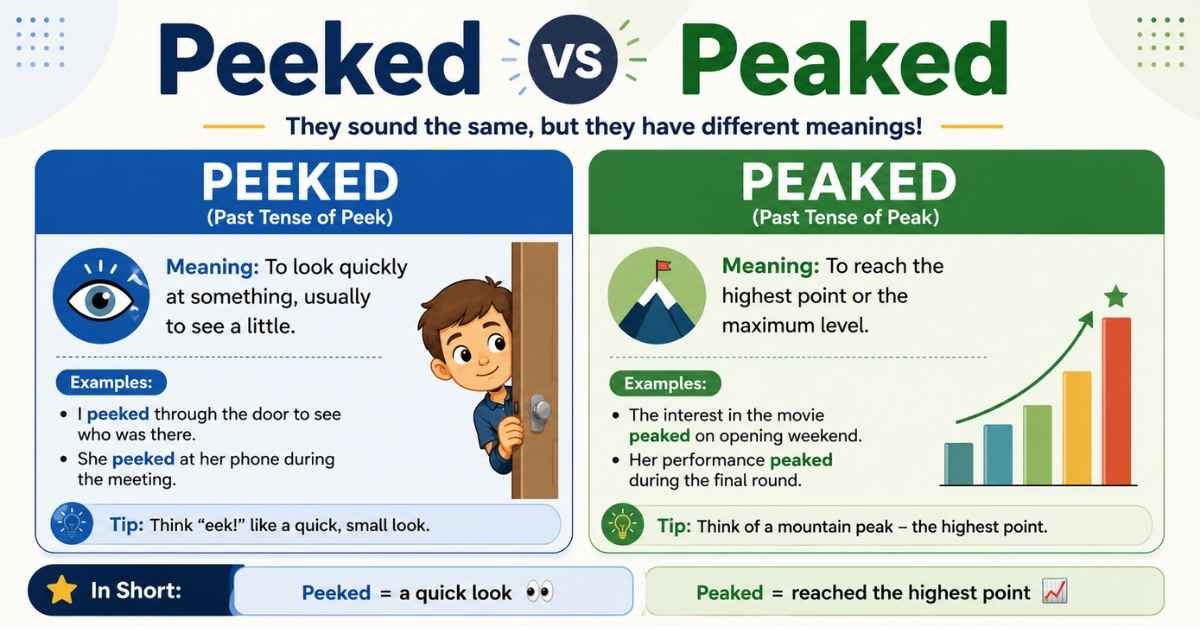
Peeked vs peaked is a common grammar confusion because the two words sound almost identical but have completely different meanings. Peeked means looked quickly, briefly, or secretly at something, while peaked means reached the highest point, maximum level, or climax. If you’re talking about taking a quick look, use peeked. If you’re describing something reaching its highest point, use peaked.
Although this difference seems simple, many writers still pause and ask themselves, “Is it peeked or peaked?” The confusion is understandable because both are correctly spelled English words, and even spellcheck often fails to catch the mistake. Whether you’re writing an email, preparing an assignment, creating a blog post, or posting on social media, using the right word can make your writing sound clearer and more professional.
In this guide, you’ll learn the difference between peeked and peaked, see practical examples, understand why people mix them up, and discover simple tricks that make these words easy to remember.
Quick Answer: Peeked vs Peaked
- Peeked = Looked quickly, secretly, or briefly.
- Peaked = Reached the highest point, maximum level, or climax.
Examples
- She peeked through the window. ✅
- Website traffic peaked in December. ✅
A simple rule to remember is:
Look = Peeked Highest Point = Peaked
Peeked vs Peaked at a Glance
| Feature | Peeked | Peaked |
|---|---|---|
| Meaning | Looked quickly or secretly | Reached the highest point |
| Part of Speech | Verb | Verb |
| Common Contexts | Looking, checking, spying | Business, trends, performance |
| Example | She peeked inside the room. | Sales peaked during the holidays. |
| Memory Trick | Peek = Eyes | Peak = Mountain Top |
This quick comparison instantly shows that these words belong to entirely different situations, even though they sound alike.
Why Do People Confuse “Peeked” and “Peaked”?
If you’ve ever stopped while typing one of these words, you’re definitely not alone. Peak and peek are homophones, meaning they have similar pronunciations but different meanings and spellings.
Several factors make them easy to confuse.
They Sound Almost Identical
When spoken aloud, peeked and peaked are pronounced nearly the same way. Because our brains often rely on sound instead of meaning during quick writing, mistakes happen naturally.
For example:
- “I peeked at the report.”
- “I peaked at the report.”
The first sentence means you briefly looked at the report. The second sentence doesn’t make sense because reports cannot be “looked at” by reaching a maximum point.
Both Words Are Correctly Spelled
This is where many people struggle.
Most spelling mistakes are easy to identify because the incorrect word doesn’t exist. However, both peeked and peaked are real English words with valid meanings.
As a result:
- Spellcheck usually won’t flag the error.
- Grammar tools may miss the context.
- Writers often submit documents with the wrong word.
This explains why the keyword “peeked vs peaked meaning” receives regular searches. People know something looks wrong but aren’t sure why.
Context Matters More Than Spelling
English often depends on context.
Consider these examples:
Correct
She peeked through the curtains.
Correct
Interest in the product peaked last year.
Although the words sound similar, the surrounding context immediately changes the meaning.
This is why understanding the difference between peeked and peaked is much more useful than simply memorizing definitions.
Even Experienced Writers Mix Them Up
This confusion isn’t limited to students or English learners.
Professional writers, bloggers, journalists, copywriters, and content creators sometimes use the wrong word because:
- They type quickly.
- They rely on autocorrect.
- They focus on ideas instead of word choice.
- They confuse peak, peek, and pique.
Even experienced editors occasionally pause and double-check these words before publishing content.
What Does “Peeked” Mean?
Peeked is the past tense of the verb peek, which means to look quickly, secretly, or briefly at something.
Think of peeked as taking a short glance without fully looking.
Simple Definition
Peeked = Looked quickly or secretly.
When Do People Use “Peeked”?
People use peeked when someone:
- Looks through a window
- Looks around a corner
- Checks something secretly
- Takes a quick glance
- Briefly looks at information
The action is usually:
- Short
- Brief
- Curious
- Secretive
- Incomplete
Real-Life Examples of “Peeked”
Example 1
She peeked through the window to see if it was raining.
Example 2
I peeked at my phone during the meeting.
Example 3
The child peeked inside the gift box before opening it.
Example 4
He peeked around the corner to check who had arrived.
Example 5
She peeked at her notes before the presentation started.
These examples all involve the same idea: taking a quick look.
Common Expressions Using “Peek”
Take a Peek
Take a peek at this report before we submit it.
Sneak Peek
The company released a sneak peek of its upcoming product.
Peek Inside
Visitors could peek inside the museum’s restoration room.
Peek Through
She peeked through the curtains.
These expressions appear frequently in:
- Business writing
- Marketing campaigns
- Social media posts
- Blog articles
- Everyday conversations
“Peeked” in Professional Writing
In an Email
I briefly peeked at the proposal before today’s meeting.
In a Blog Post
Here’s a sneak peek of our latest feature.
In School Writing
The student peeked at the answer sheet.
Understanding these practical situations helps writers choose the correct word immediately.
What Does “Peaked” Mean?
Peaked is the past tense of peak, meaning to reach the highest point, maximum level, or greatest intensity.
Think of a mountain.
The very top of the mountain is called the peak.
When something reaches its highest level, it has peaked.
Simple Definition
Peaked = Reached the highest point or maximum level.
When Do People Use “Peaked”?
People commonly use peaked when discussing:
- Sales
- Business growth
- Website traffic
- Popularity
- Performance
- Demand
- Energy levels
- Trends
- Prices
The idea is always the same:
Something rises and eventually reaches its highest point.
Real-Life Examples of “Peaked”
Example 1
Website traffic peaked during the holiday season.
Example 2
Sales peaked in December.
Example 3
The athlete’s performance peaked during the championship.
Example 4
Electricity demand peaked during the summer.
Example 5
His popularity peaked after the movie’s release.
In every example, something reached its maximum point.
Common Expressions Using “Peak”
Peak Performance
The company reached peak performance during the fourth quarter.
Peak Season
Hotels are expensive during peak season.
Peak Hours
Traffic peaked during the evening rush hour.
Peak Demand
Product demand peaked after the advertising campaign.
Peaked in Popularity
The social media platform peaked in popularity several years ago.
These expressions are widely used in:
- Business reports
- Marketing articles
- Economics discussions
- Performance analysis
- News reporting
- Data interpretation
Peeked vs Peaked: Why Choosing the Right Word Matters
Using the wrong word can completely change the meaning of your sentence.
Correct
She peeked through the door.
Meaning: She briefly looked through the door.
Incorrect
She peaked through the door.
Meaning: The sentence doesn’t make logical sense because people don’t reach their highest point through doors.
Correct
Customer demand peaked in July.
Meaning: Demand reached its highest level in July.
Incorrect
Customer demand peeked in July.
Meaning: Demand cannot secretly look at something.
These examples demonstrate why understanding peeked vs peaked is important for clear communication.
By remembering one simple idea, you’ll avoid this mistake in almost every situation:
Peeked = Looked quickly Peaked = Reached the highest point
Peeked vs Peaked: Side-by-Side Sentence Comparisons
One of the easiest ways to understand the difference between peeked and peaked is to see the words in context. Because both words are correctly spelled and sound almost identical, examples often teach the distinction better than definitions.
Examples Using “Peeked”
She peeked around the corner.
Meaning: She looked briefly around the corner.
He peeked through the curtains.
Meaning: He took a quick look through the curtains.
I peeked at my phone during the lecture.
Meaning: I briefly looked at my phone.
The child peeked inside the gift box.
Meaning: The child secretly looked inside the box.
She peeked at the answer sheet.
Meaning: She took a quick glance at the answer sheet.
Notice that every example involves looking, glancing, checking, or secretly observing something.
Examples Using “Peaked”
Sales peaked in December.
Meaning: Sales reached their highest level in December.
The athlete peaked during the championship.
Meaning: The athlete performed at their highest level.
Website traffic peaked after the product launch.
Meaning: Traffic reached its maximum point.
Demand for the product peaked during the holidays.
Meaning: Demand was at its highest.
His popularity peaked in college.
Meaning: His popularity reached its greatest level during college.
Every example of peaked involves reaching a maximum, climax, highest point, or top level of performance.
Learn More: Jersies or Jerseys
Peeked vs Peaked in Similar Sentences
Looking at nearly identical sentences can make the difference crystal clear.
| Sentence | Correct Word | Why? |
|---|---|---|
| She __ through the window. | Peeked | She looked briefly. |
| Website traffic __ in July. | Peaked | Traffic reached its maximum. |
| He __ at the report. | Peeked | He looked at the report. |
| Demand __ during winter. | Peaked | Demand reached its highest level. |
| The child __ around the door. | Peeked | The child briefly looked around. |
This side-by-side comparison makes it easier to understand the contextual usage of each word.
Which Word Fits Your Sentence?
When people search for “is it peeked or peaked?”, they usually need a quick way to decide.
Fortunately, the answer is simple.
Ask Yourself One Question
Are you talking about looking?
If the answer is yes, use peeked.
Examples:
- I peeked at the document.
- She peeked inside the room.
- He peeked around the corner.
Are you talking about reaching the highest point?
If the answer is yes, use peaked.
Examples:
- Demand peaked in June.
- Sales peaked during the holidays.
- Interest peaked after the announcement.
A Simple Decision Framework
Think of this mental flowchart:
Are you talking about looking?
↓
Yes → Peeked

No
↓
Are you talking about reaching a maximum?
↓
Yes → Peaked
This simple framework solves most peek vs peak mistakes in seconds.
Common Mistakes People Make
Because these words are homophones, people frequently use one when they mean the other.
Incorrect:
I peaked through the window.
Correct:
I peeked through the window.
Why?
You are talking about looking, not reaching a maximum.
Incorrect:
Traffic peeked at noon.
Correct:
Traffic peaked at noon.
Why?
Traffic reached its highest level, so you need peaked.
Incorrect:
She peaked at the notes before the exam.
Correct:
She peeked at the notes before the exam.
Why?
She briefly looked at the notes.
Incorrect:
Product demand peeked in December.
Correct:
Product demand peaked in December.
Why?
Demand reached its highest point.
Incorrect:
He peeked in popularity after the movie release.
Correct:
He peaked in popularity after the movie release.
Why?
Popularity reached its maximum level.
Why Spellcheck Often Doesn’t Catch the Error
Many writers assume grammar tools will automatically fix this mistake. Unfortunately, that isn’t always true.
Both Words Exist in English
This is the biggest reason.
Spellcheck is designed to identify words that do not exist. However:
- Peeked is a real word.
- Peaked is a real word.
As a result, your writing software often sees both options as correct.
The Problem Is Context, Not Spelling
Consider this sentence:
I peaked at the report.
The sentence is spelled correctly.
However, it is logically wrong because the writer meant:
I peeked at the report.
Since both words are legitimate English words, many grammar checkers fail to understand the intended meaning.
Why Even Professional Writers Make This Mistake
The human brain often processes language through sound.
Because peeked and peaked sound nearly identical, our brains sometimes select the wrong spelling automatically.
This is one reason why:
- Students make the mistake.
- Bloggers make the mistake.
- Journalists make the mistake.
- Copywriters make the mistake.
- Experienced editors occasionally make the mistake.
The confusion is normal and extremely common.
Peeked, Peaked, and Piqued: The Triple Confusion
Another reason people search for peeked vs peaked meaning is because a third word often enters the conversation:
Piqued.
These three words sound similar but have entirely different meanings.
Peeked
Meaning: Looked quickly or secretly.
Example: She peeked through the curtains.
Peaked
Meaning: Reached the highest point.
Example: Website traffic peaked after the campaign.
Piqued
Meaning: Stimulated interest, curiosity, or attention.
Example: The article piqued my curiosity.
Peeked vs Peaked vs Piqued
| Word | Meaning | Example |
|---|---|---|
| Peeked | Looked quickly | She peeked at the document. |
| Peaked | Reached the highest point | Sales peaked in December. |
| Piqued | Sparked interest | The story piqued my curiosity. |
The Famous Mistake: “Peaked My Interest”
Many people write:
The article peaked my interest.
This is incorrect.
The correct sentence is:
The article piqued my interest.
Why?
Your interest did not reach a maximum level. Instead, the article stimulated your curiosity.
Similarly:
Incorrect:
The movie trailer peaked my interest.
Correct:
The movie trailer piqued my interest.
Another Common Mistake: “Sneak Peak”
People frequently write:
Sneak peak
This is incorrect.
The correct expression is:
Sneak peek
A sneak peek means a quick preview or an early look at something.
Examples:
- Here’s a sneak peek of our upcoming product.
- The studio released a sneak peek of the movie.
- Readers got a sneak peek at the new feature.
The expression has nothing to do with reaching a highest point.
Real-World Writing Scenarios
Understanding these words becomes easier when you see them in everyday situations.
In Professional Emails
I briefly peeked at the proposal before today’s meeting.
Correct because you looked at the proposal.
In Business Reports
Customer demand peaked during the holiday season.
Correct because demand reached its highest level.
In Academic Writing
The student peeked at his notes before presenting his project.
Correct because he took a quick glance.
In Marketing Reports
Website traffic peaked after the advertising campaign.
Correct because traffic reached its maximum point.
In Everyday Conversation
I peeked outside to see if it was still raining.
Correct because you briefly looked outside.
In Sports Writing
The athlete peaked during the world championship.
Correct because performance reached its highest level.
The One Rule to Remember
Whenever you’re uncertain, ask yourself:
Am I talking about looking?
Use peeked.
Am I talking about reaching a maximum?
Use peaked.
Am I talking about becoming interested?
Use piqued.
This simple rule helps you distinguish among peeked, peaked, and piqued in almost every writing situation and eliminates one of the most common grammar mistakes in English.
Memory Tricks You’ll Actually Remember
Even after learning the definitions, many people still ask, “How do I remember the difference between peeked and peaked?” The good news is that you don’t need to memorize complicated grammar rules. A few simple memory tricks can help you choose the correct word every time.
Memory Trick #1: Peek Has Two E’s Like Two Eyes
Think about the word peek.
It has two E’s, which can remind you of two eyes.
Eyes → Looking → Peeked
Example:
She peeked through the keyhole.
Since she used her eyes to take a quick look, peeked is the correct choice.
Memory Trick #2: Peak Is the Top of a Mountain
Imagine standing at the top of a mountain.
That highest point is called a peak.
Mountain Top → Highest Point → Peaked
Example:
Sales peaked in December.
Sales reached their highest level, so peaked is the right word.
Memory Trick #3: Pique Means Curiosity
Many people also confuse piqued with peeked and peaked.
Remember this:
Piqued = Interest or Curiosity
Example:
The headline piqued my curiosity.
Your curiosity was stimulated, not your ability to look or reach a maximum.
A Simple Formula to Never Forget Again
Whenever you’re confused, use this formula:
| If You Mean… | Use… |
|---|---|
| Looking quickly | Peeked |
| Highest point or maximum | Peaked |
| Becoming interested | Piqued |
This quick-reference guide works in almost every writing situation.
See More: Bellies or Bellys
Real-World Examples You Can Relate To
Understanding grammar becomes easier when you connect it to everyday experiences.
In Professional Emails
I peeked at the proposal before the meeting started.
Why?
You briefly looked at the proposal.
In Business Reports
Customer demand peaked during the holiday season.
Why?
Demand reached its highest point.
In Blogging and Content Writing
Here’s a sneak peek of our upcoming feature.
Why?
Readers are getting an early look.
In Marketing Analytics
Website traffic peaked after the product launch.
Why?
Traffic reached its maximum level.
In School Assignments
The student peeked at his notes before giving the presentation.
Why?
He took a quick glance.
In Everyday Conversations
I peeked outside to see if it was raining.
Why?
You looked briefly.
In Sports Writing
The athlete peaked during the national championship.
Why?
His performance reached its highest level.
Why Context Is More Important Than Memorization
Many people try to memorize definitions word for word.
A better approach is understanding the context.
Ask yourself:
Is someone looking at something?
Use peeked.
Is something reaching its maximum level?
Use peaked.
Is curiosity being sparked?
Use piqued.
This method works because English often relies on context rather than spelling alone.
Common Sentences and Their Correct Forms
Correct
She peeked through the curtains.
Correct
I peeked at the report before the meeting.
Correct
Sales peaked in December.
Correct
His popularity peaked after the film’s release.
Correct
The article piqued my interest.
Quick Cheat Sheet
| Sentence Type | Correct Word |
|---|---|
| Looking through a window | Peeked |
| Looking around a corner | Peeked |
| Taking a sneak preview | Peek |
| Reaching the highest point | Peaked |
| Maximum sales or traffic | Peaked |
| Peak performance | Peak |
| Sparking curiosity | Piqued |
| “Piqued my interest” expression | Piqued |
Bookmark this table if you often confuse these words.
Frequently Asked Questions
What is the difference between peeked and peaked?
Peeked means looked quickly or secretly at something, while peaked means reached the highest point or maximum level.
Is it “peeked through the window” or “peaked through the window”?
The correct phrase is:
She peeked through the window.
You are talking about looking, not reaching a maximum.
What does “peaked” mean in business?
In business, peaked usually means something reached its highest level.
Examples:
- Sales peaked in December.
- Demand peaked during summer.
- Website traffic peaked after the campaign.
What does “peeked” mean in writing?
Peeked means taking a brief or secret look.
Examples:
- He peeked at the answer sheet.
- I peeked at the message notification.
Is “sneak peak” correct?
No.
The correct expression is:
Sneak peek
A sneak peek means an early look or preview.
Is “peaked my interest” correct?
No.
The correct phrase is:
Piqued my interest
Piqued means stimulated curiosity or attention.
Are peak and peek homophones?
Yes.
Peak and peek are homophones because they sound nearly the same but have different meanings and spellings.
Why do people confuse peeked and peaked?
People confuse them because:
- They sound alike.
- Both are valid English words.
- Spellcheck often misses the error.
- Writers focus on pronunciation instead of context.
Can grammar tools always detect the mistake?
No.
Because both words are correctly spelled, many grammar checkers cannot determine your intended meaning.
Expert Takeaway: The Rule You’ll Actually Use
Forget complicated grammar terminology.
Remember this simple formula:
Peeked = Looked
Peaked = Reached the top
Piqued = Sparked interest
If you’re talking about:
- Looking quickly → Peeked
- Reaching a maximum level → Peaked
- Becoming curious → Piqued
you’ll almost never confuse these words again.
Final Thoughts
The debate around peeked vs peaked usually comes down to one simple question: Are you talking about looking at something or reaching the highest point?
Choose peeked when someone takes a quick glance, secretly looks at something, or gets a sneak peek. Choose peaked when sales, traffic, performance, popularity, demand, or any trend reaches its highest point or maximum level.
Although these homophones can be confusing, understanding the context makes the choice easy. The next time you stop while writing peeked vs peaked, remember this:
Peeked = Eyes and Looking Peaked = Mountain Top and Maximum Level Piqued = Curiosity and Interest