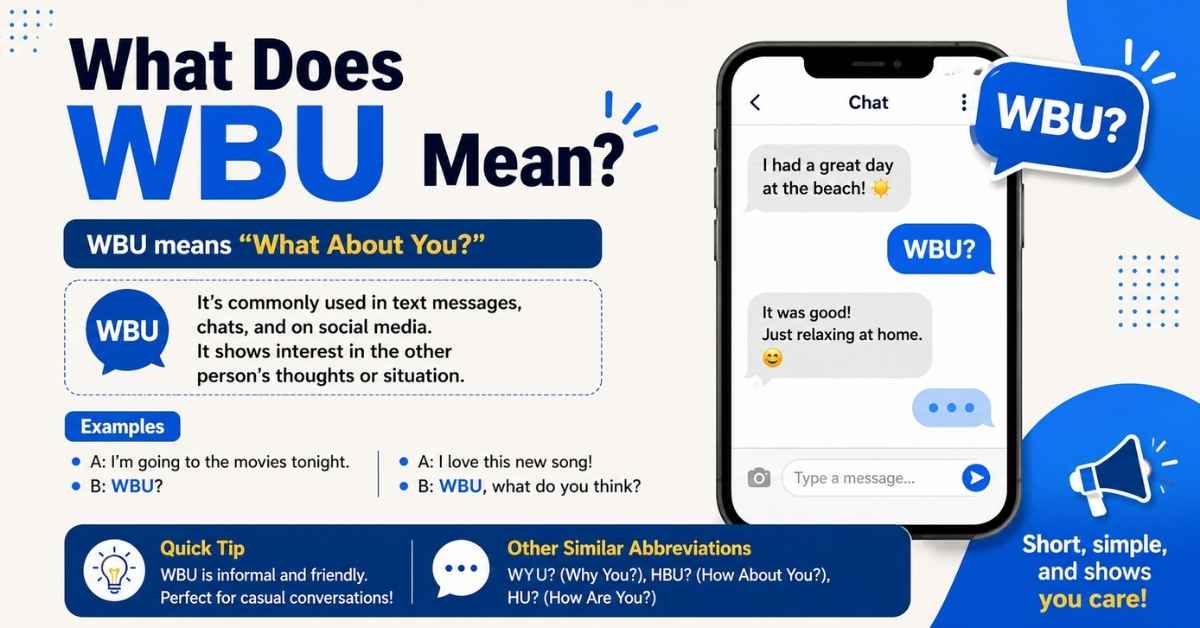
What does WBU mean? It stands for “What About You?” It is a popular texting abbreviation used in text messages, WhatsApp, Snapchat, Instagram, TikTok, Facebook Messenger, Discord, and other online messaging platforms. People use It to return a question, keep a conversation flowing naturally, and show interest in the other person’s thoughts, feelings, or experiences.
If someone texts, “I’m having a great day. WBU?”, they’re simply asking, “What about you?” Instead of typing the full question, they use this short and convenient internet slang abbreviation to save time while keeping the conversation friendly and engaging.
Whether you received It from a friend, classmate, coworker, or someone you’re getting to know, understanding its meaning helps you reply confidently without feeling confused or left out. In this guide, you’ll learn what WBU means in text, how people use it across different messaging apps, how to respond naturally, common mistakes to avoid, and how it compares with other popular texting abbreviations.
What Does Mean in Text?
In texting and online conversations, It almost always means “What About You?” It is an informal abbreviation used after someone shares information or asks a question. Rather than repeating the entire question, the sender simply writes WBU to invite your response.
For example:
Alex: I’m watching a movie tonight. WBU?
Jordan: I’m going out for dinner with my family.
In this conversation, It means “What about you?” It encourages the other person to share what they’re doing, creating a balanced and engaging exchange.
Unlike formal communication, digital conversations often rely on chat abbreviations because they’re faster to type and widely understood among regular users of social media and messaging apps.
The Full Form
The full form of WBU is:
WBU = What About You?
It’s one of the most commonly used online abbreviations because it quickly turns the focus back to the other person. Instead of asking the same question twice, people use WBU as a simple conversational shortcut.
For instance:
- I’m doing well today. WBU?
- I finished my homework. WBU?
- I’m excited for the weekend. WBU?
In every example, WBU politely asks the other person to share their own experience or opinion.
The Simple Meaning
The easiest way to understand is to think of it as a way of saying:
- What about you?
- How about you?
- And you?
Although the wording changes slightly, the purpose stays the same. It keeps conversations moving by inviting another response instead of ending the discussion.
This small abbreviation reflects an important part of digital communication—people appreciate conversations where both sides participate equally. Asking “What about you?” shows interest, encourages interaction, and makes chats feel more personal.
Why People Say This Instead of Typing the Full Question
The popularity of This isn’t random. It has become part of everyday internet slang because it makes online communication quicker and easier.
Here are the main reasons people use it:
It Saves Time
Typing only three letters instead of writing “What about you?” every time.
It Fits Fast Conversations
Whether you’re chatting on WhatsApp, Snapchat, Instagram, or Discord, conversations often happen quickly. Short abbreviations make messaging more efficient.
It Sounds Natural
Frequent texters are familiar with abbreviations like:
- HBU (How About You?)
- WYD (What Are You Doing?)
- HRU (How Are You?)
- IDK (I Don’t Know)
Using these expressions helps conversations feel relaxed and conversational.
It Shows Interest
One reason WBU remains popular is that it signals genuine interest in the other person. Instead of talking only about yourself, you’re inviting them to join the conversation.
This simple habit creates more engaging and enjoyable interactions, whether you’re chatting with close friends or someone you’ve just met online.
How To Used in Everyday Conversations?
Although WBU always means “What About You?”, the tone changes depending on who you’re talking to and the situation. Understanding the context helps you interpret the message correctly.
Friendly Chats
Friends use every day because it’s quick, casual, and familiar.
Example:
Emma: I finally finished my exams. WBU?
Noah: I still have one left tomorrow.
Here, It simply asks the other person to share their own situation.
Conversations With Friends
Friends often exchange updates throughout the day.
Example:
Friend 1: I’m thinking about ordering pizza tonight. WBU?
Friend 2: I’m cooking pasta at home.
These everyday conversations show why It is one of the most common texting abbreviations. It keeps the discussion balanced without sounding repetitive.
Dating and Flirting
Many people search “What does WBU mean from a girl?” or “What does WBU mean from a guy?” because they wonder if the abbreviation has a hidden romantic meaning.
The answer is simple: WBU itself is not flirty. It’s a neutral expression that means “What About You?”
However, the conversation around it can make it feel flirtatious.
For example:
Taylor: I love late-night coffee dates. WBU? 😊
The emoji, previous messages, and overall tone—not the abbreviation itself—create the flirtatious feeling.
Always read This within the context of the conversation instead of assuming it carries romantic intent.
Family Conversations
Family members also use It during casual chats.
Example:
Mom: I’m making dinner early today. WBU?
Son: I’ll be home in about thirty minutes.
Because families often communicate through messaging apps, abbreviations like WBU naturally become part of everyday conversations.
Group Chats
In group conversations, It invites multiple people to participate.
Example:
Sarah: I’m free on Saturday. WBU everyone?
This small addition encourages everyone in the chat to share their plans instead of leaving the conversation one-sided.
Gaming and Online Communities
Gamers regularly use WBU while chatting on Discord, multiplayer games, and online forums.
Example:
Player 1: I’m switching to support this round. WBU?
Player 2: I’ll stay on defense.
Fast-paced online discussions make short abbreviations especially useful because players can communicate quickly without interrupting gameplay.
Why Context Changes the Meaning
Although It almost always means “What About You?”, understanding the context is just as important as knowing the definition.
Several factors influence how the message feels:
Your Relationship
A message from a close friend feels different from one sent by someone you’ve just met.
Previous Messages
If someone asks about your hobbies and then says WBU, they’re inviting you to share your interests.
If they’re discussing weekend plans, It refers specifically to your plans.
Tone
Emojis, punctuation, and wording all affect how the conversation is interpreted.
Compare these examples:
- I’m good. WBU?
The abbreviation stays the same, but the emotional tone changes.
Conversation Flow
One of the biggest reasons people use WBU is to keep conversations moving naturally. Rather than ending with a statement, they encourage the other person to contribute, creating a balanced and engaging exchange.
Understanding this conversational purpose helps you recognize why WBU has become one of the most widely used internet slang abbreviations across modern messaging platforms.
Real Conversation Examples
Reading a definition is helpful, but seeing WBU used in real conversations makes it much easier to understand. Below are realistic examples that show what WBU means in text and how people naturally use this popular texting abbreviation in different situations.
Casual Conversation
This is the most common way you’ll see WBU in everyday texting.
Sophia: I’m just relaxing and watching Netflix. WBU?
Liam: I’m finishing a book before bed.
Here, WBU simply means “What about you?” and invites the other person to share what they’re doing.
Making New Friends
When you’re getting to know someone, WBU helps keep the conversation balanced.
Alex: I love hiking on weekends. WBU?
Chris: I usually go cycling or play football with my friends.
Instead of asking another long question, WBU smoothly encourages the other person to talk about themselves.
Talking to Your Crush
Many people wonder whether WBU is a flirting abbreviation. The answer depends on the conversation—not the abbreviation itself.
Emma: I can’t wait for summer vacation. WBU? 😊
Ryan: Same here! I’m planning a beach trip.
The smiley emoji and friendly tone may create a flirtatious vibe, but WBU still means “What About You?”
School or College Chat
Students frequently use internet slang and chat abbreviations while discussing assignments or classes.
Olivia: I already submitted the project. WBU?
Daniel: I’m almost done. I’ll submit it tonight.
Using WBU saves time while keeping the conversation natural.
Gaming Chat
Gamers often communicate quickly during multiplayer matches.
Player 1: I’m choosing the sniper class. WBU?
Player 2: I’ll play as support.
Short abbreviations like WBU are ideal because they reduce typing without affecting communication.
Social Media Direct Messages
Whether you’re chatting on Instagram, TikTok, or Facebook Messenger, you’ll regularly come across WBU.
Mia: I really enjoyed that new movie. WBU?
Lucas: It was great! The ending surprised me.
WhatsApp Conversation
On WhatsApp, conversations often move quickly, making abbreviations especially useful.
Sara: I’m heading to the mall later. WBU?
Ayesha: I’m staying home today.
This simple exchange shows why WBU has become one of the most widely recognized online messaging abbreviations.
How to Reply to It Naturally
Once you know what WBU means, the next question is usually:
“How should I reply to WBU?”
The best response depends on the topic of the conversation. Since WBU means “What About You?”, simply answer the same question the other person asked.
If Someone Asks About Your Day
Them: I’m having a busy day. WBU?
You: Mine’s been pretty productive too.
If Someone Asks About Your Weekend Plans
Them: I’m visiting my grandparents this weekend. WBU?
You: I’m planning a road trip with my cousins.
If You’re Busy
There’s no need for a long explanation.
Examples:
- I’m working right now.
- Just finishing some homework.
- Trying to meet a deadline.
Simple, honest replies work best.
If You’re Flirting
When chatting with someone you’re interested in, you can keep the conversation going.
Them: I’m listening to music. WBU?
You: Just thinking about what to watch tonight. Got any recommendations?
Notice how the reply naturally opens another conversation.
If You Don’t Want to Continue the Conversation
You can answer politely without sounding rude.
Examples:
- Nothing much, just relaxing.
- Pretty tired today.
- Just taking it easy.
These responses acknowledge the question while gently ending the discussion.
Learn More: Boujee vs Bougie
Replies That Keep the Conversation Going
If you’d like a longer conversation, try adding another question.
Examples:
- I’m doing great! What have you been up to today?
- I just got back from work. How’s your evening going?
- I’m excited for the weekend. Any plans?
- I’ve been learning something new recently. What about you?
This approach shows genuine interest and encourages meaningful conversation.
Replies to Avoid
Avoid responses that feel confusing or dismissive.
Examples:
- Okay.
- Fine.
- Whatever.
These one-word answers can unintentionally stop the conversation.
Instead, even a short sentence makes the interaction feel warmer and more engaging.
Where You’ll Commonly See It
Although It always carries the same basic meaning, it’s used across many different messaging platforms.
Text Messages
Traditional SMS conversations still use WBU, especially among younger users and people who prefer casual communication.
Example:
“I’m already home. WBU?”
Snapchat
On Snapchat, users often send quick updates.
Example:
“Just posted a new story. WBU?”
Because Snapchat conversations disappear quickly, abbreviations like WBU help users communicate faster.
Whether replying to Stories or chatting in DMs, WBU appears frequently.
Example:
“I loved your vacation photos. WBU? Did you enjoy the trip?”
TikTok
Although TikTok is mainly known for videos, users regularly chat through comments and direct messages.
Example:
“That trend looks fun. WBU?”
Millions of people use WhatsApp daily for conversations with friends, family, classmates, and coworkers.
Example:
“I’m free after 7 PM. WBU?”
Facebook Messenger
Messenger conversations often include familiar internet slang and texting abbreviations.
Example:
“I’m thinking about ordering dinner. WBU?”
Discord
Gaming communities and online groups commonly use WBU because conversations move quickly.
Example:
“I’m joining the next match. WBU?”
X (Formerly Twitter)
Although posts are public, private conversations on X also include abbreviations like WBU.
Example:
“I agree with that opinion. WBU?”
Is It Formal or Informal?
One important thing to remember is that WBU is an informal abbreviation.
It’s perfect for casual conversations but isn’t appropriate everywhere.
When It’s Appropriate
Use WBU when chatting with:
- Friends
- Family
- Classmates
- Close coworkers
- Online communities
- Gaming friends
- Social media contacts
These settings naturally encourage relaxed communication.
When You Should Avoid
There are situations where writing the full phrase is a better choice.
Avoid It in:
- Business emails
- Job applications
- Professional reports
- Academic assignments
- Formal presentations
- Customer support emails
Instead of writing:
“WBU?”
Write:
“What about you?”
Using complete sentences creates a more professional impression.
Does It Mean the Same Thing Everywhere?
For nearly every text message, social media conversation, or online chat, It means “What About You?”
However, like many abbreviations, it can occasionally have other meanings in specialized industries or organizations.
The Common Meaning
When used in:
- Snapchat
- TikTok
- Discord
- Facebook Messenger
- SMS
This almost always means “What About You?”
This is the meaning most people intend.
Rare Alternative Meanings
Outside of texting, It may represent different phrases depending on the industry, company, or organization.
For example, it could be an internal abbreviation for a department, project, or institution.
However, unless you’re discussing a specific workplace or technical topic, it’s safe to assume that WBU means “What About You?”
Similar Texting Abbreviations
Many people confuse This with other common internet slang abbreviations.
Here’s how they compare.
| Abbreviation | Meaning | Best Used For | Example |
|---|---|---|---|
| WBU | What About You? | Returning a question | I’m watching TV. WBU? |
| HBU | How About You? | Very similar to WBU | I’m good. HBU? |
| WYD | What Are You Doing? | Asking about current activity | WYD tonight? |
| HRU | How Are You? | Greeting someone | HRU today? |
| NM | Not Much | Casual reply | NM, WBU? |
| TBH | To Be Honest | Sharing an opinion | TBH, I liked the movie. |
| IDK | I Don’t Know | Expressing uncertainty | IDK what happened. |
| IMO | In My Opinion | Giving personal views | IMO, that’s the best option. |
| IKR | I Know, Right? | Showing agreement | IKR! That was hilarious. |
Understanding these abbreviations makes online conversations easier to follow and helps you communicate more naturally across different messaging platforms.
By learning WBU alongside other common texting acronyms, you’ll quickly become more confident when chatting on social media, messaging apps, and online communities.
Common Mistakes People Make
Although WBU is one of the easiest texting abbreviations to understand, people sometimes use it incorrectly or misunderstand its purpose. Avoiding these common mistakes will help you communicate more naturally and confidently.
Using in Professional Communication
One of the biggest mistakes is using in situations that require formal language.
For example, writing this in a job email isn’t appropriate:
“I’m available for an interview on Tuesday. WBU?”
Instead, write:
“I’m available for an interview on Tuesday. What about you?”
Professional emails, business messages, and academic writing should use complete sentences rather than internet slang.
Misreading the Context
Many people assume It has a hidden meaning.
In reality, it almost always means “What About You?”
Whether someone sends:
- I’m doing great. WBU?
- I love traveling. WBU?
The abbreviation is simply asking you the same question.
Always consider the context of the conversation instead of looking for hidden meanings.
Assuming It Is Always Flirty
Another common misunderstanding is believing WBU automatically signals romantic interest.
It doesn’t.
The surrounding conversation determines the tone.
For example:
Neutral
I enjoy reading books. WBU?
Friendly
I’m watching a movie tonight. WBU?
Potentially Flirty
I had fun talking to you today 😊 WBU?
The emoji, wording, and previous messages create the tone—not the abbreviation itself.
Overusing Text Abbreviations
Using too many abbreviations can make your messages difficult to understand.
Instead of writing:
IDK TBH WBU LOL BTW
Try writing naturally.
A balanced mix of complete sentences and familiar abbreviations makes conversations clearer and more enjoyable.
Forgetting Conversation Flow
One reason It is so popular is that it keeps conversations moving.
If someone asks:
“I’m planning a vacation. WBU?”
Don’t simply reply:
“Yes.”
Instead, answer the question:
“I’m thinking about visiting the mountains this summer.”
Meaningful replies create better conversations.
See More: Welcome Back Synonym
Why This Is So Popular in Digital Communication
The popularity of WBU isn’t just about saving a few keystrokes. It reflects how modern communication has evolved across text messages, social media, and online messaging apps.
Faster Conversations
People send dozens of messages every day. Short abbreviations like It make conversations quicker without changing the meaning.
Mobile Typing Habits
Most online conversations happen on smartphones.
Typing WBU is much faster than typing “What about you?”, especially during rapid conversations on WhatsApp, Snapchat, Instagram, and Discord.
Social Media Culture
Modern internet culture encourages brief, conversational language.
Common abbreviations include:
- HBU
- WYD
- HRU
- TBH
- IDK
- IMO
- IKR
These expressions have become a natural part of everyday digital communication.
The Evolution of Internet Slang
Over the years, messaging habits have shifted from long text messages to quick, informal exchanges.
Instead of writing every word in full, people now rely on chat abbreviations, internet slang, and texting acronyms to communicate efficiently while maintaining a friendly tone.
The Psychology Behind This
One reason It feels so natural is that it encourages reciprocal conversation.
When someone asks “What about you?”, they’re signaling that they’re interested in your thoughts or experiences—not just talking about themselves.
This small phrase helps create:
- Balanced conversations
- Better engagement
- Friendlier interactions
- Stronger online relationships
Whether you’re chatting with friends or meeting someone new, asking about the other person helps conversations feel more genuine.
Frequently Asked Questions
What does It stand for?
WBU stands for “What About You?” It is a common texting abbreviation used in casual conversations, text messages, and social media chats.
What does mean in texting?
In texting, WBU simply means “What About You?” People use it to return a question and encourage the other person to share their thoughts, feelings, or experiences.
What does It mean from a girl?
It usually means exactly the same thing: “What About You?”
The abbreviation itself isn’t romantic. The overall conversation and tone determine whether the message feels friendly, casual, or flirtatious.
What does It mean from a guy?
Again, WBU simply means “What About You?”
Don’t assume romantic interest based solely on the abbreviation.
Is It rude?
No.
In casual conversations, WBU is considered polite because it shows interest in the other person’s response.
Is This is flirting?
Not necessarily.
It becomes flirtatious only when combined with romantic language, emojis, compliments, or other signals.
Can adults use This ?
Absolutely.
Although younger users often rely on internet slang, many adults also use WBU in everyday messaging.
Can I use It in emails?
It’s best to avoid WBU in formal emails.
Instead, write “What about you?” to maintain a professional tone.
Is This still popular?
Yes.
WBU remains one of the most commonly used online abbreviations across messaging apps and social media platforms because it’s simple, widely recognized, and easy to understand.
What’s the difference ?
Very little.
- WBU = What About You?
- HBU = How About You?
Both are used to return a question and continue the conversation naturally.
How do I reply ?
Answer the same question the sender asked.
Example:
Them: I’m watching a football match. WBU?
You: I’m reading a book.
If you’d like to continue the conversation, ask another question after your reply.
Is It only used on Snapchat?
No.
You’ll commonly see WBU on:
- TikTok
- Facebook Messenger
- Discord
- SMS
- iMessage
- X (formerly Twitter)
Does have other meanings?
While WBU may represent different phrases in certain organizations or technical fields, its most common meaning in texting and social media is “What About You?”
Conclusion
Now you know the answer to “What does WBU mean?” In almost every text message, social media chat, or online conversation, It means “What About You?” It’s a simple yet effective abbreviation that helps people exchange ideas, ask follow-up questions, and keep conversations flowing naturally.
As digital communication continues to evolve, abbreviations like HBU, WYD, and IDK remain an important part of everyday online language. Understanding how and when to use them makes texting feel more natural and helps you avoid confusion in conversations.
The next time someone sends you “WBU?”, you’ll know exactly what they mean—and you’ll be able to reply with confidence.