Feral meaning refers to an animal that was once domesticated but now lives independently in the wild without regular human care or control. In modern English, the word feral can also describe a person behaving in a wild, untamed, or overly enthusiastic way, especially in internet slang and social media conversations. Although the term is often associated with feral cats, feral dogs, and other abandoned domestic animals, its meaning extends beyond wildlife into language, culture, and even humor.
Many people confuse feral, wild, stray, and domesticated because these words seem similar but describe very different situations. Understanding the difference is important whether you’re reading about animal behavior, learning English vocabulary, discussing wildlife conservation, or trying to understand why someone on TikTok says they “went feral.”
In this guide, you’ll learn the true definition of feral, how the word is used in different contexts, its pronunciation, origin, practical examples, and the important distinctions between feral animals, wild animals, and stray animals. You’ll also discover how the word has evolved into a popular expression in modern internet culture.
What Does Feral Mean?
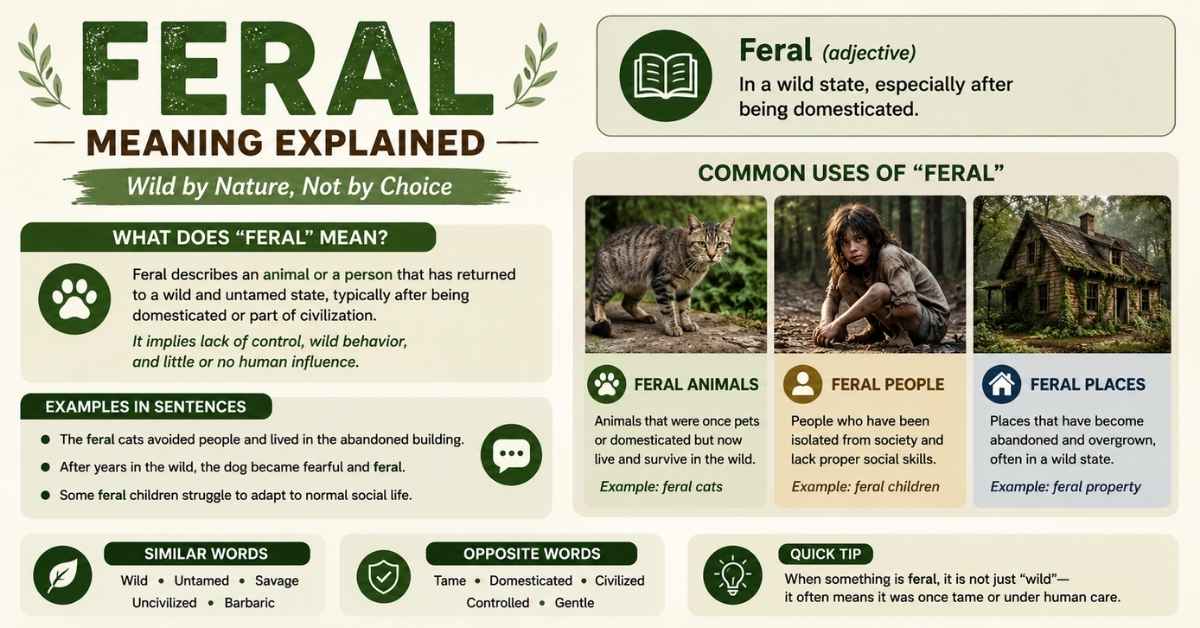
At its core, feral describes something that has returned to a wild state after being domesticated.
Simple Definition
In simple words, feral means:
An animal that once depended on humans but now survives and lives in the wild on its own.
Unlike naturally wild animals, feral animals have domestic ancestors. They may have escaped captivity, been abandoned, or gradually adapted to living without people over several generations.
When describing people, the word usually has a figurative meaning. It often refers to someone acting unrestrained, chaotic, overly excited, or socially unconventional, depending on the context.
Dictionary-Style Definition
Feral (adjective):
- Living in a wild state after domestication.
- Existing independently of human care despite domestic origins.
- Behaving in an untamed or uncontrolled manner (figurative or slang).
Pronunciation
Feral is pronounced:
/ˈfer.əl/
It sounds like:
FAIR-uhl
Origin of the Word “Feral”
The word feral comes from the Latin word fera, meaning wild beast. Over time, the term entered English to describe domesticated animals that had returned to a wild existence.
Originally, the word was used almost exclusively in zoology, agriculture, and wildlife management. Today, its meaning has expanded significantly.
Modern English uses feral in several ways:
- Animal science
- Ecology
- Conservation
- Behavioral studies
- Literature
- Social media slang
- Everyday conversation
This evolution makes feral one of those fascinating English words whose meaning depends heavily on context.
What Makes an Animal Feral?
Many people assume any animal living outdoors is feral, but that’s not always true.
A feral animal is one that has domestic origins yet now lives independently without relying on humans for food, shelter, or protection.
The transition usually happens gradually. Some animals adapt within months, while others become fully feral only after several generations born in the wild.
Typical characteristics include:
- Avoiding human interaction
- Hunting or foraging for food
- Living in colonies or groups
- Developing survival instincts
- Becoming self-sufficient
- Adapting to natural habitats
These animals are not naturally wild species like wolves or lions. Instead, they are descendants of domesticated animals that have successfully adapted to life outside human care.
The Difference Between Wild and Feral Animals
One of the biggest misconceptions is believing wild and feral mean exactly the same thing.
They don’t.
A wild animal has never been domesticated.
A feral animal has domestic ancestry but now survives independently in nature.
Comparison Table
| Feature | Wild Animal | Feral Animal |
|---|---|---|
| Origin | Naturally evolved in the wild | Descended from domesticated animals |
| Human History | Never domesticated | Previously domesticated or descended from domestic animals |
| Examples | Tigers, wolves, bears | Feral cats, feral pigs, feral horses |
| Dependence on Humans | None | No longer dependent |
| Natural Habitat | Native ecosystems | Urban, rural, or natural environments after adaptation |
Example
A tiger is wild because its species naturally evolved without domestication.
A feral cat is feral because domestic cats originally lived alongside humans before some populations adapted to life in the wild.
Understanding this distinction is especially important in wildlife conservation, where management strategies differ significantly for wildlife and feral populations.
How Animals Become Feral
Animals rarely become feral overnight. Instead, it’s usually a gradual process shaped by survival, adaptation, and reproduction.
1. Abandonment
Many pets are unfortunately abandoned.
Without human care, they must learn to survive by finding food, avoiding predators, and adapting to new environments.
Some succeed.
Others do not.
2. Escape From Captivity
Animals sometimes escape from:
- Farms
- Ranches
- Zoos
- Private collections
- Homes
If they establish breeding populations in nature, they may eventually become feral populations.
3. Reproduction in the Wild
One escaped animal doesn’t necessarily create a feral population.
However, when multiple animals reproduce outside human control, each new generation becomes increasingly adapted to surviving independently.
This is why feral pigs, feral goats, and feral horses now exist in many parts of the world.
4. Adaptation and Survival
Over time, feral animals develop behaviors that improve survival.
These include:
- Better hunting skills
- Increased caution around humans
- Improved territorial awareness
- Efficient food searching
- Group living strategies
- Seasonal adaptation
Although their ancestors were domesticated, natural selection encourages behaviors that favor survival in the wild.
Common Examples of Feral Animals
Feral animals exist on nearly every continent and play different ecological roles depending on the environment.
Here are some of the best-known examples.
| Animal | Why It’s Considered Feral | Common Habitat |
|---|---|---|
| Feral Cats | Descended from domestic cats but live independently | Cities, farms, forests |
| Feral Dogs | Former pets or descendants of abandoned dogs | Rural and urban areas |
| Feral Pigs | Escaped domestic pigs that established wild populations | Forests, wetlands, grasslands |
| Feral Horses | Descendants of domesticated horses living freely | Plains and deserts |
| Feral Goats | Escaped livestock thriving in rugged landscapes | Mountains and islands |
| Feral Camels | Domestic camels that adapted to desert life | Australian deserts |
| Feral Chickens | Domestic chickens breeding without human care | Tropical regions and islands |
Feral Cats
Perhaps the most familiar example is the feral cat.
Unlike a stray cat, which may still seek human companionship, a feral cat is typically wary of people and survives by hunting small prey or scavenging. Many live in feral colonies, where they cooperate loosely while remaining largely independent.
Feral Dogs
Feral dogs often form packs and develop survival behaviors that differ from those of household pets. Depending on the region, they may rely on hunting, scavenging, or human waste for food.
Feral Pigs
Among the most studied feral animals, feral pigs can significantly alter ecosystems. Their rooting behavior changes soil structure, damages vegetation, and affects native wildlife.
Feral Horses
Often admired for their beauty, feral horses are descendants of domesticated horses that have adapted to free-ranging life. In some regions, they are celebrated as cultural symbols, while in others, they present land management challenges.
Feral vs. Wild vs. Stray vs. Domesticated
Although these words are frequently used interchangeably, each describes a unique relationship between animals and humans.
Understanding the differences helps avoid common mistakes in everyday conversation, academic writing, and discussions about wildlife.
| Term | Meaning | Relationship With Humans | Example |
|---|---|---|---|
| Feral | Once domesticated but now living independently | Previously connected to humans | Feral cat |
| Wild | Naturally evolved without domestication | No history of domestication | Wolf |
| Stray | Lost or abandoned domestic animal that may still depend on people | Often seeks human contact | Stray dog |
| Domesticated | Bred and cared for by humans over generations | Lives with or depends on humans | Pet dog |
When Should You Use Each Word?
- Use feral when an animal has domestic origins but now lives independently in nature.
- Use wild for species that have never been domesticated.
- Use stray for a domestic animal that has become lost or abandoned but may still rely on human interaction.
- Use domesticated when referring to animals that continue to live under human care.
A simple way to remember it is:
- Wild = Always wild
- Domesticated = Lives with humans
- Stray = Lost from humans
- Feral = Returned to life without humans
This distinction is important not only for understanding feral meaning, but also for discussions involving animal welfare, ecology, wildlife management, and everyday English usage.
Can People Be Described as Feral?
The answer is yes, but the meaning depends entirely on the context.
When describing animals, feral has a literal meaning related to domestication and survival in the wild. However, when used for people, it is usually figurative, humorous, or slang-based rather than literal.
Understanding the difference is important because calling someone feral can be playful in one situation and offensive in another.
Literal Meaning: Can Humans Be Feral?
In rare cases, history has documented what are commonly referred to as feral children.
A feral child is a child who has grown up with little or no meaningful human contact during crucial stages of development. These cases are extremely uncommon and have fascinated psychologists, linguists, and anthropologists for decades.
Children raised in severe isolation may struggle with:
- Language development
- Social interaction
- Emotional communication
- Learning social norms
- Behavioral adaptation
These real-life cases have helped researchers understand how important human interaction is for learning language, communication, and social behavior.
It’s important to note that these cases are exceptional and should not be confused with the playful slang use of the word.
Figurative Meaning: When “Feral” Describes Behavior
Today, people often use feral to describe behavior that feels:
- Wild
- Chaotic
- Uncontrolled
- Messy
- Extremely energetic
- Overly excited
- Socially uninhibited
For example:
“The kids went feral after eating too much candy.”
This doesn’t mean the children became wild animals. It simply means they became very energetic and difficult to control.
Another example:
“The football fans went feral after the winning goal.”
Here, feral emphasizes overwhelming excitement rather than literal wildness.
When Is It Appropriate to Describe Someone as Feral?
The answer depends on tone, relationship, and setting.
Appropriate Situations
Friends joking with one another.
Example:
“You stayed awake for 36 hours playing games—you’ve gone completely feral!”
People often laugh because the word exaggerates someone’s behavior in a humorous way.
Situations Where You Should Avoid It
Avoid using feral in:
- Professional emails
- Workplace communication
- Academic writing
- Formal speeches
- Conversations with strangers
In these settings, the word can sound disrespectful or insulting.
What Does “Feral” Mean in Slang and on Social Media?
One reason feral meaning has become a popular search query is its growing use on TikTok, Instagram, X (formerly Twitter), YouTube, and other social platforms.
Online, the word has evolved far beyond its original definition.
Instead of referring to animals, people now use feral to describe intense emotions, exaggerated reactions, or hilarious behavior.
TikTok and Gen Z Usage
On social media, saying someone is feral usually means they’re acting in an unfiltered, over-the-top, or chaotic way.
Examples include:
- “I went feral when my favorite artist announced a new album.”
- “The crowd went feral during the concert.”
- “Everyone went feral over the surprise trailer.”
- “She went absolutely feral after seeing the puppy.”
In these examples, feral means:
- Extremely excited
- Unable to stay calm
- Acting impulsively
- Showing overwhelming enthusiasm
- Losing self-control in a humorous way
It’s often used for comic effect rather than criticism.
Why Has the Slang Meaning Become So Popular?
Social media encourages dramatic, memorable, and emotionally expressive language.
Instead of saying:
“I was very excited.”
People now say:
“I went feral.”
The second phrase creates a stronger mental image and feels more entertaining, which is why it spreads quickly through memes and online conversations.
Learn More: Torta Girl Meaning
Is Calling Someone “Feral” an Insult?
Not always.
The meaning depends on the speaker’s intention.
It Can Be Playful
Friends may use it affectionately:
“You’re feral before your morning coffee.”
This usually means someone is acting silly or energetic.
It Can Be Negative
In some situations, feral may imply:
- Poor manners
- Aggressive behavior
- Lack of self-control
- Socially unacceptable conduct
If directed at someone you don’t know well, it can easily be interpreted as offensive.
Tip: When in doubt, choose a more neutral description.
Real-Life Examples of “Feral” in Sentences
Learning vocabulary through examples is one of the best ways to remember it.
Below are examples showing how feral is used in different contexts.
Animals
- The feral cats avoid human contact and hunt at night.
- Wildlife officers monitored the growing feral pig population.
- Several feral horses roam freely across the grasslands.
- The abandoned dogs eventually formed a feral pack.
- Researchers studied how feral goats adapted to the island’s rugged terrain.
Everyday Conversations
- My hair looks absolutely feral today.
- The children became feral after the birthday party started.
- Everyone went feral when free pizza arrived at the office.
- I feel feral after staying awake all night.
- Our dog acts feral whenever someone mentions going for a walk.
Books and Creative Writing
Writers often use feral to create vivid imagery.
Examples:
- His feral instincts kept him alive in the harsh wilderness.
- Her eyes held a feral determination that frightened everyone around her.
- The abandoned village slowly became home to feral animals.
The word adds emotional intensity and paints a strong mental picture.
News and Wildlife Reports
Environmental articles frequently mention:
- Feral pig populations
- Feral cat management
- Feral horse conservation
- Feral goat control
- Urban feral animal colonies
In these contexts, feral is a technical term rather than slang.
Social Media
Examples commonly seen online:
- “The internet went feral after the announcement.”
- “Swifties went feral during the surprise performance.”
- “People are going feral over this new game.”
- “My dog goes feral whenever he hears the treat bag.”
These examples show how flexible the word has become in everyday digital communication.
Why People Confuse Feral, Wild, and Stray
This confusion happens because all three words describe animals living outside human homes.
However, their meanings are very different.
Let’s clear up the most common misconceptions.
Are All Stray Cats Feral?
No.
A stray cat usually:
- Once lived with people.
- May still trust humans.
- Often accepts food or affection.
- Can sometimes be reunited with its owner or adopted.
A feral cat generally:
- Avoids people.
- Has little or no socialization.
- Lives independently.
- Relies on hunting or scavenging.
- Is often born outdoors.
This distinction is important for animal welfare organizations, shelters, and adoption programs.
Can a Pet Become Feral?
Yes.
If a domesticated animal escapes or is abandoned and survives independently for a long time, it may gradually become feral.
The process is influenced by:
- Survival skills
- Environment
- Age
- Human interaction
- Reproduction over generations
Young animals that spend extended periods without people are more likely to adopt feral behaviors.
Are Feral Animals Dangerous?
Not necessarily.
Most feral animals are naturally cautious and prefer to avoid humans.
Some may become defensive if they feel threatened, are protecting their young, or are cornered. Their behavior depends on factors such as:
- Species
- Environment
- Previous human interaction
- Access to food
- Health
The safest approach is to observe feral wildlife from a distance and avoid attempting to handle or feed unfamiliar animals.
Can Feral Animals Become Pets Again?
Sometimes—but not always.
Animals that have spent many years living independently may find it difficult to adapt to domestic life.
For example:
- Young feral kittens can often be socialized with patience.
- Adult feral cats may remain fearful of people despite long-term care.
Successful rehabilitation depends on:
- Age
- Early socialization
- Individual temperament
- Consistent training
- Veterinary care
This is why experienced rescue organizations carefully evaluate each animal rather than assuming every feral animal can become a household pet.
Why Feral Animals Matter to Ecosystems
The discussion of feral meaning isn’t limited to vocabulary. It also plays an important role in ecology, wildlife conservation, and environmental science.
When domesticated animals establish self-sustaining populations, they can influence ecosystems in surprising ways.
Ecological Impact
Different feral populations affect the environment differently.
Some common impacts include:
Competition With Native Wildlife
Feral animals may compete with native species for:
- Food
- Water
- Shelter
- Territory
This competition can reduce biodiversity in some ecosystems.
Habitat Changes
Certain species physically alter their surroundings.
For example:
- Feral pigs disturb soil while rooting for food.
- Feral goats can overgraze vegetation.
- Feral rabbits may contribute to erosion in some regions.
These changes can affect plants, insects, birds, and other wildlife.
Predator–Prey Relationships
Feral predators may hunt native animals that have not evolved alongside them.
For example:
- Ground-nesting birds
- Small mammals
- Reptiles
This can disrupt the natural balance of local ecosystems.
Conservation and Wildlife Management
Managing feral animal populations is often challenging because it involves balancing:
- Animal welfare
- Public safety
- Environmental protection
- Biodiversity conservation
Wildlife managers may use a variety of approaches depending on the species and local regulations, including monitoring, habitat management, adoption programs, sterilization initiatives, or other conservation strategies.
The goal is to protect both native wildlife and the welfare of the animals involved.
Why This Topic Matters Beyond Vocabulary
Understanding feral meaning helps you:
- Use the word accurately.
- Avoid confusing feral, wild, and stray.
- Better understand wildlife news and conservation discussions.
- Interpret modern internet slang correctly.
- Communicate more precisely in both everyday conversation and formal writing.
Synonyms, Antonyms, and Related Words
Expanding your vocabulary helps you understand feral meaning more clearly. While some words appear similar, each has its own nuance and should be used in the right context.
Common Synonyms of Feral
The following words can sometimes replace feral, depending on the sentence:
| Synonym | Meaning | Best Used For |
|---|---|---|
| Untamed | Not trained or controlled by humans | Animals, nature |
| Wild | Naturally living without domestication | Wildlife |
| Savage | Fierce or uncontrolled (context-dependent) | Figurative descriptions |
| Uncivilized | Lacking social refinement | Human behavior (use carefully) |
| Natural | Existing in nature | Landscapes and wildlife |
| Primitive | Existing in an early or undeveloped state | Historical or figurative contexts |
Tip: Although wild and feral are sometimes used interchangeably, they are not true synonyms. A wild wolf has never been domesticated, while a feral dog descended from domesticated animals.
Common Antonyms
The opposite of feral usually refers to animals or behavior that is controlled or accustomed to human care.
Some common antonyms include:
- Domesticated
- Tame
- Trained
- Civilized (figurative)
- Socialized
Example:
- The horse was once feral but became tame after years of careful training.
Related Vocabulary
Understanding these related terms makes it easier to use feral correctly.
Domestication
The process through which humans selectively breed and care for animals over many generations.
Rewilding
A conservation approach that restores natural ecosystems, sometimes by reintroducing native species or allowing landscapes to recover with minimal human intervention.
Habitat
The natural environment where an animal or plant lives.
Adaptation
The process by which living organisms adjust to environmental conditions to improve survival.
Instinct
Natural behavior that animals perform without learning it from others.
Together, these concepts help explain why feral populations behave differently from both domesticated pets and wild animals.
How to Use “Feral” Correctly in Writing and Speech
Knowing the definition is only half the battle. Using the word naturally is what builds confidence.
In Everyday Conversation
Examples:
- The neighborhood has several feral cats.
- Everyone went feral when the team scored in the final minute.
- The puppy acts feral whenever it sees snow.
In Academic or Scientific Writing
When writing about ecology or animal science, use feral precisely.
Example:
Researchers examined the impact of feral pigs on native vegetation and biodiversity.
This usage is accurate because it refers to a population descended from domesticated animals.
In Professional Communication
In workplaces or formal documents, avoid describing people as feral unless you’re discussing wildlife or using the term in a clearly defined academic context.
Instead of writing:
“The meeting became feral.”
You might write:
“The discussion became increasingly disorderly.”
On Social Media
Online, feral is often playful and exaggerated.
Examples:
- I’m going feral waiting for the movie release.
- The comments section went absolutely feral.
- Everyone went feral over the surprise announcement.
These phrases are common in internet slang, but they may not be suitable for formal communication.
Do vs. Don’t Table
| Do | Don’t |
|---|---|
| Use feral for formerly domesticated animals living independently. | Call naturally wild animals feral. |
| Consider the context when describing people. | Assume “feral” is always an insult. |
| Distinguish between feral, wild, and stray. | Use the terms interchangeably. |
| Use the word appropriately in informal online conversations. | Use slang meanings in professional documents. |
Common Mistakes When Using the Word “Feral”
Even native English speakers sometimes misuse this word.
Here are the mistakes to avoid.
Mistake 1: Thinking Feral Means Wild
This is the most common misunderstanding.
✔ Correct
A feral horse descended from domesticated horses.
✔ Also Correct
A tiger is a wild animal.
❌ Incorrect
A tiger is feral.
Mistake 2: Confusing Feral With Stray
A stray dog may still seek human companionship.
A feral dog generally survives without human assistance and avoids close contact with people.
See more: Torta Meaning Slang
Mistake 3: Assuming All Feral Animals Are Aggressive
Many feral animals prefer to avoid humans.
Their behavior depends on:
- Species
- Environment
- Previous experiences
- Access to food
- Health
Treat every unfamiliar animal with caution, but avoid assuming that “feral” automatically means “dangerous.”
Mistake 4: Using Feral as a Personal Insult
Although the slang version is often humorous, calling someone feral without understanding the context can offend them.
Ask yourself:
- Is this a joke among friends?
- Could the comment be misunderstood?
- Would another word communicate your meaning more respectfully?
Quick Reference Cheat Sheet
Need a fast answer? Here’s a simple summary.
| Question | Quick Answer |
|---|---|
| What does feral mean? | Formerly domesticated but now living independently in the wild. |
| Is feral the same as wild? | No. Wild animals have never been domesticated. |
| Is a stray animal feral? | Not necessarily. Many stray animals still rely on people. |
| Can humans be feral? | Literally, only in extremely rare historical cases. Figuratively, yes. |
| Is feral an insult? | Sometimes. It depends on tone and context. |
| What does “go feral” mean? | To become extremely excited, chaotic, or emotionally expressive. |
| Can a pet become feral? | Yes, if it survives independently without human care for a long period. |
Frequently Asked Questions
What does feral mean in simple words?
Feral means an animal that was once domesticated but now lives on its own in the wild. It can also describe a person acting in a wild or overly excited way in informal conversations.
What is a feral animal?
A feral animal is a domestic animal or the descendant of domestic animals that now survives without regular human care.
Examples include:
- Feral cats
- Feral dogs
- Feral horses
- Feral pigs
- Feral goats
Is a feral cat the same as a stray cat?
No.
A stray cat usually had a home and may still trust people.
A feral cat has little or no socialization with humans and generally avoids close contact.
Can a domestic animal become feral?
Yes.
Animals that escape or are abandoned can adapt to independent living over time. If they survive, reproduce, and no longer rely on humans, they may become feral.
Why are feral animals difficult to tame?
Many feral animals have had limited positive interaction with people or have spent generations living independently. Their natural caution helps them survive in the wild.
Can feral animals be adopted?
It depends on the species, age, and individual temperament.
Young animals are generally easier to socialize than adults, but each case is unique. Experienced rescue organizations and veterinarians can assess whether rehabilitation is appropriate.
What does “go feral” mean?
In modern slang, “go feral” means to react with extreme excitement, enthusiasm, or chaotic energy.
Example:
“Fans went feral when the singer appeared on stage.”
What does feral mean on TikTok?
On TikTok and other social media platforms, feral usually describes someone acting in a funny, dramatic, energetic, or emotionally unfiltered way.
Is calling someone feral rude?
Sometimes.
Among close friends, it can be playful.
In formal settings or with people you don’t know well, it may sound disrespectful or insulting.
What is the opposite of feral?
The most common opposite is domesticated.
Other antonyms include:
- Tame
- Trained
- Socialized
How do you pronounce feral?
Feral is pronounced:
FAIR-uhl
Phonetic pronunciation:
/ˈfer.əl/
What is the origin of the word “feral”?
The word comes from the Latin word fera, meaning wild beast. Over time, English adopted the term to describe domesticated animals that returned to living independently in the wild.
Final Thoughts:
Understanding feral meaning is easier once you know its core idea: a feral animal is one that was once domesticated—or descended from domesticated animals—but now survives independently without human care. This sets it apart from wild animals, which have never been domesticated, and stray animals, which may still rely on people.
Today, the word feral also has a popular figurative meaning. In everyday conversations and on social media, it often describes someone acting with unrestrained excitement, chaotic energy, or playful enthusiasm. While this slang usage is common among friends and online communities, it’s best to avoid it in formal or professional settings where it could be misunderstood.
Whether you’re learning English, improving your vocabulary, reading about wildlife conservation, or trying to understand internet slang, knowing the difference between feral, wild, stray, and domesticated helps you communicate with greater accuracy and confidence.